ISO 42001 • AI Feature Launch • AI Governance Template • SaaS AI Controls • Responsible AI
Template Blog: AI Feature Launch Governance Checklist for ISO 42001
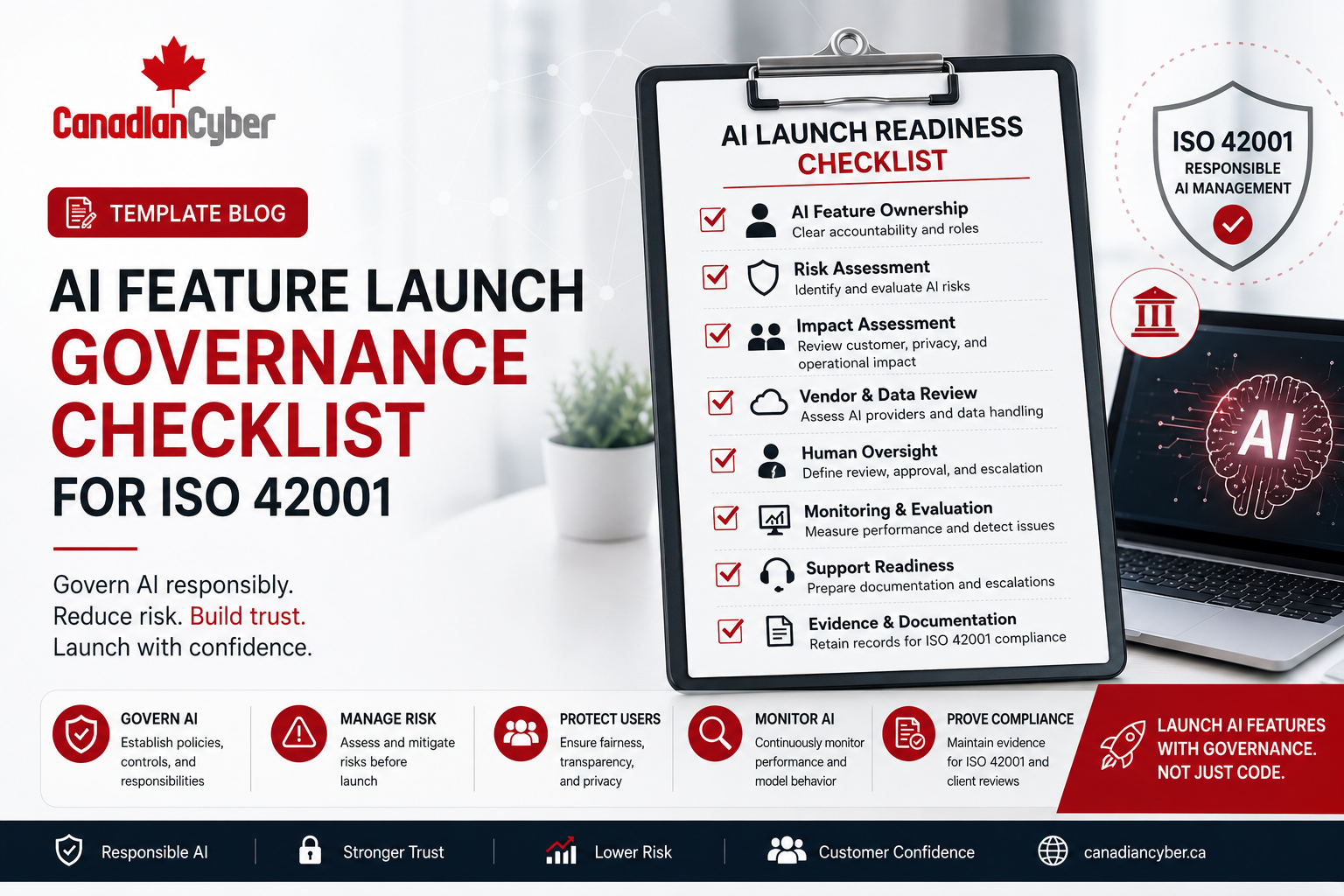
AI features should not launch without governance. For SaaS companies, AI launch readiness requires ownership, intended use, data handling, vendor review, risk assessment, impact assessment, human oversight, monitoring, support readiness, and evidence retention.
Canadian Cyber ISO 42001 AI Governance Support
Launch AI Features With Stronger Accountability, Transparency, and Evidence
Canadian Cyber helps SaaS companies build ISO 42001-ready AI launch governance workspaces, AI inventories, risk registers, impact assessments, vendor reviews, human oversight controls, support readiness plans, monitoring workflows, and SharePoint evidence dashboards.
Quick Snapshot
| Checklist Area | Why It Matters |
|---|---|
| AI Feature Ownership | Confirms who is accountable before and after launch. |
| AI Risk Assessment | Identifies what could go wrong before customers are affected. |
| AI Impact Assessment | Reviews customer, privacy, security, fairness, legal, and operational impact. |
| Vendor AI Review | Confirms AI provider terms, training data use, retention, security evidence, and subprocessors. |
| Human Oversight | Defines when people must review or approve AI outputs. |
| Launch Evidence | Helps prove responsible AI governance during ISO 42001 and client reviews. |
Introduction
SaaS companies are adding AI features quickly. AI can summarize documents, classify tickets, generate reports, search knowledge bases, recommend actions, draft responses, extract data, detect anomalies, and support customer workflows.
But AI features create different risks than traditional software. AI outputs can be wrong. AI recommendations can be misunderstood. AI vendors may process customer data. AI prompts may contain sensitive information. AI models may change over time. AI outputs may require human review. AI support issues may need escalation.
ISO 42001 gives organizations a practical structure for managing AI systems responsibly. For SaaS companies, this means AI features should be reviewed before launch, monitored after launch, and supported by evidence.
An AI feature should not launch only because it works. It should launch because it is governed.
Need an AI Feature Launch Governance Checklist?
Canadian Cyber helps product, legal, security, privacy, support, compliance, and leadership teams prepare ISO 42001-ready launch governance before releasing AI features to customers.
What Is an AI Feature Launch Governance Checklist?
An AI feature launch governance checklist is a structured review completed before an AI feature goes live. It helps the company confirm what the AI feature does, who owns it, what data it uses, which vendor is involved, what risks exist, what human review is required, and what monitoring will happen after launch.
| Checklist Confirms | Why It Matters |
|---|---|
| What the AI feature does | Defines purpose and scope. |
| Who owns the feature | Assigns accountability. |
| What data the feature uses | Identifies privacy, security, and vendor risk. |
| What risks exist | Supports risk treatment and approval. |
| What human review is required | Prevents unchecked high-impact decisions. |
| What evidence must be retained | Supports ISO 42001 and customer reviews. |
Why This Checklist Supports ISO 42001
ISO 42001 focuses on responsible AI management. For SaaS companies, this means AI systems should be governed through documented roles, policies, risk management, impact review, monitoring, supplier oversight, and continual improvement.
ISO 42001-ready launch governance should include:
AI policies
approved use cases
risk assessments
impact assessments
roles and responsibilities
supplier review
data governance
human oversight
monitoring
issue management
documented evidence
ISO 42001 readiness depends on repeatable AI governance, not one-time product approval.
Section 1: AI Feature Overview
This section defines the AI feature clearly. It gives product, legal, security, privacy, support, compliance, and leadership teams a shared understanding of what is being launched.
| Template Field | Response |
|---|---|
| AI Feature Name | |
| Product / Module | |
| Feature Description | |
| Intended Users | |
| Internal or Customer-Facing | |
| Launch Status | Planned / Testing / Approved / Launched |
| Business Owner | |
| Technical Owner | |
| Support / Compliance Owner |
If the feature cannot be explained simply, it is not ready for governance review.
Section 2: Approved and Prohibited Use Cases
AI features should have clear boundaries. Users, support teams, product owners, and leadership should know what the feature is meant to do and what it must not be used for.
| Template Field | Response |
|---|---|
| Approved Use Case | |
| Prohibited Use Cases | |
| Expected User Actions | |
| Customer Impact Level | Low / Medium / High |
| Human Review Required | Yes / No |
| User Warning or Notice Required | Yes / No |
Example: An AI document summary feature may be approved to summarize uploaded documents for user review, but prohibited from replacing legal, financial, HR, or medical advice.
Define AI Feature Ownership Before Launch
Canadian Cyber helps SaaS teams define AI feature owners, approved use cases, prohibited uses, customer impact levels, human review requirements, and launch evidence for ISO 42001 readiness.
Section 3: AI Data Use Checklist
AI data use should be documented before customer data flows into the feature. This includes customer data, personal information, confidential business data, metadata, logs, support tickets, screenshots, and regulated data.
| Data Use Question | Yes / No / Notes |
|---|---|
| Does the AI feature process customer data? | |
| Does it process personal information? | |
| Does it process confidential business data? | |
| Does it process customer-uploaded files? | |
| Does it process metadata, logs, or support ticket content? | |
| Is data minimized before use? | |
| Are prompts and outputs retained? | |
| Is deletion possible where needed? |
AI features should not process personal data unless purpose, retention, security, and vendor terms are clear.
Section 4: AI Vendor Review Checklist
If a third-party AI provider is used, vendor review is required before launch. Do not send customer data to an AI vendor until the vendor review is complete.
| AI Vendor Evidence | Ready? |
|---|---|
| Vendor name and service description | |
| Data processed by vendor | |
| Contract or DPA | |
| Security assurance report | |
| Data training terms | |
| Prompt and output retention terms | |
| Subprocessor list | |
| Data location information | |
| Incident notification terms | |
| Vendor risk rating |
AI Data Use and Vendor Terms Need Review Before Launch
Canadian Cyber helps SaaS companies review customer data use, AI vendor contracts, training terms, retention, deletion, subprocessors, security reports, privacy documentation, and risk ratings.
Section 5: AI Risk Assessment Checklist
Every AI feature should have a documented risk assessment before launch. This section identifies what could go wrong, who owns the risk, what controls exist, and whether residual risk requires approval.
| Risk Assessment Field | Response |
|---|---|
| Risk ID | |
| AI Feature | |
| Risk Description | |
| Possible Impact | |
| Likelihood | Low / Medium / High |
| Impact | Low / Medium / High |
| Existing Controls | |
| Residual Risk | Low / Medium / High |
| Approval Required | Yes / No |
Common AI risks include:
hallucinated answer
biased recommendation
privacy exposure
customer data leakage
prompt injection
vendor model change
overreliance by users
support escalation failure
unsafe automation
Section 6: AI Impact Assessment Checklist
An AI impact assessment reviews how the feature may affect customers, users, privacy, security, fairness, legal obligations, operations, transparency, and support.
| Impact Area | Questions |
|---|---|
| Customer Impact | Could users rely on the output for important decisions? |
| Privacy Impact | Does the feature process personal information? |
| Security Impact | Could prompts or outputs expose sensitive data? |
| Fairness Impact | Could outputs affect people or groups differently? |
| Legal Impact | Could the output be seen as advice or a formal decision? |
| Support Impact | Can support handle questions and complaints? |
| Impact Rating | Meaning |
|---|---|
| Low | Limited customer impact and low sensitivity. |
| Medium | Some customer reliance or moderate data sensitivity. |
| High | Customer-impacting, regulated, sensitive, or decision-support use. |
Section 7: Human Oversight Checklist
Human oversight should be specific, assigned, and evidenced before launch.
| Human Oversight Question | Yes / No / Notes |
|---|---|
| Is human review required before users act on the AI output? | |
| Who performs the review? | |
| What does the reviewer check? | |
| Can the reviewer override the AI output? | |
| Is review evidence retained? | |
| Is sample quality review performed? |
The higher the impact, the stronger the oversight, approval, and monitoring should be.
Section 8: Security Readiness Checklist
| Security Control | Ready? |
|---|---|
| AI data flow reviewed | |
| Access controls reviewed | |
| Prompt injection risk reviewed | |
| Sensitive data leakage risk reviewed | |
| Prompt and output logging reviewed | |
| Incident escalation path defined |
Section 9: Privacy Readiness Checklist
| Privacy Control | Ready? |
|---|---|
| Personal data use identified | |
| Purpose documented | |
| Data minimization reviewed | |
| Retention rules documented | |
| Vendor privacy terms reviewed | |
| Privacy incident escalation defined |
Section 10: Legal and Customer Communication Checklist
Legal and customer-facing teams should review claims, terms, notices, disclaimers, customer rights, vendor contracts, and marketing language.
| Legal / Communication Control | Ready? |
|---|---|
| Customer terms reviewed | |
| Privacy notice reviewed | |
| AI feature description reviewed | |
| AI output limitation language reviewed | |
| Vendor contract and DPA reviewed | |
| Marketing claims reviewed |
AI marketing should not promise more certainty than the system can provide.
Section 11: Support Readiness Checklist
Support should know how to explain, escalate, and document AI issues before launch.
| Support Control | Ready? |
|---|---|
| Support team trained on AI feature | |
| Support FAQ prepared | |
| Customer explanation script prepared | |
| AI limitation guidance prepared | |
| AI issue category created | |
| Escalation path defined |
Section 12: Monitoring and Issue Tracking Checklist
AI launch is not complete until monitoring is active. AI issues should be tracked, reviewed, and linked to corrective action where needed.
| Monitoring Control | Ready? |
|---|---|
| AI issue tracker created | |
| Customer complaint review defined | |
| Incorrect output tracking defined | |
| Human override tracking defined | |
| Vendor model change review defined | |
| Management reporting defined |
incomplete summary
hallucination
biased result
unsafe output
privacy concern
security concern
vendor issue
model change impact
Section 13: Final Launch Approval Checklist
Before launch, confirm that all required approvals are complete. High-risk AI features should not launch without documented approval and residual risk acceptance.
| Approval Area | Owner | Approved? |
|---|---|---|
| Product Approval | ||
| Technical Approval | ||
| Security Approval | ||
| Privacy Approval | ||
| Legal Approval | ||
| Support Readiness Approval | ||
| Leadership Approval for High-Risk AI |
Launch Decision Record
| AI Feature | |
| Launch Date | |
| Residual Risk Rating | |
| Required Conditions | |
| Open Exceptions | |
| Evidence Location | |
| Next Review Date |
AI Feature Launch Governance Checklist Summary
Use this condensed checklist for executive review before launch.
| Area | Questions to Confirm | Yes / No |
|---|---|---|
| Governance | Is the AI feature in the inventory? Are business and technical owners assigned? Are approved and prohibited uses documented? | |
| Risk and Impact | Are risk and impact assessments complete? Is customer impact reviewed? Is residual risk accepted where needed? | |
| Data and Vendor | Is customer data use documented? Is personal data use reviewed? Is the AI vendor reviewed? Are training, retention, and deletion terms clear? | |
| Security, Privacy, and Support | Are security and privacy reviews complete? Are customer notices ready? Is support trained? Is escalation defined? | |
| Monitoring | Is the AI issue tracker ready? Are complaints reviewed? Are vendor changes monitored? Are corrective actions tracked? |
How to Manage This Checklist in SharePoint
Canadian Cyber’s ISMS SharePoint solution helps SaaS companies manage AI launch governance evidence in one workspace. Teams can link AI features, risks, approvals, vendor reviews, testing evidence, oversight records, issues, and corrective actions.
| Recommended SharePoint Section | Purpose |
|---|---|
| AI Feature Inventory | Tracks AI features, owners, vendors, and launch status. |
| AI Launch Checklist | Tracks governance, legal, security, privacy, and support readiness. |
| AI Risk Register | Tracks AI risks, treatments, and residual risk. |
| AI Impact Assessments | Stores customer, privacy, security, and fairness reviews. |
| AI Vendor Register | Tracks AI suppliers, contracts, terms, and assurance. |
| AI Testing Evidence | Stores accuracy, security, privacy, and launch testing. |
| AI Issue Tracker | Tracks errors, complaints, bias, privacy, and security issues. |
| Management Review Dashboard | Shows launch status, high-risk AI items, and overdue actions. |
Recommended Metadata
product area
business owner
technical owner
vendor
data type
risk level
impact rating
launch status
approval status
human review required
evidence link
Build an ISO 42001-Ready AI Launch Governance Workspace
Canadian Cyber helps SaaS companies build AI launch governance workspaces in SharePoint with inventories, risk registers, impact assessments, vendor reviews, launch approvals, monitoring, and evidence dashboards.
Common Mistakes to Avoid
- Launching AI without ownership. Every AI feature needs a business owner and technical owner.
- No approved use case. Users and teams need to know what the AI feature is meant to do.
- Ignoring prohibited uses. AI outputs should not be used for unsupported or high-risk decisions without controls.
- Vendor review happens too late. AI provider terms should be reviewed before customer data flows.
- No human oversight. High-impact AI outputs need review, approval, or user confirmation.
- Support is not prepared. Support teams need guidance before customers report issues.
- No evidence. ISO 42001 readiness depends on documented governance evidence.
What Good Looks Like
A strong AI feature launch governance process can show:
- AI feature inventory
- assigned owners
- approved use cases
- prohibited use cases
- data use review
- AI vendor review
- AI risk assessment
- AI impact assessment
- security review
- privacy review
- legal review
- support readiness approval
- human oversight rules
- testing evidence
- launch decision record
- AI issue tracker
- management review dashboard
- SharePoint evidence workspace
This helps SaaS companies launch AI features with stronger governance and customer trust.
Canadian Cyber’s Take
AI product launches should be fast, but not uncontrolled. At Canadian Cyber, we see SaaS teams moving quickly to add AI features. That speed can create value, but it can also create compliance risk if governance is missing.
ISO 42001 gives companies a structured way to manage AI features before and after launch. The practical goal is simple: know what AI features exist, assign ownership, review data use, assess risks, check vendors, define human oversight, prepare support, monitor issues, and keep evidence.
AI features should not only be built. They should be governed.
Takeaway
An AI feature launch governance checklist helps SaaS companies prepare for ISO 42001 readiness and responsible AI launch.
Before launching AI features, confirm:
- ownership
- approved use case
- data use
- vendor review
- risk assessment
- impact assessment
- human oversight
- security review
- privacy review
- legal review
- support readiness
- launch approval evidence
How Canadian Cyber Can Help
Canadian Cyber helps SaaS companies build ISO 42001-ready AI governance programs and AI launch checklists.
- ISO 42001 readiness assessments
- AI launch governance checklist design
- AI feature inventory creation
- AI risk register development
- AI impact assessments
- AI vendor reviews
- AI data flow reviews
- AI security and privacy reviews
- human oversight control design
- support readiness planning
- AI issue tracker setup
- SharePoint AI governance workspace setup
- management review dashboards
- client-ready AI governance evidence packs
- vCISO and AI governance support
Stay Connected With Canadian Cyber
Follow Canadian Cyber for practical guidance on ISO 42001, AI launch governance, SaaS AI compliance, responsible AI, SharePoint ISMS, SOC 2, ISO 27001, ISO 27018, and vCISO support.