

SOC 2 • AI Vendors • Vendor Risk • AI SaaS • SOC 2 in Toronto
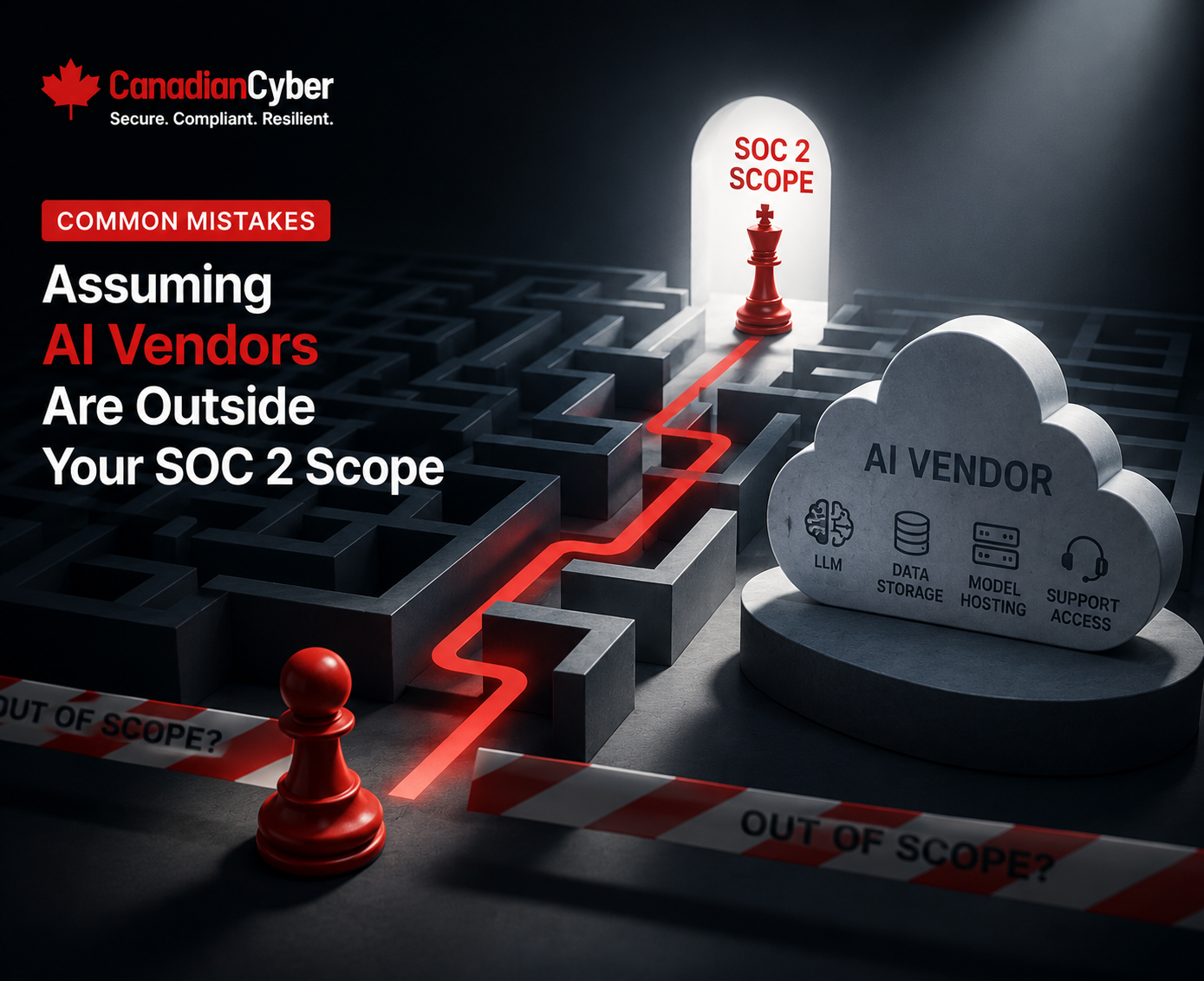
Common Mistakes: Assuming AI Vendors Are Outside Your SOC 2 Scope
AI vendors are not automatically outside your SOC 2 scope. If your SaaS product sends customer prompts, uploaded files, embeddings, model outputs, logs, or support data to an AI provider, that vendor can directly affect your security, confidentiality, privacy, availability, and customer trust story.
Quick Snapshot
| AI Vendor Scope Issue | Why It Matters |
|---|---|
| Model providers process customer data | They may affect confidentiality, privacy, and vendor risk controls. |
| AI tools store prompts or outputs | Those records may become customer data or sensitive audit evidence. |
| Embedding and vector vendors support product features | They may sit inside the production data flow. |
| Support teams use AI tools | Customer data may leave approved systems. |
| Best Outcome | AI vendors are reviewed, risk-rated, documented, and mapped to SOC 2 controls before audit or buyer review. |
Introduction
AI SaaS teams often make one dangerous assumption during SOC 2 readiness:
“Our AI vendor is outside our SOC 2 scope.”
Sometimes that is true. Often, it is not.
If your product uses an LLM provider, embedding service, vector database, AI agent platform, MLOps tool, data labeling vendor, AI support assistant, or AI monitoring tool, that vendor may be part of your control environment.
The key question is simple: Does the AI vendor affect the service you provide to customers or the data you are trusted to protect?
If yes, the vendor probably needs to be considered during SOC 2 readiness. For SaaS companies searching for SOC 2 in Toronto, this is one of the most important AI governance questions to answer early.
Need SOC 2 Readiness for AI Vendors?
Canadian Cyber helps SaaS and AI companies review AI vendors, map customer data flows, prepare SOC 2 evidence, build vendor registers, and create SharePoint evidence workspaces for audit readiness.
Why AI Vendors Create SOC 2 Scope Confusion
Traditional SaaS vendor risk is already complex. AI makes it harder.
A normal vendor may host data, process payments, deliver email, support monitoring, or manage tickets. An AI vendor may process:
- customer prompts
- uploaded files
- model outputs and chat history
- embeddings and metadata
- fine-tuning or evaluation data
- support tickets and customer documents
- logs, feedback, and product telemetry
These data flows are not always visible to sales, legal, compliance, or leadership. Engineering may see the AI vendor as a technical integration. Customers may see it as a data processor. Auditors may see it as a supplier supporting the system.
If an AI vendor processes, stores, transmits, analyzes, or influences customer data or production service delivery, do not assume it is out of scope.
Mistake 1: Treating the LLM Provider Like a Simple API
Many teams say, “It is just an API call.”
But if the API call sends customer prompts, documents, or outputs to a third-party model provider, it becomes more than a technical detail.
| Buyer Question | Why It Matters |
|---|---|
| Which LLM provider do you use? | Identifies third-party processing. |
| What data is sent to the model? | Defines customer data exposure. |
| Are prompts retained? | Affects confidentiality and privacy. |
| Is customer data used for training? | Major enterprise concern. |
| Where is data processed? | Data residency and contractual concern. |
| Does the provider have SOC 2 or ISO 27001? | Supplier assurance. |
Weak answer: “We use a trusted AI API.”
Strong answer: “We use an approved model provider. We have reviewed the vendor’s security documentation, data processing terms, retention settings, sub-processors, and customer data use commitments. The vendor is listed in our vendor register and reviewed as part of our SOC 2 readiness program.”
Mistake 2: Ignoring Prompt and Output Retention
Prompt and output retention is a major SOC 2 and customer trust issue.
Your team needs to know whether the AI vendor stores prompts, uploaded files, chat history, outputs, metadata, feedback, logs, or evaluation data.
| Vendor Retention Question | Evidence Needed |
|---|---|
| Are prompts retained by the vendor? | Vendor terms or admin setting. |
| How long are prompts retained? | Retention documentation. |
| Are outputs retained? | Vendor documentation. |
| Can retention be disabled? | Configuration evidence. |
| Can data be deleted? | Deletion process. |
| Are prompts used for model training? | Data use statement. |
If you cannot explain prompt and output retention, you are not ready for AI vendor SOC 2 questions.
Need a Clear AI Vendor Retention Review?
Canadian Cyber can help review prompt retention, output retention, training data use, deletion commitments, vendor terms, and evidence needed for SOC 2 and enterprise security reviews.
Mistake 3: Assuming “No Training” Without Proof
Many AI SaaS companies tell buyers, “We do not train on customer data.” That may be true. But SOC 2 readiness needs evidence.
Evidence that supports “no training” includes:
- vendor contract or terms
- model provider data use statement
- enterprise agreement
- DPA or security addendum
- internal customer data use policy
- engineering architecture note
- admin setting screenshot if available
- approved customer-facing FAQ and legal review record
Weak answer: “We do not think customer data is used for training.”
Strong answer: “Customer data is not used to train shared models unless explicitly agreed in writing. This is supported by our vendor terms, internal data use policy, product architecture, and approved customer data handling commitments.”
Mistake 4: Forgetting Embedding and Vector Database Vendors
AI vendor scope is not only about LLMs. Embedding services and vector databases can also be in the customer data flow.
Embeddings may be derived from uploaded documents, knowledge base content, customer records, support tickets, legal documents, financial reports, medical notes, business strategy content, or technical documentation.
| Vector Database Review Question | Why It Matters |
|---|---|
| What customer data is embedded? | Defines exposure. |
| Where are embeddings stored? | Scope and residency. |
| Who can access the vector database? | Access control. |
| Are embeddings encrypted? | Data protection. |
| Can embeddings be deleted? | Customer deletion commitments. |
| Are tenant boundaries enforced? | Multi-tenant risk. |
Do not ignore embeddings just because they are not plain text files.
Mistake 5: Leaving AI Support Tools Out of Vendor Risk
Support teams may use AI tools to summarize tickets, draft replies, classify issues, or analyze customer screenshots. That can create hidden vendor risk.
| Support AI Risk Example | Control Needed |
|---|---|
| Support agent pastes customer ticket into public AI tool | Approved AI tool list and support data rules. |
| AI assistant summarizes confidential customer issue | Vendor review and retention review. |
| Support chatbot stores customer screenshots | Customer data restrictions and access control. |
| AI tool processes logs with personal information | Training, logging, and incident reporting process. |
Practical rule: If support uses AI on customer tickets, treat it as both vendor risk and customer data risk.
Mistake 6: Not Updating the Vendor Register
AI vendors often get adopted quickly. Engineering tests a model. Product adds an AI feature. Support tries an AI assistant. Sales uses an AI note taker. Developers use coding agents.
But the vendor register does not get updated. That creates a gap.
| AI Vendor Register Field | Purpose |
|---|---|
| Vendor Name | Identifies the AI supplier. |
| AI Use Case | Explains business purpose. |
| Data Processed | Prompts, outputs, files, logs, embeddings. |
| Customer Data Involved | Yes / No. |
| Training Data Position | Used, not used, opt-in, unknown. |
| Approval Status | Approved, restricted, pending, rejected. |
| Next Review Date | Ongoing review. |
If an AI vendor is not in the vendor register, it is probably not being governed.
Build an AI Vendor Register Before SOC 2 Testing
Canadian Cyber helps AI SaaS teams identify AI vendors, document data flows, risk-rate suppliers, map vendors to controls, and prepare audit-ready evidence.
Mistake 7: Assuming AI Vendors Are Covered by the Cloud Provider Review
Some teams think, “Our cloud provider is reviewed, so AI is covered.” Not necessarily.
Your AI provider may be separate from your cloud provider. Even if your model provider is hosted on a major cloud, you still need to understand the specific service terms, data flow, retention, access, and sub-processors.
| Cloud Provider Review Does Not Automatically Cover | Why It Still Needs Review |
|---|---|
| Model training terms | Training use affects customer commitments. |
| Prompt and output retention | Retention affects confidentiality and deletion. |
| Fine-tuning data handling | Fine-tuning can involve sensitive datasets. |
| AI sub-processors | Supply chain may extend further than expected. |
| Enterprise privacy settings | Admin settings can change risk posture. |
Mistake 8: Not Mapping AI Vendors to SOC 2 Controls
AI vendor risk should connect to SOC 2 controls. If the vendor is only listed in a spreadsheet, the control story is incomplete.
| SOC 2 Control Area | AI Vendor Evidence |
|---|---|
| Vendor Management | AI vendor review, approval, next review date. |
| Confidentiality | Prompt/output handling, retention, encryption. |
| Privacy | Personal information processing and deletion terms. |
| Security | Access controls, assurance reports, incident notifications. |
| Incident Response | Vendor breach escalation and customer impact review. |
| Risk Management | AI vendor risk in the risk register. |
A vendor register tells you who the vendor is. Control mapping tells you why the vendor matters.
Mistake 9: Not Preparing Evidence for the Auditor
Auditors do not want a casual statement that the AI vendor is safe. They need evidence.
| AI Vendor Evidence | Purpose |
|---|---|
| Vendor Register Entry | Shows AI vendor is tracked. |
| Data Flow Map | Shows what data goes to vendor. |
| Vendor Risk Review | Shows review and decision. |
| Assurance Report Review | Shows SOC 2 or ISO evidence was reviewed. |
| Prompt Retention Evidence | Shows data handling. |
| Training Data Statement | Supports customer answer. |
| Related Risk Entry | Connects vendor to risk management. |
Mistake 10: Not Knowing What to Tell Customers
Customer-facing answers need to be accurate and approved. Do not let sales, engineering, and legal answer AI vendor questions differently.
Common customer questions include:
- Which AI vendors do you use?
- Do you send our data to third-party models?
- Do vendors retain prompts?
- Is our data used to train models?
- Where is data processed?
- Can we opt out of AI features?
- Can you delete our AI data?
- Do you maintain a sub-processor list?
| Approved Answer Library Field | Purpose |
|---|---|
| Customer Question | Common buyer question. |
| Approved Answer | Standard response. |
| Evidence Link | Supporting proof. |
| Owner | Person responsible. |
| Last Reviewed | Keeps answer current. |
AI Vendor SOC 2 Scope Checklist
Use this checklist before deciding whether an AI vendor is outside scope.
| Question | Yes / No |
|---|---|
| Does the vendor process customer prompts? | |
| Does the vendor process uploaded files? | |
| Does the vendor process model outputs? | |
| Does the vendor store embeddings or vector data? | |
| Does the vendor support a production AI feature? | |
| Does the vendor process personal information? | |
| Does the vendor retain logs, prompts, outputs, or metadata? | |
| Does the vendor use data for training or model improvement? | |
| Does the vendor have sub-processors? | |
| Would a vendor breach affect customers? |
If several answers are “yes,” do not assume the vendor is outside SOC 2 scope.
What Good Looks Like
A strong AI vendor SOC 2 approach can show:
- AI vendor register
- AI data flow map
- model provider review
- embedding provider review
- vector database review
- DPA or contract evidence
- vendor SOC 2 or ISO review notes
- prompt and output retention review
- training data position
- sub-processor review
- risk register entry
- control mapping
- customer-facing answer library and approval decision
This gives buyers and auditors confidence that AI vendor risk is being managed, not ignored.
SharePoint Evidence Structure for AI Vendors
Canadian Cyber often recommends organizing AI vendor evidence in a structured SharePoint ISMS or evidence workspace.
| Recommended Metadata | Purpose |
|---|---|
| Vendor Name | AI supplier. |
| Evidence Type | Contract, DPA, SOC 2, review, approval. |
| Data Type | Prompts, outputs, embeddings, files, logs. |
| Framework | SOC 2, ISO 27001, ISO 42001, customer review. |
| Control Area | Vendor risk, confidentiality, privacy, security. |
| Review Status | Requested, uploaded, reviewed, approved. |
| Related Risk | Links to AI vendor risk. |
Useful SharePoint views:
- AI vendors
- vendors processing customer data
- vendors missing DPA
- vendors with training data risk
- vendors due for review
- SOC 2 vendor evidence and customer-shareable vendor summary
Build My AI Vendor Evidence Workspace
Canadian Cyber’s ISMS SharePoint solution helps SaaS companies manage AI vendor evidence, vendor registers, risk mapping, control ownership, and SOC 2 audit readiness in one structured workspace.
Common Warning Signs
Your AI vendor may be improperly scoped if:
- engineering added it without vendor review
- sales does not know whether to disclose it
- legal has not reviewed data processing terms
- the vendor is missing from the vendor register
- nobody knows whether prompts are retained
- nobody knows whether data is used for training
- support teams use the tool without approval
- embeddings are stored but not documented
- customer answers vary by team
- SOC 2 evidence is not linked to vendor review
These are not small paperwork issues. They can affect audit readiness and enterprise trust.
Canadian Cyber’s Take
At Canadian Cyber, we often see AI SaaS teams treat AI vendors as product infrastructure rather than compliance-relevant suppliers.
That creates risk.
If an AI vendor processes customer data, stores prompts, generates outputs, retains logs, supports embeddings, or influences product behavior, it may matter for SOC 2.
The goal is not to panic or include every AI experiment in scope. The goal is to make clear, evidence-based decisions.
For SaaS teams looking for SOC 2 in Toronto, this is exactly the kind of scope and evidence work that should happen before the auditor or buyer asks.
Takeaway
Do not assume AI vendors are outside your SOC 2 scope.
Ask better questions:
- Does the vendor process customer data?
- Does it support a production AI feature?
- Does it retain prompts or outputs?
- Does it store embeddings?
- Does it use data for training?
- Does it affect customer trust?
- Would a breach matter?
If yes, review it. Document it. Map it to controls. Store evidence. Prepare customer answers. That is how AI SaaS companies avoid SOC 2 surprises and build stronger trust.
How Canadian Cyber Can Help
Canadian Cyber helps AI SaaS companies prepare for SOC 2 by reviewing AI vendors, mapping data flows, and building audit-ready evidence.
- AI vendor SOC 2 scope review
- model provider risk reviews
- embedding and vector database reviews
- AI vendor register setup
- vendor risk evidence packs
- prompt and output retention review
- training data use assessment
- AI data flow mapping
- customer security answer library
- SharePoint evidence workspace setup
- SOC 2 readiness assessments
- SOC 2 in Toronto support
- vCISO support for AI governance and enterprise security review preparation
Stay Connected With Canadian Cyber
Follow Canadian Cyber for practical guidance on SOC 2, AI vendor risk, AI SaaS security, SharePoint ISMS, ISO 27001, ISO 42001, vCISO support, and customer trust.