ISO 27017 • ISO 27018 • Cloud Security • Cloud Privacy • Control Calendar
Playbook: Cloud Privacy and Security Control Calendar for ISO 27017 and ISO 27018
Cloud security and cloud privacy controls should not be checked only before an audit. A practical ISO 27017 and ISO 27018 control calendar helps teams review admin access, backups, monitoring, support privacy, metadata, vendors, incidents, and evidence on a predictable schedule.
Canadian Cyber Cloud Governance Support
Turn ISO 27017 and ISO 27018 Controls Into a Repeatable Calendar
Canadian Cyber helps SaaS companies and cloud-first teams build ISO 27017 and ISO 27018 control calendars, assign owners, automate evidence reminders, review cloud security controls, govern support privacy, and organize audit-ready evidence in SharePoint.
Quick Snapshot
| Calendar Area | What to Track |
|---|---|
| Cloud Admin Access | Admin inventory, MFA, privileged access reviews, emergency accounts, and removed access evidence. |
| Backup and Recovery | Backup reports, restore tests, backup access reviews, retention settings, and failure alerts. |
| Monitoring and Logging | Alert reviews, log retention, admin activity logs, incident tickets, and escalation evidence. |
| Support Privacy | Support ticket handling, screenshot redaction, metadata governance, support access, and retention. |
| Supplier Assurance | Cloud provider evidence, support vendors, AI tools, DPAs, subprocessors, and review dates. |
| Evidence Outcome | A repeatable evidence rhythm for ISO 27017, ISO 27018, ISO 27001, SOC 2, and client reviews. |
Introduction
Cloud controls often fail because teams treat evidence as an audit project instead of an operating rhythm. A company may enable MFA, configure backups, collect cloud provider reports, define support privacy rules, and write policies. But if no one reviews those controls on schedule, evidence becomes stale.
ISO 27017 focuses on cloud security controls such as shared responsibility, cloud administrator access, monitoring, logging, backups, supplier assurance, and cloud incident management. ISO 27018 focuses on privacy controls for personally identifiable information processed in cloud environments, including support tickets, screenshots, metadata, vendors, retention, and privacy incidents.
A control calendar connects both frameworks to recurring work. It shows what must happen monthly, quarterly, semi-annually, and annually. It also shows who owns each task, where evidence is stored, and how overdue actions are escalated.
A control calendar turns ISO 27017 and ISO 27018 from documentation into operating discipline.
Need a Cloud Security and Privacy Control Calendar?
Canadian Cyber helps teams build recurring ISO 27017 and ISO 27018 control calendars with evidence owners, review schedules, SharePoint evidence libraries, and management dashboards.
Why a Control Calendar Matters
Cloud environments change quickly. Administrators change roles. Contractors join and leave. New vendors are added. Logs expire. Backup settings drift. Support tickets collect screenshots. AI tools enter workflows. Customer metadata appears in monitoring and analytics tools.
Without a calendar, teams often discover gaps too late. They find missing access reviews before an audit. They realize restore testing was not performed. They find outdated vendor reports during a customer review. They notice that support screenshots have no retention rules after a privacy concern appears.
| Without a Calendar | With a Calendar |
|---|---|
| Evidence is collected only before audits. | Evidence is collected continuously. |
| Access reviews are missed or delayed. | Access reviews occur on defined dates. |
| Backup restore testing is forgotten. | Restore testing is scheduled and evidenced. |
| Vendor evidence becomes stale. | Vendor reviews have owners and renewal dates. |
| Privacy tasks are informal. | Support privacy tasks are reviewed and tracked. |
| Leadership sees gaps too late. | Management dashboards show status early. |
Control Calendar Structure
A useful control calendar should be simple enough for teams to follow and detailed enough for audits. Each task should have an owner, frequency, evidence requirement, due date, status, and escalation path.
| Calendar Field | Purpose |
|---|---|
| Control Area | Cloud security, cloud privacy, vendor, incident, training, or evidence management. |
| Framework | ISO 27017, ISO 27018, ISO 27001, SOC 2, or shared control. |
| Task Name | Specific recurring action. |
| Owner | Person accountable for completion. |
| Frequency | Monthly, quarterly, semi-annual, annual, or event-based. |
| Evidence Required | Report, ticket, export, screenshot, approval, review record, or meeting minutes. |
| Status | Not started, in progress, complete, overdue, or exception. |
| Evidence Link | Direct link to approved evidence in SharePoint. |
Monthly Control Tasks
Monthly tasks should focus on high-change areas. These include cloud monitoring, backup jobs, support privacy events, overdue evidence, and incident follow-up.
| Monthly Task | Framework Link | Evidence to Store |
|---|---|---|
| Review cloud security alerts | ISO 27017 | Alert review record, incident tickets, corrective actions. |
| Review backup job status | ISO 27017 | Backup report, failure alerts, remediation notes. |
| Check overdue evidence tasks | Shared | Evidence dashboard export or SharePoint task view. |
| Review support privacy events | ISO 27018 | Privacy event register, escalation records, closure notes. |
| Review sensitive ticket queue | ISO 27018 | Sensitive ticket review record and exceptions. |
| Update corrective action tracker | Shared | Open findings, owner updates, due dates, closure evidence. |
Monthly tasks should catch operational drift before it becomes an audit issue.
Quarterly Control Tasks
Quarterly tasks should focus on access, vendors, restore testing, logging, metadata, and management review. These are common evidence areas for ISO 27017, ISO 27018, SOC 2, and ISO 27001.
| Quarterly Task | Framework Link | Evidence to Store |
|---|---|---|
| Privileged cloud access review | ISO 27017 | Admin export, reviewer sign-off, removed access evidence. |
| Support access review | ISO 27018 | Support user export, role matrix, exceptions, sign-off. |
| Backup restore test | ISO 27017 | Restore test record, result, issues, corrective actions. |
| Metadata access and retention review | ISO 27018 | Metadata register update, access review, retention evidence. |
| Cloud log retention review | ISO 27017 | Retention setting export, review note, gaps. |
| Management review dashboard update | Shared | Dashboard, decisions, risks, action items. |
Need Quarterly Evidence Reviews That Actually Happen?
Canadian Cyber helps teams design quarterly access reviews, backup restore tests, metadata reviews, vendor reviews, management dashboards, and evidence workflows inside SharePoint.
Semi-Annual Control Tasks
Semi-annual tasks help teams reassess control design, supplier risk, support privacy rules, and incident response readiness.
| Semi-Annual Task | Framework Link | Evidence to Store |
|---|---|---|
| Review shared responsibility matrix | ISO 27017 | Updated matrix, provider responsibility notes, owner approvals. |
| Review support privacy procedures | ISO 27018 | Updated procedure, approval, training notes. |
| Review critical cloud suppliers | ISO 27017 / ISO 27018 | Vendor review record, SOC 2 / ISO reports, open issues. |
| Run cloud incident tabletop | ISO 27017 | Scenario, attendees, results, lessons learned. |
| Review privacy incident procedure | ISO 27018 | Procedure update, privacy event examples, corrective actions. |
| Review AI support tool controls | ISO 27018 | Approved tool list, vendor review, data-use restrictions. |
Annual Control Tasks
Annual tasks should confirm that the cloud privacy and security control program remains aligned with business operations, customer commitments, contracts, risk appetite, and audit expectations.
| Annual Task | Framework Link | Evidence to Store |
|---|---|---|
| Review cloud security policy | ISO 27017 | Policy approval, version history, review record. |
| Review privacy and support data handling policies | ISO 27018 | Approved policy updates and training evidence. |
| Update cloud and privacy risk assessment | Shared | Risk register updates, treatment plan, approvals. |
| Review full vendor register | Shared | Vendor register, evidence, review notes, action items. |
| Review data retention schedule | ISO 27018 | Retention schedule, deletion evidence, exceptions. |
| Review client-ready evidence pack | Shared | Approved customer-facing summaries and owner sign-off. |
Event-Based Control Tasks
Some control tasks should happen when a specific event occurs. These tasks are easy to miss if they are not added to onboarding, procurement, change management, incident response, and vendor workflows.
| Trigger Event | Control Task | Evidence |
|---|---|---|
| New cloud service added | Update shared responsibility, access model, monitoring, backup, and vendor review. | Cloud service review record. |
| New support tool added | Review support data processing, access, retention, vendor terms, and privacy controls. | Support vendor review. |
| New AI support tool proposed | Review data use, training terms, approvals, human review, and restrictions. | AI tool assessment. |
| Admin user joins or leaves | Update privileged access list and evidence. | Access request or removal ticket. |
| Privacy incident occurs | Classify, investigate, contain, notify where required, and track corrective action. | Incident record. |
| Client security review received | Update client-ready evidence pack and response library. | Approved response record. |
How to Build the Calendar in SharePoint
Canadian Cyber’s ISMS SharePoint solution can turn recurring ISO 27017 and ISO 27018 tasks into assigned evidence tasks. Each item can include frequency, owner, due date, evidence link, review status, and escalation notes.
| SharePoint Component | Purpose |
|---|---|
| Control Calendar List | Tracks recurring cloud privacy and security tasks. |
| Evidence Tasks | Assigns evidence collection to owners by date. |
| Cloud Control Register | Maps tasks to ISO 27017, ISO 27018, ISO 27001, and SOC 2 controls. |
| Evidence Library | Stores approved evidence records and supporting documents. |
| Vendor Register | Tracks cloud, support, privacy, AI, logging, and monitoring vendors. |
| Corrective Action Tracker | Tracks failed tasks, overdue items, and remediation. |
| Management Review Dashboard | Shows control status, overdue tasks, risks, and decisions. |
Recommended SharePoint Metadata
control ID
task owner
frequency
due date
evidence type
privacy sensitivity
review status
evidence link
auditor ready
client ready
Build a SharePoint Control Calendar for ISO 27017 and ISO 27018
Canadian Cyber helps SaaS and cloud teams build SharePoint evidence calendars with recurring tasks, owners, reminders, dashboards, control mapping, and audit-ready evidence libraries.
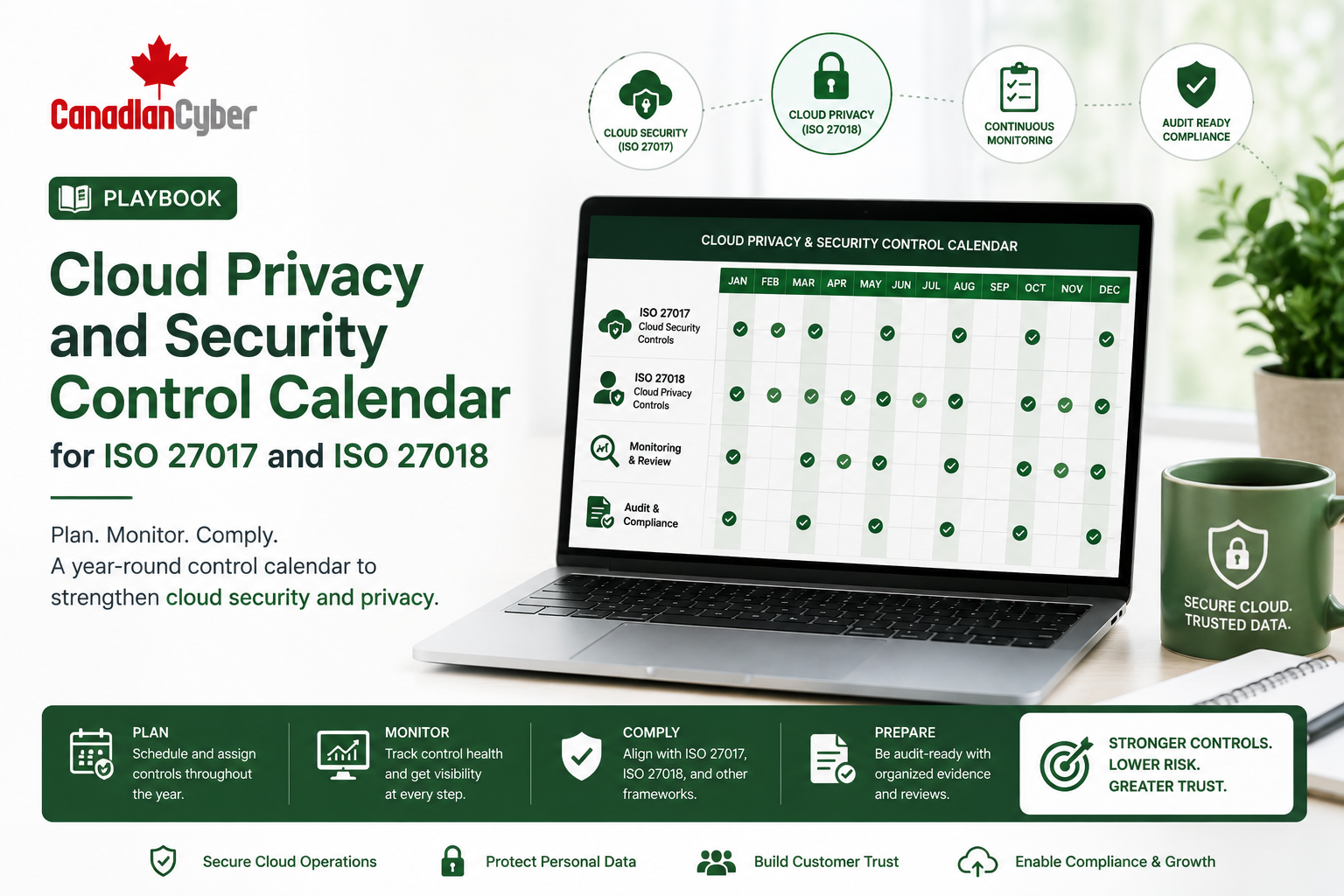
Sample 12-Month Control Calendar
Use this sample structure to plan recurring cloud security and privacy work across the year.
| Month | Primary Focus | Key Evidence |
|---|---|---|
| January | Annual cloud and privacy risk review | Risk register, treatment plan, management approval. |
| February | Cloud admin access review | Admin export, sign-off, access removals. |
| March | Backup restore test | Restore record, result, corrective actions. |
| April | Support privacy and metadata review | Support access review, metadata register, retention evidence. |
| May | Critical vendor review | Vendor register, SOC 2 / ISO reports, DPAs, open issues. |
| June | Cloud incident tabletop | Scenario notes, participants, lessons learned. |
| July | Mid-year management review | Dashboard, decisions, action items. |
| August | Privileged and support access review | User exports, role matrix, sign-off. |
| September | Retention and deletion review | Retention settings, deletion records, exceptions. |
| October | Monitoring and log review | Alert review, log retention, incident tickets. |
| November | Policy and procedure review | Updated policies, approvals, training records. |
| December | Evidence readiness and annual closeout | Evidence dashboard, open actions, next-year plan. |
Common Mistakes to Avoid
- Only scheduling policy reviews. A control calendar should include access, backups, monitoring, vendors, privacy, incidents, and evidence.
- No clear owner. Every recurring task needs one accountable person.
- No evidence link. Completed tasks should link directly to approved evidence.
- No escalation for overdue tasks. Missed tasks should appear in management review.
- Vendors are reviewed once and forgotten. Supplier evidence changes and must be refreshed.
- Privacy tasks are treated as optional. Support tickets, screenshots, AI tools, and metadata need recurring review.
- Evidence is stored in random folders. Use structured libraries, metadata, and approved views.
What Good Looks Like
A strong ISO 27017 and ISO 27018 control calendar can show:
- recurring cloud admin access reviews
- MFA and privileged access evidence
- backup job reviews
- restore test records
- monitoring alert reviews
- log retention reviews
- shared responsibility updates
- cloud supplier assurance reviews
- support privacy reviews
- support access reviews
- metadata governance reviews
- retention and deletion checks
- AI support tool governance reviews
- privacy incident tracking
- corrective action updates
- SharePoint evidence links
- management review dashboards
This makes cloud privacy and security easier to prove during audits, client reviews, and management meetings.
Canadian Cyber’s Take
Canadian Cyber often sees cloud-first companies with strong tools but weak control rhythm. The organization may have MFA, backups, monitoring, vendor reports, and support privacy rules, but no one can show when they were last reviewed.
That creates avoidable audit stress. A control calendar makes responsibility visible. It helps owners know what to do, when to do it, what evidence to store, and when leadership needs to intervene.
For ISO 27017 and ISO 27018, the best calendar connects cloud security and privacy work. Admin access, backups, monitoring, support tickets, metadata, vendors, AI tools, retention, and incidents should all be part of the same evidence rhythm.
Controls are easier to defend when they are scheduled, assigned, reviewed, and evidenced.
Takeaway
A cloud privacy and security control calendar helps teams operationalize ISO 27017 and ISO 27018. It reduces last-minute evidence collection, improves ownership, and gives leadership visibility into cloud risk.
Focus the calendar on:
- cloud admin access
- MFA and privileged access
- backup and restore evidence
- monitoring and logging
- shared responsibility
- cloud and support vendors
- support ticket privacy
- customer screenshots
- metadata governance
- AI support tools
- retention and deletion
- privacy and security incidents
When these activities are repeated on schedule, audits become easier and cloud governance becomes stronger.