ISO 27001 • AI-Enabled SaaS • ISMS Scope • AI Governance • Audit Readiness
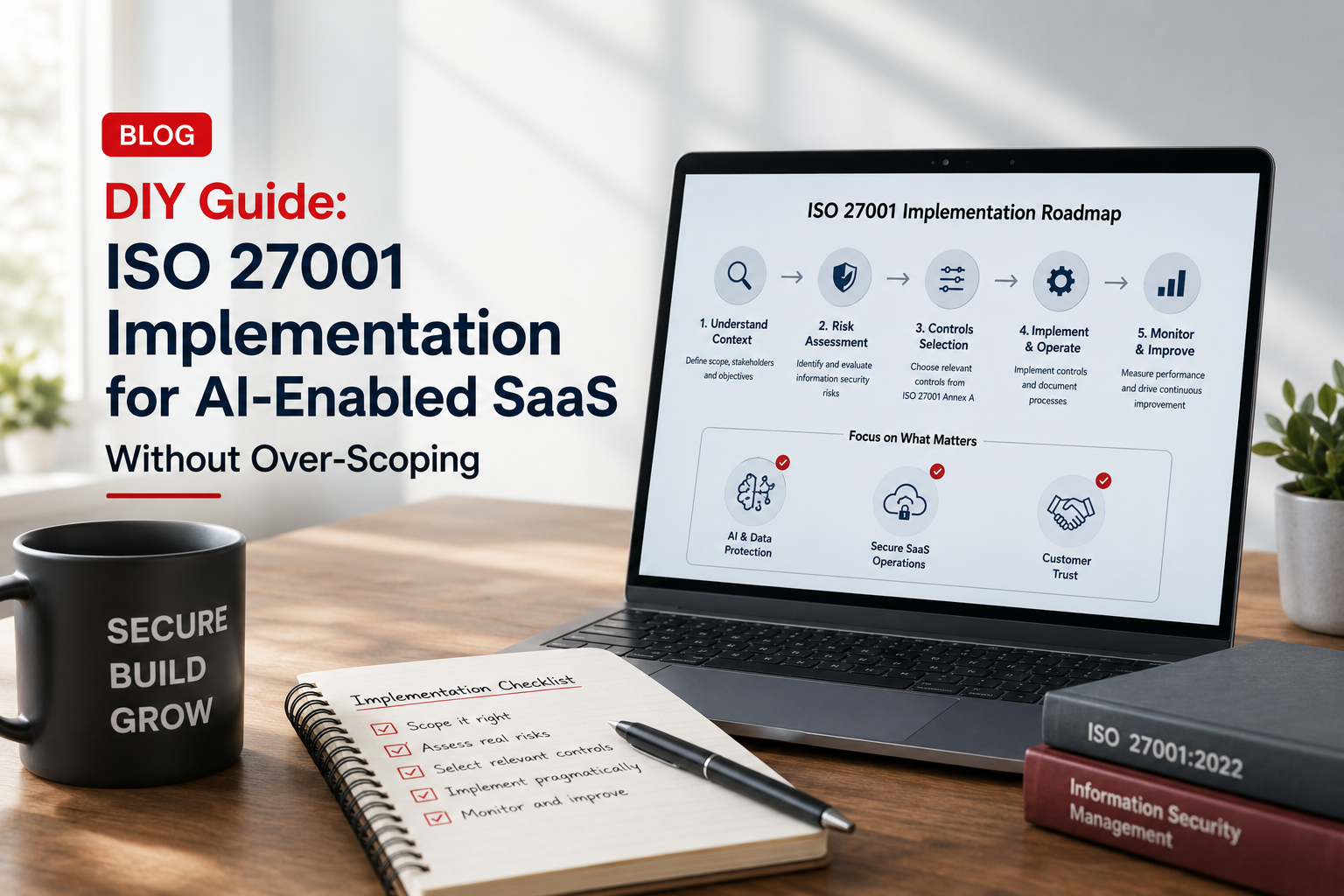
DIY Guide: ISO 27001 Implementation for AI-Enabled SaaS Without Over-Scoping
AI-enabled SaaS companies often make ISO 27001 harder than it needs to be. The goal is not to place every AI experiment, prototype, internal tool, customer workflow, vendor, model, prompt, and data set into scope on day one. The goal is to define a practical ISMS scope that protects customer trust and stays audit-ready.
Quick Snapshot
| Implementation Area | What AI SaaS Teams Should Do |
|---|---|
| Scope | Include the AI-enabled SaaS product, customer data flows, core infrastructure, and supporting operations. |
| Avoid Over-Scoping | Do not include every internal AI experiment or unrelated business system unless it affects the service. |
| AI Data | Map prompts, files, outputs, embeddings, logs, training data, and model provider flows. |
| Controls | Focus on access, vendor risk, data handling, secure development, logging, incident response, and evidence. |
| Outcome | A practical ISO 27001 program that supports customer trust without crushing product teams. |
Introduction
AI-enabled SaaS teams are moving fast.
Product is shipping features. Engineering is testing models. Sales is answering AI security questions. Customers are asking about data use. Investors want speed. Enterprise buyers want proof. Leadership wants ISO 27001 without slowing the roadmap.
That is where many teams make the same mistake.
They over-scope the ISMS.
They try to include every AI feature, experiment, internal chatbot, data set, vendor, model, notebook, and future idea. Then ISO 27001 becomes too large to operate.
- The risk register explodes.
- Evidence collection becomes messy.
- Control ownership becomes unclear.
- Auditors ask harder questions.
- Engineering gets frustrated.
- Leadership loses momentum.
A better approach is to scope ISO 27001 around the real service, real customer commitments, real data flows, and real risks.
Need ISO 27001 for Your AI SaaS Platform?
Canadian Cyber helps AI-enabled SaaS companies define ISMS scope, map AI data flows, review model vendors, build evidence packs, design SharePoint ISMS workspaces, and prepare for ISO 27001 audit readiness.
Why AI SaaS Teams Over-Scope ISO 27001
AI adds complexity to an already complex SaaS environment.
A normal SaaS platform may already include cloud infrastructure, application code, databases, identity, CI/CD, support tools, monitoring, vendors, employee devices, policies, access reviews, and incident response.
AI adds more moving parts:
- LLM providers
- model APIs
- vector databases
- embeddings
- prompt logs
- uploaded files
- model outputs
- RAG sources
- fine-tuning data
- AI agents and internal AI tools
| Over-Scoped Area | Why It Becomes a Problem |
|---|---|
| Every AI prototype | Creates audit expectations for tools not in production. |
| Every internal AI assistant | Expands scope beyond customer service delivery. |
| Every historical data set | Makes data control harder to prove. |
| Every experimental model | Adds change and vendor evidence burden. |
| Every future AI feature | Creates controls for things that do not exist yet. |
Your ISO 27001 scope should cover what you actually operate, sell, support, and commit to customers. Not every idea your product team is testing.
Step 1: Define the Business Service First
Start with the service, not the technology.
Ask:
- What AI-enabled SaaS service do we provide to customers?
- Which product is being certified?
- Which customers rely on it?
- Which data does it process?
- Which teams operate it?
- Which vendors support it?
- Which systems are required for delivery?
Example Scope Boundary
An AI SaaS company provides a platform that helps customers summarize documents, search internal knowledge, and generate workflow recommendations.
A practical ISO 27001 scope may include:
- customer-facing SaaS application
- cloud infrastructure
- identity and access management
- production database and object storage
- vector database
- LLM provider integration
- CI/CD pipeline
- monitoring and logging
- customer support process
- vendor, incident, risk, policy, and evidence management
Scope statement example:
“The ISMS covers the AI-enabled SaaS platform used to process customer prompts, uploaded files, generated outputs, embeddings, application metadata, and supporting customer account data. The scope includes the production application, cloud infrastructure, identity systems, CI/CD pipeline, monitoring and logging, AI model provider integration, vector database, customer support workflows, vendor management, incident response, risk management, and supporting governance processes.”
Step 2: Separate Production AI From Experimental AI
AI teams experiment constantly. That does not mean every experiment belongs in ISO 27001 certification scope.
| AI Activity | Include in Scope? | Reason |
|---|---|---|
| Customer-facing AI document summary | Yes | Part of the service. |
| Production LLM API integration | Yes | Processes customer data. |
| Vector database used for customer search | Yes | Supports product function. |
| Internal prototype using synthetic data | Usually no | Not production and no customer data. |
| Research notebook using customer data | Likely yes or tightly controlled | Customer data risk. |
| Demo model with fake data | Usually no | Not production service. |
Experimentation can stay outside the main ISO 27001 scope, but only if it is separated, controlled, and not processing real customer data without approval.
Step 3: Map AI Data Flows Clearly
AI data flow mapping prevents both under-scoping and over-scoping. You need to know where customer data enters, where it is processed, where it is stored, and where it leaves.
| AI Data Type | Example |
|---|---|
| Prompts | Customer questions, instructions, chat messages. |
| Uploaded Files | PDFs, contracts, reports, spreadsheets, images. |
| Model Outputs | Summaries, answers, recommendations, classifications. |
| Embeddings | Vector representations of customer content. |
| Logs | Prompt metadata, API usage, error logs. |
| Support Data | Tickets containing prompts, screenshots, outputs. |
| Data Flow Question | Why It Matters |
|---|---|
| Does customer data go to a third-party model provider? | Vendor and data protection risk. |
| Are prompts stored? | Retention and confidentiality risk. |
| Are outputs stored? | Customer data and confidentiality risk. |
| Are embeddings stored? | Sensitive derived data risk. |
| Is customer data used for training? | High buyer concern. |
| Can data be deleted? | Customer and privacy expectation. |
If you cannot map the AI data flow, your ISO 27001 scope is not ready.
Need AI Data Flow Mapping?
Canadian Cyber can help map prompts, uploaded files, outputs, embeddings, logs, AI vendors, RAG sources, support workflows, and customer data movement for ISO 27001 readiness.
Step 4: Do Not Put “All AI” in Scope
Many teams write vague scope language like: “The ISMS covers all AI systems.”
That is risky. What does “all AI systems” mean? Does it include internal AI note takers, developer copilots, marketing tools, customer-facing models, experimental notebooks, third-party plugins, and personal AI accounts?
Vague scope language creates audit confusion.
Instead of: “All AI systems are included.”
Use: “The scope includes AI processing components used by the production SaaS platform, including customer prompt processing, model API integrations, vector database storage, generated outputs, and related logging and support workflows.”
Step 5: Include AI Vendor Risk Early
AI-enabled SaaS often depends on vendors that directly affect customer trust.
These may include LLM providers, embedding providers, vector database providers, MLOps tools, data labeling vendors, monitoring tools, support platforms, analytics tools, content moderation providers, and AI security tools.
| AI Vendor Review Question | Why It Matters |
|---|---|
| What data is sent to the vendor? | Defines exposure. |
| Is customer data used for model training? | Buyer concern. |
| Where is data processed? | Data residency and privacy. |
| How long is data retained? | Retention risk. |
| Are prompts logged by the vendor? | Confidentiality risk. |
| Does the vendor provide SOC 2 or ISO evidence? | Assurance. |
| Is there a DPA or security addendum? | Legal protection. |
Evidence to keep:
- vendor register
- AI vendor risk review
- SOC 2 or ISO report review notes
- DPA or contract link
- data processing terms
- approval decision
- next review date and remediation items
Review Your AI Vendor Risk
Canadian Cyber can help AI SaaS companies review model providers, vector databases, MLOps platforms, AI security tools, and other AI vendors for ISO 27001 readiness.
Step 6: Scope Secure Development Around AI Changes
AI-enabled SaaS does not only change when code changes.
It can also change when prompt templates, model settings, retrieval sources, guardrails, system prompts, fine-tuning data, evaluation criteria, model provider versions, or RAG permissions change.
| Change Type | Should It Be Controlled? | Evidence |
|---|---|---|
| Production code change | Yes | Pull request, approval, deployment record. |
| Prompt template change | Yes, if production-impacting | Review record, test result. |
| Model provider change | Yes | Vendor review, approval, risk assessment. |
| RAG source change | Yes | Access review, source approval. |
| Fine-tuning data change | Yes | Data approval, training record. |
| Experimental prompt test | Maybe | If no customer data and no production impact, use lighter control. |
If an AI change affects customers, customer data, security, or production behavior, it belongs in change management.
Step 7: Build an AI Risk Register Without Making It Huge
Do not create 200 AI risks. Start with the risks that matter most.
| High-Value AI SaaS Risk | Treatment Example |
|---|---|
| Customer data sent to unapproved AI vendor | Approved AI vendor list and review process. |
| Customer prompts used for training without approval | Data use policy and contractual controls. |
| Model output exposes confidential data | Output handling and testing controls. |
| Support staff access prompts unnecessarily | Role-based access and logging. |
| Vector database contains sensitive customer content | Access controls, encryption, retention. |
| AI vendor changes terms | Vendor review and contract monitoring. |
A useful AI risk register is focused, owned, and connected to treatment evidence.
Step 8: Choose ISO 27001 Controls That Match Real AI Risk
Do not choose controls just because AI sounds scary. Select controls based on risk and scope.
| Control Area | Why It Matters |
|---|---|
| Access Control | Protect prompts, outputs, admin tools, and support access. |
| Supplier Security | Review model providers and AI vendors. |
| Secure Development | Control code, prompt, model, and RAG changes. |
| Logging and Monitoring | Detect misuse, admin activity, abuse, and incidents. |
| Incident Response | Handle AI data exposure and vendor incidents. |
| Data Classification | Define prompts, outputs, embeddings, and files. |
| Retention and Deletion | Support customer expectations. |
Step 9: Define What Is Out of Scope Carefully
Out of scope does not mean ignored. It means not part of certification scope. Some systems may still need basic governance.
| Out-of-Scope Example | Why It May Be Out of Scope | Minimum Control |
|---|---|---|
| Internal marketing AI tool | Not part of SaaS service. | Acceptable use rules. |
| Synthetic data model experiment | No customer data or production impact. | Sandbox controls. |
| Personal productivity AI | Not part of service. | AI use policy. |
| Unreleased prototype | Not customer-facing. | Access and data restrictions. |
| Demo environment | No real customer data. | Environment separation. |
Safer out-of-scope wording:
“Experimental AI systems using synthetic or non-customer data are excluded from certification scope. Any experimental system processing customer data must follow approved data handling, access control, and risk review processes.”
Step 10: Build Evidence From the Start
ISO 27001 audit readiness depends on evidence. For AI-enabled SaaS, evidence should prove both traditional ISMS controls and AI-specific governance.
| Evidence Area | Examples |
|---|---|
| Scope | Scope statement, architecture diagram, data flow map. |
| Risk | AI risk register, treatment actions, accepted risks. |
| Vendor Risk | AI vendor reviews, model provider terms, DPAs. |
| Access Control | Admin access review, support access logs, MFA evidence. |
| Secure Development | PR approvals, prompt change reviews, model change records. |
| Incident Response | AI incident scenarios and tabletop exercise evidence. |
| Management Review | AI risk decisions, open actions, resource needs. |
Evidence Naming Examples
- AIGovernance-DataFlowMap-2026-Q2.pdf
- VendorRisk-LLMProviderReview-2026-Q2.pdf
- AccessControl-AIPlatformAdminReview-2026-Q2.pdf
- ChangeManagement-PromptTemplateReview-2026-05.pdf
- IncidentResponse-AIDataExposureTabletop-2026-Q2.docx
Build an AI SaaS Evidence Vault
Canadian Cyber can help build a SharePoint ISMS evidence vault for AI SaaS ISO 27001 readiness, including vendor reviews, data flow maps, AI risk registers, model change records, and management review evidence.
Suggested Scope Decision Checklist
Use this before finalizing your ISO 27001 scope.
| Question | Yes / No |
|---|---|
| Is the customer-facing AI SaaS platform clearly defined? | |
| Are production AI components separated from experiments? | |
| Are prompts, files, outputs, embeddings, and logs mapped? | |
| Are model providers included as vendors? | |
| Are vector databases and RAG sources reviewed? | |
| Is customer data use for training clearly defined? | |
| Are secure development controls applied to AI changes? | |
| Are out-of-scope systems documented clearly? | |
| Are AI risks included in the risk register? | |
| Is the scope realistic for the team to operate? |
If several answers are “no,” pause before moving into implementation.
Common Mistakes to Avoid
- Including every AI tool in scope. This makes the ISMS too large and hard to operate.
- Excluding AI vendors. If a model provider processes customer data, vendor risk belongs in scope.
- Forgetting model outputs. Outputs can contain confidential or personal information.
- Ignoring embeddings and vector databases. Embeddings may be derived from sensitive customer data.
- Treating prompt changes as harmless. Prompt changes can affect product behavior.
- Not defining training data rules. Customers will ask if their data trains models.
- Letting research use customer data informally. Research workflows need approval if customer data is involved.
- Writing scope too broadly. Broad scope language creates broad audit expectations.
What Good Looks Like
A well-scoped ISO 27001 program for AI-enabled SaaS has:
- clear scope statement
- production AI boundary
- AI data flow map
- customer data use rules
- model provider review
- vector database controls
- access review process
- support access logging
- AI risk register
- secure development controls for AI changes
- incident response scenarios
- evidence vault
- management review visibility
- clear out-of-scope criteria
The ISMS should not be too small. It should not be too broad. It should be practical, defensible, and aligned with customer trust.
Canadian Cyber’s Take
At Canadian Cyber, we often see AI SaaS companies make ISO 27001 harder than necessary.
They either under-scope by ignoring AI data flows, or over-scope by including every AI experiment. Both create problems.
The right approach is focused:
- Include the AI-enabled service customers actually use.
- Include the systems and vendors that process customer data.
- Include support workflows and evidence.
- Include AI risks that matter.
- Exclude experiments only when they are properly separated and do not affect customer data or production services.
ISO 27001 should help the business prove trust. It should not punish innovation. Good scoping makes that possible.
Takeaway
AI-enabled SaaS companies can implement ISO 27001 without over-scoping.
Start with the business service:
- define the production AI boundary
- map customer data flows
- review model providers
- protect prompts, outputs, embeddings, and logs
- control production-impacting AI changes
- document what is out of scope
- assign owners
- build evidence early
The goal is not to certify every AI idea in the company. The goal is to build an ISMS that protects the customer-facing service and supports real trust.
How Canadian Cyber Can Help
Canadian Cyber helps AI-enabled SaaS companies implement ISO 27001 without over-scoping or under-controlling the real risks.
- AI SaaS ISO 27001 readiness assessments
- ISMS scope definition
- AI data flow mapping
- AI risk register development
- model provider vendor reviews
- vector database and RAG control reviews
- AI data use policy development
- secure development control mapping
- prompt and model change management
- AI incident response tabletop exercises
- SharePoint ISMS evidence vault setup
- internal audit preparation
- management review support
- vCISO support for AI governance
Stay Connected With Canadian Cyber
Follow Canadian Cyber for practical guidance on ISO 27001, AI governance, SaaS security, SharePoint ISMS, vCISO leadership, vendor risk, audit readiness, and evidence management.