SOC 2 • Small SaaS Teams • Control Ownership • vCISO • Audit Readiness
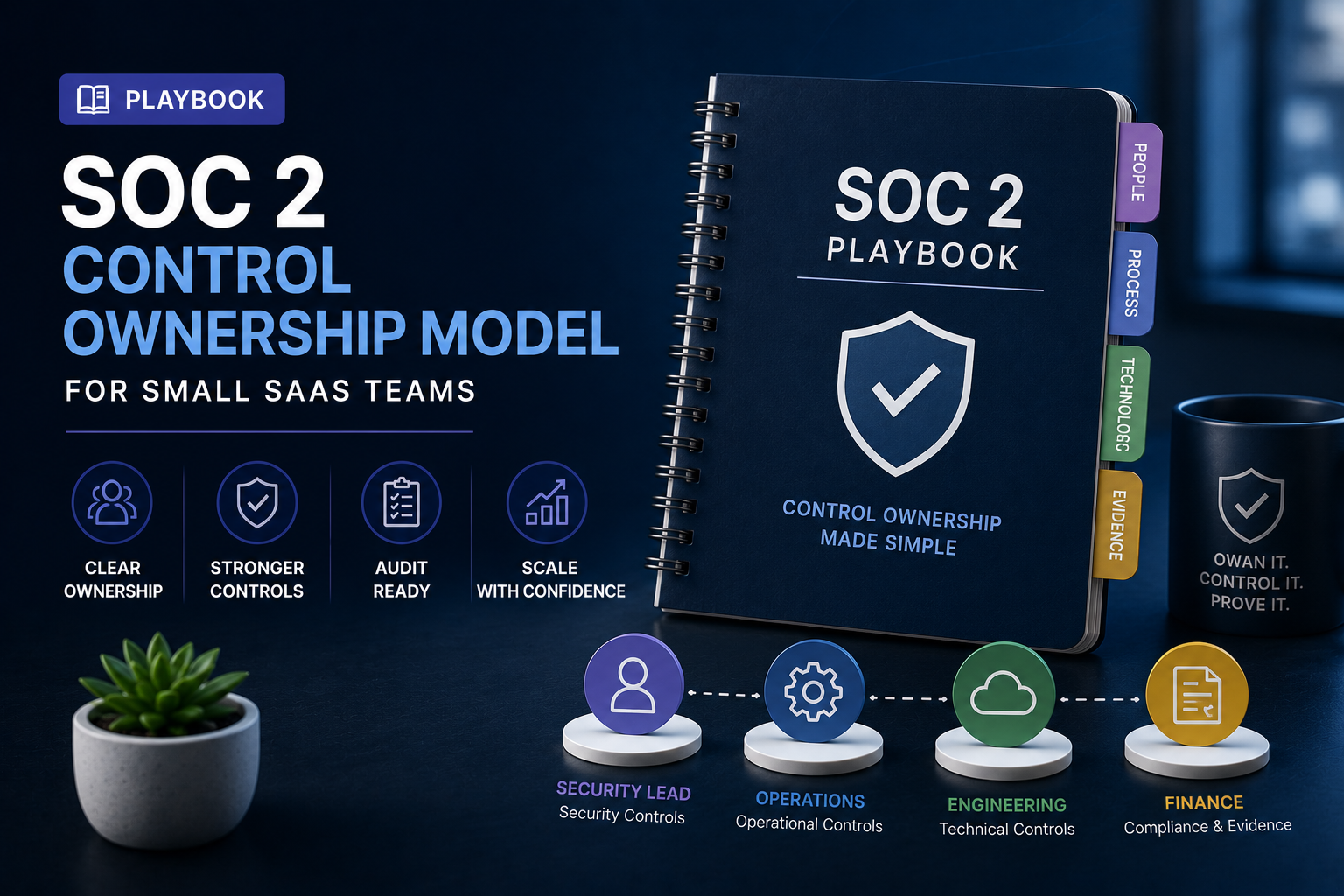
Playbook: SOC 2 Control Ownership Model for Small SaaS Teams
Small SaaS teams often need SOC 2 before they have a full security department. A clear control ownership model helps teams assign responsibility, collect evidence, close gaps, and prepare for audit without building a large internal security team.
Canadian Cyber SOC 2 Readiness and vCISO Support
Build SOC 2 Ownership Without Overloading Your Team
Canadian Cyber helps SaaS companies prepare for SOC 2 with readiness assessments, control ownership models, evidence planning, access reviews, vendor reviews, incident response preparation, SharePoint evidence workspaces, and vCISO support.
Quick Snapshot
| Control Ownership Area | Why It Matters |
|---|---|
| Founders / Leadership | Own risk decisions, budget, customer trust, and SOC 2 priorities. |
| Engineering | Owns cloud security, change management, deployment, monitoring, and technical evidence. |
| Operations | Owns vendor reviews, evidence tracking, policies, audit coordination, and control calendars. |
| HR / People Ops | Owns onboarding, offboarding, training, and policy acknowledgments. |
| Support | Owns customer data handling, support access, ticket confidentiality, and approved responses. |
| vCISO | Provides security leadership, control design, readiness guidance, and management reporting. |
Why SOC 2 Ownership Feels Hard for Small SaaS Teams
SOC 2 readiness can feel overwhelming when a SaaS company is still lean. Enterprise buyers, investors, procurement teams, and partners may ask for SOC 2 evidence while the company is still operating with founders, engineers, product leads, operations, support, and a small admin team.
Small teams often ask:
- Who owns access reviews?
- Who reviews vendors?
- Who approves policies?
- Who tracks evidence?
- Who responds to audit requests?
- Who runs incident response?
- Who prepares management review?
- Who talks to customers about security?
SOC 2 does not require a large department on day one. It requires clear ownership, repeatable evidence, and management visibility.
This playbook explains how small SaaS teams can build a practical SOC 2 control ownership model without assigning everything to engineering or waiting for a future security hire.
Need SOC 2 Ownership Support for Your SaaS Team?
Canadian Cyber helps small SaaS teams build ownership models, control registers, evidence calendars, SharePoint evidence workspaces, and vCISO-supported SOC 2 readiness plans.
Why Control Ownership Matters in SOC 2
SOC 2 is not only about having policies and tools. It is about proving that controls are designed, operating, reviewed, and improved.
That proof requires ownership. Controls need owners. Evidence needs owners. Risks need owners. Findings need owners. Audit requests need owners.
| Without Clear Ownership | With Clear Ownership |
|---|---|
| Evidence is missed. | Evidence is collected on schedule. |
| Access reviews are delayed. | Everyone knows who reviews access. |
| Vendor reviews are incomplete. | Vendor owners and review dates are visible. |
| Policies become outdated. | Policy owners and review cycles are tracked. |
| Audit findings remain open. | Gaps are assigned quickly and tracked to closure. |
| Customer questionnaires take too long. | Evidence is easier to reuse for buyer trust. |
Practical rule: A control without an owner is not really controlled.
SOC 2 Control Ownership Model for Small SaaS Teams
Small SaaS companies can assign control ownership across existing roles. The goal is not to make every role a separate person. The goal is to make every control area accountable.
| Role | SOC 2 Ownership Area |
|---|---|
| CEO / Founder | Risk acceptance, budget, management review, customer trust, and security priorities. |
| CTO / Engineering Lead | Cloud security, access, changes, monitoring, availability, backups, and technical evidence. |
| Product Lead | Product workflow controls, permission design, privacy-by-design, and customer-facing controls. |
| Operations Lead | Evidence library, vendor reviews, audit coordination, policies, control calendar, and corrective actions. |
| HR / People Ops | Onboarding, offboarding, training, policy acknowledgment, and contractor management. |
| Support Lead | Customer support access, ticket handling, customer data procedures, and approved response templates. |
| Finance / Admin | Billing tools, financial systems, insurance evidence, and administrative vendor records. |
| vCISO | Control design, readiness roadmap, governance reporting, audit preparation, and security leadership. |
Step 1: Define SOC 2 Scope First
Control ownership depends on scope. Before assigning owners, define what SOC 2 covers.
| Scope Question | Why It Matters |
|---|---|
| Which product or platform is in scope? | Defines audit boundary. |
| Which environments are included? | Defines infrastructure controls. |
| Which data is processed? | Defines confidentiality and privacy needs. |
| Which teams support the system? | Defines people and process controls. |
| Which vendors support the platform? | Defines third-party controls. |
| Which trust services categories apply? | Defines evidence needs. |
Step 2: Create a Control Register
A control register is the master list of SOC 2 controls. It shows what must be done, who owns it, and what evidence is needed.
| Control Register Field | Purpose |
|---|---|
| Control ID | Creates a unique reference. |
| Control Name | Describes the control in plain language. |
| SOC 2 Area | Access, change, vendor, incident, or availability. |
| Control Owner | Shows accountability. |
| Evidence Owner | Shows who provides evidence. |
| Evidence Needed | Defines required proof. |
| Frequency | Monthly, quarterly, annual, or event-based. |
| Status and Due Date | Tracks readiness and deadlines. |
Turn SOC 2 Into an Owned Operating Model
Canadian Cyber helps SaaS teams build control registers, ownership maps, evidence registers, RACI matrices, and recurring control calendars.
Step 3: Assign Leadership Ownership
Leadership owns risk. Even when engineers and operators perform the work, founders and executives own business decisions, resource allocation, customer trust, and risk acceptance.
| Leadership-Owned Area | Evidence Examples |
|---|---|
| Risk Management | Risk register approval and top risk review. |
| Management Review | Management review minutes and security performance updates. |
| Resource Decisions | Budget approvals and remediation decisions. |
| Customer Trust | Approved security commitments and client responses. |
| Corrective Actions | Major findings reviewed and closed. |
Step 4: Assign Engineering Ownership
Engineering usually owns many technical SOC 2 controls, but engineering should not own the entire SOC 2 program alone.
| Engineering-Owned Control | Evidence Examples |
|---|---|
| Cloud Security | Configuration review, access controls, and monitoring evidence. |
| Code Review | Pull request approvals and review samples. |
| Change Management | Change tickets, test results, deployment records, and release notes. |
| Vulnerability Management | Scan results and remediation tickets. |
| Backup and Recovery | Backup reports and restore test evidence. |
| API Security | API key reviews and access tests. |
Step 5: Assign Operations Ownership
Operations is often the best owner for evidence coordination and recurring compliance tasks. This keeps SOC 2 from becoming a last-minute document scramble.
| Operations-Owned Control | Evidence Examples |
|---|---|
| Evidence Library | SharePoint SOC 2 evidence workspace. |
| Vendor Reviews | Vendor register, risk reviews, SOC 2 reports, and review dates. |
| Policy Tracking | Policy review dates and approvals. |
| Corrective Actions | Action tracker and closure evidence. |
| Control Calendar | Due dates and recurring evidence reminders. |
Step 6: Assign HR, Support, and Product Ownership
SOC 2 also includes people controls, customer data handling, support access, privacy-by-design, and workflow controls. These areas should not be ignored just because they are not purely technical.
| Team | SOC 2 Ownership Areas |
|---|---|
| HR / People Ops | Background checks where applicable, onboarding, offboarding, training, policy acknowledgments, role changes, and contractor management. |
| Support | Support access, ticket confidentiality, customer data handling, sensitive attachments, escalations, and approved response templates. |
| Product | Role design, customer portal controls, workflow controls, processing integrity, privacy-by-design, and high-risk feature review. |
Step 7: Use vCISO Support for Security Leadership
Small SaaS teams may not have a CISO. A vCISO can provide security leadership without requiring a full-time executive hire.
Readiness Roadmap
Prioritizes SOC 2 scope, controls, evidence, owners, and audit readiness tasks.
Control Design
Helps teams design practical access, vendor, incident, change, and evidence controls.
Governance Reporting
Gives leadership visibility into risk, readiness, gaps, and corrective actions.
Audit Preparation
Reviews evidence, prepares owners, and helps respond to customer and auditor questions.
Practical rule: A vCISO helps small SaaS teams avoid guessing their way through SOC 2.
Step 8: Build a SOC 2 RACI Matrix
A RACI matrix clarifies responsibility. RACI stands for Responsible, Accountable, Consulted, and Informed.
| Control Area | Responsible | Accountable | Consulted |
|---|---|---|---|
| Access Review | Operations | CTO | HR, vCISO |
| Privileged Access | Engineering | CTO | vCISO |
| Vendor Review | Operations | COO | Legal, vCISO |
| Incident Response | Engineering | CTO | Support, vCISO |
| Change Management | Engineering | CTO | Product |
| Management Review | vCISO / Operations | CEO | CTO, COO |
Step 9: Create a Control Calendar
SOC 2 controls have recurring evidence needs. A control calendar helps teams stay ahead instead of relying on memory.
| Frequency | Control Activity |
|---|---|
| Monthly | Vulnerability review, backup monitoring, access change review, and open issue review. |
| Quarterly | User access review, privileged access review, vendor status review, and control owner check-in. |
| Semi-Annual | Incident tabletop and risk register review. |
| Annual | Policy review, vendor reassessment, management review, and security training. |
| Event-Based | New vendor review, major change review, incident response, new hire onboarding, and offboarding. |
Step 10: Centralize Evidence in SharePoint
Small teams need a simple evidence system. Canadian Cyber’s ISMS SharePoint solution can help organize SOC 2 evidence without a heavy GRC platform.
| SharePoint Section | Purpose |
|---|---|
| SOC 2 Control Register | Tracks controls and owners. |
| Evidence Library | Stores approved audit evidence. |
| Access Reviews | Stores user, admin, support, API, and service account reviews. |
| Vendor Register | Tracks suppliers and assurance evidence. |
| Change Management | Stores release and approval evidence. |
| Incident Response | Stores plans, tabletop records, and incident logs. |
| Policies | Stores approved policies and review dates. |
| Management Review | Stores leadership reports and decisions. |
Build a SOC 2 Evidence Workspace in SharePoint
Canadian Cyber helps small SaaS teams build SOC 2 evidence workspaces in SharePoint with owners, metadata, review dates, auditor-ready views, and corrective action tracking.
SOC 2 Control Ownership Checklist
Ownership
| Question | Yes / No |
|---|---|
| Is every SOC 2 control assigned to an owner? | |
| Is every evidence item assigned to an owner? | |
| Is leadership accountable for risk decisions? | |
| Does engineering own technical controls? | |
| Does operations own evidence coordination? | |
| Does support own customer data handling procedures? |
Evidence
| Question | Yes / No |
|---|---|
| Is there a control register? | |
| Is there a control calendar? | |
| Is evidence stored centrally? | |
| Are evidence due dates tracked? | |
| Are corrective actions assigned? | |
| Is management review documented? |
Common Mistakes to Avoid
- Assigning everything to engineering. Engineering owns technical controls, but SOC 2 also includes vendors, HR, operations, support, product, and leadership.
- No evidence owner. A control owner may approve the control, but someone must collect the evidence.
- No control calendar. Recurring evidence will be missed without reminders.
- No leadership review. SOC 2 is stronger when leadership reviews risk and readiness.
- Waiting for a security hire. Small teams can begin with vCISO support and clear internal owners.
- Storing evidence in Slack and email. Evidence should live in a controlled workspace.
- No RACI for shared controls. Shared controls need clear responsibility.
What Good Looks Like
A strong SOC 2 control ownership model for a small SaaS team can show:
- defined SOC 2 scope
- control register
- control owners
- evidence owners
- RACI matrix
- control calendar
- risk register
- policy owners
- access review owners
- vendor review owners
- incident response owners
- change management owners
- support access owners
- management review records
- SharePoint evidence library
- corrective action tracker
- vCISO oversight
This makes SOC 2 readiness practical, even for lean teams.
Canadian Cyber’s Take
At Canadian Cyber, we see many small SaaS teams delay SOC 2 because they believe they need a full security department first.
That is not always true. A small team can start SOC 2 readiness by assigning ownership clearly.
A practical model looks like this:
- The CEO owns risk decisions.
- The CTO owns technical controls.
- Operations owns evidence coordination.
- HR owns people controls.
- Support owns customer data handling.
- Product owns workflow and permission design.
- A vCISO supports the overall program.
SOC 2 becomes easier when everyone knows their role. The goal is not to create a heavy process. The goal is to make trust repeatable.
Takeaway
Small SaaS teams can build a practical SOC 2 control ownership model without a large security team.
Start with:
- scope
- control register
- control owners
- evidence owners
- RACI matrix
- control calendar
- SharePoint evidence workspace
- vCISO support
- management review
- corrective action tracking
SOC 2 readiness improves when responsibility is visible. The earlier ownership is assigned, the easier the audit becomes.
How Canadian Cyber Can Help
Canadian Cyber helps small SaaS teams prepare for SOC 2 with practical ownership models, evidence systems, and vCISO-backed guidance.
- SOC 2 readiness assessments
- SOC 2 control ownership models
- RACI matrix development
- control register creation
- control calendar setup
- evidence ownership planning
- SharePoint SOC 2 evidence workspace setup
- access review programs
- vendor review processes
- incident response planning
- change management evidence reviews
- management review preparation
- corrective action tracking
- vCISO support for SaaS teams
- client security evidence packs
Stay Connected With Canadian Cyber
Follow Canadian Cyber for practical guidance on SOC 2, SaaS security, control ownership, evidence management, ISO 27001, SharePoint ISMS, ISO 42001, and vCISO support.