SOC 2 • Startup Security • Enterprise Buyers • SaaS Compliance • Canada
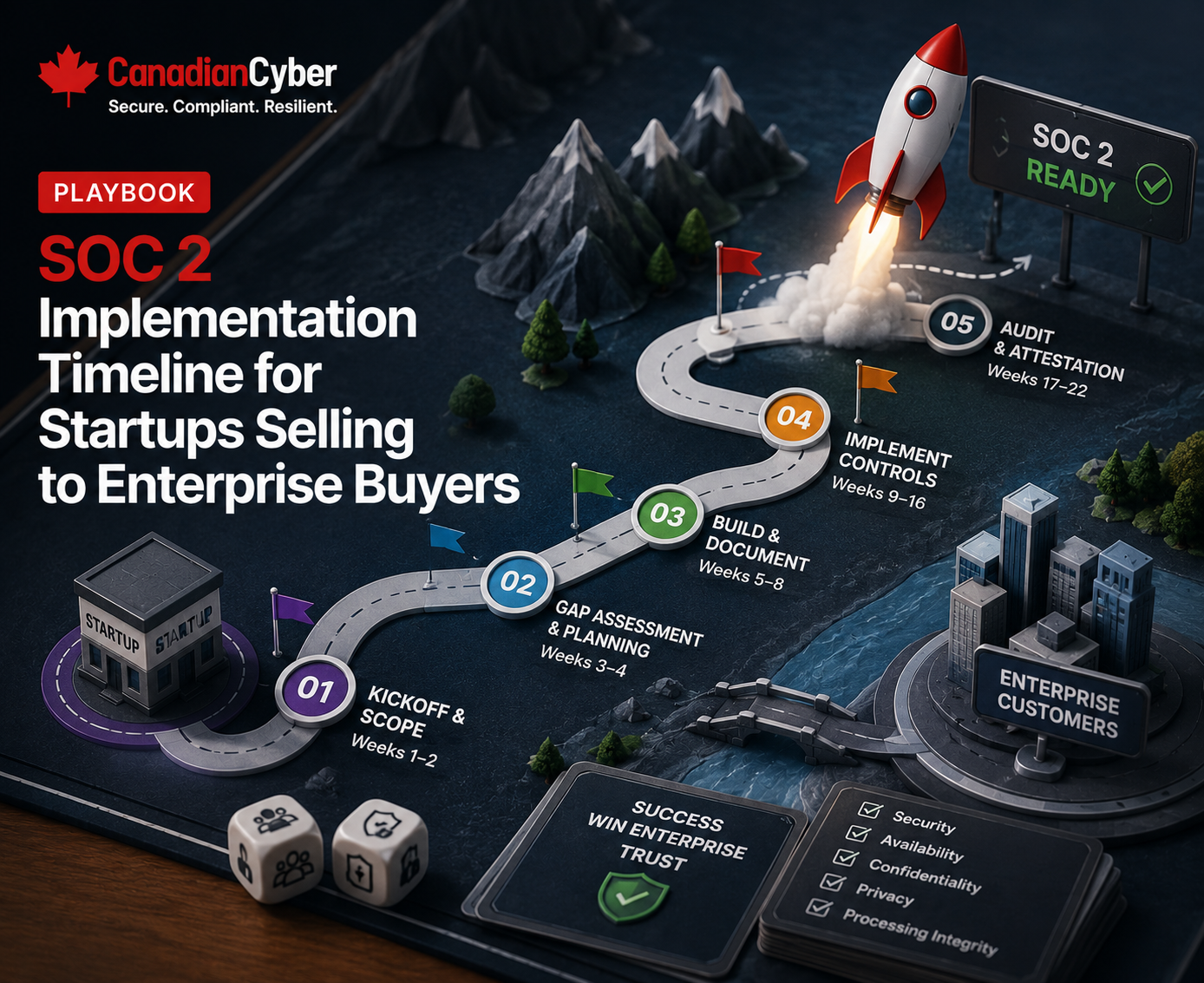
Playbook: SOC 2 Implementation Timeline for Startups Selling to Enterprise Buyers
For startups selling to enterprise buyers, SOC 2 is not just an audit project. It is a sales requirement, a trust signal, and a procurement accelerator. The right implementation timeline helps your team move from scattered security activity to buyer-ready evidence without overwhelming engineering, product, or leadership.
Quick Snapshot
| Timeline Phase | What Happens |
|---|---|
| Weeks 1–2 | Define SOC 2 scope, buyer requirements, systems, and control owners. |
| Weeks 3–6 | Build core controls for access, vendors, policies, change management, and evidence. |
| Weeks 7–10 | Collect proof, close gaps, test incident response, and prepare trust materials. |
| Weeks 11–12 | Validate readiness, prepare auditor handoff, and package buyer-facing evidence. |
| Main Outcome | A realistic SOC 2 implementation path that supports enterprise procurement and audit readiness. |
Introduction
Enterprise buyers do not only buy your product. They buy trust.
Your startup may have strong features, a clean demo, and a clear business case. But when the buyer’s procurement team arrives, the conversation changes.
They ask for SOC 2 status, security policies, MFA evidence, access review records, vendor risk process, incident response proof, backup and recovery evidence, change management samples, data protection summaries, sub-processor lists, and security questionnaire answers.
If your team is not ready, the deal slows down. The founder starts chasing answers. The CTO pulls screenshots. Engineering gets interrupted. Sales waits. Legal reviews every word. The buyer sends follow-up questions.
This is why startups need a SOC 2 implementation timeline before enterprise procurement becomes painful.
For companies looking for SOC 2 services in Canada, the goal should not be a generic checklist. The goal should be a practical timeline that helps the startup build controls, collect evidence, answer buyers, and move toward audit readiness with confidence.
Need SOC 2 Before Enterprise Buyers Slow the Deal?
Canadian Cyber helps startups and SaaS companies prepare for SOC 2 with readiness assessments, evidence mapping, SharePoint evidence workspaces, security questionnaire support, vendor risk reviews, and vCISO guidance.
Why SOC 2 Matters Earlier Than Startups Expect
Many startups think SOC 2 is something they need later. After more funding. After more customers. After hiring security staff. After the product matures.
But enterprise buyers often ask for SOC 2 before the startup feels ready.
| Trigger | What Happens |
|---|---|
| Enterprise sales opportunity | Buyer asks for SOC 2 report or roadmap. |
| Security questionnaire | Startup must prove controls before contract approval. |
| Investor diligence | Investors ask about security maturity and customer data risk. |
| Cyber insurance renewal | Insurer asks for evidence of MFA, backups, and incident response. |
| Regulated customer | Buyer asks about vendors, access, logging, and data protection. |
If your startup wants enterprise customers, SOC 2 readiness should start before the buyer asks.
The SOC 2 Implementation Timeline at a Glance
A realistic startup timeline usually has four stages. This does not mean every startup will be fully audited in 12 weeks. It means the startup can build serious readiness momentum in 90 days.
| Phase | Weeks | Focus |
|---|---|---|
| Phase 1 | Weeks 1–2 | Scope and planning. |
| Phase 2 | Weeks 3–6 | Control design and ownership. |
| Phase 3 | Weeks 7–10 | Evidence collection and gap closure. |
| Phase 4 | Weeks 11–12 | Readiness validation and buyer packaging. |
Important note:
SOC 2 Type I tests whether controls are designed at a point in time. SOC 2 Type II tests whether controls operated over a period, often 3 to 12 months. This playbook focuses on building readiness before audit and enterprise buyer review.
Phase 1: Weeks 1–2 — Define Scope and Buyer Requirements
The first mistake startups make is jumping into policies before defining scope.
SOC 2 scope should answer which product is included, which systems support the product, which data is processed, which teams are involved, which vendors support the service, which buyer concerns matter most, and which Trust Services Criteria apply.
| Scope Question | Why It Matters |
|---|---|
| Which SaaS platform is in scope? | Defines the system being reviewed. |
| What customer data is processed? | Drives control requirements. |
| Which cloud systems support production? | Defines infrastructure scope. |
| Which vendors process data? | Supports vendor risk review. |
| Which tools support development? | Supports change management. |
| Are AI features included? | Adds prompts, outputs, model vendors, and AI data controls. |
| Week 1–2 Deliverable | Purpose |
|---|---|
| SOC 2 scope statement | Defines what is included. |
| System inventory | Lists key applications and infrastructure. |
| Data flow summary | Shows where customer data moves. |
| Vendor list | Identifies critical suppliers. |
| Control owner list | Assigns accountability. |
| Initial readiness gap list | Shows what needs attention first. |
SOC 2 scope should match what buyers care about and what the product actually does.
Phase 2: Weeks 3–6 — Build the Core Control Foundation
Once scope is clear, build the control foundation. Do not try to fix everything at once. Start with the controls buyers, auditors, and insurers ask about most.
| Priority SOC 2 Control Area | Why It Matters |
|---|---|
| Access Control | Protects customer data and production systems. |
| Vendor Risk | Shows third-party oversight. |
| Incident Response | Shows readiness for security events. |
| Change Management | Shows product changes are reviewed. |
| Backup and Recovery | Shows resilience. |
| Logging and Monitoring | Shows detection and investigation capability. |
| Risk Management | Shows leadership understands security risk. |
| Control Foundation Task | Owner |
|---|---|
| Enforce MFA | IT / Security |
| Review privileged access | IT / Security |
| Create offboarding checklist | HR / IT |
| Build vendor register | Operations / Compliance |
| Approve core policies | Policy owners |
| Define change management process | Engineering |
| Create evidence workspace | ISMS / Compliance |
Core policies to approve:
Information Security Policy, Access Control Policy, Incident Response Plan, Vendor Management Policy, Change Management Procedure, Backup and Recovery Procedure, Acceptable Use Policy, Data Handling Policy, and Risk Management Procedure.
Need Help Building the SOC 2 Control Foundation?
Canadian Cyber can help define your SOC 2 scope, assign control owners, build core policies, set up evidence tracking, and prepare your startup for enterprise security reviews.
Phase 3: Weeks 7–10 — Collect Evidence and Close Gaps
SOC 2 readiness is not complete when policies exist. The real question is: Can you prove the controls operate?
| Control Area | Evidence to Collect |
|---|---|
| Access Control | MFA report, admin access review, offboarding samples. |
| Vendor Risk | Vendor register, vendor reviews, sub-processor list. |
| Incident Response | Approved plan, role matrix, tabletop plan. |
| Backup Recovery | Backup configuration, restore test evidence. |
| Change Management | Pull request samples, deployment records, tickets. |
| Logging | Log source inventory, alert review samples. |
| Risk Management | Risk register and treatment actions. |
Common evidence gaps include:
- no access review sign-off
- no restore test record
- vendor SOC 2 reports saved but not reviewed
- policies approved but not version-controlled
- cloud logs enabled but not reviewed
- incident response plan exists but no tabletop
- offboarding process exists but no samples
| Gap Closure Tracker Field | Purpose |
|---|---|
| Gap Description | What is missing. |
| Control Area | Access, vendor, incident, backup, change. |
| Risk Rating | High, medium, low. |
| Owner | Person accountable. |
| Evidence Required | Proof needed. |
| Status | Open, in progress, closed. |
Build My SOC 2 Evidence Pack
Canadian Cyber can help startups build SOC 2 evidence packs and gap closure trackers that make enterprise reviews easier.
Phase 4: Weeks 11–12 — Validate Readiness and Package Buyer Evidence
The final phase is about validation and packaging. Before talking to auditors or enterprise buyers, confirm that evidence is clear, current, and mapped to controls.
| Readiness Validation Question | Yes / No |
|---|---|
| Is SOC 2 scope documented? | |
| Are key systems listed? | |
| Are control owners assigned? | |
| Are policies approved? | |
| Is MFA evidence available? | |
| Is privileged access reviewed? | |
| Is vendor risk evidence available? | |
| Is evidence stored in one controlled workspace? | |
| Is a buyer-facing trust summary ready? |
Buyer Trust Pack Contents
| Item | Purpose |
|---|---|
| SOC 2 roadmap | Shows readiness path. |
| Security overview | Explains control environment. |
| Access control summary | Shows MFA, access review, and offboarding. |
| Vendor risk summary | Shows supplier oversight. |
| Incident response summary | Shows response readiness. |
| Sub-processor list | Supports procurement. |
| Security FAQ | Speeds questionnaire response. |
Do not send buyers raw evidence without context. Use a trust summary and evidence index.
Timeline Option: SOC 2 Type I vs Type II
Startups often confuse SOC 2 Type I and Type II. The right path depends on buyer pressure, maturity, and how long your controls have operated.
| Report Type | Best Fit |
|---|---|
| SOC 2 Type I | Useful when buyers need proof quickly, controls are newly implemented, and the company wants a first report sooner. |
| SOC 2 Type II | Useful when enterprise buyers expect stronger assurance and the company can collect operating evidence over several months. |
SOC 2 Type I can help open doors. SOC 2 Type II usually builds stronger long-term trust.
What Startups Should Do Before Choosing an Auditor
Before selecting an auditor, prepare internally. Do not use the auditor as your implementation plan.
| Auditor-Ready Item | Why It Matters |
|---|---|
| Scope statement | Auditor needs system boundaries. |
| Control list | Shows expected controls. |
| Evidence workspace | Speeds audit. |
| Risk register | Shows risk management. |
| Vendor register | Shows supplier oversight. |
| Open gap tracker | Shows remediation status. |
How SharePoint Helps SOC 2 Readiness
Many startups already use Microsoft 365. That makes SharePoint a practical SOC 2 evidence workspace.
SharePoint can track risks, controls, evidence, policies, vendors, audit requests, corrective actions, management review, questionnaire answers, and owner tasks.
| SharePoint Evidence Field | Purpose |
|---|---|
| Control Area | Access, vendor, cloud, incident. |
| Evidence Owner | Person accountable. |
| Period Covered | Month, quarter, year. |
| Source System | Entra ID, AWS, GitHub, Jira. |
| Review Status | Requested, uploaded, approved, rejected. |
| Sensitivity | Public, NDA-only, confidential. |
Explore the ISMS SharePoint Solution
Canadian Cyber’s ISMS SharePoint solution helps startups manage SOC 2 evidence, risks, vendors, policies, audit requests, corrective actions, and buyer trust packs in one Microsoft 365 workspace.
Security Questionnaire Preparation During SOC 2
Startups selling to enterprise buyers cannot wait for the final SOC 2 report. They need questionnaire readiness during implementation.
| Questionnaire Library Field | Purpose |
|---|---|
| Question | Buyer question. |
| Approved Answer | Standard response. |
| Evidence Link | Proof. |
| Owner | Person responsible. |
| Sensitivity | Public, NDA-only, confidential. |
Strong SOC 2 timeline answer:
“We are actively preparing for SOC 2. Our current readiness work includes access control, vendor risk, incident response, backup recovery, change management, logging, policy governance, risk management, and evidence collection. We can share our readiness roadmap and security overview under NDA.”
90-Day SOC 2 Startup Timeline
| Timeline | Focus | Actions |
|---|---|---|
| Days 1–15 | Scope and Plan | Define scope, identify systems, map customer data, list vendors, assign owners, create evidence workspace, and review buyer requirements. |
| Days 16–30 | Build Foundations | Approve priority policies, enforce MFA, export admin access, build vendor register, create risk register, define change process, and finalize incident response plan. |
| Days 31–60 | Operate Controls | Run access review, collect offboarding samples, review critical vendors, collect change samples, test backup restore, review logs, and start questionnaire library. |
| Days 61–75 | Validate Evidence | Review evidence quality, close high-risk gaps, update risk register, prepare buyer trust summary, schedule tabletop, and review sub-processors. |
| Days 76–90 | Package and Prepare | Run tabletop, finalize trust pack, prepare auditor handoff, brief leadership, confirm next audit step, and prepare Type I or Type II path. |
Common Mistakes to Avoid
- Waiting until a buyer asks. Start before procurement pressure hits.
- Writing policies without evidence. Policies are not enough. You need proof.
- Letting engineering own everything. SOC 2 needs IT, HR, legal, operations, leadership, and security ownership.
- Ignoring vendor risk. Enterprise buyers ask about sub-processors and critical vendors.
- No access review evidence. MFA is important, but access reviews are also expected.
- No restore test evidence. Backups are not enough. Recovery must be tested.
- Overpromising SOC 2 timelines. Buyers respect clear roadmaps more than vague promises.
- Using email as evidence storage. Use SharePoint, a GRC tool, or a controlled evidence workspace.
What Good Looks Like
A startup ready for enterprise SOC 2 conversations can show:
- SOC 2 scope
- system inventory
- data flow summary
- risk register
- approved policies
- control owner list
- MFA evidence
- access review evidence
- vendor register
- sub-processor list
- incident response plan
- backup and recovery evidence
- change management samples
- logging evidence
- security questionnaire library, buyer trust pack, and audit readiness roadmap
This gives buyers confidence before the final report is complete.
Canadian Cyber’s Take
At Canadian Cyber, we often see startups wait until a major enterprise deal is already in procurement before starting SOC 2.
That creates pressure. The better approach is to prepare early.
SOC 2 readiness should support sales, not slow it down.
For startups looking for SOC 2 services in Canada, the right partner should help with more than checklists. You need scope definition, control design, evidence collection, vendor reviews, access reviews, questionnaire answers, and a practical path to audit readiness.
SOC 2 is not just about passing an audit. It is about building trust before the buyer walks away.
Takeaway
Startups selling to enterprise buyers need a realistic SOC 2 implementation timeline.
Start with scope. Then build controls. Assign owners. Collect evidence. Close gaps. Prepare buyer answers. Package trust materials. Choose the right audit path.
Do not wait for procurement to expose the gaps. A strong 90-day SOC 2 readiness plan can help your startup move faster, answer buyers better, and prepare for audit with less chaos.
How Canadian Cyber Can Help
Canadian Cyber helps startups and SaaS companies prepare for SOC 2 with practical implementation support and buyer-ready evidence.
- SOC 2 readiness assessments
- SOC 2 implementation timelines
- SOC 2 Type I and Type II readiness
- SharePoint evidence workspace setup
- security questionnaire support
- buyer trust pack development
- access control evidence reviews
- vendor risk register setup
- sub-processor list preparation
- incident response planning
- backup and restore evidence reviews
- change management evidence mapping
- SOC 2 audit preparation
- vCISO support for startup security governance
Stay Connected With Canadian Cyber
Follow Canadian Cyber for practical guidance on SOC 2, startup security, SaaS compliance, enterprise procurement, SharePoint evidence management, ISO 27001, and vCISO support.