vCISO • Board Reporting • Cyber Budget • Executive Risk • Security Governance
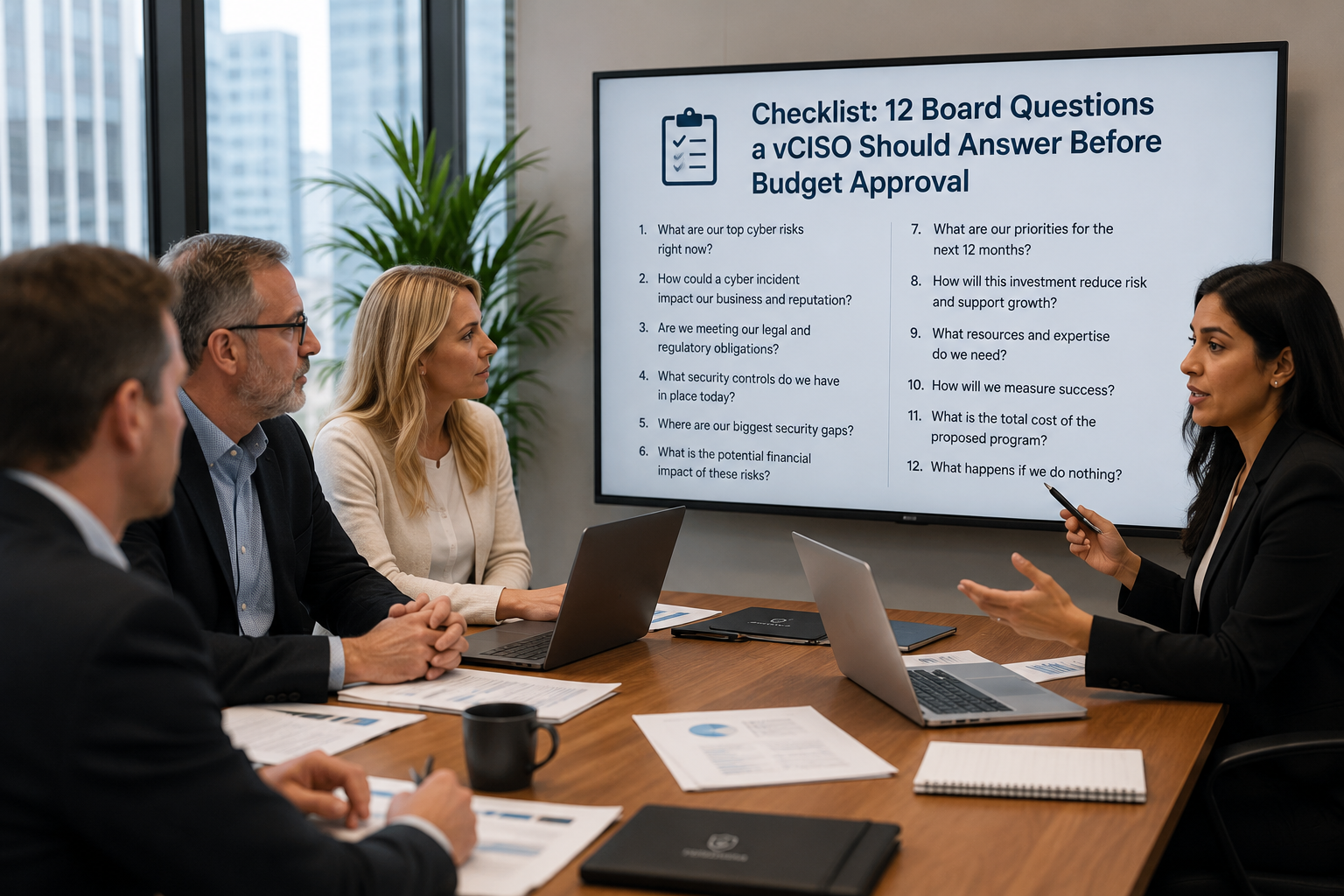
Checklist: 12 Board Questions a vCISO Should Answer Before Budget Approval
Cybersecurity budget approval should not be based on fear, tool demos, or vague risk language. Before the board approves another security spend, the vCISO should explain what risk is being reduced, why it matters now, what evidence supports the request, and how success will be measured.
Quick Snapshot
| Board Concern | What the vCISO Should Explain |
|---|---|
| Business Risk | Which cyber risks threaten revenue, operations, clients, compliance, or reputation. |
| Budget Priority | Why this spend matters more than other security needs right now. |
| Control Gaps | Which controls are missing, weak, or not evidenced. |
| Measurable Outcome | How the company will know the investment worked. |
| Best Outcome | Cyber budget becomes a risk-based business decision, not a technical wish list. |
Introduction
Boards do not want random cybersecurity spending.
They want confidence.
They want to know:
- Are we spending on the right things?
- Are we reducing real business risk?
- Are we exposed to ransomware, data loss, audit failure, or customer trust issues?
- Are we buying another tool because we need it, or because security is nervous?
- Will this budget help with SOC 2, ISO 27001, cyber insurance, or enterprise procurement?
- Can leadership prove the investment made the company safer?
This is where a vCISO earns trust.
A strong vCISO does not walk into a board meeting with fear-based slides and a shopping list. They walk in with a business case. They explain risk clearly, connect security gaps to business outcomes, show evidence, compare options, define success, and tell the board what decision is needed.
Need Board-Ready Cyber Budget Support?
Canadian Cyber helps organizations build vCISO board reporting, cyber budget cases, risk registers, SOC 2 and ISO 27001 roadmaps, cyber insurance evidence, and executive security dashboards.
Why Boards Push Back on Cybersecurity Budget
Boards do not always reject security spending because they do not care. They push back because the request is often unclear.
Weak budget request: “We need a new security tool.”
Strong budget request: “We need to fund privileged access reviews, backup restore testing, vendor risk management, and incident tabletop exercises because these gaps affect ransomware recovery, customer data protection, cyber insurance renewal, and enterprise buyer trust.”
| Reason Boards Say No | What It Means |
|---|---|
| The risk is vague. | Leadership cannot see business impact. |
| The budget feels tool-heavy. | Spend is not mapped to controls. |
| No evidence is provided. | Claims are unsupported. |
| Success is unclear. | The board cannot measure value. |
| No alternatives are shown. | Leadership cannot compare options. |
The board should not be asked to fund “cybersecurity.” It should be asked to fund specific risk reduction.
The 12 Questions Every vCISO Should Answer
1. What Business Risk Are We Trying to Reduce?
If the vCISO cannot explain the business risk clearly, the budget request is not ready.
| Risk Type | Example |
|---|---|
| Revenue Risk | Security review delays enterprise sales. |
| Operational Risk | Ransomware disrupts critical systems. |
| Customer Risk | Weak access control exposes client data. |
| Compliance Risk | ISO 27001 or SOC 2 evidence gaps remain open. |
| Insurance Risk | Cyber insurance renewal becomes more expensive or limited. |
2. Why This Budget, and Why Now?
Boards need timing. Good reasons include enterprise buyer requirements, SOC 2 or ISO 27001 timelines, cyber insurance renewal, internal audit findings, ransomware readiness gaps, new cloud or AI risks, business growth, or investor due diligence.
Strong answer: “We should fund this now because three enterprise buyers asked for stronger evidence, our cyber insurance renewal is in 90 days, and our access reviews and restore testing are not yet audit-ready.”
3. Which Controls Are Missing, Weak, or Not Evidenced?
| Control Problem | Meaning |
|---|---|
| Missing Control | The control does not exist. |
| Weak Control | The control exists but is incomplete. |
| Evidence Gap | The control may work, but proof is missing. |
4. What Happens If We Do Nothing?
Boards need to understand the cost of delay. Not fear. Impact.
| Gap | Possible Impact |
|---|---|
| No access reviews | Former users or over-permissioned admins may retain access. |
| No restore testing | Recovery may fail during ransomware. |
| No vendor review | Supplier breach risk remains unmanaged. |
| No incident tabletop | Executives may make poor decisions under pressure. |
| No evidence vault | Audit and procurement responses stay slow. |
Turn Security Gaps Into a Board-Ready Business Case
Canadian Cyber can help translate access, vendor, backup, incident response, cloud, AI, SOC 2, and ISO 27001 gaps into business risk, evidence, and budget options.
5. What Are the Top Three Priorities?
A vCISO should not bring 18 equal priorities. Boards need focus.
| Priority | Why It Matters |
|---|---|
| Privileged Access Review | Reduces risk of unauthorized access to critical systems. |
| Backup Restore Testing | Proves ransomware recovery capability. |
| Incident Tabletop Exercise | Tests leadership, legal, IT, and communications readiness. |
6. How Does This Budget Support Revenue or Customer Trust?
Cybersecurity budget is easier to approve when tied to business growth.
| Security Investment | Revenue or Trust Impact |
|---|---|
| SOC 2 readiness | Supports enterprise sales. |
| ISO 27001 implementation | Builds trust with regulated clients. |
| Security questionnaire library | Speeds procurement. |
| SharePoint evidence vault | Reduces audit and review friction. |
| Access control improvements | Protects customer data commitments. |
7. What Evidence Supports the Request?
Boards should not approve budget based only on opinion. The vCISO should bring evidence.
| Evidence | What It Shows |
|---|---|
| Risk Register | Top business risks. |
| Gap Assessment | Missing or weak controls. |
| Internal Audit Findings | Tested weaknesses. |
| Customer Questionnaires | Buyer expectations. |
| Cyber Insurance Questions | Insurer concerns. |
8. What Are the Options?
Do not give the board only one path. Give options and explain trade-offs.
| Option | Description | Risk Impact |
|---|---|---|
| Minimum | Fix highest-risk gaps only. | Reduces urgent risk but leaves maturity gaps. |
| Recommended | Fix high-risk gaps and build evidence workflows. | Best balance of risk reduction and audit readiness. |
| Accelerated | Add automation, tooling, and external support. | Faster maturity with higher cost. |
9. What Will Success Look Like in 90 Days?
Cyber budget should have measurable outcomes.
| Area | 90-Day Success Measure |
|---|---|
| Access Control | Privileged access review completed and exceptions tracked. |
| Backup Recovery | Restore test completed and documented. |
| Incident Response | Tabletop completed with corrective actions. |
| Vendor Risk | Critical vendor register created and top vendors reviewed. |
| Evidence Management | Evidence vault created with owners and metadata. |
Build a 90-Day Cyber Budget Roadmap
Canadian Cyber helps vCISOs and leadership teams define board-ready 90-day outcomes for access reviews, vendor risk, backup testing, incident readiness, evidence management, SOC 2, and ISO 27001.
10. Who Owns Delivery?
Budget approval does not equal execution. The board should know who owns the work.
| Workstream | Owner |
|---|---|
| Access Reviews | IT Lead |
| Vendor Risk | Operations Manager |
| Incident Tabletop | vCISO |
| Backup Restore Test | Infrastructure Lead |
| Evidence Vault | ISMS Owner / SharePoint Owner |
11. How Will We Measure Risk Reduction?
Boards need metrics. Not too many. Just enough to see progress.
| Metric | Why It Helps |
|---|---|
| Critical risks open vs. closed | Shows risk movement. |
| Privileged access exceptions | Shows access risk. |
| Vendor reviews completed | Shows third-party risk maturity. |
| Restore tests completed | Shows resilience. |
| Evidence completeness | Shows audit readiness. |
12. What Decision Do We Need From the Board?
A vCISO should end with a clear decision request. Not just an update.
| Decision Needed | Example |
|---|---|
| Approve Budget | Fund SOC 2 readiness and evidence workflow. |
| Accept Risk | Delay vendor review until next quarter. |
| Set Priority | Choose ransomware readiness before new tooling. |
| Approve Timeline | Support 90-day remediation plan. |
| Assign Executive Sponsor | Confirm leadership owner. |
A board cyber presentation should end with a decision. Not confusion.
Board Budget Approval Checklist
Before requesting cybersecurity budget, the vCISO should be ready to answer these questions.
| Question | Yes / No |
|---|---|
| What business risk are we reducing? | |
| Why does this need funding now? | |
| Which controls are missing, weak, or not evidenced? | |
| What happens if we do nothing? | |
| What are the top three priorities? | |
| How does this support revenue or customer trust? | |
| What evidence supports the request? | |
| What options and trade-offs does the board have? | |
| What will success look like in 90 days? | |
| Who owns delivery? | |
| How will we measure risk reduction? | |
| What decision do we need from the board? |
Example Board Budget Request
| Area | Example |
|---|---|
| Situation | The company is preparing for SOC 2, cyber insurance renewal, and enterprise buyer reviews. |
| Top Risks | Privileged access not reviewed, vendor process incomplete, restore testing missing, incident response untested, evidence scattered. |
| Recommended Budget Focus | Access review workflow, vendor risk register, backup restore testing, ransomware tabletop, SharePoint evidence vault, vCISO board reporting. |
| 90-Day Outcomes | Access review complete, critical vendors reviewed, restore test documented, tabletop completed, evidence vault live, board dashboard created. |
| Board Decision Needed | Approve recommended budget and confirm executive sponsor. |
Common Mistakes to Avoid
- Asking for tools before explaining risk. Start with risk. Then explain tools, services, or process improvements.
- Using fear instead of evidence. Fear gets attention. Evidence gets approval.
- Bringing too many priorities. The board needs focus.
- Not showing alternatives. Boards need options and trade-offs.
- Ignoring revenue impact. Security supports enterprise sales, insurance, compliance, and customer trust.
- No 90-day outcome. Budget should lead to measurable progress.
- No owner. If nobody owns delivery, the board may lose confidence.
What Good Looks Like
A strong vCISO budget request includes:
- business risk summary
- top priorities
- evidence
- control gaps
- budget options
- recommended path
- 90-day success measures
- delivery owners
- risk metrics
- customer trust impact
- board decision request
The board should leave with clarity. Not fear. Not confusion. Clarity.
Canadian Cyber’s Take
At Canadian Cyber, we often see organizations struggle to get cybersecurity budget approved because the request is too technical.
The board does not need a tool tour. It needs a risk decision.
A vCISO should translate security needs into business language. What risk are we reducing? Why now? What happens if we delay? What will this improve? How will we measure success? Who owns delivery?
That is strategic leadership. Cyber budget approval becomes much easier when the board can see the risk, the evidence, the options, and the outcome.
Takeaway
Before asking the board for cybersecurity budget, the vCISO should be ready. Not with fear. With clarity.
Answer the 12 questions:
- What risk are we reducing?
- Why now?
- Which controls are weak?
- What happens if we do nothing?
- What are the top priorities?
- How does this support customer trust?
- What evidence supports it?
- What are the options?
- What will success look like?
- Who owns delivery?
- How will we measure risk reduction?
- What decision is needed?
That is how cybersecurity budget becomes a business decision, not a security wish list.
How Canadian Cyber Can Help
Canadian Cyber helps organizations prepare board-ready cybersecurity budget cases with vCISO strategic leadership.
- vCISO board reporting
- cyber budget business cases
- risk register development
- 90-day security roadmaps
- SOC 2 readiness planning
- ISO 27001 readiness planning
- cyber insurance evidence packs
- access control reviews
- vendor risk programs
- incident response tabletop exercises
- backup and restore evidence reviews
- SharePoint evidence vault setup
- executive cyber dashboards and board presentations
Stay Connected With Canadian Cyber
Follow Canadian Cyber for practical guidance on vCISO services, board cyber reporting, cybersecurity budget planning, SOC 2, ISO 27001, cyber insurance, and executive risk management.