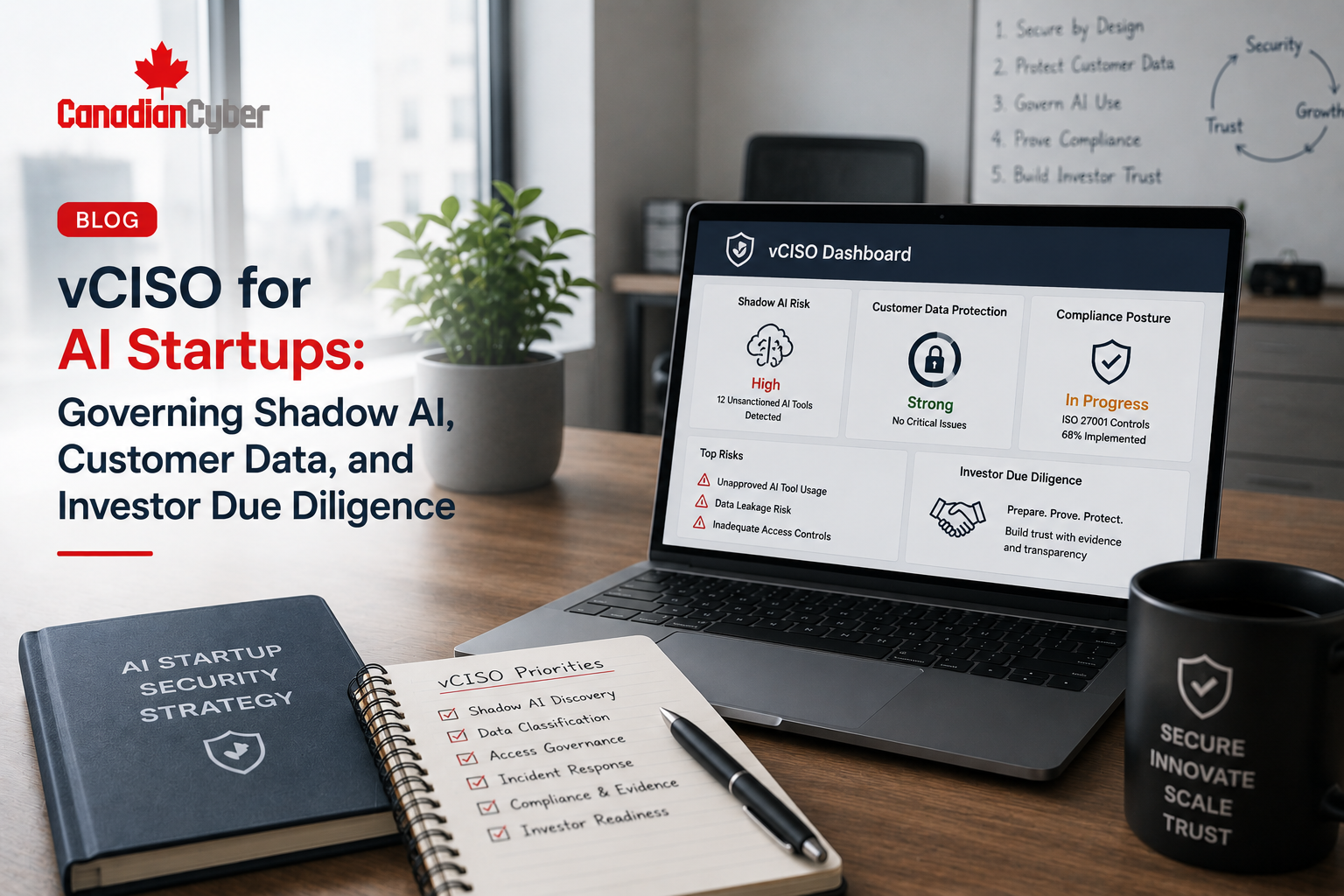
vCISO • AI Startups • Shadow AI • Customer Data • Investor Due Diligence
vCISO for AI Startups: Governing Shadow AI, Customer Data, and Investor Due Diligence
AI startups move fast. That speed helps product, sales, and fundraising. But it also creates risk. Shadow AI tools, customer data in prompts, unreviewed model providers, weak access controls, and vague investor security answers can quickly turn innovation into a trust problem.
Quick Snapshot
| AI Startup Risk Area | What a vCISO Helps Fix |
|---|---|
| Shadow AI | Identifies unapproved AI tools, agents, plugins, coding assistants, and employee workarounds. |
| Customer Data | Defines what data can be used in prompts, models, logs, outputs, training, and testing. |
| AI Vendors | Reviews LLM providers, vector databases, MLOps tools, cloud providers, and annotation vendors. |
| Access Control | Limits who can access customer prompts, outputs, admin tools, logs, and production systems. |
| Investor Due Diligence | Builds security evidence packs, risk summaries, customer data answers, and roadmap materials. |
Introduction
AI startups are built for speed.
Founders want product-market fit. Engineers want to ship. Investors want traction. Customers want features. Sales wants enterprise deals. Everyone wants the demo to work.
Then security questions arrive.
- Do you use our data to train your models?
- Who has access to customer prompts and outputs?
- Which AI vendors process our data?
- Do we have a data retention process?
- Can developers use Cursor, Copilot, ChatGPT, or internal AI agents?
- Can we answer all this without slowing product?
This is where a vCISO becomes valuable.
A vCISO gives AI startups strategic cybersecurity leadership without needing a full-time security executive too early. The right vCISO helps govern shadow AI, protect customer data, prepare investor due diligence evidence, and build trust with enterprise buyers.
Need AI Security Governance Without Slowing Product?
Canadian Cyber helps AI startups build practical AI governance, customer data controls, vendor risk reviews, investor due diligence packs, SOC 2 readiness, ISO 27001 readiness, and vCISO-led security roadmaps.
Why AI Startups Need vCISO Support Early
Most startups do not need a full-time CISO on day one. But AI startups often need security leadership earlier than they expect.
Why? Because AI platforms may handle sensitive data before the company has mature security operations.
An AI startup may process:
- customer prompts and uploaded files
- chat histories and model outputs
- embeddings, logs, and feedback
- training and evaluation data
- API payloads and customer documents
- source code, support tickets, and business workflows
| Security Pressure | Why It Matters |
|---|---|
| Enterprise Sales | Buyers ask for SOC 2, data handling, vendor reviews, and access controls. |
| Investor Due Diligence | Investors want to understand security, privacy, and operational risk. |
| Shadow AI | Employees use tools before governance exists. |
| Model Vendors | Customer data may flow to third-party AI providers. |
| Compliance | SOC 2, ISO 27001, privacy, and cyber insurance requirements appear earlier. |
AI startups do not need heavy bureaucracy. They need lightweight governance before trust questions become blockers.
The Shadow AI Problem
Shadow AI happens when employees use AI tools without formal approval, visibility, or controls.
In AI startups, this is common. Teams may use ChatGPT, Claude, Copilot, Cursor, internal LLM agents, meeting note takers, AI coding assistants, research tools, prompt testing tools, browser plugins, customer support AI tools, and sales email generators.
| Shadow AI Warning Sign | Risk |
|---|---|
| Developers paste code into public AI tools. | Source code exposure. |
| Support uses AI to summarize tickets. | Customer data leakage. |
| Sales uploads client documents. | Confidentiality risk. |
| Product tests prompts with real customer data. | Privacy and contractual risk. |
| Employees use personal AI accounts. | No admin control or audit trail. |
| AI tools are not in the vendor register. | Third-party risk is invisible. |
What a vCISO Does
A vCISO does not start by banning everything. That usually fails. Instead, they help create:
- approved AI tool lists
- AI acceptable use rules
- data handling restrictions
- AI vendor review processes
- prompt and output classification
- employee training
- access controls for AI agents
- evidence for customers and investors
The goal is not “no AI.” The goal is approved AI, with rules.
Customer Data: The Question That Can Kill the Deal
For AI startups, one customer data question matters more than almost any other: “Do you use our data to train your models?”
If the answer is unclear, enterprise buyers get nervous. If sales, product, and engineering answer differently, trust drops fast.
| Data Type | Governance Question |
|---|---|
| Prompts | Are prompts stored, logged, or reviewed? |
| Uploaded Files | Are files used for model processing or training? |
| Model Outputs | Are outputs stored, shared, or reused? |
| Embeddings | Are embeddings retained or deleted? |
| Logs | Do logs contain customer content? |
| Training Data | Is customer data included? |
| Support Tickets | Can support staff access customer AI data? |
Strong customer answer:
“Customer prompts, uploaded files, and model outputs are not used to train shared models unless explicitly agreed in writing. Customer data is processed according to our data handling controls, vendor review process, access controls, retention rules, and contractual commitments.”
Need a Clear Customer Data Use Statement?
Canadian Cyber helps AI startups define approved customer data answers for sales, legal, product, engineering, investor diligence, and security questionnaires.
The vCISO’s AI Governance Framework
A practical AI governance framework does not need to be huge. It should answer the questions customers, investors, and employees actually ask.
| Governance Area | What It Should Define |
|---|---|
| Approved AI Tools | Which tools employees can use. |
| Restricted Data | What data cannot be entered into AI tools. |
| Customer Data Use | Whether customer data trains models. |
| Vendor Review | How AI vendors are assessed. |
| Access Control | Who can access prompts, outputs, logs, and model settings. |
| Retention and Deletion | How long AI data is stored and how it can be deleted. |
| Incident Response | What happens if AI data is exposed. |
Practical AI policy statement:
“Employees may only use approved AI tools for company work. Customer confidential data, personal information, credentials, API keys, regulated data, source code, and non-public client information must not be entered into unapproved AI systems. Any AI tool processing customer data must be reviewed and approved through the AI vendor and data handling process.”
Access Control for AI Startups
AI startups often focus on the model and forget access. But customers and investors will ask who can access customer data, prompts, outputs, embeddings, model settings, production logs, and support accounts.
| Access Area | Why It Matters |
|---|---|
| AI Application Admin | Customer account access. |
| Prompt Logs | Sensitive input exposure. |
| Model Outputs | Confidential generated content. |
| Vector Database | Embedding and retrieval data. |
| Cloud Storage | Uploaded files and datasets. |
| Model Provider Console | Vendor and processing settings. |
| GitHub / GitLab | Source code and secrets. |
Evidence to keep:
- MFA report
- admin access export
- privileged access review
- support access logs
- service account register
- offboarding samples
- AI agent permission review
- model console access review
If a human engineer needs access review, an AI agent needs access review too.
AI Vendor Risk: Model Providers Are Not Just Tools
AI startups depend on vendors. These vendors may process customer data or support production services. That makes them part of the trust story.
AI vendors to review include LLM providers, embedding providers, vector databases, MLOps platforms, cloud providers, data labeling vendors, monitoring tools, analytics tools, support platforms, AI security tools, content moderation providers, and fine-tuning platforms.
| AI Vendor Review Question | Why It Matters |
|---|---|
| What data is sent to the vendor? | Defines exposure. |
| Is customer data used for training? | Buyer and investor concern. |
| Where is data processed? | Data residency and privacy. |
| How long is data retained? | Retention risk. |
| Can data be deleted? | Customer commitments. |
| Does the vendor provide SOC 2 or ISO evidence? | Assurance. |
| Is there a DPA or security addendum? | Legal protection. |
Review Your AI Vendor Risk
Canadian Cyber helps AI startups review model providers, vector databases, MLOps vendors, and AI tools for customer trust, investor due diligence, SOC 2, and ISO 27001 readiness.
Investor Due Diligence: What They Will Ask
Investors do not only care about growth. They also care about hidden risk.
For AI startups, investor diligence may include questions about security, privacy, data use, IP, vendors, model dependency, compliance roadmap, and incident readiness.
| Investor Question | What You Need |
|---|---|
| What customer data do you process? | Data inventory and data flow map. |
| Do you use customer data for training? | Approved data use position. |
| Which AI vendors process data? | Vendor register and reviews. |
| Do you have SOC 2 or a roadmap? | Readiness plan. |
| Who has access to production? | Access review evidence. |
| How do you handle incidents? | Incident response plan. |
| What is your security roadmap? | 90-day and 12-month plan. |
Investor Due Diligence Evidence Pack
| Evidence | Purpose |
|---|---|
| Security Overview | Explains current security posture. |
| AI Data Flow Map | Shows data movement. |
| Customer Data Use Statement | Clarifies training and processing. |
| Vendor Register | Shows third-party risk visibility. |
| Access Control Summary | Shows role-based access and MFA. |
| Risk Register | Shows risk governance. |
| vCISO Roadmap | Shows leadership and priorities. |
Do not wait until due diligence starts to build your security story. Build it before the investor asks.
The vCISO 30-Day Plan for AI Startups
A vCISO should create clarity quickly. The first 30 days should focus on discovery, governance, and proof.
| Days | Focus | Outcome |
|---|---|---|
| Days 1–7 | Discover AI tools, customer data flows, model providers, admin access, and customer commitments. | Risk visibility. |
| Days 8–15 | Create approved AI tool list, AI acceptable use rules, data use position, vendor register, and owners. | Governance baseline. |
| Days 16–30 | Build investor security pack, access review evidence, security FAQ, 90-day roadmap, and leadership briefing. | Proof and direction. |
Build a 30-Day vCISO Plan for Your AI Startup
Canadian Cyber can help AI startups build a 30-day vCISO plan for shadow AI, customer data governance, investor diligence, and security roadmap development.
SOC 2 and ISO 27001 Readiness for AI Startups
AI startups often need SOC 2 or ISO 27001 earlier than expected. Enterprise buyers may request SOC 2. Regulated customers may ask for ISO 27001. Investors may ask for a compliance roadmap.
| Framework | When It Helps |
|---|---|
| SOC 2 | Enterprise SaaS sales, buyer trust, and customer security reviews. |
| ISO 27001 | Global trust, structured ISMS, risk management, and supplier assurance. |
| Both | Mature enterprise sales, regulated buyers, and international growth. |
AI evidence needed for both includes:
- AI data flow map
- customer data use rules
- vendor reviews
- access reviews
- incident response plan
- risk register
- security policies
- support access controls
- data retention and deletion workflows
Common Mistakes AI Startups Should Avoid
- Saying “we do not use customer data for training” without evidence. The statement must match product design, vendor terms, contracts, and engineering reality.
- Ignoring shadow AI. Employees will use AI tools unless approved tools and rules exist.
- Forgetting model outputs. Outputs may contain sensitive customer information and need protection.
- Treating AI vendors like normal SaaS tools. Model providers may process prompts, files, outputs, and embeddings.
- Letting sales invent security answers. Create approved answers for customer and investor questions.
- Not reviewing AI agent access. Internal agents can have broad access to code, tickets, docs, and data.
- Waiting until due diligence. Investor diligence moves fast. Prepare evidence early.
AI Startup vCISO Readiness Checklist
Use this checklist before enterprise buyers or investors start asking harder questions.
| Question | Yes / No |
|---|---|
| Do we have an approved AI tool list? | |
| Do we know which AI tools employees actually use? | |
| Do we have one approved customer data use statement? | |
| Are AI vendors listed in our vendor register? | |
| Have we reviewed model provider data use terms? | |
| Do we know who can access prompts, outputs, logs, and embeddings? | |
| Do we have investor due diligence security evidence ready? | |
| Do we have a SOC 2 or ISO 27001 readiness roadmap? | |
| Do we have a 90-day security roadmap? |
If several answers are “no,” your AI startup may need vCISO support before the next customer or investor review.
What Good Looks Like
An AI startup with strong vCISO support can show:
- approved AI tool list
- AI acceptable use rules
- customer data use statement
- AI vendor register
- model provider reviews
- access control evidence
- prompt and output data flow map
- retention and deletion rules
- incident response plan
- AI risk register
- investor security pack
- customer security FAQ
- SOC 2 or ISO 27001 roadmap
This does not slow the startup down. It helps the startup scale with trust.
Canadian Cyber’s Take
At Canadian Cyber, we often see AI startups wait too long to formalize security governance.
At first, the team is small. Everyone trusts everyone. Engineers move quickly. Customer data flows change often. AI vendors are added fast. Sales answers security questions manually. Investors assume controls will mature later.
Then the company grows. Enterprise buyers ask for SOC 2. Investors ask about data use. Customers ask about model training. Legal asks about AI vendors. Security questionnaires get harder.
The startups that win trust are the ones that build lightweight governance before the pressure becomes painful.
A vCISO helps AI startups move fast by making innovation safe enough to scale.
Takeaway
AI startups need security leadership before they need a full-time security department.
A vCISO helps govern the risks that matter most:
- shadow AI
- customer data
- model providers
- prompt and output handling
- access control
- vendor risk
- investor due diligence
- SOC 2 and ISO 27001 readiness
Start simple. Inventory AI tools. Define customer data use. Review vendors. Control access. Build evidence. Prepare investor answers. Create a 90-day roadmap. That is how AI startups move fast without losing trust.
How Canadian Cyber Can Help
Canadian Cyber helps AI startups build practical cybersecurity governance with vCISO support.
- vCISO services for AI startups
- shadow AI discovery
- AI acceptable use policies
- customer data governance
- AI vendor risk reviews
- model provider security reviews
- prompt and output data flow mapping
- investor due diligence security packs
- SOC 2 readiness
- ISO 27001 readiness
- access control reviews
- AI incident response tabletop exercises
- SharePoint evidence vault setup
- board and investor cyber reporting
Stay Connected With Canadian Cyber
Follow Canadian Cyber for practical guidance on vCISO services, AI startup security, shadow AI governance, customer data protection, SOC 2, ISO 27001, investor due diligence, and cyber risk management.