vCISO • Executive Security Leadership • Technical Monitoring • Cyber Governance • MSP Security
Common Mistakes: Confusing Technical Monitoring with Executive Security Leadership
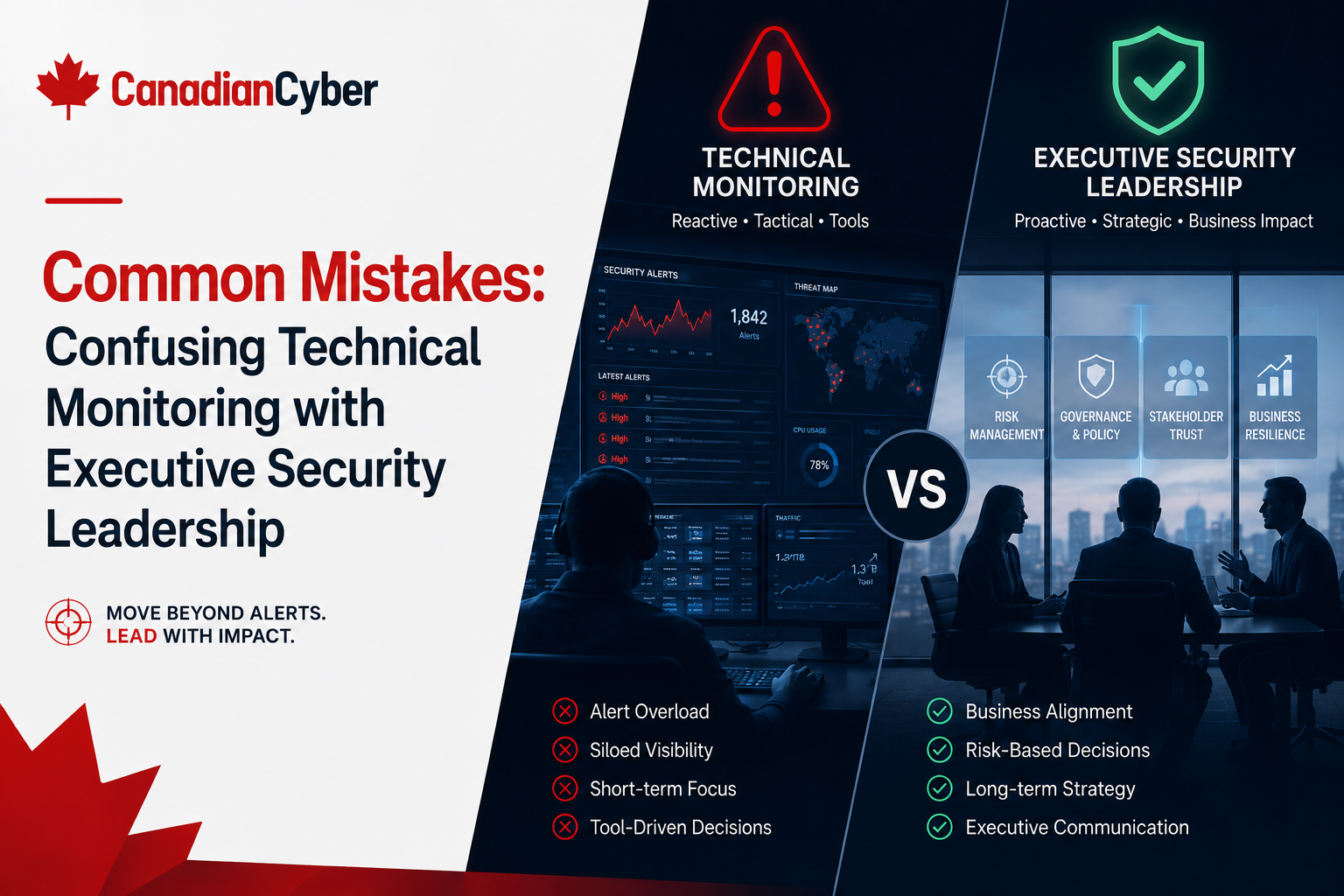
Technical monitoring helps detect alerts, suspicious activity, system issues, and security events. Executive security leadership helps the business decide what risks matter, what to fix first, how much to invest, who owns security actions, and how cyber risk affects customers, revenue, compliance, and growth.
Quick Snapshot
| Area | Technical Monitoring | Executive Security Leadership |
|---|---|---|
| Main Focus | Alerts, logs, endpoints, systems, and events. | Risk, strategy, governance, accountability, and business decisions. |
| Typical Owner | IT, MSP, SOC, MSSP, or security operations. | vCISO, CISO, executive sponsor, or leadership team. |
| Output | Tickets, alerts, dashboards, investigations. | Roadmaps, risk reports, decisions, budgets, policies, and evidence. |
| Common Mistake | Assuming alerts equal governance. | Treating security as only a technical function. |
| Better Outcome | Monitoring feeds leadership decisions, and leadership sets priorities for monitoring, investment, compliance, and risk treatment. | |
Introduction
Many organizations believe they have security leadership because they have monitoring tools.
They have endpoint alerts, firewall logs, email security reports, cloud dashboards, an MSP watching tickets, or even an MSSP reviewing alerts.
That is useful.
But it is not the same as executive security leadership.
Monitoring can tell you that something happened. Leadership decides what it means, what to do next, who owns the risk, what budget is needed, and how the business should improve.
Tools create visibility. Leadership creates direction.
This is where many companies get stuck. They buy tools, receive alerts, open tickets, close tickets, and still have no one guiding the bigger security program.
- What are our top cyber risks?
- Which controls reduce business risk fastest?
- Are we ready for cyber insurance?
- Do we need ISO 27001 or SOC 2?
- Can we prove our controls to customers?
- Who owns remediation?
- What should leadership approve this quarter?
Need Security Leadership Beyond Alerts?
Canadian Cyber helps organizations move from technical monitoring to executive cyber governance with vCISO support, risk registers, security roadmaps, board reporting, incident readiness, compliance planning, and SharePoint ISMS workspaces.
Mistake 1: Assuming Alerts Equal Security Strategy
Alerts are important. They show potential problems. But alerts do not create strategy.
What Alerts Can Tell You
| Alert Type | What It Shows |
|---|---|
| Endpoint alert | Suspicious activity on a device. |
| Email alert | Phishing or malicious email attempt. |
| Firewall alert | Blocked or unusual traffic. |
| Cloud alert | Configuration or access concern. |
| Backup alert | Job failure or missed backup. |
| Identity alert | Risky login or MFA issue. |
What Alerts Do Not Tell You
- which risks matter most
- which controls need investment
- which business units are exposed
- which remediation should happen first
- which risks leadership should accept
- which customer commitments are at risk
- which compliance roadmap is realistic
Practical rule: Monitoring shows activity. Leadership sets direction.
Mistake 2: Treating the MSP as the Security Executive
MSPs are valuable. They support IT systems, users, devices, backups, cloud tools, and tickets. Some MSPs also provide strong security services.
But that does not automatically make them the executive security leader.
| MSP Support Usually Covers | Executive Security Leadership Covers |
|---|---|
| Helpdesk tickets and Microsoft 365 support. | Risk strategy and security roadmap. |
| Endpoint management and patching. | Executive reporting and budget prioritization. |
| Backup monitoring and firewall support. | Policy governance and compliance readiness. |
| Device management and offboarding support. | Risk acceptance and management review. |
| Basic security tool management. | Board communication and third-party risk governance. |
Practical rule: Your MSP can be a strong technical partner, but your business still needs someone responsible for cyber governance.
Mistake 3: Believing an MSSP Replaces a vCISO
An MSSP and a vCISO solve different problems. An MSSP usually focuses on monitoring, detection, and response support. A vCISO focuses on governance, strategy, risk, leadership, and compliance.
| MSSP | vCISO |
|---|---|
| Monitors alerts. | Builds security strategy. |
| Reviews logs. | Reviews business risk. |
| Escalates incidents. | Guides executive decisions. |
| Manages security tools. | Prioritizes security investments. |
| Supports detection. | Supports governance and compliance. |
| Produces alert reports. | Produces leadership risk reports. |
Why both may be needed:
An MSSP may tell you, “We detected suspicious activity.” A vCISO helps answer what it means for the business, what should be fixed, who owns the action, whether it affects compliance, and whether leadership must fund the risk treatment.
Connect Monitoring to Business Risk
Canadian Cyber helps organizations align MSP, MSSP, IT, and leadership responsibilities through vCISO-led governance, reporting, risk registers, and security roadmaps.
Mistake 4: Reviewing Dashboards Without Reviewing Risk
Dashboards can be useful. But they are not the same as a risk register.
| Dashboard Metrics | Risk Register Questions |
|---|---|
| Blocked threats and open alerts. | What could go wrong and what is the business impact? |
| Patch status and vulnerability counts. | How likely is the risk and who owns it? |
| Endpoint coverage and backup success rate. | What treatment is planned and what is overdue? |
| Phishing clicks and MFA adoption. | What needs budget and what risk has leadership accepted? |
| Ticket volume and alert trends. | What evidence supports closure? |
Example:
A dashboard may show “Backup success rate: 94%.” A risk register asks: Which systems failed backup? Are they critical? Were failures resolved? Was restore tested? Could ransomware affect backups? Who owns recovery risk?
Mistake 5: Closing Tickets Without Fixing Root Causes
Security tickets often focus on the immediate issue. That is necessary. But executive leadership looks for patterns.
| Ticket Response | Leadership Response |
|---|---|
| Reset password. | Was MFA enforced? |
| Review mailbox rules. | Was training completed? |
| Check login activity. | Did email filtering fail? |
| Close ticket. | Do we need stronger conditional access? |
| Document immediate action. | Is this a repeat pattern that belongs in the risk register? |
Practical rule: Tickets close incidents. Leadership improves the system.
Mistake 6: Buying Tools Without a Security Roadmap
Many organizations respond to risk by buying another tool. That can help, but tools without strategy create confusion.
Common tool purchases include:
SIEM
MDR
Email security
Password manager
Backup platform
Vulnerability scanner
GRC platform
| Security Roadmap Question | Why It Matters |
|---|---|
| What are our top risks? | Prioritizes action. |
| Which tools are already working? | Avoids waste. |
| Which gaps are process gaps? | Tools may not fix them. |
| Which controls are needed for compliance? | Supports ISO 27001 or SOC 2. |
| Which actions reduce risk fastest? | Improves budget decisions. |
| What evidence will prove success? | Supports audit and insurance. |
Build a Roadmap Before Buying More Tools
Canadian Cyber helps organizations create practical 30/60/90-day and annual security roadmaps that connect tools, controls, risks, evidence, compliance, and business priorities.
Mistake 7: No Executive-Level Security Reporting
Technical reports often contain too much detail for leadership. Executives need clear risk language.
| Poor Executive Reporting | Better Executive Reporting |
|---|---|
| “37 medium vulnerabilities remain open.” | “Several vulnerabilities remain open beyond the patch window. This increases exposure. We recommend risk-based patch prioritization and owner accountability.” |
| “EDR agent missing on 12 endpoints.” | “Several systems may not be monitored for ransomware activity. This increases detection and response risk.” |
| “Backup job failed on server 4.” | “Backup failures affected critical systems. This creates recovery uncertainty. We recommend restore testing and monthly failure review.” |
| “SIEM ingestion failed for three sources.” | “Some critical logs may not be available during investigation. This weakens detection and response confidence.” |
Executive Report Sections
| Section | Purpose |
|---|---|
| Top Risks | Focus leadership attention. |
| Open Decisions | Shows what needs approval. |
| Budget Needs | Supports investment. |
| Overdue Actions | Creates accountability. |
| Incidents and Lessons Learned | Improves response. |
| Compliance Readiness | Tracks ISO 27001, SOC 2, or insurance. |
| Next 90 Days | Converts risk into action. |
Mistake 8: No Owner for Security Governance
Many organizations have technical owners but no governance owner. That creates confusion.
| Technical Owners May Include | Governance Owners May Include |
|---|---|
| IT manager, MSP, cloud engineer. | vCISO, CISO, executive sponsor. |
| Helpdesk lead, security analyst. | Risk committee or management team. |
| System administrator or network engineer. | Control owners and business process owners. |
Governance needs ownership for:
- risk register and security roadmap
- policy approval and management review
- incident response roles and vendor risk decisions
- budget prioritization and compliance readiness
- risk acceptance and corrective actions
If no one owns cyber governance, security becomes a collection of disconnected tasks.
Mistake 9: Ignoring Compliance Until a Buyer or Auditor Asks
Monitoring tools do not automatically create compliance readiness. Organizations still need evidence.
| Common Compliance Evidence | What It Proves |
|---|---|
| Access reviews and MFA reports. | Access is controlled and reviewed. |
| Vendor reviews and risk register. | Third-party and business risks are managed. |
| Incident response plan and tabletop records. | The business can respond to incidents. |
| Backup restore tests. | Recovery is tested, not assumed. |
| Policy approvals and training records. | Governance expectations are documented. |
| Management review and corrective actions. | Leadership reviews risk and follows through. |
Build My Compliance Readiness Roadmap
Canadian Cyber helps organizations prepare for ISO 27001, SOC 2, cyber insurance, and customer security reviews by turning technical controls into evidence-backed governance.
Mistake 10: No Link Between Monitoring and Business Risk
Monitoring should feed governance. If alerts do not influence risk decisions, the organization is missing value.
| Monitoring Signal | Leadership Action |
|---|---|
| Repeated phishing attempts | Review training, email security, and executive protection. |
| Backup failures | Escalate recovery risk. |
| Privileged login alerts | Review admin access and conditional access. |
| Vulnerability trends | Fund patching or system upgrades. |
| Cloud misconfiguration alerts | Improve cloud governance. |
| Endpoint coverage gaps | Approve remediation project. |
| Vendor platform incident | Review vendor risk and contracts. |
Monitoring should not sit in a technical silo. It should inform risk management.
What Executive Security Leadership Should Include
A strong executive security leadership function should connect cyber activity to business decisions.
Risk Governance
Risk register, risk acceptance, control ownership, and corrective action tracking.
Security Strategy
Roadmap, priorities, budget planning, and investment justification.
Incident Leadership
Escalation, decision-making, tabletop exercises, and lessons learned.
Compliance Readiness
ISO 27001, SOC 2, cyber insurance, customer reviews, and audit evidence.
vCISO Checklist: Do You Need Executive Security Leadership?
Use this checklist to test whether technical monitoring is enough for your current risk level.
| Question | Yes / No |
|---|---|
| Do we have security tools but no security roadmap? | |
| Do we receive alerts but no executive risk report? | |
| Are security decisions made reactively? | |
| Do we lack a formal risk register? | |
| Are audit or insurance evidence requests stressful? | |
| Are security budgets hard to justify? | |
| Are policies outdated or unused? | |
| Are vendor risks not reviewed consistently? | |
| Are incidents handled as tickets only? | |
| Does leadership lack visibility into cyber risk? | |
| Are customers asking for security proof? | |
| Is the MSP or IT team expected to own all security strategy? |
If several answers are “yes,” technical monitoring is not enough. You likely need stronger security leadership.
How a vCISO Helps Close the Gap
A vCISO helps connect technical activity to business decisions.
| vCISO Support Area | What the vCISO Does |
|---|---|
| Risk Management | Builds and maintains the risk register. |
| Security Roadmap | Prioritizes actions over 30, 60, 90 days and annually. |
| Executive Reporting | Translates technical issues into business risk. |
| Compliance Readiness | Supports ISO 27001, SOC 2, cyber insurance, and questionnaires. |
| Incident Response | Defines roles, escalation, tabletop exercises, and lessons learned. |
| Vendor Risk | Reviews critical suppliers and evidence. |
| Policy Governance | Creates practical policies with owners. |
| Evidence Management | Organizes proof for audits and buyers. |
Talk to a Canadian Cyber vCISO
Canadian Cyber provides vCISO services that help organizations move beyond alerts and build practical cyber governance, executive reporting, risk ownership, incident readiness, and compliance roadmaps.
Common Warning Signs
You may be confusing monitoring with leadership if:
- security reports are only dashboards
- no one maintains a risk register
- incidents close without lessons learned
- tools are purchased without a roadmap
- leadership only hears about security after a problem
- security budget is reactive
- customer questionnaires are painful
- cyber insurance renewals create panic
- policies exist but are not used
- vendor reviews are inconsistent
- the MSP is expected to make executive risk decisions alone
These signs do not mean the organization is failing. They mean the security operating model needs leadership.
What Good Looks Like
A mature security program can show:
- technical monitoring and defined escalation paths
- risk register and executive security report
- security roadmap and incident response plan
- vendor risk register and access review process
- backup recovery evidence and policy governance
- management review and compliance roadmap
- budget priorities and corrective action tracker
- clear ownership across IT, MSP, MSSP, vCISO, and leadership
Monitoring and leadership work together. One detects signals. The other drives decisions.
Canadian Cyber’s Take
At Canadian Cyber, we often see organizations invest in security tools before building security leadership.
The tools are useful. But tools alone do not answer the biggest questions:
- What are our top risks?
- What should we fix first?
- What can we accept?
- What needs funding?
- What evidence do customers need?
- What does leadership need to know?
- How do we prepare for ISO 27001, SOC 2, or cyber insurance?
Technical monitoring is necessary. Executive security leadership is what turns monitoring into action. A vCISO helps bridge that gap.
Takeaway
Do not confuse technical monitoring with executive security leadership.
| Monitoring helps detect issues. | Leadership helps decide what matters. |
| Monitoring creates alerts. | Leadership creates direction. |
| Monitoring supports response. | Leadership supports governance. |
| Monitoring shows symptoms. | Leadership fixes the system. |
If your organization has tools, dashboards, and alerts but no risk register, roadmap, executive reporting, or ownership model, it may be time to add vCISO support.
How Canadian Cyber Can Help
Canadian Cyber helps organizations build executive security leadership through practical vCISO services.
- vCISO services
- executive cyber risk reporting
- security roadmap development
- risk register creation
- incident response planning
- security tabletop exercises
- vendor risk reviews
- cyber insurance readiness
- ISO 27001 readiness
- SOC 2 readiness
- SharePoint ISMS setup
- policy governance
- corrective action tracking
- management review preparation
- MSP and MSSP governance alignment
Stay Connected With Canadian Cyber
Follow Canadian Cyber for practical guidance on vCISO services, executive cyber leadership, security monitoring, ISO 27001, SOC 2, cyber insurance readiness, MSP governance, and SharePoint ISMS.