MSP Security Advisory • vCISO • Cyber Governance • Client Trust • Managed Services
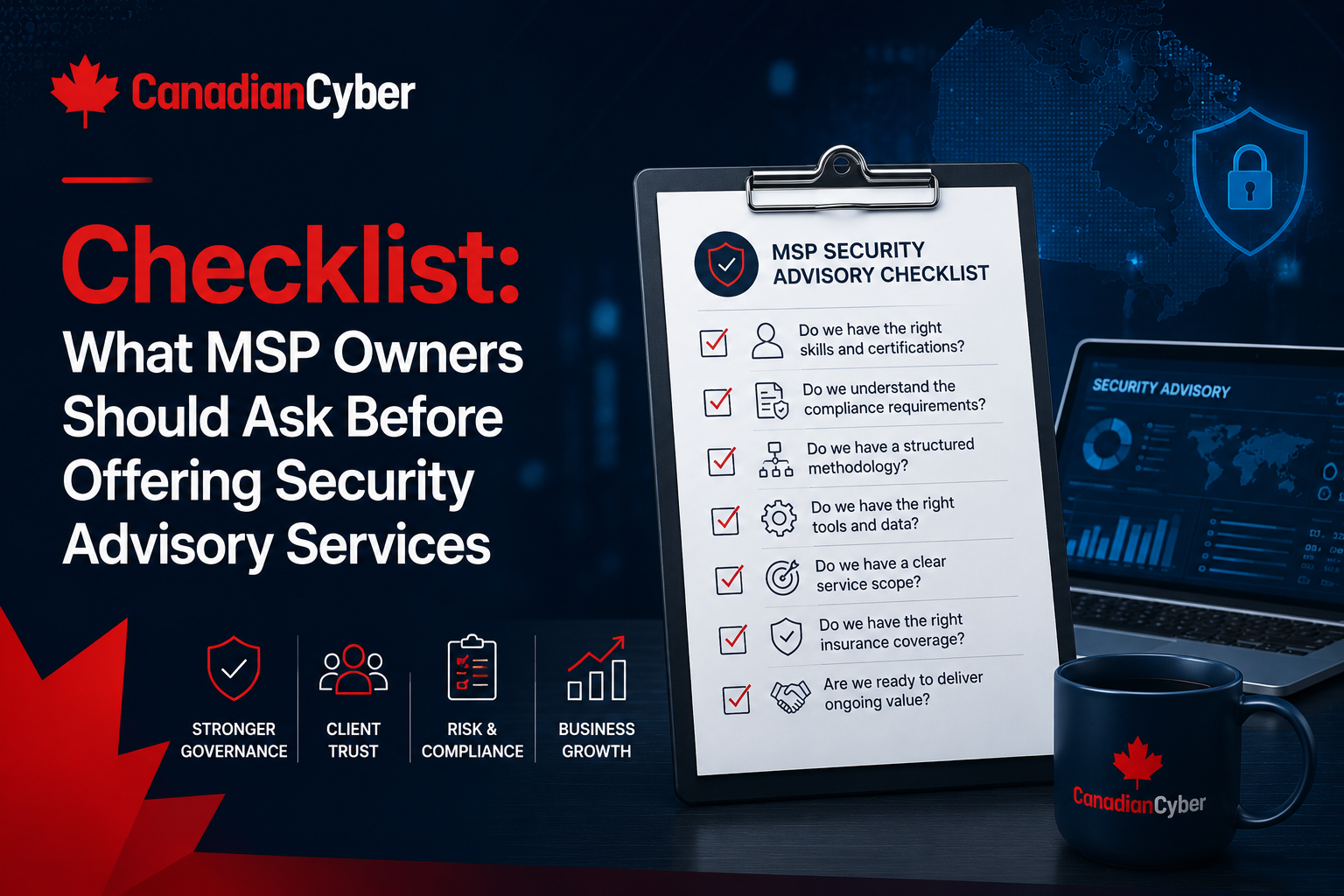
Checklist: What MSP Owners Should Ask Before Offering Security Advisory Services
Security advisory services can help MSPs move beyond reactive IT support and become trusted cyber governance partners. But advisory services need structure, boundaries, pricing, evidence, and clear delivery. Without that, the service can create risk, scope creep, and client disappointment.
Quick Snapshot
| Advisory Readiness Area | Why It Matters |
|---|---|
| Service Scope | Prevents advisory work from becoming unlimited free consulting. |
| Client Fit | Helps MSPs identify which clients are ready for security leadership. |
| Delivery Model | Defines whether advisory is handled internally, by a vCISO, or through a partner. |
| Evidence | Proves that recommendations, reviews, risks, and decisions are documented. |
| Liability | Reduces the risk of vague promises and unclear accountability. |
| Business Outcome | Creates a scalable security advisory offering that builds revenue and client trust. |
Introduction
Many MSP owners are thinking about security advisory services.
That makes sense. Clients are asking harder questions about cyber insurance, ransomware readiness, MFA, backups, ISO 27001, SOC 2, vendor risk, security questionnaires, and board-level reporting.
These are not normal helpdesk tickets.
They are governance questions. They need risk context, leadership communication, prioritization, evidence, and decision-making.
Security advisory can be a strong growth area for MSPs, but only when the service is clearly defined.
Without structure, the service can become messy. The MSP gives free advice. The client expects executive-level guidance. Technicians get pulled into strategy meetings. No one documents decisions. Pricing does not match effort. Liability becomes unclear.
This checklist helps MSP owners decide whether they are ready to offer security advisory services and what should be in place before going to market.
Why Security Advisory Is a Major Opportunity for MSPs
MSPs already have trusted client relationships. They know the client’s tools, environment, operations, recurring risks, delayed decisions, and missing controls.
That makes MSPs well-positioned to offer advisory services.
| Client Need | Advisory Value |
|---|---|
| Cyber insurance pressure | Helps clients understand required controls. |
| Ransomware concern | Prioritizes resilience and recovery actions. |
| Compliance requirements | Builds ISO 27001, SOC 2, or policy roadmaps. |
| Executive uncertainty | Translates technical risk into business language. |
| Security tool confusion | Prioritizes what matters before buying more tools. |
| Vendor risk | Reviews third-party exposure. |
| Board or leadership reporting | Provides structured risk updates. |
Security advisory is not just better IT support. It is structured cybersecurity leadership.
The Big Warning for MSP Owners
Security advisory can generate revenue. It can also create risk if the service is vague.
Before launching, MSP owners should define:
- what the service includes and excludes
- who delivers it and how recommendations are documented
- how client decisions and findings are tracked
- how pricing works and how liability is managed
- how success is measured
Do not sell security advisory as a vague promise. Turn it into a defined service.
Checklist 1: Are We Clear on the Service Scope?
Start with scope. If the scope is unclear, advisory work will expand quickly.
| Question | Yes / No |
|---|---|
| Do we know what “security advisory” means in our MSP? | |
| Have we defined what is included? | |
| Have we defined what is excluded? | |
| Do we have a service description? | |
| Do we have a statement of work template? | |
| Do we know how often advisory meetings happen? | |
| Do we know what reports clients receive? | |
| Do we know when advisory becomes a separate project? |
Possible Advisory Inclusions
- security roadmap and risk register
- quarterly security review
- cyber insurance readiness review
- MFA, access control, backup, and recovery reviews
- incident response planning and vendor risk review
- policy review and leadership reporting
- ISO 27001 readiness roadmap and SOC 2 readiness roadmap
Possible Exclusions
- 24/7 incident response unless separately scoped
- legal advice, privacy counsel, or audit opinion
- guaranteed compliance certification or cyber insurance approval
- penetration testing unless separately scoped
- unlimited questionnaire support
- forensic investigation or guaranteed ransomware protection
Checklist 2: Which Clients Are Ready for Advisory?
Not every client is ready to buy advisory. Some clients want low-cost IT support only. Others are ready because risk, insurance, compliance, or customer pressure has changed.
| Best-Fit Client Signal | Why It Matters |
|---|---|
| Client has cyber insurance renewal pressure | They need control evidence. |
| Client sells to larger customers | They may face questionnaires. |
| Client handles sensitive data | Security risk is higher. |
| Client is growing quickly | Governance needs are increasing. |
| Client has compliance goals | Roadmap is needed. |
| Client has no security owner | vCISO-style support is valuable. |
Security advisory works best when the client is willing to make decisions.
Checklist 3: Do We Have a Delivery Model?
MSP owners need to decide how advisory will be delivered. This is where many programs fail.
| Delivery Model | Best For |
|---|---|
| Internal MSP Lead | Small advisory offering with simple reviews. |
| Dedicated Security Advisor | MSPs building a mature security practice. |
| Fractional vCISO Partner | MSPs needing strategic expertise without hiring full-time. |
| Hybrid Model | MSP handles technical operations, vCISO handles governance. |
| Project-Based Advisory | One-time risk assessment, roadmap, or readiness review. |
| Key Delivery Question | Yes / No |
|---|---|
| Who will lead advisory meetings? | |
| Who will create the risk register? | |
| Who will write leadership reports? | |
| Who will review evidence? | |
| Who will explain risk to executives? | |
| Who will manage client decisions? | |
| Who will support compliance roadmaps? |
Add vCISO Delivery Support to Your MSP Advisory Offer
Canadian Cyber helps MSPs co-deliver advisory services with vCISO support, risk registers, leadership reports, client trust packs, ISO 27001 roadmaps, and SOC 2 readiness support.
Checklist 4: Can We Explain the Difference Between MSP, MSSP, and vCISO?
Clients may confuse service types. MSP owners should be able to explain the difference clearly.
| Service Type | Main Focus |
|---|---|
| MSP | IT operations, support, devices, users, and systems. |
| MSSP | Security monitoring, alerts, detection, and managed security tools. |
| vCISO | Governance, risk, strategy, compliance, and leadership reporting. |
| Security Advisory | Structured guidance, roadmap, control reviews, and risk prioritization. |
Simple client explanation: MSP services help operate and support your IT environment. Security advisory helps leadership understand cyber risk, prioritize controls, prepare for insurance or compliance, and make better security decisions.
Checklist 5: Can We Build a Client Risk Register?
A risk register is one of the most useful advisory tools because it turns security conversations into tracked decisions.
| Risk Register Field | Purpose |
|---|---|
| Risk ID | Unique tracking number. |
| Risk Title | Clear risk name. |
| Business Impact | Operational, financial, legal, customer, reputation. |
| Risk Rating | High, medium, low. |
| Recommendation | What should be done. |
| Client Owner | Who makes the decision. |
| Decision Notes | Client response. |
| Evidence Link | Supporting proof. |
Example risks:
- MFA not enabled for all users
- no documented incident response plan
- backups are not restore-tested
- admin accounts are not reviewed
- vendor access is not monitored
- cloud logs are not retained
Checklist 6: Can We Provide Executive-Friendly Reporting?
Clients do not need long technical reports every month. They need clear, decision-ready reporting.
| Report Section | What It Shows |
|---|---|
| Top 5 Risks | Most important issues. |
| Completed Actions | Progress since last review. |
| Open Decisions | What leadership must approve. |
| Overdue Items | What is blocked. |
| Security Metrics | Access, backups, incidents, patches, vendor reviews. |
| Compliance Roadmap | ISO 27001, SOC 2, insurance, client reviews. |
| Next 30 / 60 / 90 Days | Practical action plan. |
Better advisory language:
Some systems may not be monitored for ransomware activity. This increases detection and response risk. We recommend completing endpoint protection coverage this quarter.
Checklist 7: Can We Support Cyber Insurance Readiness?
Cyber insurance is a major driver for advisory services. Clients may need evidence for MFA, EDR, backups, restore testing, incident response, security awareness, privileged access, patching, logging, vendor management, and business continuity.
| Cyber Insurance Readiness Question | Yes / No |
|---|---|
| Can we help clients collect MFA evidence? | |
| Can we review backup and restore evidence? | |
| Can we document incident response readiness? | |
| Can we help clients identify control gaps? | |
| Can we avoid making insurance guarantees? | |
| Can we track remediation actions? |
Checklist 8: Do We Have a Pricing Model?
Security advisory should not become unpaid consulting. Define the pricing model before selling.
| Pricing Model | Best For |
|---|---|
| Monthly Advisory Retainer | Ongoing vCISO-style service. |
| Quarterly Security Review Package | Smaller clients needing structured reviews. |
| Project-Based Roadmap | One-time assessment and action plan. |
| Compliance Readiness Package | ISO 27001, SOC 2, or insurance prep. |
| Co-Delivered vCISO Model | MSP plus external security leadership partner. |
| Pricing Question | Yes / No |
|---|---|
| Is advisory separate from standard MSP support? | |
| Do we know what each tier includes? | |
| Are meetings limited and defined? | |
| Are reports included? | |
| Are compliance projects priced separately? | |
| Is incident response separately scoped? |
If advisory has no price boundary, it will become free labour.
Checklist 9: Are We Managing Liability?
Security advisory creates expectations. MSPs must be careful with promises.
| Avoid Saying | Better Language |
|---|---|
| “You are secure.” | “This reduces risk.” |
| “You will pass the audit.” | “This supports audit preparation.” |
| “You will get insurance.” | “This helps meet common insurer expectations.” |
| “You are protected from ransomware.” | “This improves ransomware readiness.” |
| “We guarantee no breach.” | “This risk remains until actions are approved and implemented.” |
Liability controls to use:
- clear statement of work and documented exclusions
- client decision records and risk acceptance notes
- evidence of recommendations and approved meeting minutes
- no guarantees of certification, insurance, or breach prevention
Checklist 10: Can We Maintain Evidence?
Advisory work becomes more valuable when evidence is organized. A structured workspace helps MSPs manage risk registers, roadmaps, meeting notes, reports, questionnaire answers, corrective actions, and vendor reviews.
| Evidence to Maintain | Why It Matters |
|---|---|
| Risk register | Tracks risks and decisions. |
| Security roadmap | Shows priorities and direction. |
| Meeting notes | Documents decisions and approvals. |
| Access review evidence | Supports governance and insurance readiness. |
| Backup review evidence | Supports resilience and recovery confidence. |
| Corrective action tracker | Tracks remediation. |
| Compliance roadmap | Supports ISO 27001, SOC 2, insurance, and questionnaires. |
Build My MSP Advisory SharePoint Workspace
Canadian Cyber’s ISMS SharePoint solution helps MSPs manage advisory evidence, client risk registers, security roadmaps, access reviews, vendor reviews, corrective actions, and client trust packs in one Microsoft 365 workspace.
Checklist 11: Do We Have a Repeatable Advisory Meeting Agenda?
Security advisory should follow a consistent rhythm. A repeatable agenda makes the service easier to deliver and easier to sell.
| Agenda Item | Purpose |
|---|---|
| Review top risks | Focus leadership attention. |
| Review completed actions | Show progress. |
| Review overdue items | Remove blockers. |
| Review access and identity risks | Reduce account exposure. |
| Review backup and recovery status | Improve resilience. |
| Review vendor concerns | Manage supplier risk. |
| Confirm next 90-day actions | Keep momentum. |
Checklist 12: Can We Turn Advisory Into a Sales Advantage?
Security advisory can help MSPs stand out. Many clients are tired of tool-heavy conversations. They want direction.
| Client Concern | Advisory Positioning |
|---|---|
| “We do not know what to fix first.” | We help prioritize security risk. |
| “Cyber insurance is getting harder.” | We help prepare evidence and remediation plans. |
| “Leadership does not understand cyber risk.” | We provide executive-ready reporting. |
| “We are not ready for ISO 27001.” | We build a practical readiness roadmap. |
| “We keep getting questionnaires.” | We help build approved answers and evidence packs. |
| “We have too many security tools.” | We help align tools to risk and business needs. |
30-Day Launch Plan for MSP Security Advisory
| Week | Focus | Actions |
|---|---|---|
| Week 1 | Define the Offering | Write service description, define inclusions and exclusions, create advisory tiers, prepare SOW language, and decide delivery model. |
| Week 2 | Build Templates | Create risk register, advisory report, meeting agenda, evidence checklist, and cyber insurance readiness checklist. |
| Week 3 | Select Pilot Clients | Choose 2–3 clients, run baseline review, build initial risk register, prepare first advisory report, and document decisions. |
| Week 4 | Package and Improve | Review delivery effort, adjust pricing, improve templates, train account managers, and create advisory sales messaging. |
Pilot before scaling.
MSP Security Advisory Readiness Checklist
Use this before launching.
| Question | Yes / No |
|---|---|
| Do we have a defined advisory service? | |
| Are inclusions and exclusions clear? | |
| Do we know who delivers the service? | |
| Do we have a risk register template? | |
| Do we have an executive report template? | |
| Do we have a pricing model? | |
| Do we document client decisions? | |
| Do we avoid compliance and insurance guarantees? | |
| Do we have an evidence workspace? | |
| Do we have vCISO support if needed? |
Common Mistakes to Avoid
- Offering advisory for free. If the advice is strategic, price it properly.
- Letting advisory become unlimited scope. Define meeting frequency, reporting, evidence review, and project boundaries.
- Having technicians deliver executive risk advice alone. Technical skill is valuable, but executive advisory requires governance language.
- Not documenting client decisions. If the client rejects MFA, backup testing, or incident planning, document that decision.
- Promising compliance outcomes. Support readiness. Do not guarantee certification, insurance approval, or no breaches.
- Selling tools instead of governance. Advisory should help clients decide what matters most.
- No repeatable templates. Templates help MSPs scale advisory services profitably.
What Good Looks Like
A strong MSP security advisory offering can include:
- clear service description and defined inclusions and exclusions
- tiered pricing and statement of work language
- client risk register and quarterly advisory report
- executive meeting agenda and cyber insurance checklist
- compliance roadmap options and access review checklist
- backup review, incident response review, and vendor risk review
- SharePoint advisory workspace and documented client decisions
- vCISO delivery support and client trust materials
This turns security advisory into a scalable service, not random consulting.
Canadian Cyber’s Take
At Canadian Cyber, we often see MSPs ready to provide more strategic value, but unsure how to package security advisory services.
The opportunity is real. Clients need help understanding cyber risk, preparing for cyber insurance, prioritizing controls, building ISO 27001 and SOC 2 readiness, answering security questionnaires, and reporting to leadership.
But MSPs should not launch advisory services without structure.
The right approach is to define the offer, set boundaries, create templates, document decisions, and use vCISO support where needed.
Security advisory can become one of the strongest growth areas for MSPs. But only when it is delivered as governance, not vague advice.
Takeaway
Before offering security advisory services, MSP owners should ask:
- What exactly are we selling?
- Who is the right client?
- Who delivers the service?
- How do we document risk?
- How do we report to leadership?
- How do we price it?
- How do we manage liability?
- How do we maintain evidence and scale delivery?
Answer these questions first. Then build the offer. A strong security advisory service can help MSPs increase revenue, improve client trust, support compliance readiness, and become a stronger strategic partner.
How Canadian Cyber Can Help
Canadian Cyber helps MSPs build and deliver security advisory services with practical vCISO support.
- MSP security advisory program design
- vCISO services for MSPs
- client risk register templates
- quarterly advisory report templates
- cyber insurance readiness reviews
- ISO 27001 readiness roadmaps
- SOC 2 readiness roadmaps
- security questionnaire support
- SharePoint advisory workspace setup
- client trust pack development
- incident response tabletop exercises
- vendor risk register setup
- backup recovery evidence reviews
- monthly leadership reporting
Stay Connected With Canadian Cyber
Follow Canadian Cyber for practical guidance on MSP security advisory, vCISO services, cyber governance, ISO 27001, SOC 2, cyber insurance readiness, SharePoint ISMS, and client trust.