

vCISO • CEO Cyber Scorecard • CTO Security Readiness • Founder Cyber Risk
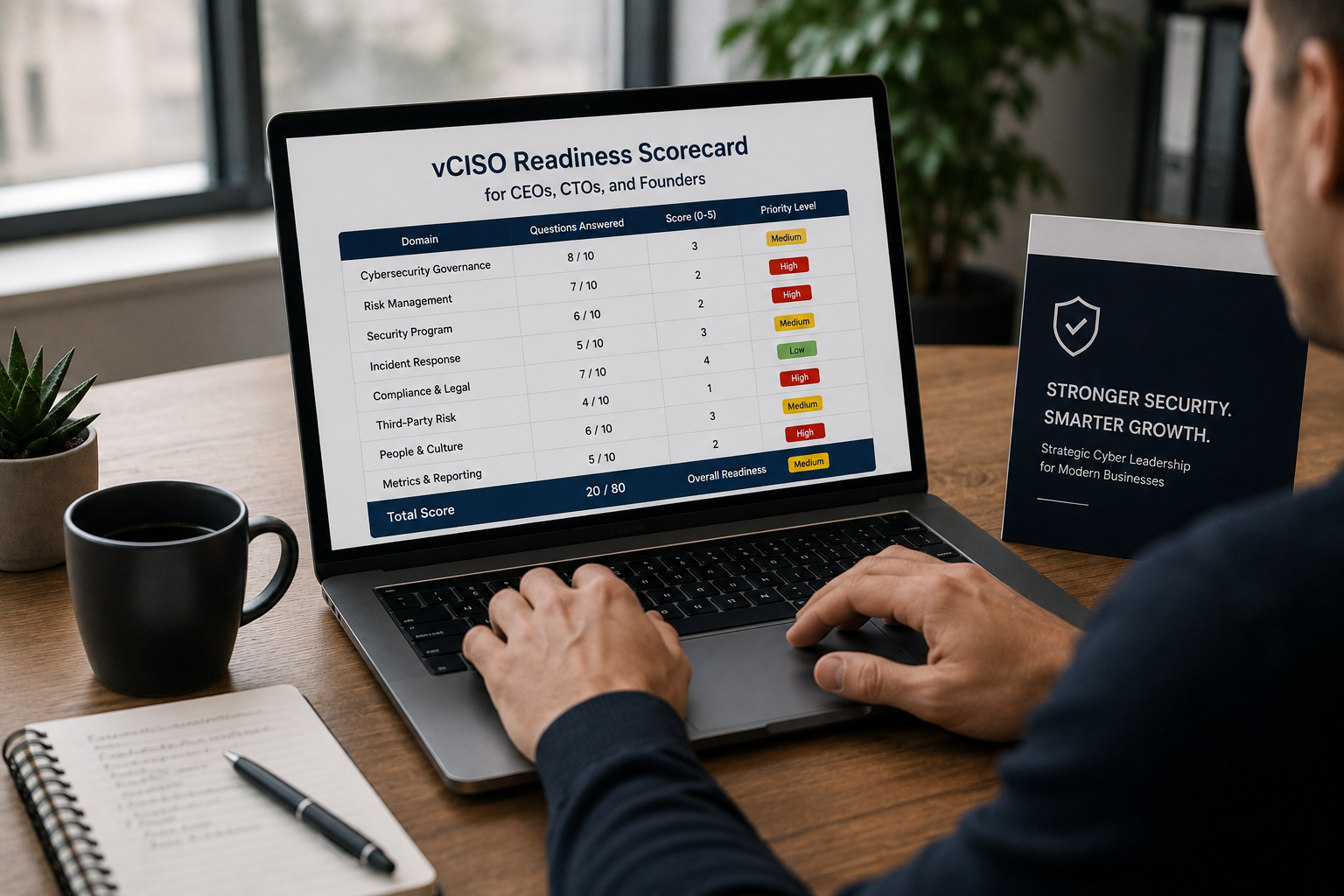
vCISO Readiness Scorecard for CEOs, CTOs, and Founders
A vCISO Readiness Scorecard helps CEOs, CTOs, and founders quickly understand whether the business needs stronger cybersecurity leadership, better governance, clearer ownership, audit readiness, or a practical security roadmap. It turns vague cyber concerns into a simple score executives can act on.
Quick Snapshot
| Scorecard Area | What It Measures |
|---|---|
| Cyber Leadership | Whether someone clearly owns cybersecurity strategy and risk decisions. |
| Access Control | Whether admin access, MFA, offboarding, and user reviews are controlled. |
| Compliance Readiness | Whether SOC 2, ISO 27001, cyber insurance, or customer evidence is ready. |
| Incident Readiness | Whether the company can respond to ransomware, breaches, vendor incidents, and outages. |
| Business Outcome | A clear score that tells leadership whether vCISO support is urgent, helpful, or optional. |
Introduction
Most CEOs, CTOs, and founders know cybersecurity matters.
But many do not know how mature their company really is.
The business may have MFA. The IT provider may say everything is fine. The CTO may be managing security between product releases. The company may have cyber insurance. A few policies may exist. A SOC 2 or ISO 27001 plan may be “coming soon.”
Then a buyer asks for a security review. Or the board asks for a risk update. Or an investor asks about data protection. Or an insurer asks for evidence.
Then one simple question exposes the gap:
“Who is responsible for cybersecurity leadership?”
A vCISO Readiness Scorecard gives leadership a simple way to assess whether the company is ready, exposed, or overdue for fractional cybersecurity leadership.
What Is a vCISO Readiness Scorecard?
A vCISO Readiness Scorecard is a simple executive assessment. It helps leadership answer practical questions before cybersecurity becomes a blocker.
- Do we need a vCISO?
- Are we ready for SOC 2 or ISO 27001?
- Can we answer customer security questions?
- Do we know our top cyber risks?
- Are security responsibilities clear?
- Is our current IT or security model enough?
- Can we prove our controls?
| Role | Why It Helps |
|---|---|
| CEO | Understand business risk, budget priorities, and board exposure. |
| CTO | Identify security gaps before they block product or enterprise sales. |
| Founder | Prepare for customers, investors, insurers, and procurement reviews. |
| COO | Improve ownership, workflows, vendor risk, and incident readiness. |
| Board Member | Ask better questions before approving security budget. |
If cybersecurity ownership is unclear, a scorecard can reveal the leadership gap quickly.
Why This Works as a Lead Magnet
A good lead magnet solves an immediate problem. For CEOs, CTOs, and founders, the problem is not always “we need cybersecurity.”
The real problem is: “We do not know where we stand.”
| Executive Pain | Scorecard Value |
|---|---|
| Unsure if security is mature enough | Gives a simple readiness score. |
| Preparing for SOC 2 or ISO 27001 | Shows readiness gaps. |
| Enterprise buyers asking hard questions | Identifies evidence weaknesses. |
| Cyber insurance renewal coming up | Highlights missing proof. |
| Security budget unclear | Helps prioritize spend. |
| CTO overloaded | Shows where leadership support is needed. |
Lead magnet CTA example:
Get your vCISO Readiness Score in under 10 minutes. Find out whether your company is ready, at risk, or overdue for fractional cybersecurity leadership.
The vCISO Readiness Scorecard
Use the questions below to assess your current state. Score each question from 0 to 3.
| Score | Meaning |
|---|---|
| 0 | Not in place. |
| 1 | Informal or inconsistent. |
| 2 | Partially implemented. |
| 3 | Implemented and evidenced. |
Maximum score: 60 points.
Section 1: Cyber Leadership and Ownership
Cybersecurity needs clear leadership. If nobody owns risk decisions, security becomes reactive.
| Question | Score 0–3 |
|---|---|
| Is there a named person responsible for cybersecurity strategy? | |
| Does leadership review cyber risks at least quarterly? | |
| Is there a current cybersecurity roadmap? | |
| Are security responsibilities clearly assigned across IT, HR, legal, operations, and engineering? | |
| Does the company have a process for escalating cyber risks to executives? |
What this reveals: A low score means cybersecurity may be managed through scattered tasks instead of leadership.
vCISO opportunity: A vCISO can provide strategic leadership, risk reporting, ownership mapping, board updates, and a practical security roadmap.
Section 2: Access Control and Identity Security
Access control is one of the fastest ways to reduce real risk. It is also one of the first things customers, auditors, and insurers ask about.
| Question | Score 0–3 |
|---|---|
| Is MFA enforced for all staff and administrators? | |
| Are privileged accounts reviewed regularly? | |
| Are former employees removed from all key systems quickly? | |
| Is access to customer data limited by role? | |
| Are support or admin access activities logged where needed? |
Evidence to look for:
- MFA report
- admin access review
- offboarding checklist
- user access export
- support access logs
- access exception register
Section 3: Compliance, Audit, and Evidence Readiness
Many companies think they are close to SOC 2 or ISO 27001 until evidence is requested. Policies are not enough. You need proof.
| Question | Score 0–3 |
|---|---|
| Are security policies approved, current, and version-controlled? | |
| Is evidence stored in one controlled location? | |
| Are controls mapped to owners and evidence? | |
| Is there a SOC 2, ISO 27001, or cyber insurance readiness roadmap? | |
| Can the company answer customer security questionnaires consistently? |
Build an Evidence Vault Before the Audit Starts
Canadian Cyber can help set up a SharePoint evidence vault for SOC 2, ISO 27001, cyber insurance, and customer security reviews.
Section 4: Incident Response and Business Resilience
A company does not truly know its incident readiness until it tests the plan. A written incident response plan is useful. A tested plan is better.
| Question | Score 0–3 |
|---|---|
| Does the company have an approved incident response plan? | |
| Has the leadership team completed a tabletop exercise in the last 12 months? | |
| Are backup and restore tests documented? | |
| Are customer notification decisions defined? | |
| Are incident roles clear across IT, leadership, legal, and communications? |
What this reveals: A low score means the company may be unprepared for ransomware, data breaches, vendor incidents, or cloud outages.
Section 5: Vendor, Cloud, and AI Risk
Your company’s risk does not stop at your own systems. Vendors, cloud platforms, AI tools, MSPs, and SaaS applications can all expose customer data or operations.
| Question | Score 0–3 |
|---|---|
| Is there a vendor register with risk ratings? | |
| Are critical vendors reviewed before approval and periodically after? | |
| Are cloud security settings, alerts, and admin activity reviewed? | |
| Are AI tools and model providers approved before customer data is used? | |
| Are vendor incidents and remediation items tracked? |
Evidence to look for:
- vendor register
- critical vendor review records
- sub-processor list
- cloud admin activity review
- AI vendor review
- model provider terms
- vendor remediation tracker
Scoring Your vCISO Readiness
Add your score from all five sections. The maximum score is 60.
| Score | Readiness Level | What It Means |
|---|---|---|
| 0–20 | High Risk / Leadership Gap | Cybersecurity is likely reactive, undocumented, or poorly owned. |
| 21–35 | Developing / Needs Structure | Some controls exist, but ownership, evidence, or governance may be weak. |
| 36–50 | Improving / vCISO Helpful | Good foundation, but strategic leadership could speed maturity. |
| 51–60 | Strong / Maintain and Optimize | Controls are operating; vCISO support may help with board reporting or special projects. |
A high score does not mean the company is breach-proof. A low score does not mean the company is failing. The score shows where leadership should focus next.
What CEOs Should Look For
CEOs should focus on business risk, board confidence, budget priorities, cyber insurance, enterprise sales, and recovery readiness.
| CEO Red Flag | Why It Matters |
|---|---|
| No cyber roadmap | Security priorities may be reactive. |
| No board reporting | Leadership lacks visibility. |
| No security owner | Accountability is unclear. |
| No incident tabletop | Recovery readiness is untested. |
| No evidence pack | Customer, insurer, and audit responses may be slow. |
Build a CEO Cyber Roadmap
Canadian Cyber helps CEOs turn cybersecurity from scattered technical work into a board-ready risk and budget roadmap.
What CTOs Should Look For
CTOs often carry security before the company has a full security team. That can work for a while, but it becomes risky when customers, auditors, investors, and insurers need evidence.
- Security tasks are always “next sprint.”
- Evidence is hard to find.
- Support access is informal.
- Cloud security is dashboard-based but not reviewed.
- AI tools are used without approval.
- Enterprise questionnaires slow engineering down.
Support Your CTO Security Roadmap
Canadian Cyber helps CTOs build practical security workflows without slowing product teams.
What Founders Should Look For
Founders need trust to grow. Security maturity affects fundraising, sales, procurement, partnerships, and reputation.
- Security answers depend on memory.
- Sales is inventing questionnaire responses.
- Investor diligence feels risky.
- SOC 2 is being promised without a plan.
- Customer data flows are not documented.
- No one owns security leadership.
Common Mistakes This Scorecard Helps Reveal
- Thinking IT ownership is the same as cyber leadership. IT can manage systems. Cyber leadership manages risk.
- Assuming tools equal maturity. Tools need owners, review processes, and evidence.
- Waiting for SOC 2 before organizing evidence. Evidence should be collected before the audit starts.
- Ignoring incident readiness. A plan that has not been tested is still a risk.
- Underestimating vendor and AI risk. Vendors and AI tools can expose customer data.
- Not preparing for board or investor questions. Leadership should be ready before due diligence starts.
What Good Looks Like
A company with strong vCISO readiness can show:
- named cybersecurity leadership
- risk register
- 90-day security roadmap
- board reporting
- MFA and access review evidence
- vendor risk register
- incident response plan
- tabletop exercise evidence
- backup restore testing
- approved policies
- SOC 2 or ISO 27001 roadmap
- customer security answer library
- evidence vault
- clear budget priorities
That gives CEOs, CTOs, and founders confidence. It also makes customer, investor, and board conversations easier.
Canadian Cyber’s Take
At Canadian Cyber, we often see growing companies wait too long to add cybersecurity leadership.
They buy tools. They write policies. They answer questionnaires manually. They rely on the CTO. They assume the MSP has everything covered.
Then pressure arrives.
SOC 2. ISO 27001. Cyber insurance. Enterprise procurement. Investor due diligence. Ransomware readiness. AI governance.
A vCISO Readiness Scorecard helps leadership see the gap before it becomes a blocker.
Takeaway
A vCISO Readiness Scorecard is a powerful lead magnet because it gives CEOs, CTOs, and founders something they need: clarity.
It shows whether cybersecurity leadership is strong, developing, or missing. It helps identify gaps in:
- leadership
- access control
- compliance readiness
- incident response
- vendor risk
- cloud controls
- AI governance
- evidence management
The score is not the final answer. It is the start of the right conversation. If the score reveals gaps, the next step is a practical vCISO roadmap.
How Canadian Cyber Can Help
Canadian Cyber helps CEOs, CTOs, and founders understand their vCISO readiness and build practical cybersecurity leadership programs.
- vCISO readiness assessments
- cyber leadership scorecards
- 90-day security roadmaps
- board cyber reporting
- SOC 2 readiness
- ISO 27001 readiness
- cyber insurance evidence packs
- enterprise security review preparation
- access control reviews
- vendor risk programs
- AI governance reviews
- incident response tabletop exercises
- SharePoint evidence vault setup and security budget prioritization
Stay Connected With Canadian Cyber
Follow Canadian Cyber for practical guidance on vCISO services, cybersecurity leadership, board reporting, SOC 2, ISO 27001, cyber insurance, AI governance, and executive risk management.