email-svg
Get in touch
info@canadiancyber.ca

Canadian SaaS Privacy Addendum Checklist

A practical ISO 27018-aligned checklist for Canadian SaaS privacy addendums. Covers subprocessors, retention, deletion, breach notification, and buyer-ready contract language.
Main Hero Image
DPA • Privacy Addendum • ISO 27018 • Buyer-Ready Terms

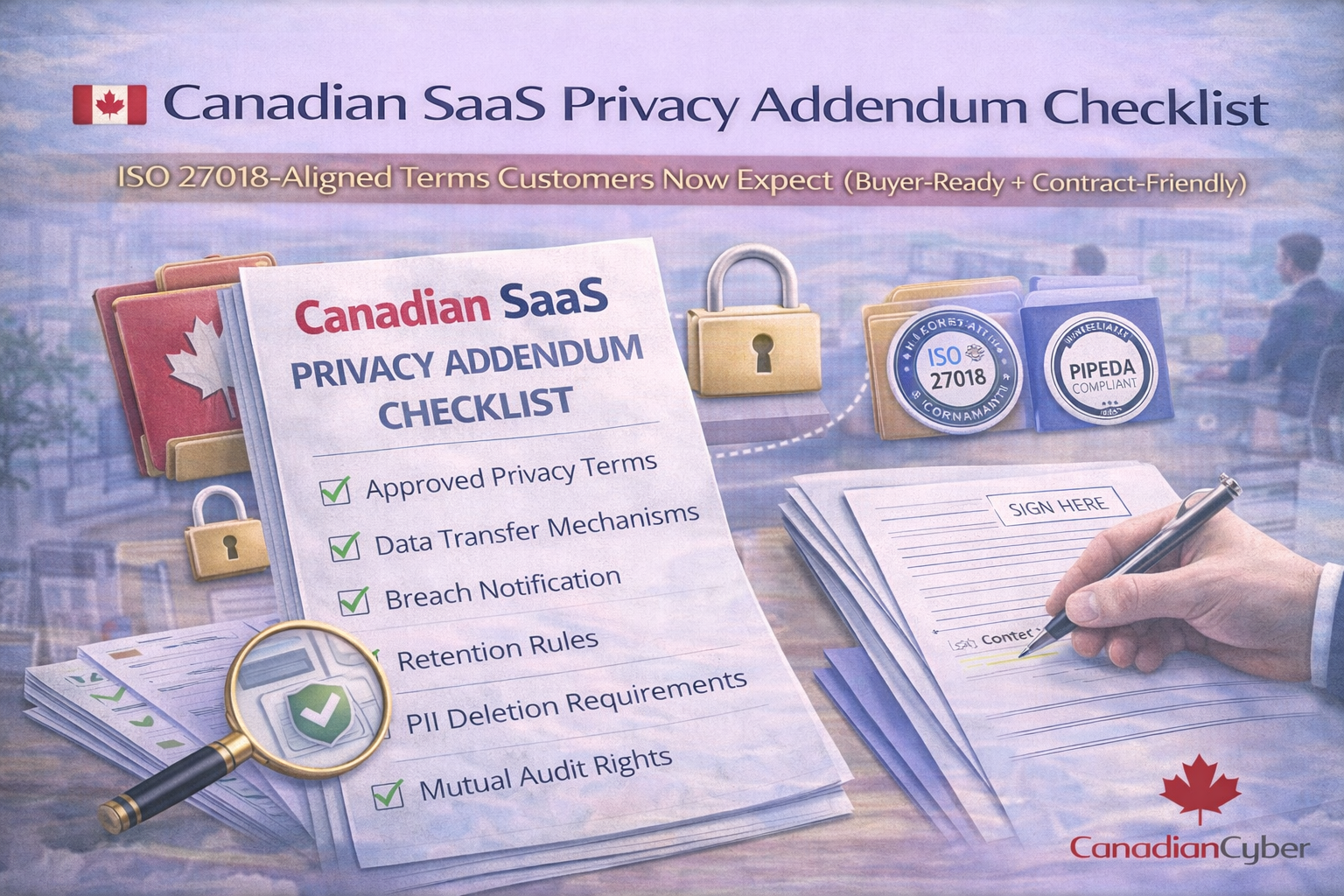
Canadian SaaS Privacy Addendum Checklist

ISO 27018-Aligned Terms Customers Now Expect (Buyer-Ready + Contract-Friendly)

Enterprise customers aren’t only asking for SOC 2 or ISO 27001 anymore. They’re asking for privacy contract terms especially when your SaaS processes personal information in the cloud. This blog gives Canadian SaaS teams a practical, ISO 27018-aligned checklist for privacy addendums (DPAs): what customers expect, what to include, and how to avoid overpromising.

What slows deals
Unclear processing, subprocessors, deletion, locations.
What buyers want
Clear roles + commitments you can evidence.
What ISO 27018 helps with
Cloud privacy clarity for PII processing.

Why privacy addendums suddenly slow deals for Canadian SaaS

Deals stall when privacy terms are unclear: where data is processed, how subprocessors are managed, what happens after termination, and whether you can prove deletion.

High intent reality
Your privacy addendum doesn’t need to be long. It needs to be clear, aligned, and consistent with how your service operates.

What ISO 27018 alignment means (in plain English)

ISO 27018 is guidance for protecting personally identifiable information (PII) in public cloud environments, especially when the provider acts as a PII processor.
Contract alignment usually means you can clearly describe your role, permitted processing, retention and deletion, subprocessors, safeguards, breach notification, cross-border processing, and assurance mechanisms.

This is the language enterprise customers expect even when they don’t cite ISO 27018 by name.

The ISO 27018-aligned privacy addendum checklist (Canadian SaaS)

Use this as a buyer-ready checklist to review your DPA/privacy addendum. Keep each clause factual and tied to how your service really works.

1) Roles and definitions (get the basics right)
  • Customer = controller (or equivalent)
  • SaaS provider = processor/service provider (or equivalent)
  • clear definitions for personal information/PII and processing
Avoid: vague secondary-use language without limits.

2) Permitted purpose and processing instructions
  • process only to provide the services
  • process per customer instructions (contract + configuration)
  • limits on secondary use unless explicitly agreed
Customer expectation: “We don’t use customer personal data for unrelated purposes.”

3) Data types and categories (transparent without oversharing)
  • categories of data subjects (employees, end-users)
  • high-level personal information categories
  • short appendix aligned to product features
Tip: keep it accurate; don’t list every database field.

4) Data location and cross-border processing (Canada-sensitive)
  • hosting region(s) and cross-border disclosure language
  • whether processing may occur outside Canada
  • approach to vendor/subprocessor locations
Avoid: “Data stays in Canada” unless you can guarantee it contractually.

5) Subprocessors (the biggest back-and-forth clause)
  • subprocessor list (or link to maintained list)
  • criteria for adding subprocessors
  • notification period for material changes (e.g., 30 days)
  • customer objection process (practical)
Evidence customers like: due diligence approach (SOC reports, security reviews).

6) Security measures (commitments you can deliver)
  • access control and least privilege
  • encryption in transit (and at rest where applicable)
  • logging/monitoring and incident response
  • vulnerability management and secure development
  • security training
Tip: reference a security appendix or SOC 2/ISO evidence rather than rewriting technical controls in legal text.

7) Confidentiality obligations and staff access controls
  • confidentiality obligations for staff/contractors
  • access limited to authorized personnel
  • role-based access controls
  • background checks where appropriate (risk-based)

8) Data retention and deletion (buyers expect proof)
  • retention principles (data minimization)
  • deletion timelines after termination
  • deletion process description
  • backup handling disclosure (retention window)
Avoid: promising immediate deletion from backups unless you can do it.

9) Customer access, export, and portability
  • how customers access and export their data
  • offboarding support expectations
  • timelines and method (API/admin export/support request)

10) Breach notification and cooperation
  • definition of incident/breach
  • notification timeline you can operationalize
  • what info you will provide (scope, mitigation)
  • customer cooperation expectations
Tip: don’t promise timelines you can’t meet consistently.

11) Privacy requests (DSARs): who does what
  • customer remains responsible for responding
  • provider assistance described (reasonable requests)
  • process and timelines

12) Audit rights and assurance (SOC 2 / ISO evidence)
  • assurance approach (SOC 2 under NDA, ISO cert, pen test summary)
  • reasonable additional information
  • limits to prevent unlimited audit disruption

13) Product improvement and AI use (modern expectation)
  • whether customer data is used to train models (ideally: no unless agreed)
  • what telemetry you collect
  • opt-out options (if feasible)
  • de-identification safeguards where applicable
Deal blocker clause: handle it clearly and consistently.

14) International transfers and legal requests
  • legal request handling process
  • customer notification if legally permitted
  • transparency reporting approach (if you have one)

The one-page checklist customers will love (quick scan)

Summarize your DPA with these bullets so buyers can approve faster.
  • Roles: controller/processor clear
  • Data categories: defined (high level)
  • Hosting/locations: disclosed
  • Subprocessors: listed + notification process
  • Security measures: committed + referenced
  • Retention/deletion: defined + backup disclosure
  • Breach notification: defined + cooperation
  • Data subject requests: assistance described
  • Offboarding/export: process described
  • Assurance: SOC 2/ISO evidence under NDA
  • AI/secondary use: clearly stated

Make your privacy addendum match reality (and pass reviews faster)
If your DPA is slowing deals or failing security reviews, Canadian Cyber can help you operationalize privacy commitments with evidence so legal terms stay aligned with operations.
With our ISMS SharePoint solution, we support:
  • DPA/privacy addendum readiness (ISO 27018-aligned)
  • subprocessor tracking and review evidence
  • proof of deletion workflows and records
  • incident response evidence packs
  • auditor/buyer-ready trust package folders

Common mistakes Canadian SaaS teams make (avoid these)

  • promising “data stays in Canada” without guaranteed controls
  • saying “we delete everything immediately” without backup realities
  • no subprocessor list or notification process
  • vague breach notification wording that conflicts with operations
  • no deletion evidence or retention schedule
  • contract terms not aligned with SOC 2/ISO control evidence

Download the Privacy Addendum Checklist (ISO 27018-Aligned)
Want the editable version? Use it to review your DPA clause-by-clause and speed up buyer approvals.
Includes:
  • clause-by-clause checklist
  • customer-friendly wording suggestions
  • backup retention disclosure paragraph
  • subprocessor clause template
  • proof-of-deletion evidence template

Follow Canadian Cyber
Practical cybersecurity + compliance guidance for Canadian SaaS teams:

© 2026 Canadian Cyber. All rights reserved.


Related Post