Why HR tech SOC 2 is different
If you build HR software ATS, HRIS integrations, payroll workflows, performance tools, benefits platforms you handle some of the most sensitive business data a company has:
- employee identifiers (names, emails, IDs)
- compensation information
- performance and disciplinary records
- hiring decisions
- contracts and documents
- sometimes health or leave-related information (depending on product)
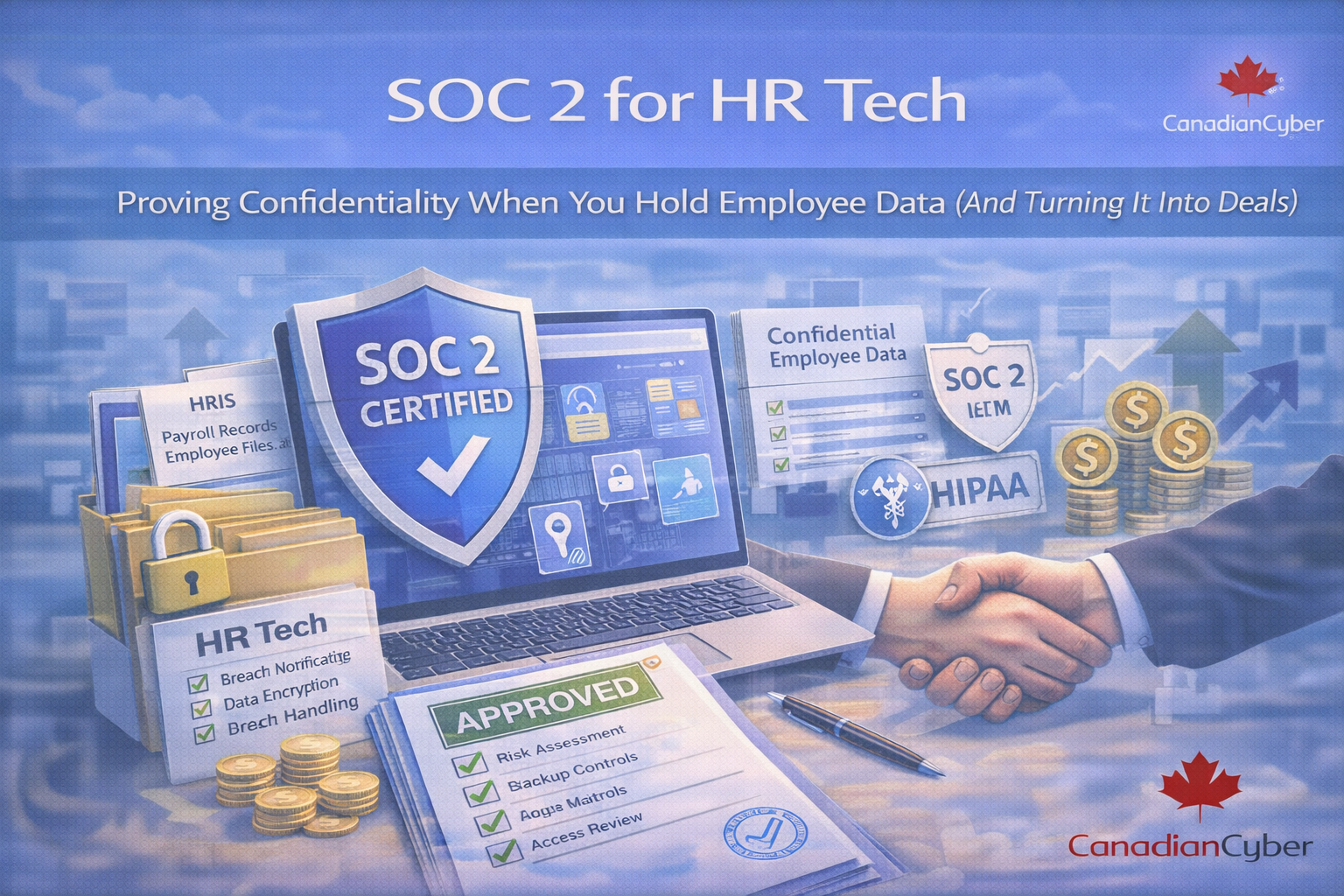
In HR tech, SOC 2 Security is assumed.
Confidentiality is what closes deals.
What “Confidentiality” means in SOC 2 (plain English)
SOC 2 Confidentiality is about ensuring information designated as confidential is protected from unauthorized disclosure,
accessed only by authorized people and systems, stored and transmitted securely, and retained and deleted according to rules.
Auditors don’t accept “we take security seriously.” They accept controls mapped to commitments, plus evidence that controls operated over time.
The #1 reason SOC 2 doesn’t generate leads
Most SOC 2 pages sound identical. Procurement teams don’t buy “secure.” They buy approved.
If you want leads, you need a buyer-ready package that answers scope, data categories, controls, incident handling, and deletion fast.
The HR Tech confidentiality threat model (what buyers worry about)
Buyer concerns you must address directly
- cross-tenant leakage (one customer’s employee data visible to another)
- support access abuse (support can see too much employee data)
- misconfigured integrations (HRIS sync pulls more data than intended)
- exports and downloads (bulk export risk)
- weak retention/deletion (data kept forever, no proof of deletion)
- logs and backups (sensitive data in logs, unclear backup retention)
- AI/analytics reuse (employee data used for training or profiling)
The controls that prove confidentiality in HR tech (auditor + buyer ready)
1) Data classification + “what we store” clarity
Reduce questionnaire back-and-forth with one clear inventory
Evidence to prepare
- data classification policy
- HR Data Inventory one-pager (data categories + where they live)
- high-level system diagram (data flows)
2) Tenant isolation (HR tech’s biggest confidentiality control)
Prove cross-tenant leakage is prevented by design and testing
Evidence buyers and auditors trust
- authorization design summary (tenant ID enforcement approach)
- secure SDLC + code review evidence (PR approvals)
- automated authorization tests (results)
- monitoring for suspicious access patterns
“We enforce tenant isolation at the application layer and validate it through automated authorization testing and periodic reviews.”
3) Least-privilege support access (and proof)
Where HR buyers decide if they trust you
Controls that win reviews
- support RBAC (limited roles)
- just-in-time approvals (time boxed)
- logging of support access actions
- policy restricting exports unless authorized
Evidence: support access policy + role matrix + one sample approval record + audit log proof access was removed.
4) Encryption and key management (keep it factual)
Buyers expect clear statements: encryption in transit (TLS), encryption at rest (where applicable), and key management responsibility (KMS/HSM, rotation).
5) HRIS integrations and data minimization
Workday/ADP/BambooHR/UKG-style integrations are a confidentiality hotspot
Controls
- least-data integration scopes
- environment separation (dev vs prod)
- token management and rotation
- integration monitoring and alerts
Evidence: integration scope docs + secrets management proof + token rotation records + monitoring alerts/runbooks.
6) Retention, deletion, and proof-of-deletion
Hot buyer requirement: “Show us deletion proof.”
What you need
- retention schedule by data type
- termination/offboarding workflow
- deletion request workflow
- backup retention disclosure (what remains until backups expire)
7) Logging and monitoring (without logging sensitive content)
HR tech teams often accidentally log PII in application logs. Use a logging standard that prohibits sensitive payload logging,
and alert on admin actions and bulk exports.
Evidence: logging policy + log review sign-offs + sample alert → ticket → closure chain.
8) Incident response tailored to HR data exposure
Practice HR breach scenarios and record the tabletop
Include scenarios like employee data exfiltration, mis-sent exports, compromised support credentials, and integration token compromise. Evidence: IR plan + one tabletop record + improvement actions.
The HR Tech SOC 2 Trust Package
If you want SOC 2 to produce leads, don’t just say “SOC 2 compliant.”
Offer a Trust Package that buyers can use immediately.
Your downloadable one-page HR Tech Trust Package should include
- product scope (what’s in SOC 2 scope)
- data categories (what employee data you store/process)
- confidentiality controls summary (support access, tenant isolation, encryption)
- retention & deletion summary (with backup disclosure)
- subprocessors list link (or summary)
- incident notification commitment (high level)
- how to request the SOC 2 report under NDA
Want the HR Tech SOC 2 Trust Package template?
We’ll send the exact one-page template we use with HR tech teams plus the evidence checklist so buyers approve faster.
Includes:
- data inventory one-pager
- confidentiality control mapping
- retention/deletion wording + backup disclosure paragraph
- NDA request script for SOC 2 report sharing
Why HR tech SOC 2 projects stall (and how to avoid it)
1) Scope is unclear
Fix: Put scope and system boundaries in the one-page Trust Package.
2) Confidentiality isn’t explicit
Fix: Add a Confidentiality section: support access, tenant isolation, retention/deletion.
3) No buyer-ready artifacts
Fix: Publish Trust Package + subprocessor list + deletion statement + security contact.
4) Evidence isn’t repeatable (Type II problem)
Fix: Build a monthly cadence for evidence: access reviews, log reviews, vendor reviews, IR tabletop.
The vCISO approach: how we get HR tech SOC 2 done faster (and usable for sales)
What we do in the first 30 days
- define scoping boundaries (no overreach)
- build the Confidentiality control set (what buyers care about)
- create the Trust Package and evidence library
- set up an evidence calendar (monthly/quarterly)
- prepare your NDA-based report sharing workflow
Why it works
- audit readiness improves
- security reviews get faster
- sales gets an asset they can send early
- you stop rewriting answers for every questionnaire
If SOC 2 isn’t generating leads, fix the trust layer
Book a 15-minute SOC 2 for HR Tech readiness call with Canadian Cyber. We’ll tell you what buyers will block you on, what to include in your Trust Package, and the fastest evidence wins for Type II readiness.
Bonus: “Confidentiality proof” checklist
- support access is least-privilege + time-bound approvals
- admin actions and exports are logged and reviewed
- HRIS integration scopes documented + tokens managed
- retention schedule exists + deletion workflow produces proof
- backup retention and restore controls documented
- incident response tabletop for HR data exposure completed
- Trust Package ready + SOC 2 report share process under NDA
Follow Canadian Cyber
Practical cybersecurity + compliance guidance: