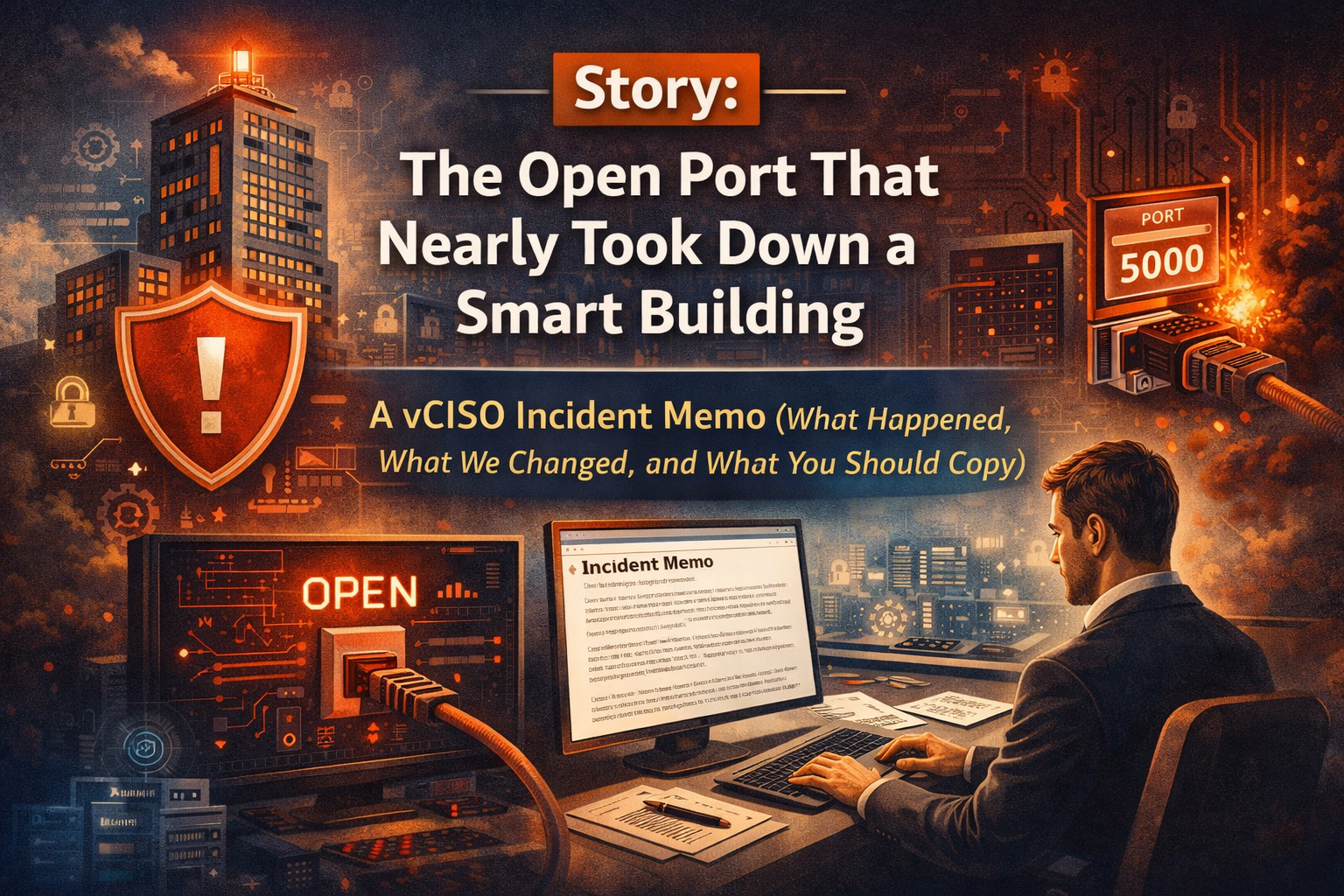
Executive Summary
Incident type
External exposure plus attempted unauthorized access
Environment
Smart building OT/IoT network connected to cloud management
Primary weakness
An internet-reachable management port that should never have been exposed
Impact
No confirmed safety impact or data breach; near-miss with real downtime potential
Root cause
Misconfigured network boundary plus unclear ownership of OT/IT remote access controls
Key fix
Closed exposure, enforced approved remote access paths, implemented monitoring and quarterly verification
Why smart buildings are high-risk in 2026
Smart buildings blend OT and IT in a way that makes cyber governance unusually tricky. The environment often includes building automation controllers, BAS dashboards, HVAC systems, elevators, access control, cameras, energy systems, remote vendor support, and cloud analytics all tied together across operational and corporate boundaries.
Business requirement
Uptime and occupant safety.
Cyber reality
A single exposed pathway can create building-wide disruption, loss of visibility, safety alarms, emergency service calls, and tenant trust damage.
High-impact lesson:
in OT/IoT environments, availability and safety risk can show up faster than data-theft risk.
Timeline of Events
Day 0 — 08:12
A facility engineer reports intermittent issues: HVAC zones are not responding reliably, the BAS dashboard shows delayed telemetry, and some controllers are flapping online and offline. At first glance, this looks like a reliability issue.
09:05
IT receives a spike alert from perimeter logs showing repeated inbound connection attempts on a management port. Source IPs are rotating, which strongly suggests automated scanning. The building network was not supposed to be internet-reachable.
09:22
Quick triage confirms the port is open to the internet, it maps to a building automation management interface, and the interface is returning a banner that reveals device type and version.
Near-miss factor: the exposure was discoverable and fingerprintable.
09:35
Containment begins. The port is blocked at the edge firewall, temporary geo and ASN blocks are applied, and vendor remote access is paused until scope is understood.
10:10
Operations confirms building services are stabilizing. Telemetry delays decrease, controller flapping drops, and BAS responsiveness returns. No successful login is confirmed at this point, but the attempts were persistent and credible.
11:20
Investigation expands. Firewall change history is reviewed, NAT rules and recent network changes are checked, vendor remote access configuration is examined, and controller logs are collected where available.
13:00
The team discovers the cause: a temporary NAT rule was created during a vendor troubleshooting session, but it was never removed. Ownership was unclear. The vendor requested access, IT implemented the change, and no one verified or closed the temporary exposure afterward.
16:30
Leadership-level decision: treat the event as a documented security incident and near-miss, rotate relevant credentials, review privileged access, and create corrective actions with named owners and deadlines.
What made this dangerous
This was not “just an open port.” In smart building OT, management interfaces can enable configuration changes, network discovery, lateral movement, remote disruption, and persistent access if credentials are weak or reused.
Credible risks created by the exposure
- building-wide operational disruption
- tenant impact and safety escalations
- equipment instability or fail-safe behavior
- incident response and emergency costs
Root Cause Analysis
A firewall and NAT rule exposed a building automation management port to the public internet.
- No enforced remote access standard for OT support
- Temporary changes had no closure mechanism
- Ownership ambiguity between Engineering and IT
- Monitoring existed but was not tuned for OT exposures
What we changed
1) Locked down OT remote access to one approved pathway
New standard
- all vendor access must use an approved pathway
- VPN with MFA plus jump host, or brokered remote access gateway
- no direct inbound exposure to OT management interfaces
- vendor access is time-bound and approved per session or maintenance window
Evidence created: OT remote access policy, runbook, approved access methods list, quarterly vendor access review record.
2) Introduced temporary change closure as a required step
New rule
- every temporary firewall or NAT change must have an owner
- every temporary change must have an expiry time
- closure verification is mandatory
- rollback or removal must be documented
Evidence created: updated change request template with temporary checkbox, expiry field, closure sign-off field, and monthly review of temporary changes.
3) Added OT-specific exposure monitoring
New detection controls
- alerts for internet exposure of OT segments
- alerts for firewall and NAT rule changes affecting OT subnets
- scheduled port exposure sweeps against known OT management ports
Evidence created: alert rules list, sample alert-to-ticket chain, monthly log review sign-offs.
4) Clarified OT/IT decision rights
| Role |
Ownership |
| Engineering |
Operational requirements and maintenance windows |
| IT |
Firewall implementation and identity controls |
| Security / vCISO |
Approval requirements for exposure-risk changes |
| Vendors |
May request access changes but cannot implement them |
Evidence created: OT/IT responsibility matrix and management review minutes documenting the governance decision.
5) Improved credential hygiene for OT management paths
Even without confirmed compromise, the exposure justified a full trust reset on the affected management pathway.
- rotated credentials used during the vendor session
- reviewed privileged accounts and remote access groups
- validated MFA coverage on admin access paths
Evidence created: privileged access review snapshot and sign-off, credential rotation ticket record.
What auditors and boards care about
This kind of memo should answer the same questions every time, because those are the questions leadership and auditors always ask after a near-miss.
Questions they ask
- What happened and how bad was it?
- What did you do immediately?
- Why did it happen?
- How do we know it won’t happen again?
- Where’s the evidence?
What we documented
- timeline, impact statement, and scope
- containment steps and escalation path
- root cause and contributing causes
- corrective actions with owners and dates
- linked evidence records and sign-offs
This is the governance value:
a near-miss becomes a stronger control system instead of a one-time scare.
Copy this: The vCISO Smart Building Open Port Checklist
Immediate containment (first 60 minutes)
- Block exposed port at the edge
- Disable direct vendor access paths
- Preserve firewall logs and change history
- Identify affected device or service and isolate if needed
- Confirm scope: what was exposed and for how long
- Check for successful authentication attempts where logs exist
- Review recent firewall and NAT changes plus approvals
- Identify who requested and who implemented the change
- Document the incident record and decisions
Corrective actions (first 7 days)
- Implement the approved remote access pattern
- Add temporary change expiry and closure verification
- Add monitoring for exposure and config changes
- Run an OT/IT governance review for RACI and decision rights
- Create an evidence pack for auditors and leadership
Next steps
If your smart building or OT/IoT environment still allows temporary access paths, ad hoc vendor changes, or unclear ownership between Engineering and IT, this is the place to tighten governance before a near-miss becomes an outage.
Final takeaway
The exposed port was a technical problem, but the real weakness was governance. A temporary access path was created under pressure, no one owned the secure end state, and the environment only got attention once operations started to wobble.
The strongest response was not just blocking the port. It was defining the remote access standard, forcing temporary change closure, assigning decision rights, rotating credentials, and building a reusable evidence trail.
In one line
In smart building security, the near-miss you document properly becomes the governance control that prevents the real incident later.
Follow Canadian Cyber
Practical cybersecurity + compliance guidance: