email-svg
Get in touch
info@canadiancyber.ca

Security Leadership Without Burnout

A practical guide on how a vCISO helps CTOs reduce security workload, manage compliance, and keep engineering focused without burnout.
Main Hero Image

CTO Burnout Relief • Security Operating System • Keep Engineering Shipping

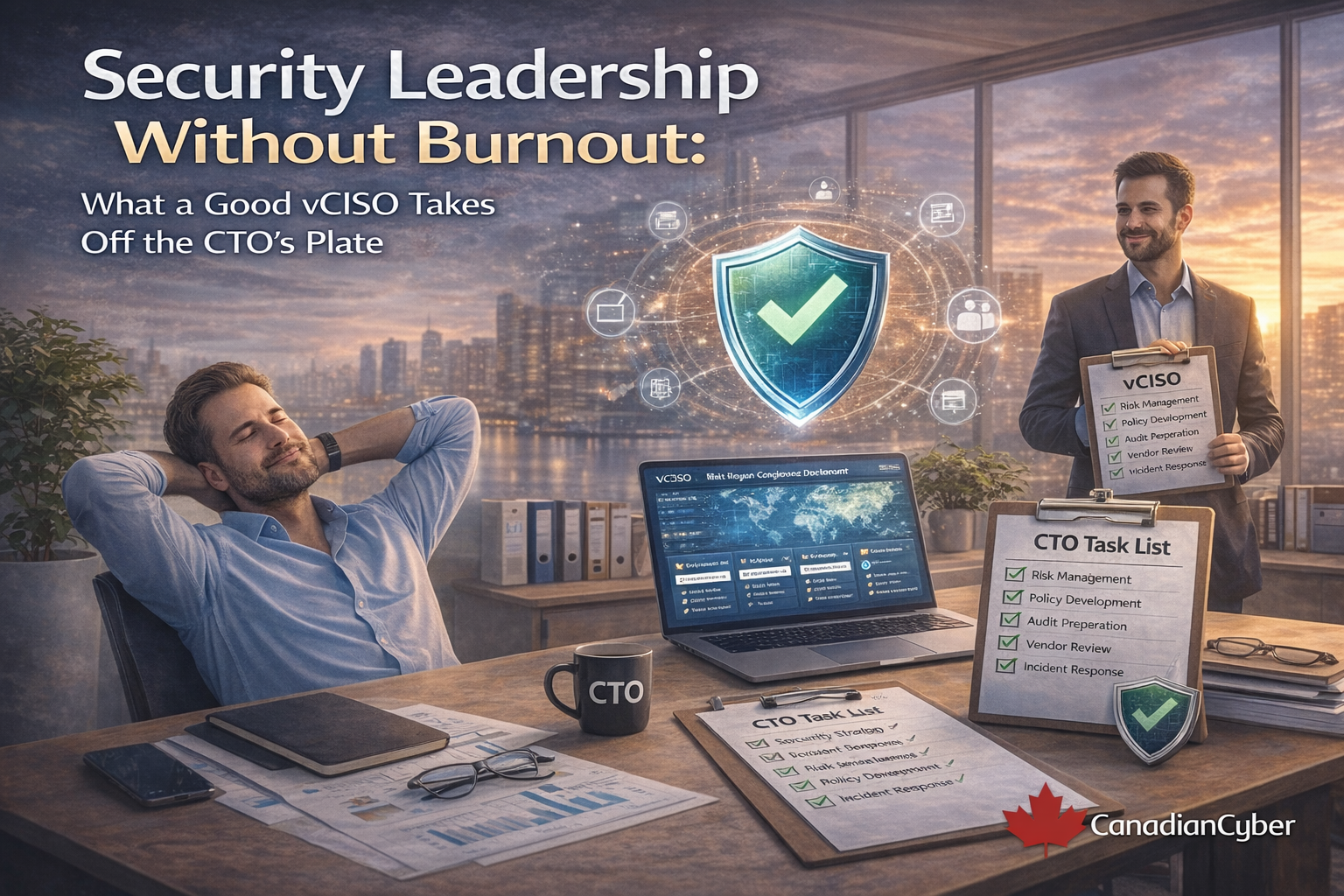
Security Leadership Without Burnout

What a good vCISO takes off the CTO’s plate so engineering can keep shipping
If you’re a CTO at a growing company, you already know the pattern. Security questions keep showing up in deals. Compliance wants proof. Vendors keep multiplying. Incidents and near misses steal focus. And the security to-do list never ends while the product roadmap still has to move.

This is where many startups and mid-market teams get stuck. Security becomes the CTO’s second full-time job. A good vCISO does not just advise from the side. They take ownership of the security operating system so the CTO can lead engineering without carrying every security loose end personally. fileciteturn18file0

The CTO’s real security workload: the hidden tax

CTOs are rarely overwhelmed by security tools alone. They are overwhelmed by interruptions, unclear decisions, missing proof, and the constant sense that the first major incident could expose gaps nobody has properly tracked. fileciteturn18file0

Constant inbound questions
Sales, customers, legal, leadership, and procurement all want answers fast.
Decisions with unclear tradeoffs
Risk acceptance, urgency, funding, and acceptable exposure stay fuzzy.
Lack of evidence structure
The work may exist, but the proof does not live anywhere cleanly.
Vendor and access sprawl
Tools, admins, vendors, and subprocessors multiply faster than oversight.
The real win:
a vCISO turns security from an endless stream of interruptions into a repeatable system with owners, cadence, and proof. fileciteturn18file0

What a good vCISO takes off the CTO’s plate

1) Ownership of security clarity

A good vCISO becomes the owner of translating technical reality into business risk, maintaining a living top 10 risk list, and deciding what matters this month versus what can wait. That removes one of the biggest mental burdens from the CTO. fileciteturn18file0

What comes off your plate
  • translating technical reality into business risk
  • deciding what matters now versus later
  • maintaining a live top risk list with owners and deadlines
What you get
  • a clean risk register instead of a spreadsheet graveyard
  • monthly risk treatment review
  • clear leadership asks around budget, time, and acceptance
CTO win:
fewer random security fires and more planned work. fileciteturn18file0

2) The recurring security cadence runs without you chasing people

Most burnout does not come from one big project. It comes from endless chasing: did the access review happen, where is the log review sign-off, did we test restores, did we review Vendor X, do we have management review minutes. A good vCISO runs that cadence so it does not depend on the CTO’s memory. fileciteturn18file0

What comes off your plate What you get instead
Coordinating recurring security tasks A monthly and quarterly calendar that actually runs
Reminding owners and collecting sign-offs Evidence packs by period with consistent approvals and audit trail
Keeping the program moving when priorities shift A security system that continues operating even when engineering is busy
CTO win:
security stops being dependent on your memory. fileciteturn18file0

The biggest relief pattern
The best vCISO relationships do not add more meetings and more noise. They remove mental overhead by making security tasks predictable, scheduled, and easier to prove.

3) Deal friction work gets professionalized instead of stealing engineering time

Security questionnaires and enterprise reviews are one of the most frustrating engineering taxes. A good vCISO removes repeated questionnaire writing, repeated evidence pulling, and the need to explain the program differently every time a buyer asks. fileciteturn18file0

What comes off your plate
Repeated questionnaires, security narratives, evidence hunts, and last-minute buyer calls during sprint work.
What you get
A standard trust package, a reusable response library, and a controlled auditor or customer view in SharePoint.
CTO win:
fewer “can you jump on this call” interruptions during active engineering work. fileciteturn18file0

4) Vendor and subprocessor risk becomes predictable, not reactive

CTOs often get dragged into vendor questions simply because nobody else owns the process. A good vCISO makes vendor review, renewal timing, and security decisions structured enough that surprises stop landing on the CTO’s desk. fileciteturn18file0

What you get
  • tiered vendor register with critical, high, medium, and low
  • review cadence tied to renewals 60 to 90 days ahead
  • decision records such as approve, conditional, or exit
  • exception tracking with expiry dates
CTO win:
vendor risk becomes predictable instead of reactive. fileciteturn18file0

5) Authorized change becomes provable, so audits stop hitting engineering like emergencies

Auditors and enterprise buyers ask the same painful questions: show change management evidence and show how risky changes are prevented. Without a real system, engineering gets pulled into emergency evidence assembly. A good vCISO stops that by making change proof repeatable. fileciteturn18file0

What comes off your plate What you get
Ad hoc change evidence creation A repeatable change sampling pack with 3 to 5 samples per quarter
Rewriting CI/CD explanations for each review Clean traceability from ticket to PR to approval to deploy to validation
“Prove it” requests during audits A high-risk change lane with stronger review for IAM, networking, and logging-impacting changes
CTO win:
audits stop being engineering’s emergency project. fileciteturn18file0

6) Incident readiness becomes controlled operations instead of heroic improvisation

When something goes wrong, the CTO often becomes incident commander by default. A good vCISO reduces that burden by ensuring roles, communication templates, runbooks, tabletops, and post-incident review loops are already in place before the stressful day arrives. fileciteturn18file0

Runnable incident runbooks
Tabletop records that are audit-friendly
Post-incident review templates
Corrective action workflow that closes with proof
CTO win:
incidents become controlled operations, not chaos. fileciteturn18file0

The best engineering-protection move
A good vCISO protects engineering time by professionalizing evidence, cadence, reviews, and decision-making. The biggest payoff is not just lower risk. It is fewer context switches for the CTO and less compliance chaos for the team.

7) Compliance becomes a system instead of a seasonal fire drill

ISO 27001 and SOC 2 become expensive and disruptive when the work is unstructured. A good vCISO reduces scramble by replacing last-minute evidence hunts with micro-audits, corrective action discipline, and management review inputs generated from real operating data. fileciteturn18file0

What you get
  • micro-audits such as 10 controls per month to stay continuously ready
  • a corrective action register that closes with verification
  • management review inputs built from actual program data
  • scope discipline so engineering does not overbuild
CTO win:
compliance stops disrupting product velocity. fileciteturn18file0

What a good vCISO does not do

A vCISO should not become a bottleneck, a perfectionist documentation gatekeeper, a slide-deck factory, or someone who talks strategy but cannot produce operating evidence. The best ones are practical and reduce risk while reducing friction at the same time. fileciteturn18file0

Not a bottleneck that slows engineering
Not someone demanding perfect docs before progress
Not a slide-deck factory
Not someone who cannot create operating proof

The CTO Relief Checklist

You have a good vCISO if, within the first 60 to 90 days, the security program feels lighter and more structured in very specific ways. fileciteturn18file0

  • you spend fewer hours answering security questions
  • evidence is organized and approvals are consistent
  • vendor reviews and renewals stop surprising you
  • access reviews happen without you chasing
  • audits feel like sampling, not archaeology
  • leadership gets clear decisions and funding asks
  • the security backlog becomes a plan instead of a guilt pile
The blunt test:
if none of that changes, you did not hire security leadership. You hired more noise. fileciteturn18file0

If security is starting to burn out your CTO or slow engineering
The best next step is building the operating system that takes the load off: a real cadence, cleaner evidence, stronger vendor oversight, and a security plan that does not depend on the CTO personally keeping it alive.

Final thought

The best vCISO relationships do not feel like extra process. They feel like relief. Risks become clearer, evidence becomes easier to find, reviews happen on time, vendor questions stop arriving as surprises, and the CTO gets time back to lead product and engineering properly. fileciteturn18file0

That is what security leadership without burnout actually looks like.
Follow Canadian Cyber
Practical cybersecurity and compliance guidance:

Related Post