Get in touch
info@canadiancyber.ca


Rafia Rizwan

April 14, 2026
A practical guide on how a vCISO helps CTOs reduce security workload, manage compliance, and keep engineering focused without burnout.
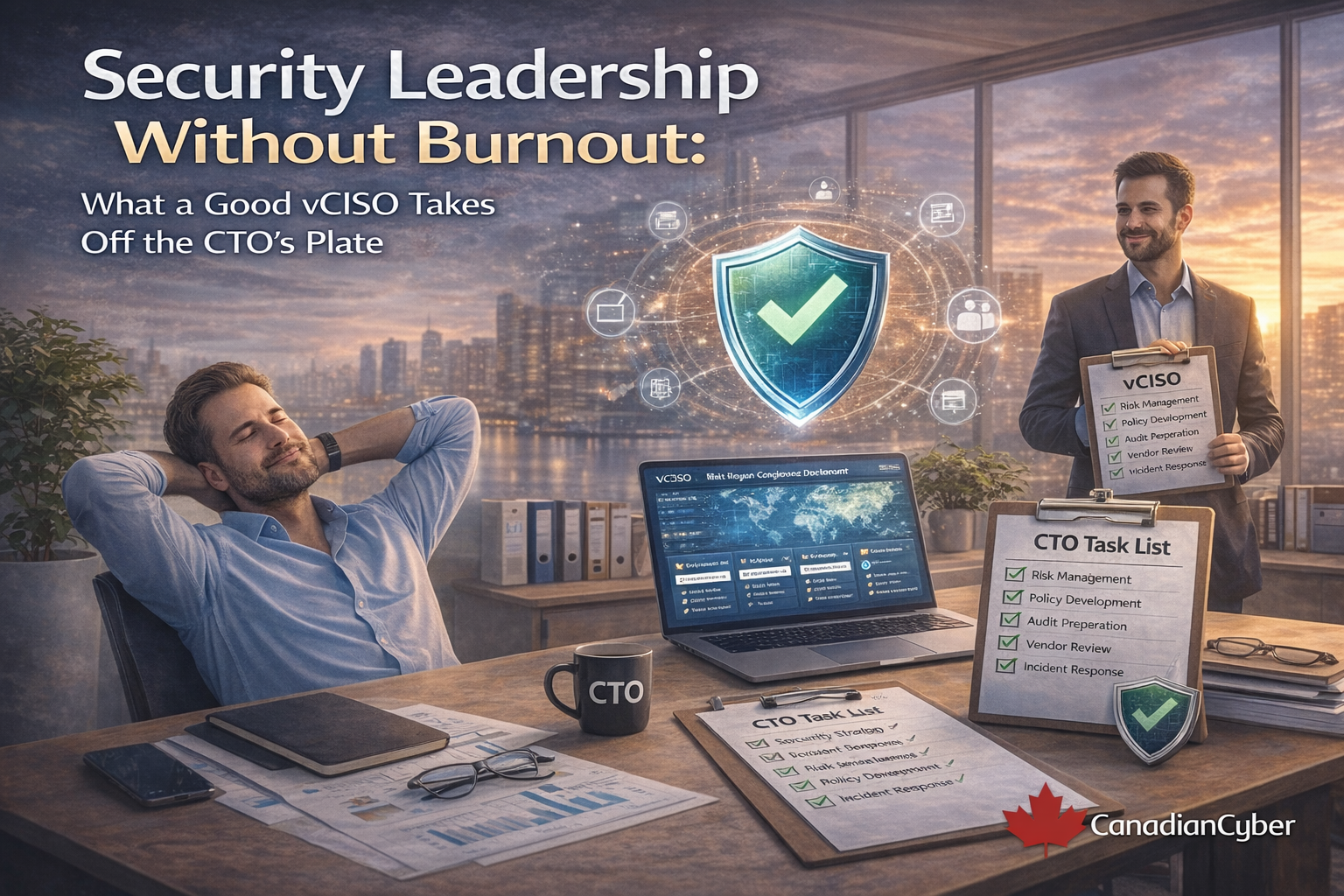
This is where many startups and mid-market teams get stuck. Security becomes the CTO’s second full-time job. A good vCISO does not just advise from the side. They take ownership of the security operating system so the CTO can lead engineering without carrying every security loose end personally. fileciteturn18file0
CTOs are rarely overwhelmed by security tools alone. They are overwhelmed by interruptions, unclear decisions, missing proof, and the constant sense that the first major incident could expose gaps nobody has properly tracked. fileciteturn18file0
A good vCISO becomes the owner of translating technical reality into business risk, maintaining a living top 10 risk list, and deciding what matters this month versus what can wait. That removes one of the biggest mental burdens from the CTO. fileciteturn18file0
Most burnout does not come from one big project. It comes from endless chasing: did the access review happen, where is the log review sign-off, did we test restores, did we review Vendor X, do we have management review minutes. A good vCISO runs that cadence so it does not depend on the CTO’s memory. fileciteturn18file0
| What comes off your plate | What you get instead |
|---|---|
| Coordinating recurring security tasks | A monthly and quarterly calendar that actually runs |
| Reminding owners and collecting sign-offs | Evidence packs by period with consistent approvals and audit trail |
| Keeping the program moving when priorities shift | A security system that continues operating even when engineering is busy |
Security questionnaires and enterprise reviews are one of the most frustrating engineering taxes. A good vCISO removes repeated questionnaire writing, repeated evidence pulling, and the need to explain the program differently every time a buyer asks. fileciteturn18file0
CTOs often get dragged into vendor questions simply because nobody else owns the process. A good vCISO makes vendor review, renewal timing, and security decisions structured enough that surprises stop landing on the CTO’s desk. fileciteturn18file0
Auditors and enterprise buyers ask the same painful questions: show change management evidence and show how risky changes are prevented. Without a real system, engineering gets pulled into emergency evidence assembly. A good vCISO stops that by making change proof repeatable. fileciteturn18file0
| What comes off your plate | What you get |
|---|---|
| Ad hoc change evidence creation | A repeatable change sampling pack with 3 to 5 samples per quarter |
| Rewriting CI/CD explanations for each review | Clean traceability from ticket to PR to approval to deploy to validation |
| “Prove it” requests during audits | A high-risk change lane with stronger review for IAM, networking, and logging-impacting changes |
When something goes wrong, the CTO often becomes incident commander by default. A good vCISO reduces that burden by ensuring roles, communication templates, runbooks, tabletops, and post-incident review loops are already in place before the stressful day arrives. fileciteturn18file0
ISO 27001 and SOC 2 become expensive and disruptive when the work is unstructured. A good vCISO reduces scramble by replacing last-minute evidence hunts with micro-audits, corrective action discipline, and management review inputs generated from real operating data. fileciteturn18file0
A vCISO should not become a bottleneck, a perfectionist documentation gatekeeper, a slide-deck factory, or someone who talks strategy but cannot produce operating evidence. The best ones are practical and reduce risk while reducing friction at the same time. fileciteturn18file0
You have a good vCISO if, within the first 60 to 90 days, the security program feels lighter and more structured in very specific ways. fileciteturn18file0
The best vCISO relationships do not feel like extra process. They feel like relief. Risks become clearer, evidence becomes easier to find, reviews happen on time, vendor questions stop arriving as surprises, and the CTO gets time back to lead product and engineering properly. fileciteturn18file0
That is what security leadership without burnout actually looks like.