Get in touch
info@canadiancyber.ca


Rafia Rizwan

April 23, 2026
A practical guide comparing SOC 2 vs ISO 27001 for startups, helping you choose the right path based on buyers, geography, and growth stage.
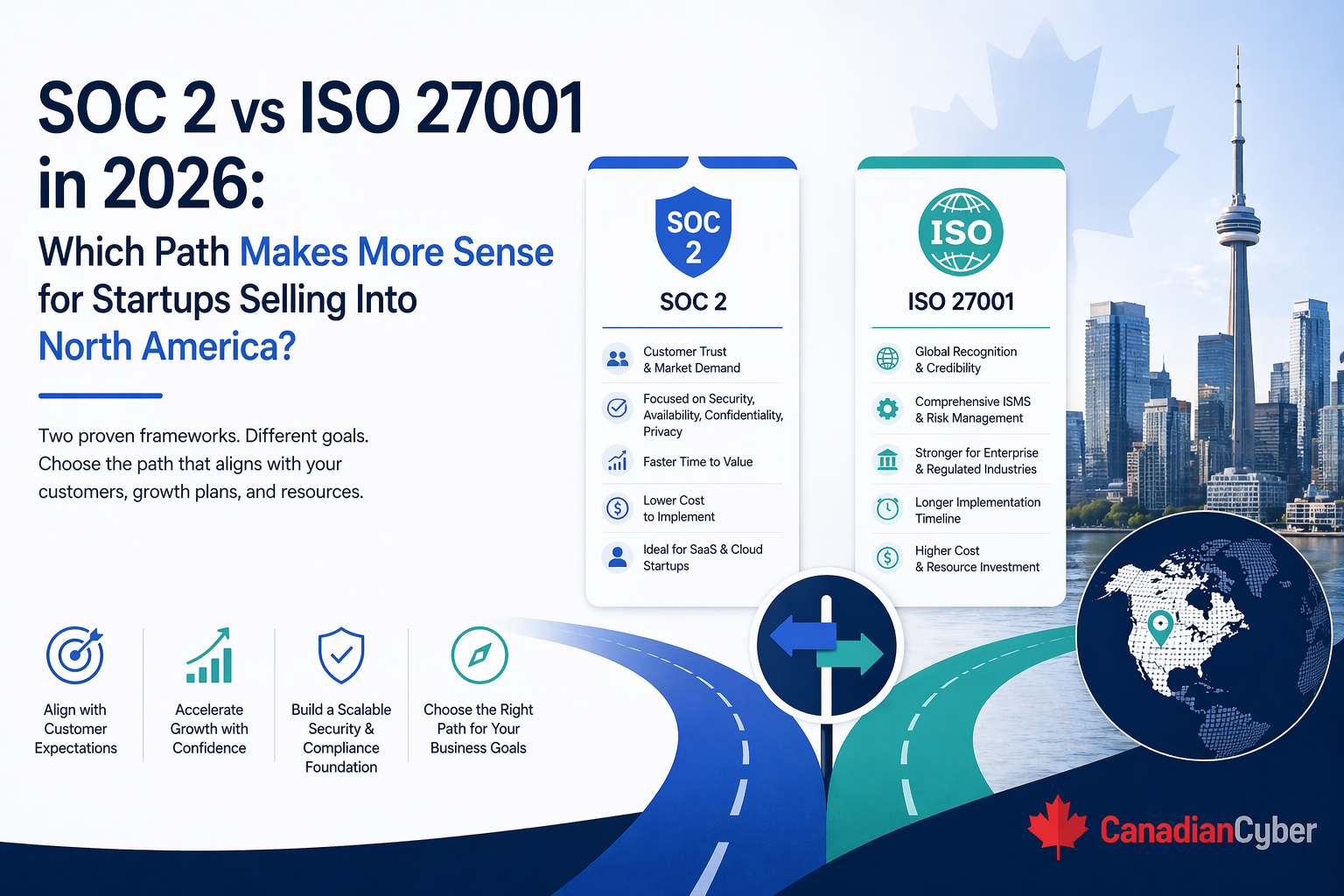
For startups selling into North America, the compliance question usually shows up earlier than expected.
At first, buyers ask for a security questionnaire. Then they ask for policies. Then they ask whether you have a SOC 2. Sometimes they ask about ISO 27001 instead. And eventually the leadership team ends up in the same meeting asking one frustrating question: Which one should we actually do first?
That question matters because SOC 2 and ISO 27001 are not interchangeable. They solve related trust problems, but they do it in different ways.
A SOC 2 examination gives you an attestation report about controls relevant to the Trust Services Criteria. ISO 27001 gives you a certifiable management-system standard built around an information security management system, or ISMS.
So the real decision is not which one is “better.” The real decision is which one makes more sense for your buyer base, your sales cycle, your geography, your internal maturity, and your next 12 to 24 months of growth.
If your startup is selling mainly to US or Canadian B2B buyers, getting pulled into procurement reviews, trying to unblock deals quickly, and does not yet have a mature formal ISMS, then SOC 2 usually makes more sense first.
If your startup is expanding beyond North America, selling into regions where ISO-style certification carries more weight, building a long-term governance program, or wants a certification centered on a formal ISMS, then ISO 27001 often becomes the better strategic first move.
And if you are scaling into both North American and international enterprise markets, the long-term answer may be both. But the real question is usually which one comes first, not which one wins forever.
The comparison happens because both frameworks signal that your company takes security seriously. Both can help with enterprise sales, procurement reviews, trust building, internal control discipline, investor confidence, and security program maturity.
But they do that in different ways. SOC 2 is a buyer-facing attestation framework. ISO 27001 is a management-system certification framework.
That difference matters a lot in North American sales. Startups are not really choosing between two identical trust badges. They are choosing between a report buyers often expect to review and a broader certification model for operating security over time.
SOC 2 gives you something very practical for North American sales: a document that many buyers already expect to see. That is especially useful when your sales process includes security questionnaires, procurement review, trust portals, vendor onboarding requirements, and repeated requests for evidence of operating controls.
For startups, this often translates into a more direct commercial payoff. If the customer asks, “Do you have a SOC 2?” the answer lines up closely with the request.
That makes SOC 2 very sales-friendly for US and Canadian B2B startups.
ISO 27001 gives you a formal framework for running information security as a management system. For startups, that often means something different from SOC 2: a more structured way to operate security over time.
ISO 27001 is especially valuable when you want to show that the company is not only secure in isolated spots, but is operating under a formal ISMS with defined scope, risk treatment, controls, review, and continual improvement.
That logic becomes much stronger when the company expects buyers outside North America or wants one security story that travels better across regions.
If your market is North America, especially the United States, the most practical question is usually not “Which framework is stronger in theory?” The real question is: What are your buyers already expecting to review?
For many startups selling into North America, the answer is still SOC 2. That is not an official rule from the AICPA or ISO. It is a market reality reflected in how enterprise procurement and security review processes tend to work.
But if North American sales are only part of the story, and the startup expects broader geographic expansion or certification-driven procurement later, ISO 27001 may deserve earlier consideration.
Picture a seed-to-Series B SaaS company selling workflow software into healthcare, fintech, or enterprise operations teams in the US and Canada.
The buyers ask for a security questionnaire, proof of MFA, access control answers, incident response language, vendor risk details, and eventually a SOC 2 report.
At that stage, going straight to ISO 27001 may still improve the security program. But commercially, it may not answer the buyer’s immediate question as directly as SOC 2 does.
That is why many North American startups choose a simple sequence: SOC 2 first, ISO 27001 later if international growth or broader governance maturity justifies it.
SOC 2 and ISO 27001 overlap, but they are not the same. And either path still requires real controls, evidence, ownership, and maintenance.
| Choose SOC 2 first if: | Choose ISO 27001 first if: |
|---|---|
| most of your revenue target is in the US or Canada | your go-to-market is international from the start |
| enterprise buyers already ask for SOC 2 | you want a formal ISMS certification as your foundation |
| you need a commercially familiar trust report | your buyers value global certification language |
| you want the shortest path to answering procurement expectations | you are building for longer-term governance maturity across regions |
And if you are scaling fast into both US and international enterprise markets, planning for both may be the right long-term answer, as long as you sequence the work without overloading the team.
For a typical startup selling into North America in 2026, the most practical answer is straightforward: start with SOC 2 unless you have a clear international or certification-driven reason to start with ISO 27001.
That is not because ISO 27001 is less respected. It is because North American startup sales still tend to reward SOC 2 more directly in active procurement cycles.
Then, once the company’s security program is stronger and the go-to-market expands, ISO 27001 often becomes the logical second move.
At Canadian Cyber, we usually advise startups to make this decision based on buyer pressure, geography, and internal maturity, not on abstract debates about which framework is more prestigious.
For North America-first startups, SOC 2 is often the more commercially efficient first step. For startups with broader market ambitions or a stronger push toward formal governance, ISO 27001 can be the better strategic foundation.
And for many companies, the smartest answer is not “SOC 2 or ISO 27001 forever.” It is a sequence: SOC 2 first, ISO 27001 next, or ISO 27001 first, then SOC 2 when North American buyer pressure demands it. The right sequence matters more than the slogan.
In 2026, startups selling into North America should stop asking which framework is universally better.
The better question is: Which one will help us win trust fastest in the market we are actually selling into?
If that market is mostly the US and Canada, SOC 2 usually makes more sense first. If the company needs a globally recognizable ISMS certification and is building for wider geographic trust, ISO 27001 may be the stronger starting point.
Because in the end, the best compliance path is not the one that sounds most impressive. It is the one that matches your buyers, your growth plan, and your ability to operate the controls well.