vCISO • Security Leadership • Cyber Risk • Tool Sprawl • Executive Guidance
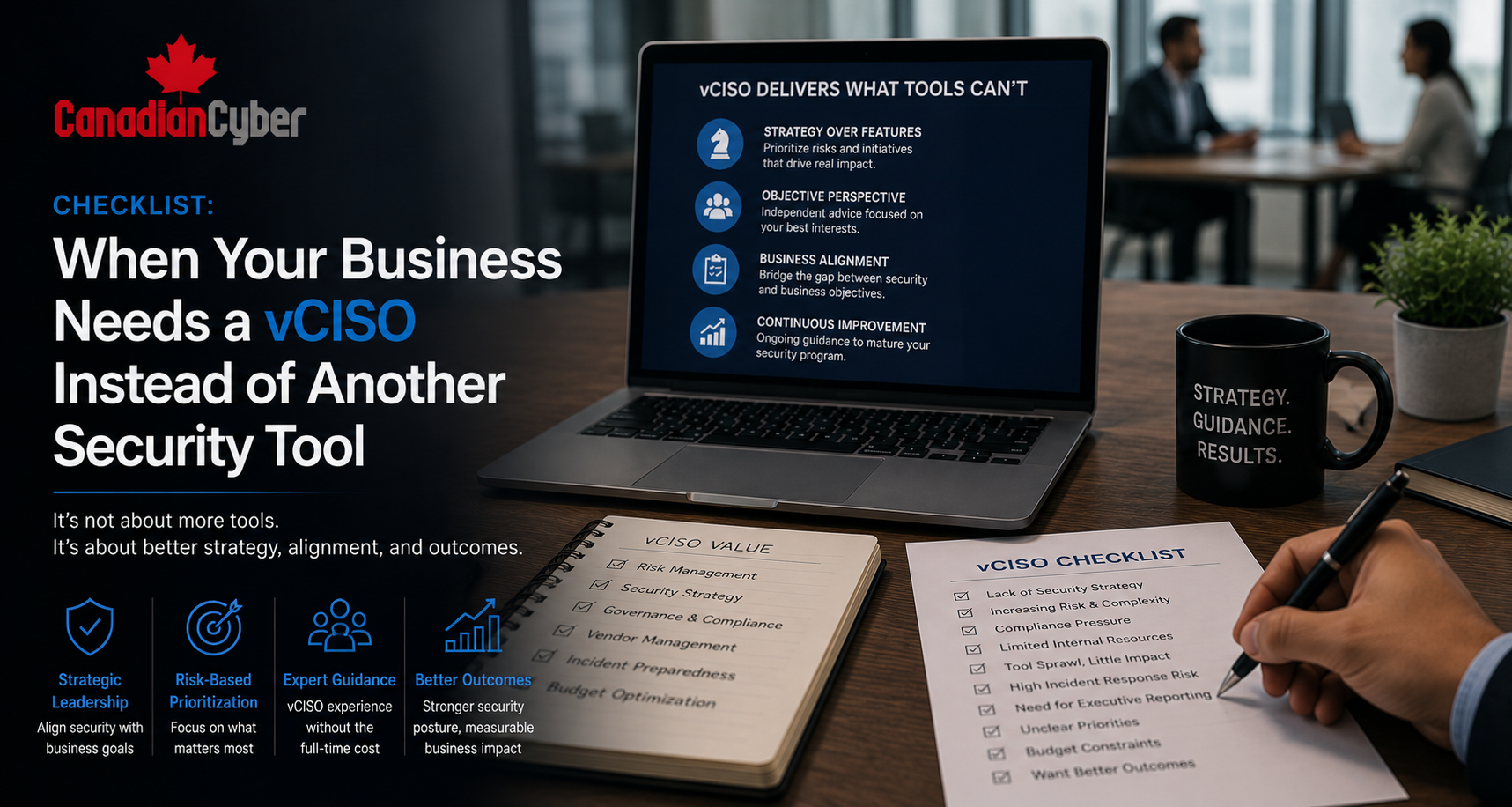
Checklist: When Your Business Needs a vCISO Instead of Another Security Tool
Buying another security tool can feel like progress. But if no one owns the strategy, reviews risk, or turns alerts into action, the real gap may be leadership.
Quick Snapshot
| Warning Sign | What It Usually Means |
|---|---|
| Tools are in place but risk is unclear | The business lacks security leadership and prioritization. |
| Alerts keep growing | Ownership, triage, and decision-making may be weak. |
| Customer questionnaires slow sales | You need a clear trust, evidence, and governance story. |
| Compliance feels scattered | Controls, evidence, policies, and risk decisions need structure. |
| Leadership does not know what to fund next | Cyber risk needs to be translated into business priorities. |
Introduction
Many businesses respond to cyber risk by buying tools.
A scanner. A firewall. A SIEM. A password manager. A compliance platform. A cloud security dashboard.
Some of these tools may be useful.
But tools do not create strategy by themselves.
They do not:
- decide which risks matter most
- explain cyber risk to leadership
- build a board-ready roadmap
- fix weak ownership
- make customer reviews easier
- turn policies into operating evidence
That is where many growing businesses get stuck.
They do not have a tool problem. They have a leadership problem.
What a vCISO Actually Does
A vCISO is a virtual Chief Information Security Officer.
The role gives your business senior security leadership without hiring a full-time CISO.
A good vCISO helps the business:
- understand cyber risk
- set clear priorities
- build governance
- prepare for audits
- guide teams
- support customer security reviews
- make better security decisions
Sometimes the missing piece is not another tool. It is someone to connect risk, people, process, evidence, and leadership decisions.
Why Another Tool May Not Solve the Problem
Security tools are only useful when they fit into a program.
A tool needs:
- an owner
- a purpose
- a risk it reduces
- a process around it
- a response workflow
- a review cadence
- a way to measure value
Without those things, tools create more noise.
| Symptom | Tool Problem | Leadership Problem |
|---|---|---|
| Vulnerabilities are unknown | You may need scanning. | You need risk-based remediation governance. |
| Customer questionnaires are hard | A GRC tool may help. | You need evidence, owners, and trust messaging. |
| Alerts are overwhelming | Better tuning may help. | You need triage rules and escalation paths. |
| Board reporting is unclear | Dashboards may help. | You need risk translated into business language. |
Checklist 1: You Have Tools, but No Clear Strategy
This is one of the strongest signs that you need a vCISO.
Your business may already have security tools. But no one can explain the overall strategy.
| Question | If the Answer Is “No” |
|---|---|
| Do we know our top 5 cyber risks? | Security work may be reactive. |
| Do we have a 90-day security roadmap? | Teams may be working without priorities. |
| Does leadership know what risk is increasing? | Board reporting may be weak. |
| Do we know which tools matter most? | Tool spend may be inefficient. |
| Are security decisions documented? | Governance may be informal. |
Practical rule: If you cannot explain your security strategy in one page, you probably need leadership before more technology.
Checklist 2: Alerts Are Increasing, but Action Is Inconsistent
Many tools generate alerts.
That sounds useful.
But alerts only reduce risk when someone reviews, triages, escalates, and resolves them.
| Warning Sign | What It Means |
|---|---|
| Alerts are ignored. | No owner or triage process exists. |
| Every alert feels urgent. | Risk scoring is weak. |
| Tickets stay open too long. | Remediation accountability is unclear. |
| The same issues repeat. | Root cause is not being fixed. |
A tool says, “Here are 300 findings.” A vCISO says, “These 12 findings create the highest business risk, and these 4 need leadership decisions.”
Need Help Turning Alerts Into Action?
Canadian Cyber helps organizations build triage rules, ownership models, remediation workflows, risk acceptance processes, and executive reporting that make tools more useful.
Checklist 3: Customer Security Questions Are Slowing Sales
This is a high-intent warning sign.
When customers ask harder security questions, the business needs more than screenshots.
It needs a trust story.
| Customer Question | What You Need |
|---|---|
| Do you enforce MFA? | Access control evidence. |
| Do you review vendors? | Vendor register and review decisions. |
| Do you test incident response? | Tabletop record. |
| Do you have SOC 2 or ISO 27001? | Compliance roadmap. |
| Can you provide a security overview? | Trust package or security brief. |
How a vCISO Helps
- standard questionnaire answers
- customer security response library
- trust package
- security overview document
- evidence folder
- control owner map
- SOC 2 or ISO 27001 roadmap
Checklist 4: Compliance Work Feels Scattered
Compliance can quickly become overwhelming.
You may be dealing with:
- ISO 27001
- SOC 2
- cyber insurance
- privacy requirements
- customer audits
- vendor reviews
A tool may help organize this. But it will not decide the right scope, assign owners, or explain what matters first.
| Warning Sign | What It Usually Means |
|---|---|
| Policies do not match reality. | Documentation is not tied to operations. |
| Evidence is collected at the last minute. | Compliance rhythm is missing. |
| Controls have no owners. | Accountability is unclear. |
| Audit findings repeat. | Corrective action process is weak. |
Practical rule: If compliance feels scattered, do not just buy a platform. Build the operating model first.
Checklist 5: Leadership Does Not Know What to Fund Next
Security spending can become emotional.
A vendor says you need a tool. An insurer asks new questions. A customer requests a feature. An audit points to a control gap.
Without security leadership, the business may fund whatever feels most urgent.
| Question | If the Answer Is Unclear |
|---|---|
| What is our highest cyber risk? | Budget may be misdirected. |
| Which tool reduces the most risk? | Spend may not match priorities. |
| Which gaps block sales or audits? | Revenue impact may be missed. |
| Which controls are already strong enough? | The company may overbuy. |
Checklist 6: No One Owns Security Across the Business
Security is cross-functional.
IT owns systems. Engineering owns product. HR owns onboarding. Legal owns contracts. Finance owns insurance and budget. Leadership owns risk decisions.
If no one connects those pieces, security becomes fragmented.
| Area | Fragmentation Example |
|---|---|
| Offboarding | IT removes Microsoft 365, but SaaS apps remain active. |
| Vendor risk | Procurement signs vendors before security review. |
| Incident response | IT investigates, but leadership does not know escalation triggers. |
| Board reporting | Technical updates do not explain business risk. |
Decision Checklist: Tool or vCISO?
Use this checklist before your next security purchase.
| Question | If Yes, You May Need a vCISO First |
|---|---|
| Do we lack a clear security roadmap? | Yes. |
| Are tools creating alerts no one owns? | Yes. |
| Are customer questionnaires slowing deals? | Yes. |
| Is compliance work scattered? | Yes. |
| Does leadership lack clear cyber risk reporting? | Yes. |
| Are controls operating but evidence is weak? | Yes. |
Simple rule: If the problem is missing capability, a tool may help. If the problem is unclear priority, ownership, risk, evidence, or leadership, a vCISO is likely the better first move.
What a vCISO Should Deliver
A vCISO should not only give advice.
A good vCISO should create useful outputs.
| Deliverable | Why It Matters |
|---|---|
| Security maturity assessment | Shows where the business stands. |
| Top risk register | Focuses leadership on what matters. |
| 90-day roadmap | Turns risk into action. |
| Board reporting pack | Helps executives govern cyber risk. |
| Evidence pack structure | Makes audits and questionnaires easier. |
| Budget recommendations | Helps leadership fund the right work. |
When You Still Need a Security Tool
This does not mean tools are bad.
You may still need endpoint protection, cloud monitoring, vulnerability scanning, password management, logging, backup, email security, or identity governance.
But tools should support a plan.
| Good Reason to Buy a Tool | Example |
|---|---|
| Clear control gap | No vulnerability scanning exists. |
| Known risk | Cloud misconfiguration risk needs monitoring. |
| Scale issue | Manual access reviews are no longer practical. |
| Response need | Alerts must be monitored after hours. |
Buy tools to support strategy. Do not buy tools to replace strategy.
What Good Looks Like
After a strong vCISO engagement, your business should be able to say:
- we know our top risks
- we know what to fix first
- we know which tools are useful
- we have owners for key controls
- we can answer customer security questions faster
- we have a compliance roadmap
- we have better board reporting
- we are making security decisions intentionally
Tools matter. But leadership decides whether tools reduce risk.
Canadian Cyber’s Take
At Canadian Cyber, we often see organizations with more tools than leadership capacity.
They have scanners, dashboards, portals, agents, policies, and reports.
But they still struggle to answer simple business questions:
- What are our top cyber risks?
- Are we improving?
- What should leadership fund?
- Can we pass a customer review?
- Are we ready for an incident?
- Who owns security decisions?
That is where a vCISO can create real impact. The right vCISO helps turn disconnected activity into a security program.
Takeaway
Another security tool may not be the answer.
If your business lacks strategy, ownership, prioritization, evidence, board reporting, or compliance structure, a vCISO may create more value than another platform.
Use tools when you need capability.
Use a vCISO when you need direction.
The strongest security programs usually need both. But the order matters. Build the plan first, then buy tools that support the roadmap.
How Canadian Cyber Can Help
Canadian Cyber helps organizations decide whether they need a vCISO, a tool, or a better operating model first.
- vCISO readiness assessments
- security maturity reviews
- 90-day cyber roadmaps
- board reporting packs
- ISO 27001 and SOC 2 planning
- customer questionnaire support
- vendor risk program design
- incident response tabletops
- tool rationalization
- cyber budget prioritization
- ongoing vCISO support
Stay Connected With Canadian Cyber
Follow Canadian Cyber for practical guidance on vCISO services, cyber risk, ISO 27001, SOC 2, customer trust, tool rationalization, and security governance.