

Internal Audit • ISO 27001 • Audit Fatigue • Continuous Compliance • ISMS Rhythm
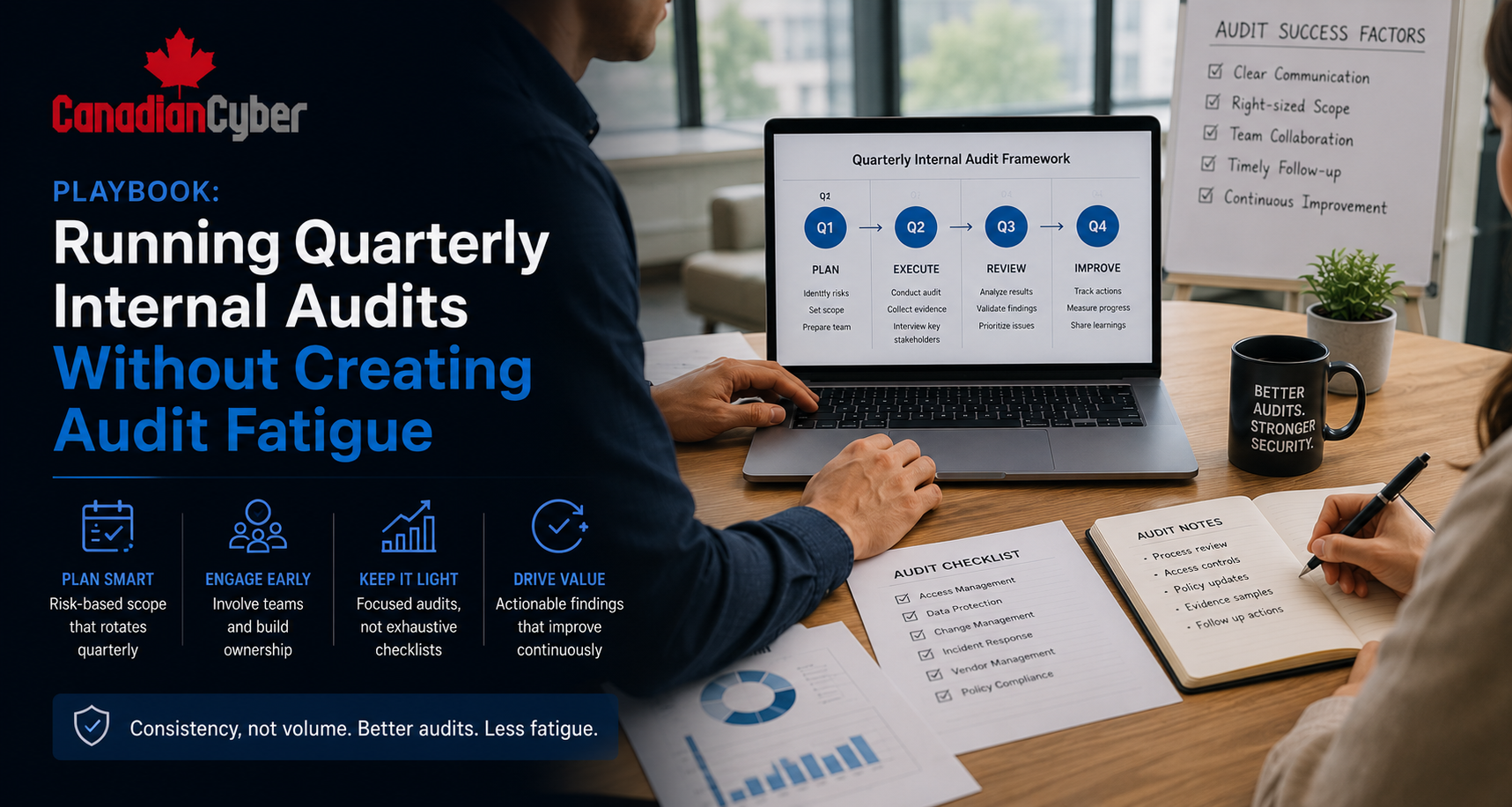
Playbook: Running Quarterly Internal Audits Without Creating Audit Fatigue
Quarterly internal audits can make ISO 27001 easier to manage, but only when they are focused, lightweight, and useful.
Quick Snapshot
| Audit Area | Practical Approach |
|---|---|
| Audit Frequency | Run small quarterly audits instead of one large annual audit exercise. |
| Scope | Test a focused set of controls each quarter. |
| Evidence | Reuse operating evidence from access reviews, vendor reviews, incidents, changes, and risk updates. |
| Team Impact | Keep interviews short, requests specific, and findings actionable. |
| Outcome | A steady internal audit rhythm that improves readiness without exhausting control owners. |
Introduction
Internal audits are necessary.
Audit fatigue is not.
Many organizations treat internal audit as a heavy annual event. The compliance lead sends a long evidence list. Control owners rush to find screenshots. Teams get pulled into meetings. Findings pile up.
Everyone feels like audit work is a distraction from real work.
Then the cycle repeats next year.
Quarterly internal audits can solve this problem.
But they need the right design. A quarterly internal audit should not feel like four full audits per year. It should feel like a practical control check.
Why Quarterly Internal Audits Work
Quarterly internal audits work because they spread the effort across the year.
Instead of testing everything at once, you test smaller areas more often.
This helps teams find gaps earlier, collect fresh evidence, and fix problems before certification audits, customer reviews, or management reviews.
| Annual Audit Model | Quarterly Audit Model |
|---|---|
| Large evidence request once per year. | Smaller requests throughout the year. |
| High pressure near audit date. | Lower pressure across the year. |
| Findings discovered late. | Gaps found earlier. |
| Control owners forget details. | Evidence is reviewed closer to when work happened. |
| Audit feels disruptive. | Audit becomes part of the normal ISMS rhythm. |
Quarterly audits are not about doing more work. They are about doing the work earlier and in smaller pieces.
The Risk of Audit Fatigue
Audit fatigue happens when internal audit feels repetitive, unclear, or disconnected from real risk.
Teams start to disengage. They may:
- see audit requests as paperwork
- answer slowly
- provide weak evidence
- reuse old screenshots
- attend meetings without learning anything
- close findings without real improvement
| Cause | What It Looks Like |
|---|---|
| Too much scope | Every audit asks for too many controls. |
| Vague requests | Control owners do not know what evidence is needed. |
| Repeated questions | Teams answer the same questions every quarter. |
| Poor follow-up | Corrective actions stay open forever. |
| No feedback loop | Teams do not see how audit work improves the business. |
Internal audit should create clarity, not exhaustion.
Step 1: Define the Quarterly Audit Purpose
Before building the schedule, decide what each quarterly audit is meant to achieve.
A quarterly audit should answer a focused question.
For example:
- Are access controls operating?
- Are vendor reviews current?
- Are risks being reviewed?
- Are incidents and corrective actions tracked?
- Are cloud logs reviewed?
- Are policies current and approved?
| Weak Purpose | Better Purpose |
|---|---|
| Audit ISO 27001. | Test access control and offboarding evidence for Q1. |
| Review all policies. | Confirm critical policies have owners, approvals, and review dates. |
| Check vendors. | Review high-risk vendors and renewal decisions. |
| Audit security. | Test incident response evidence and corrective action closure. |
Step 2: Build a 12-Month Internal Audit Calendar
Quarterly audits work best when teams know what is coming.
Create a simple 12-month audit calendar. It should show:
- quarter
- audit theme
- control areas
- control owners
- evidence needed
- expected output
| Quarter | Audit Theme | Controls Tested | Main Evidence |
|---|---|---|---|
| Q1 | Access and Identity | MFA, onboarding, offboarding, access reviews, privileged access. | User exports, access review sign-off, offboarding tickets. |
| Q2 | Vendor and Risk Management | Vendor reviews, risk register, treatment plans, accepted risks. | Vendor register, risk register, approval records. |
| Q3 | Incident, Backup, and Continuity | Incident response, tabletop, restore testing, continuity actions. | Tabletop record, restore test, incident log. |
| Q4 | Governance and Evidence Readiness | Policies, management review, internal audit findings, CAPA closure. | Policy approvals, management review minutes, CAPA register. |
Step 3: Keep Each Quarterly Audit Small
A quarterly audit should be small enough that teams can complete it without disrupting operations.
A good rule is to test 8 to 15 controls per quarter.
That is enough to find meaningful issues. It is not so much that control owners stop cooperating.
| Company Size | Practical Quarterly Scope |
|---|---|
| Small team | 5 to 8 controls. |
| Growing SaaS company | 8 to 12 controls. |
| Mid-sized organization | 10 to 15 controls. |
| Complex environment | 15 controls plus sampling by risk area. |
Quarterly audit should feel like a control health check, not an audit emergency.
Step 4: Use Evidence Packs Instead of Fresh Evidence Hunts
Audit fatigue gets worse when every audit starts from zero.
The better approach is to use evidence packs already collected during normal operations.
| Evidence Pack | When It Helps |
|---|---|
| Access Reviews | Q1 access and identity audit. |
| Vendor Reviews | Q2 vendor and supplier audit. |
| Risk Register | Q2 risk management audit. |
| Incident Records | Q3 incident response audit. |
| Policy Library | Q4 governance audit. |
| CAPA Register | Every quarter for finding closure. |
Better request example:
Please provide the Q1 access review pack for Microsoft 365, Entra ID, SharePoint, and the client portal, including user exports, reviewer sign-off, removals, and exceptions.
Step 5: Write Better Evidence Requests
Bad evidence requests create fatigue.
Good evidence requests reduce it.
Control owners should know exactly what is needed, why it is needed, and how much is enough.
| Weak Request | Strong Request |
|---|---|
| Send vendor evidence. | Send the vendor register, review notes, and approval decisions for the top 10 critical vendors reviewed this quarter. |
| Provide access control proof. | Send the quarterly access review record for Microsoft 365 and SharePoint, including removed users and open exceptions. |
| Show incident response. | Send the latest incident tabletop record, action items, and closure status. |
| Send policy evidence. | Send the approved Information Security Policy with version history and next review date. |
Evidence Request Template
| Field | Example |
| Control Area | Access Review |
| Evidence Needed | User export, reviewer sign-off, removals, exceptions. |
| Period Covered | Q1 2026 |
| Owner | IT Lead |
| Format | PDF export or SharePoint evidence link. |
Step 6: Use Sampling Instead of Testing Everything
Quarterly audits should use sampling.
Sampling means you select a practical set of records instead of reviewing everything.
This reduces team burden while still testing whether the control works.
| Control Area | Sample Approach |
|---|---|
| Offboarding | Review 5 recent leavers. |
| Vendor Reviews | Review top 10 critical vendors. |
| Access Reviews | Review privileged users and 2 high-risk systems. |
| Changes | Review 10 production changes. |
| Corrective Actions | Review overdue and high-risk actions. |
Sampling should be risk-based. Do not choose easy records just to avoid findings.
Step 7: Keep Interviews Short and Focused
Interviews are useful.
Long interviews create fatigue.
For quarterly audits, most interviews should be 20 to 30 minutes.
| Time | Activity |
|---|---|
| 5 minutes | Confirm control owner and process summary. |
| 10 minutes | Review sample evidence. |
| 10 minutes | Ask targeted control questions. |
| 5 minutes | Confirm gaps, actions, and next steps. |
Questions that work:
- What changed this quarter?
- Were any exceptions approved?
- Were any reviews missed?
- What evidence proves the control operated?
- Were any issues escalated?
- What needs improvement next quarter?
Step 8: Report Findings in Plain Language
Internal audit reports should be useful.
They should not be filled with vague audit language.
A clear finding explains:
- what was expected
- what was found
- why it matters
- what needs to change
- who owns the action
- what evidence will close it
| Field | Example |
| Finding | Guest user access was not reviewed for two sensitive SharePoint sites. |
| Risk | Former external users may retain access to client documents. |
| Owner | SharePoint Site Owner. |
| Corrective Action | Complete guest review and remove inactive users. |
| Closure Evidence | Guest export, review sign-off, and removed-user list. |
Avoid this:
Access governance requires improvement.
Use this instead:
Guest users in the Client Projects SharePoint site have not been reviewed in the last 12 months. Complete a guest access review, remove inactive users, and document the result by May 15.
Step 9: Prioritize Findings So Teams Do Not Burn Out
Not all findings are equal.
Audit fatigue increases when every issue is treated as urgent. Prioritize findings based on risk.
| Priority | Meaning | Example |
|---|---|---|
| High | Could affect security, audit readiness, customer trust, or compliance. | No access review for privileged users. |
| Medium | Control exists, but evidence or consistency is weak. | Vendor review missing approval decision. |
| Low | Minor documentation or process cleanup. | Policy review date missing from metadata. |
| Observation | Improvement suggestion, not a formal gap. | Evidence naming could be clearer. |
Step 10: Close Corrective Actions Properly
Findings create fatigue when they never close.
Quarterly audits need strong corrective action tracking.
| Corrective Action Field | Why It Matters |
|---|---|
| Finding ID | Tracks the issue. |
| Owner | Assigns accountability. |
| Root Cause | Prevents repeat findings. |
| Corrective Action | Defines the fix. |
| Closure Evidence | Proves completion. |
| Verification | Confirms the fix worked. |
Weak closure: “Done.”
Strong closure: “Guest access review completed on May 12. Six inactive guests removed. Site owner approved remaining guest users. Evidence saved in Q2 Access Review folder.”
Need a Quarterly Audit Checklist Built Around Your ISMS?
Canadian Cyber can create a practical internal audit checklist based on your ISO 27001 scope, risk register, control owners, and evidence workspace.
Step 11: Connect Quarterly Audits to Management Review
Quarterly audits should feed leadership decisions.
If audit findings stay only with compliance, the process loses value.
Management should see:
- high-risk findings
- overdue actions
- repeated issues
- accepted risks
- resource needs
- improvement progress
| Topic | What Leadership Should See |
|---|---|
| Audit Scope | What was tested this quarter. |
| Key Findings | High and medium findings. |
| Corrective Actions | Open, overdue, and closed actions. |
| Risk Impact | Risks created or reduced by findings. |
| Decisions Needed | Risk acceptance, funding, or priority changes. |
Step 12: Rotate Themes to Keep Audits Fresh
Repeating the same audit every quarter creates fatigue.
Rotate themes. This keeps the process useful and reduces repeated evidence requests.
| Quarter | Theme | Main Teams Involved |
|---|---|---|
| Q1 | Identity and Access | IT, Security, HR, System Owners. |
| Q2 | Vendors and Risk | Compliance, Procurement, Operations. |
| Q3 | Incidents and Resilience | IT, Security, DevOps, Business Owners. |
| Q4 | Governance and ISMS Performance | Leadership, Compliance, Control Owners. |
Quarterly Internal Audit Checklist
Use this checklist before each quarterly audit.
| Question | Yes / No |
|---|---|
| Is the audit scope focused? | |
| Are control owners identified? | |
| Are evidence requests specific? | |
| Is sampling risk-based? | |
| Are interviews limited and scheduled? | |
| Is prior evidence reused where possible? | |
| Are findings written in plain language? | |
| Are findings prioritized by risk? | |
| Will results feed management review? |
Common Mistakes to Avoid
- Mistake 1: Treating quarterly audits like full audits. Quarterly audits should be smaller. Do not audit the entire ISMS every quarter.
- Mistake 2: Asking for evidence that already exists. Check the evidence workspace before asking control owners again.
- Mistake 3: Using vague audit language. Write findings in plain language so owners know what to fix.
- Mistake 4: Overloading the same people. Rotate control areas and spread requests across owners.
- Mistake 5: Ignoring previous findings. Quarterly audits should check whether prior corrective actions were completed.
- Mistake 6: Creating too many low-value findings. Focus on issues that reduce real risk or improve audit readiness.
- Mistake 7: Letting corrective actions stay open. Open findings create fatigue and reduce trust in the audit process.
What Good Looks Like
A strong quarterly internal audit program has:
- focused scope
- clear owners
- short interviews
- specific evidence requests
- risk-based sampling
- plain-language findings
- prioritized corrective actions
- management review input
- evidence reuse
The audit should feel useful. Control owners should understand why they are being asked for evidence.
Canadian Cyber’s Take
At Canadian Cyber, we often see organizations move from annual audit panic to quarterly audit fatigue.
That happens when quarterly audits are too broad, too repetitive, and too disconnected from real risk.
The solution is not fewer audits.
The solution is better audit design.
A good quarterly audit is focused, evidence-driven, and practical. It tests the controls that matter. It uses evidence already produced by the business. It creates findings that owners can actually close.
The best internal audit programs do not exhaust teams. They create a rhythm.
Takeaway
Quarterly internal audits can improve audit readiness without creating audit fatigue.
But only if they are designed carefully.
Keep each audit focused. Then:
- rotate themes
- use evidence packs
- ask clear questions
- sample by risk
- keep interviews short
- prioritize findings
- close corrective actions with proof
- feed results into management review
The goal is not to audit constantly. The goal is to make audit readiness part of normal operations.
How Canadian Cyber Can Help
Canadian Cyber helps organizations build quarterly internal audit programs that support ISO 27001 without overwhelming teams.
- quarterly internal audit planning
- ISO 27001 audit calendars
- internal audit checklists
- risk-based audit sampling
- evidence request templates
- SharePoint audit workspaces
- corrective action tracking
- management review reporting
- mock internal audits
- control owner coaching
- vCISO support for continuous compliance
- ISO 27001 certification readiness
Stay Connected With Canadian Cyber
Follow Canadian Cyber for practical guidance on ISO 27001, internal audits, audit readiness, continuous compliance, evidence management, and vCISO support.