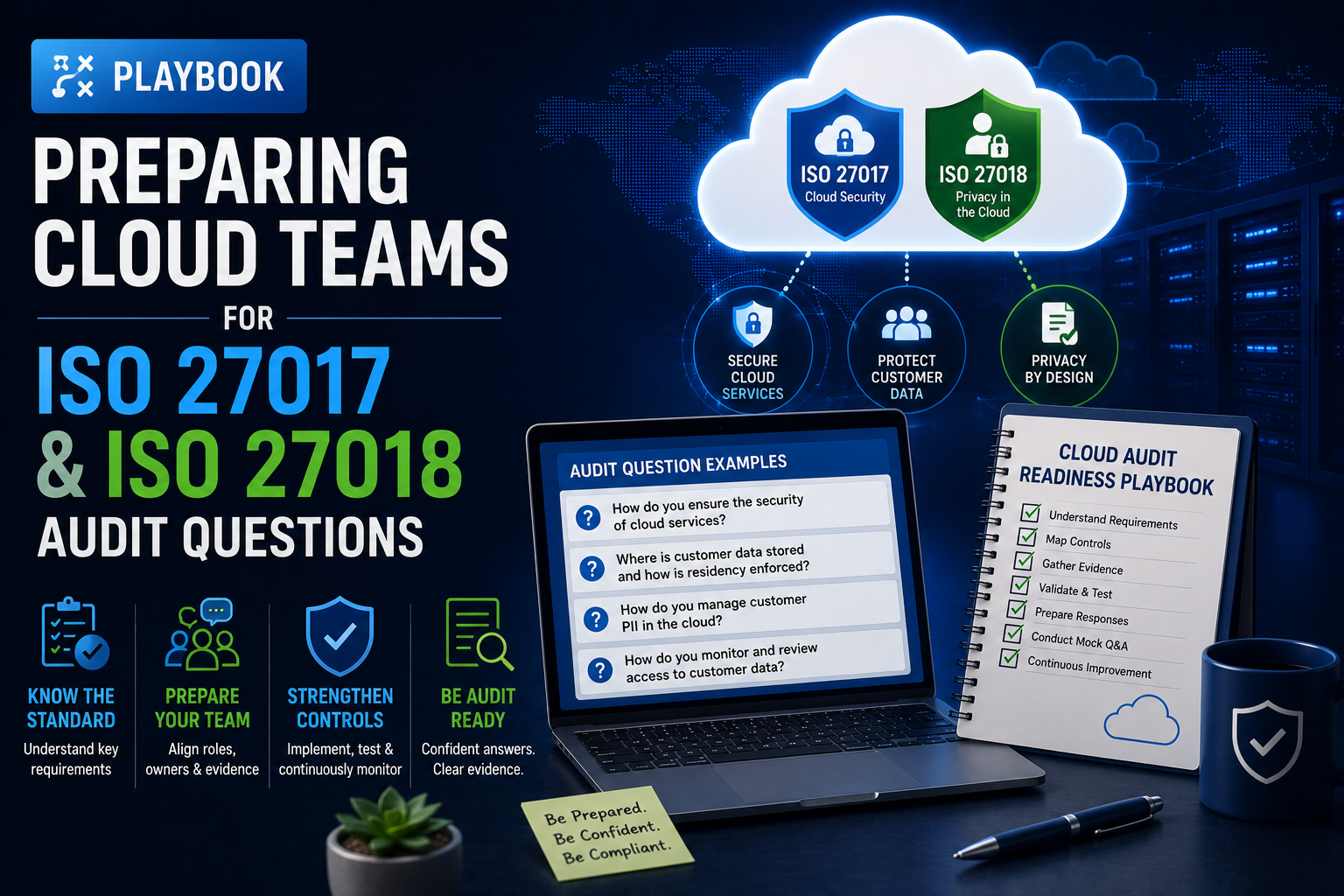
Cloud Audit Readiness • ISO 27017 • ISO 27018 • SaaS Evidence
Playbook: Preparing Cloud Teams for ISO 27017 and 27018 Audit Questions
ISO 27017 and ISO 27018 audits are easier when cloud teams know what questions are coming, where evidence lives, and how to explain shared responsibility, cloud security, and personal data protection without scrambling.
Quick Snapshot
| Audit Area | What Cloud Teams Should Prepare |
|---|---|
| Shared Responsibility | Clear split between cloud provider controls, SaaS team controls, and shared controls. |
| Cloud Configuration | Security baselines, configuration reviews, hardening records, and remediation tickets. |
| Access Control | MFA proof, privileged access reviews, service account ownership, and support access logs. |
| Personal Data Protection | Data inventory, sub-processor register, retention rules, deletion records, and privacy workflows. |
| Evidence Readiness | Control-linked evidence packs with owners, review dates, and clear audit explanations. |
Introduction
Cloud audits do not usually fail because teams know nothing about security.
They fail because the answers are scattered.
One person knows where AWS logs are stored. Another knows how Azure roles are reviewed. Someone else understands the support platform. The privacy lead knows the sub-processors. DevOps knows the backup setup. Engineering knows the tenant model.
But when an auditor asks a simple question, the team needs a clear answer.
For ISO 27017 and ISO 27018, the questions usually focus on cloud responsibility, access, configuration, logging, vendors, data location, personal data protection, and evidence.
This playbook helps cloud, security, privacy, DevOps, and compliance teams prepare before the audit starts.
Need Help Preparing Your Cloud Team?
Canadian Cyber helps SaaS and cloud teams prepare for ISO 27017 and ISO 27018 audit questions with practical evidence packs, owner mapping, mock interviews, and SharePoint audit workspaces.
Why ISO 27017 and ISO 27018 Questions Feel Different
ISO 27017 and ISO 27018 questions are more specific than general security questions.
They do not stop at “Do you have a policy?”
They ask how cloud controls work in real environments.
| Standard | Audit Focus | Typical Question |
|---|---|---|
| ISO 27017 | Cloud security and shared responsibility. | Who owns this cloud control, and how is it operated? |
| ISO 27018 | Protection of personal data in public cloud services. | Where does personal data live, who can access it, and how is it protected? |
The biggest challenge is not answering once. It is proving the answer with evidence.
Playbook Step 1: Build an Audit Question Register
Start by listing the questions your cloud team is likely to face.
This helps the team prepare answers before the auditor is in the room.
| Question Area | Example Audit Question | Best Evidence |
|---|---|---|
| Shared Responsibility | Which controls are handled by the cloud provider and which are handled by your team? | Shared responsibility matrix. |
| Cloud Access | How do you review privileged cloud access? | Quarterly access review record. |
| Logging | What cloud logs are collected and reviewed? | Log inventory, retention proof, review sign-off. |
| Personal Data | Where is customer or patient data stored? | Data inventory and data flow map. |
| Sub-Processors | Which vendors process personal data? | Sub-processor register and vendor reviews. |
Practical Tip:
Do not wait for the auditor to ask. Run a mock question session with cloud owners, security, privacy, engineering, and compliance before the audit starts.
Playbook Step 2: Assign Owners Before the Audit
Audit answers become weak when nobody owns the control.
Every major ISO 27017 and ISO 27018 topic should have a named owner.
| Control Area | Likely Owner | What They Must Explain |
|---|---|---|
| Cloud architecture | Cloud Lead / DevOps | Regions, environments, network design, and workload separation. |
| Identity and access | IT / Security | MFA, SSO, privileged roles, access reviews, and offboarding. |
| Logging and monitoring | Security / DevOps | Log sources, alerting, retention, review, and incident escalation. |
| Personal data | Privacy / Compliance | Data inventory, processing purposes, retention, deletion, and requests. |
| Vendors and sub-processors | Compliance / Procurement | Vendor risk, data handled, assurance reviewed, and approval decisions. |
Playbook Step 3: Prepare the Shared Responsibility Story
Auditors want to know whether your team understands cloud responsibility.
Your answer should not be vague.
A good shared responsibility story explains what the cloud provider manages, what your team manages, and where responsibilities overlap.
| Control | Provider Responsibility | Your Responsibility | Evidence |
|---|---|---|---|
| Physical security | Data center security. | Review provider assurance. | SOC 2 / ISO report review. |
| IAM | IAM capability. | Configure roles, MFA, and reviews. | Access review record. |
| Encryption | Encryption services. | Enable encryption and manage keys. | KMS settings and key access review. |
| Logging | Logging features. | Enable, retain, review, and alert. | Log inventory and review sign-off. |
Still Using Generic Cloud Responsibility Answers?
Canadian Cyber helps teams build practical shared responsibility matrices that match their real AWS, Azure, GCP, SaaS, and support-tool environments.
Playbook Step 4: Prepare Evidence by Question, Not by Tool
Cloud teams often store evidence by platform.
That creates folders like AWS, Azure, GCP, GitHub, Datadog, and Zendesk.
Auditors usually ask by control area.
| Audit Question | Evidence Pack | What to Include |
|---|---|---|
| Who can access cloud admin functions? | Access Control | Admin list, MFA proof, access review, exceptions. |
| Where is personal data stored? | Data Inventory | Data map, system list, storage regions, vendors. |
| Are logs reviewed? | Logging and Monitoring | Log sources, retention proof, review sign-off, alert tickets. |
| How are sub-processors managed? | Vendor Management | Register, DPA, assurance review, approval decision. |
Playbook Step 5: Rehearse the High-Risk Questions
Some questions create more audit stress than others.
These are the questions your cloud team should rehearse first.
1. Shared Responsibility
What does the provider handle, and what does your team still need to configure, review, and prove?
2. Admin Access
Who has privileged access, when was it reviewed, and what exceptions remain open?
3. Data Location
Where is customer or patient data stored, including backups, logs, support tools, and vendors?
4. Logging
What activity is logged, how long is it retained, who reviews it, and how are alerts handled?
5. Sub-Processors
Which vendors process personal data, and what decision trail shows they were reviewed?
6. Deletion and Retention
Can the team prove what happens to data across production, backups, logs, exports, and support tools?
Playbook Step 6: Prepare Simple, Defensible Answers
Cloud teams do not need long speeches.
They need short answers backed by evidence.
| Weak Answer | Stronger Answer |
|---|---|
| “AWS handles that.” | “AWS handles the underlying infrastructure. We manage IAM, logging, encryption settings, access reviews, and configuration evidence.” |
| “Logs are enabled.” | “Critical logs are collected, retained for the approved period, reviewed monthly, and linked to alert tickets when action is needed.” |
| “We use encryption.” | “Data is encrypted in transit and at rest. Key access is restricted, reviewed, and supported by KMS evidence.” |
| “We review vendors.” | “Sub-processors are listed, risk-rated, assigned an owner, reviewed for assurance, and approved with a decision record.” |
Playbook Step 7: Run a Mock Audit Session
A mock audit session is one of the fastest ways to find weak answers before the real audit.
Keep it focused. Use realistic questions. Ask real control owners to answer.
| Step | What to Do | Output |
|---|---|---|
| 1 | Pick 10 to 15 high-value audit questions. | Mock question list. |
| 2 | Assign each question to a real owner. | Owner map. |
| 3 | Ask the owner to explain the control. | Interview notes. |
| 4 | Ask for evidence immediately. | Evidence retrieval test. |
| 5 | Log weak answers and missing evidence. | Gap register. |
The Goal:
The goal is not to embarrass control owners. The goal is to find confusing answers, missing evidence, outdated records, and unclear ownership while there is still time to fix them.
Common Cloud Team Mistakes
- Assuming cloud provider certification covers internal configuration.
- Using technical screenshots without explaining what they prove.
- Storing evidence by platform instead of by control question.
- Not preparing DevOps and engineering teams for interviews.
- Leaving privacy, security, and cloud teams with different answers.
- Forgetting logs, backups, support tickets, and exports in the data map.
- Not linking vendor assurance to actual review decisions.
- Waiting until the audit week to find evidence.
What Good Looks Like
A prepared cloud team can answer audit questions clearly and show evidence quickly.
| Good Practice | Why It Helps |
|---|---|
| Control owners are assigned | Questions do not bounce between teams. |
| Evidence is mapped to audit questions | Retrieval is faster and cleaner. |
| Cloud responsibility is documented | Provider and customer duties are clear. |
| Personal data is inventoried | ISO 27018 questions become easier to answer. |
| Mock interviews are completed | Weak answers are fixed before the audit. |
Canadian Cyber’s Take
At Canadian Cyber, we often see cloud teams that are technically capable but audit-unprepared.
They know their systems. They know their tools. They know their cloud provider.
But they have not practiced explaining controls in audit language.
ISO 27017 and ISO 27018 audits are much smoother when the team has three things in place: clear owners, mapped evidence, and rehearsed answers.
The strongest audit preparation is not a last-minute document hunt. It is a structured readiness exercise that helps cloud teams show what they already do well and fix the gaps before the auditor finds them.
Takeaway
Preparing cloud teams for ISO 27017 and ISO 27018 audit questions is not only about collecting documents.
It is about helping the right people answer the right questions with the right evidence.
Start with an audit question register. Assign owners. Build a shared responsibility matrix. Organize evidence by control area. Prepare access, logging, data, vendor, and privacy evidence. Then run a mock audit session.
When the auditor asks how cloud security and personal data protection work, your team should not need to scramble. They should be able to show it.
How Canadian Cyber Can Help
Canadian Cyber helps SaaS, healthcare, fintech, and cloud service organizations prepare for ISO 27017 and ISO 27018 audit questions.
- ISO 27017 readiness reviews
- ISO 27018 readiness reviews
- cloud audit question registers
- shared responsibility matrices
- evidence pack design
- mock audit interviews
- SharePoint audit workspaces
- vCISO support for cloud compliance
Stay Connected With Canadian Cyber
Follow Canadian Cyber for practical guidance on ISO 27017, ISO 27018, cloud compliance, audit readiness, SaaS security, SharePoint evidence management, and vCISO support.