

Risk Management • ISO 27001 • Audit Readiness • Risk Register • Corrective Actions
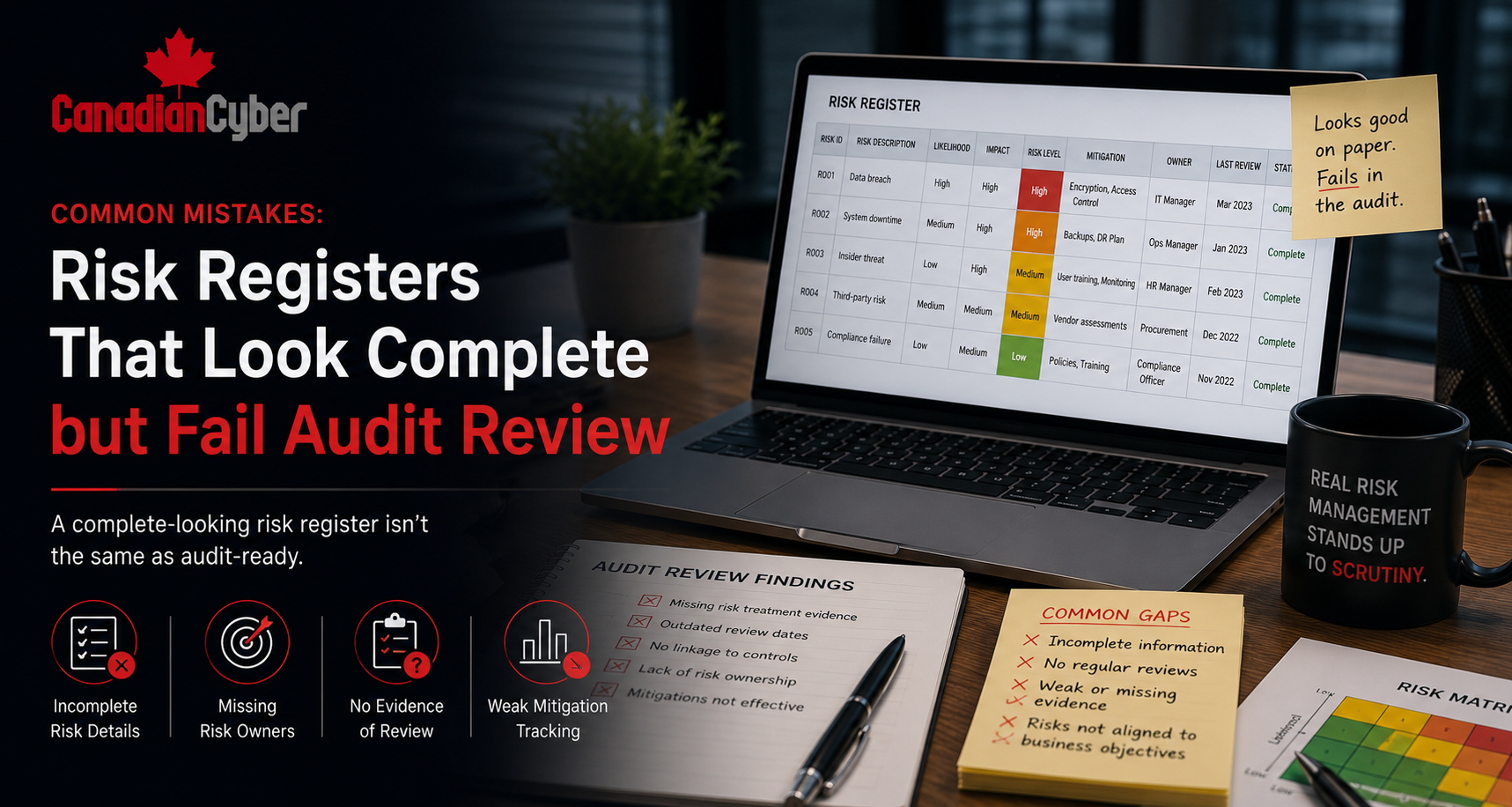
Common Mistakes: Risk Registers That Look Complete but Fail Audit Review
A risk register can look polished and still fail audit review. The real issue is often weak ownership, vague treatment, missing evidence, and stale reviews.
Quick Snapshot
| Risk Register Area | Common Audit Problem |
|---|---|
| Risk Descriptions | Risks are too vague, generic, or copied from templates. |
| Ownership | Risk owners are missing, unrealistic, or not involved. |
| Treatment Plans | Actions are unclear, overdue, or not linked to evidence. |
| Residual Risk | Ratings are not updated after treatment. |
| Outcome | A register that looks complete but cannot prove real ISO 27001 risk management. |
Introduction
A risk register can look impressive.
It may have:
- risk IDs
- likelihood scores
- impact scores
- risk ratings
- owners
- treatment plans
- status columns
- review dates
But auditors do not only check whether the register has columns.
They check whether the risk process is real.
That means they want to see clear risks, real owners, treatment decisions, evidence, residual risk, and review history.
Why Risk Registers Fail Audit Review
A risk register fails audit review when it does not tell a believable story.
Auditors want to see a risk process that works.
Risks should be identified, assessed, treated, reviewed, accepted, and improved.
A weak register often shows only the first part. It lists risks. But it does not prove that anything meaningful happened after that.
| Audit Question | What the Register Should Show |
|---|---|
| How are risks identified? | A consistent process and relevant risk sources. |
| Who owns each risk? | A real accountable person or role. |
| How are risks scored? | A documented likelihood and impact method. |
| What action was taken? | A specific plan with owner, due date, and evidence. |
| Is the register current? | Review dates, updates, and status history. |
The register should not be a static spreadsheet. It should be a living record of risk decisions.
Mistake 1: Using Generic Risk Descriptions
Generic risks sound professional.
But they do not show that the organization understands its real environment.
| Weak Risk | Why It Fails |
|---|---|
| Cyberattack | Too broad to treat or assign clearly. |
| Data breach | No specific cause, system, or impact. |
| Vendor risk | Does not identify which vendor or exposure. |
| Cloud misconfiguration | No affected service or control area. |
Better Risk Descriptions
| Better Risk | Why It Works |
|---|---|
| Former employees retain access to Microsoft 365 after offboarding. | Specific cause, system, and consequence. |
| Excessive SharePoint permissions expose client tax files to unauthorized staff. | Clear asset, threat, and impact. |
| Critical payroll vendor outage delays client payroll processing. | Specific vendor dependency and business impact. |
| Security incidents are not escalated on time due to unclear roles. | Specific process weakness. |
Practical rule:
A good risk should explain what could happen, why it could happen, what is affected, and what the impact would be.
Mistake 2: Not Linking Risks to Assets
Many registers have risks floating on their own.
They are not tied to systems, data, vendors, or business processes.
That makes the register harder to audit.
| Risk | Linked Asset or Process |
|---|---|
| Excessive permissions expose client documents. | SharePoint client libraries. |
| API token compromise allows unauthorized access. | SaaS production API. |
| Vendor outage disrupts reporting service. | Data warehouse vendor. |
| Incomplete offboarding leaves accounts active. | Entra ID and SaaS access. |
When risks link to assets, auditors can trace the logic.
Mistake 3: Assigning Weak Risk Owners
A risk owner should be able to influence the risk.
Weak ownership can look like this:
- all risks owned by compliance
- all risks owned by IT
- no named owner
- owner listed as “team”
- owner has left the company
- owner has no authority over the treatment
| Risk | Better Owner |
|---|---|
| Vendor outage affects client service. | Vendor Relationship Owner. |
| Cloud misconfiguration exposes data. | Cloud or DevOps Lead. |
| Developers retain production access. | Engineering Manager. |
| SharePoint permissions expose client data. | Site Owner or Operations Lead. |
If the owner cannot explain the risk, treatment, progress, and evidence, ownership is weak.
Mistake 4: Scoring Risks Without a Method
A risk register may show likelihood and impact scores.
But auditors may still ask how those scores were chosen.
If the answer is “we just estimated,” the register becomes weaker.
| Score | Likelihood Meaning | Impact Meaning |
|---|---|---|
| 1 | Rare. | Minimal disruption or limited data exposure. |
| 2 | Unlikely. | Minor operational or compliance impact. |
| 3 | Possible. | Moderate business, client, or audit impact. |
| 4 | Likely. | Significant legal, financial, service, or trust impact. |
| 5 | Almost certain. | Severe business impact or major data exposure. |
Better evidence includes:
- risk methodology
- likelihood and impact definitions
- risk appetite statement
- review notes explaining rating changes
- management review records for high risks
Mistake 5: No Clear Treatment Decision
Every meaningful risk needs a treatment decision.
But many registers list risks without saying what the organization decided to do.
| Treatment Option | Meaning |
|---|---|
| Mitigate | Reduce the risk with controls or actions. |
| Accept | Formally accept the risk within tolerance. |
| Transfer | Shift part of the risk through insurance, contract, or vendor. |
| Avoid | Stop the activity that creates the risk. |
Strong Treatment Examples
| Risk | Treatment Decision | Treatment Action |
|---|---|---|
| Former employees retain SaaS access. | Mitigate. | Add SaaS systems to offboarding checklist and complete quarterly access review. |
| Critical vendor outage affects payroll delivery. | Transfer / Mitigate. | Review vendor SLA and document a contingency plan. |
| Low-risk internal tool lacks SSO. | Accept. | Accept until renewal due to low data sensitivity and limited users. |
Mistake 6: Treatment Plans Are Too Vague
A treatment plan should be specific enough to test.
If it cannot be verified, it is not audit-ready.
Weak treatment plan:
Improve access control.
Better treatment plan:
By March 31, IT will complete a quarterly access review for Microsoft 365, SharePoint, and the client portal. Evidence will include user exports, reviewer sign-off, removed accounts, and documented exceptions.
| Treatment Plan Field | Why It Matters |
|---|---|
| Action | Defines what will change. |
| Owner | Assigns accountability. |
| Due Date | Prevents drift. |
| Evidence Needed | Defines proof. |
| Verification Step | Confirms the action worked. |
Want a Risk Register Audit Review?
Canadian Cyber can review your risk register before the auditor does. We identify weak descriptions, missing evidence, stale risks, ownership gaps, and treatment issues.
More Mistakes That Can Break Traceability
| Mistake | Why It Fails Audit Review | Better Approach |
|---|---|---|
| 7. Closing risks without evidence | The register says “closed,” but no proof shows what changed. | Link closure to access reviews, vendor reviews, test records, or approvals. |
| 8. Missing residual risk | Treatment effectiveness is not shown. | Update residual risk after treatment and explain rating changes. |
| 9. Accepted risks lack approval | Acceptance looks accidental. | Record reason, approver, date, review date, and compensating controls. |
| 10. Risks do not link to controls | The ISMS looks like a checklist instead of a risk-based system. | Map risks to controls, evidence, and corrective actions. |
| 11. Register is not reviewed | It looks created for the audit. | Review risks quarterly and after major changes. |
Example of a Strong Risk Register Entry
| Field | Example |
| Risk ID | R-014 |
| Risk Description | Former employees may retain access to SharePoint client folders if offboarding is not completed across all systems. |
| Asset / Process | SharePoint client libraries and offboarding process. |
| Owner | Operations Manager. |
| Inherent Risk | High. |
| Treatment Decision | Mitigate. |
| Treatment Action | Update offboarding checklist, review SharePoint access quarterly, remove inactive users, and document exceptions. |
| Evidence Needed | Updated checklist, access review export, removal record, and reviewer sign-off. |
| Residual Risk | Medium. |
This entry is audit-friendly because it is specific, owned, measurable, and evidence-based.
Risk Register Audit Checklist
Use this checklist before your internal audit or certification review.
| Question | Yes / No |
|---|---|
| Are risks specific to real systems, data, vendors, and processes? | |
| Does each risk have an owner? | |
| Is the scoring method documented? | |
| Is there a treatment decision for each risk? | |
| Are treatment actions specific and measurable? | |
| Is evidence linked to completed actions? | |
| Is residual risk updated after treatment? | |
| Are accepted risks approved and reviewed? | |
| Are high risks discussed in management review? |
What Good Looks Like
A strong risk register does not need to be complicated.
It needs to be real. Good signs include:
- risks are specific
- owners are clear
- scoring is consistent
- treatment decisions are documented
- actions have due dates
- evidence is linked
- residual risk is updated
- accepted risks are approved
- high risks are reviewed by leadership
- findings connect to corrective actions
Auditors like risk registers that show decisions. Not just lists.
Canadian Cyber’s Take
At Canadian Cyber, we often see risk registers that look complete at first glance.
They have rows, columns, scores, and statuses.
But once audit review begins, the weaknesses become clear.
Common issues include:
- risks are too generic
- owners are not involved
- treatments are vague
- evidence is missing
- residual risk is not updated
- accepted risks have no approval
- management review does not mention top risks
That is not a spreadsheet problem. It is a risk management problem.
The strongest organizations use the risk register as a working tool. It helps them decide what matters, who owns it, what needs to change, and how they will prove improvement.
Takeaway
A risk register can look complete and still fail audit review.
The difference is evidence.
A strong risk register shows real risks, real owners, real treatment decisions, real evidence, and real review history.
Do not rely on polished formatting.
Focus on traceability. The auditor should be able to trace a risk through:
- identification
- scoring
- treatment
- evidence
- residual risk
- acceptance
- management review
If that trace is clear, your risk register is doing its job.
How Canadian Cyber Can Help
Canadian Cyber helps organizations build and improve audit-ready risk registers.
- risk register reviews
- ISO 27001 risk assessment design
- risk methodology development
- risk treatment planning
- residual risk review
- risk acceptance workflows
- SharePoint risk register setup
- risk and control mapping
- corrective action tracking
- management review preparation
- internal audit readiness
- vCISO support for risk governance
Stay Connected With Canadian Cyber
Follow Canadian Cyber for practical guidance on ISO 27001, risk management, audit readiness, corrective actions, evidence management, and vCISO support.