ISO 27001 • Control Ownership • ISMS Governance • Audit Readiness • SharePoint ISMS
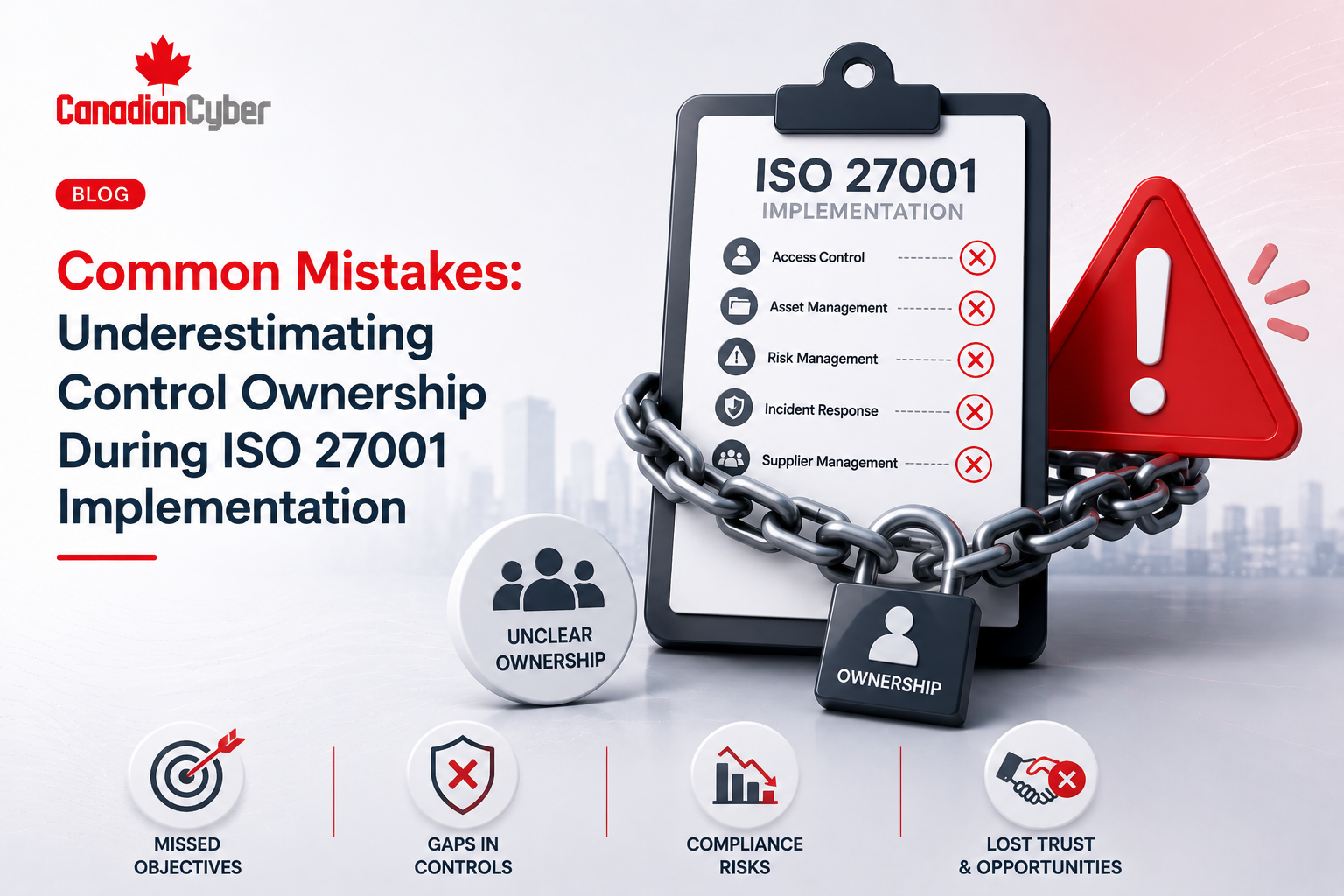
Common Mistakes: Underestimating Control Ownership During ISO 27001 Implementation
ISO 27001 implementation does not fail because the company forgot to write a policy. It usually fails because nobody owns the control after the policy is approved. A control without an owner is just a good intention waiting to become an audit finding.
Quick Snapshot
| Control Ownership Problem | What Goes Wrong |
|---|---|
| No Named Owner | Nobody knows who must operate, review, or evidence the control. |
| Compliance Owns Everything | IT, HR, legal, operations, and leadership stay disconnected. |
| Owners Assigned Too Late | Evidence is missing when internal audit begins. |
| Owners Do Not Understand Expectations | Controls are documented but not operating. |
| Best Outcome | Each control has an owner, evidence source, review cadence, backup owner, and escalation path. |
Introduction
Many organizations start ISO 27001 with documents.
They create policies. They build a risk register. They draft a Statement of Applicability. They prepare templates. They organize folders. They start collecting evidence.
At first, everything looks organized.
Then implementation begins.
- The Access Control Policy says access must be reviewed. But who performs the review?
- The Supplier Security Policy says critical vendors must be assessed. But who owns vendor review?
- The Backup Procedure says restore testing must happen. But who schedules the test?
- The Incident Response Plan says tabletop exercises must be performed. But who organizes them?
- The Risk Management Procedure says risks must be reviewed. But who updates the treatment status?
This is where many ISO 27001 projects slow down. The company has controls, but control ownership is unclear. When ownership is unclear, evidence is weak.
Need Help Assigning ISO 27001 Control Owners?
Canadian Cyber helps organizations build practical ISO 27001 ownership models, SharePoint ISMS trackers, evidence workflows, risk registers, and management review dashboards.
Why Control Ownership Matters
ISO 27001 is not only about choosing controls. It is about making sure controls operate.
That requires people.
A control owner is responsible for making sure a control is implemented, reviewed, evidenced, and improved.
A Control Owner Should Know
- what the control requires
- which systems or processes are in scope
- what evidence is needed
- how often the control operates
- where evidence is stored
- which exceptions exist
- which risks the control treats
- who to escalate to if the control fails
| Control | Weak Ownership | Strong Ownership |
|---|---|---|
| Access Reviews | “IT handles it.” | IT Lead owns quarterly reviews for Entra ID, SharePoint, GitHub, and production access. |
| Vendor Reviews | “Operations tracks vendors.” | Operations Manager owns critical vendor reviews and approval evidence. |
| Restore Testing | “Backups are automatic.” | Infrastructure Lead owns quarterly restore tests and evidence. |
| Incident Response | “Security owns incidents.” | vCISO owns tabletop planning; executives own crisis decisions. |
| Policy Reviews | “Compliance updates policies.” | Each policy has an owner, approver, and next review date. |
If a control does not have a named owner, it is not fully implemented.
Mistake 1: Assigning Ownership to Departments Instead of People
This is one of the most common mistakes.
The control owner field says IT, HR, Legal, Operations, Security, or Finance. That sounds useful, but departments do not complete evidence. People do.
| Problem | Impact |
|---|---|
| No one feels personally responsible. | Tasks are missed. |
| Evidence requests bounce between teams. | Audit prep slows down. |
| Escalation is unclear. | Overdue items stay overdue. |
| Internal audit cannot interview the right person. | Testing becomes harder. |
| Staff turnover creates gaps. | Controls lose continuity. |
Better Approach
Assign a named owner and a backup owner.
| Control Area | Primary Owner | Backup Owner |
|---|---|---|
| Access Control | IT Lead | Security Analyst |
| Vendor Risk | Operations Manager | Finance Manager |
| Security Training | HR Manager | ISMS Coordinator |
| Backup Recovery | Infrastructure Lead | Cloud Engineer |
| Incident Response | vCISO | IT Director |
Use departments for reporting. Use named people for accountability.
Mistake 2: Making Compliance Own Every Control
The compliance lead can coordinate ISO 27001, but they cannot operate every control.
When compliance owns everything, they end up chasing IT for access reviews, HR for training records, operations for vendor reviews, leadership for management review, and engineering for change evidence.
This creates frustration. It also makes the ISMS fragile.
| Function | Controls They Usually Own |
|---|---|
| IT | Access, endpoint security, backups, logging. |
| HR | Training, onboarding, offboarding coordination. |
| Engineering | Secure development, code review, deployments. |
| Operations | Vendor management and business continuity support. |
| Legal | Contracts, privacy, notification input. |
| Leadership | Risk acceptance, objectives, management review. |
| Compliance / ISMS Owner | Coordination, evidence tracking, and audit readiness. |
Compliance coordinates the ISMS. The business owns the controls.
Turn ISO 27001 Ownership Into a Working System
Canadian Cyber can help map control owners, evidence sources, review dates, risks, policies, and escalation paths into a practical ISO 27001 operating model.
Mistake 3: Assigning Owners Too Late
Some teams wait until internal audit to assign owners. That is too late.
For example, the policy says access reviews happen quarterly. But nobody was assigned to run them. Six months later, internal audit asks for review evidence. The team realizes no formal review happened.
Now the issue is not only missing evidence. The control did not operate.
Assign control owners when:
- scope is defined
- risks are identified
- controls are selected
- the Statement of Applicability is drafted
- policies are approved
- evidence requirements are mapped
Mistake 4: Not Explaining What Ownership Means
Assigning someone as a control owner is not enough. They need to understand the responsibility.
| Responsibility | What It Means |
|---|---|
| Operate the Control | Ensure the control activity happens. |
| Collect Evidence | Save proof in the right location. |
| Review Exceptions | Identify and approve or escalate gaps. |
| Track Due Dates | Complete recurring tasks on time. |
| Support Internal Audit | Explain how the control works. |
| Improve the Control | Fix repeat problems. |
Poor instruction: “You own access control.”
Better instruction: “You own quarterly access reviews for Entra ID, SharePoint, GitHub, and production cloud roles. Each quarter, export user access, review with system owners, document removals and exceptions, sign off the review, and upload evidence to the Access Control evidence folder.”
Mistake 5: No Evidence Responsibility
Control ownership and evidence ownership are connected. If nobody owns evidence, the audit will be painful.
Every control owner should answer:
- What evidence proves the control operated?
- Where does the evidence come from?
- How often is evidence collected?
- Where is evidence stored?
- Who reviews evidence before audit?
- What happens if evidence is missing?
| Control | Owner | Evidence |
|---|---|---|
| Access Review | IT Lead | User export, review sign-off, removals, exceptions. |
| Vendor Review | Operations Manager | Vendor register, assurance review, approval decision. |
| Restore Testing | Infrastructure Lead | Restore test record, result, review notes. |
| Security Training | HR Manager | Completion report, overdue reminders. |
| Incident Tabletop | vCISO | Scenario, attendance, lessons learned, actions. |
Every control should have a defined evidence source. If evidence is unclear, ownership is incomplete.
Mistake 6: No Backup Owner
People go on vacation. People change roles. People leave the company.
If one person is the only owner, the control can fail.
Critical controls that need backup owners include:
- access reviews
- vendor reviews
- backup restore tests
- incident response
- security monitoring
- policy reviews
- risk register updates
- corrective actions
Mistake 7: No Escalation Path for Overdue Controls
Even good owners miss deadlines. The problem is not always the missed deadline. The problem is when nobody notices.
| Status | Action |
|---|---|
| Due in 14 days | Reminder to owner. |
| Due in 7 days | Reminder to owner and backup owner. |
| Overdue | Escalate to ISMS owner. |
| Overdue by 14 days | Escalate to executive sponsor. |
| High-risk overdue item | Add to management review or risk register. |
Automate ISMS Control Reminders
Canadian Cyber can help configure SharePoint ISMS reminders and escalation workflows using metadata, views, dashboards, and Power Automate.
Mistake 8: Owners Are Not Involved in Risk Treatment
ISO 27001 is risk-based. Control owners should understand which risks their controls help treat.
For example, the risk is: “Former employees may retain access to customer systems.”
The control is quarterly access reviews and offboarding checks. The owner is the IT Lead.
If the IT Lead does not understand the risk, they may treat the access review as paperwork. If they understand the business risk, the review becomes meaningful.
| Risk | Control | Owner |
|---|---|---|
| Unauthorized access to customer data | Access review | IT Lead |
| Critical vendor breach | Vendor review | Operations Manager |
| Ransomware recovery failure | Restore testing | Infrastructure Lead |
| Unapproved production change | Change review | Engineering Manager |
| Incident response delay | Tabletop exercise | vCISO |
Mistake 9: Control Owners Are Not Prepared for Internal Audit
Internal audit tests whether controls operate. That means auditors may interview control owners.
Owners should be able to explain:
- what the control does
- why the control exists
- how often it operates
- what systems are included
- what evidence proves operation
- what exceptions occurred
- where evidence is stored
Strong owner answer:
“Each quarter, we export privileged access from Entra ID, GitHub, and cloud admin roles. System owners review access, removals are documented, exceptions are tracked, and evidence is saved in the Access Control evidence library.”
Mistake 10: Control Ownership Is Not Reflected in SharePoint or the ISMS Tool
Ownership should be visible in the system. If your ISMS is in SharePoint, owners should appear in metadata, lists, dashboards, and views.
| SharePoint Field | Purpose |
|---|---|
| Control Owner | Primary accountable person. |
| Backup Owner | Secondary person. |
| Review Frequency | Monthly, quarterly, or annual. |
| Next Review Date | Due date. |
| Evidence Required | What proof is needed. |
| Related Risk | Risk treated by the control. |
| Status | Operating, overdue, or needs improvement. |
Useful SharePoint views include:
- controls by owner
- overdue controls
- controls due in 30 days
- controls missing evidence
- high-risk controls
- audit-ready controls
Track Control Owners in SharePoint ISMS
Canadian Cyber’s ISMS SharePoint solution helps organizations track control owners, evidence, review dates, risk links, corrective actions, and audit readiness in one structured workspace.
Mistake 11: Leadership Does Not Review Ownership Gaps
Control ownership gaps should reach leadership, especially if they affect high-risk controls.
| Ownership Issue | Why Leadership Should See It |
|---|---|
| No owner for critical control | Accountability gap. |
| Repeated overdue reviews | Resource or priority issue. |
| Missing evidence | Audit readiness risk. |
| Control owner left company | Continuity risk. |
| High-risk exception open | Risk acceptance may be needed. |
Management review should include ownership, overdue controls, evidence gaps, and resource needs.
Control Ownership Matrix Template
Use this structure to assign and track ownership.
| Field | Example |
|---|---|
| Control ID | AC-01 |
| Control Name | Quarterly Access Review |
| Related Risk | Unauthorized access to customer data |
| Primary Owner | IT Lead |
| Backup Owner | Security Analyst |
| Review Frequency | Quarterly |
| Evidence Required | User export, review sign-off, removals, exceptions |
| Status | Operating |
Sample Control Ownership Matrix
| Control | Owner | Backup | Frequency | Evidence |
|---|---|---|---|---|
| Access Review | IT Lead | Security Analyst | Quarterly | User export, sign-off |
| Vendor Review | Operations Manager | Finance Manager | Annual | Vendor register, approval |
| Restore Testing | Infrastructure Lead | Cloud Engineer | Quarterly | Restore test record |
| Incident Tabletop | vCISO | IT Director | Annual | Tabletop report |
| Security Training | HR Manager | HR Coordinator | Annual / onboarding | Completion report |
ISO 27001 Control Ownership Checklist
Use this during implementation.
| Question | Yes / No |
|---|---|
| Does every selected control have a named owner? | |
| Does every critical control have a backup owner? | |
| Does each owner understand the control expectation? | |
| Is evidence defined for each control? | |
| Is review frequency defined? | |
| Is the next review date tracked? | |
| Are overdue controls escalated? | |
| Are owners mapped in SharePoint or the ISMS tool? | |
| Are controls linked to risks? | |
| Are control owners prepared for internal audit? | |
| Are ownership gaps reviewed by leadership? |
If several answers are “no,” your ISO 27001 implementation may have an ownership problem.
Common Warning Signs
Your control ownership model may be weak if:
- compliance chases every evidence item
- owners are listed as departments
- access reviews are late
- vendor reviews are informal
- policy owners are missing
- corrective actions have no clear owner
- internal audit findings repeat
- evidence is stored randomly
- control owners cannot explain their controls
These are not documentation problems. They are governance problems.
What Good Looks Like
A strong ISO 27001 control ownership model has:
- named control owners
- backup owners
- clear evidence requirements
- review frequency
- next due dates
- escalation paths
- risk-to-control mapping
- policy owner mapping
- SharePoint or ISMS tracking
- owner training
- internal audit preparation
- management review visibility
- corrective action ownership
The result is a working ISMS, not a policy library with no accountability.
Canadian Cyber’s Take
At Canadian Cyber, we often see ISO 27001 projects that start strong and slow down during evidence collection.
The reason is usually ownership.
The policy exists. The control is selected. The risk is documented. The template is ready. But nobody owns the operating rhythm.
ISO 27001 works best when every important control has a person responsible for running it, proving it, and improving it. That does not mean one person does all the work. It means accountability is clear.
Control ownership is what turns ISO 27001 from documentation into governance.
Takeaway
Do not underestimate control ownership during ISO 27001 implementation.
A control without an owner will eventually fail.
Build ownership early:
- assign named owners
- use backup owners
- define evidence
- set review dates
- escalate overdue work
- link controls to risks
- prepare owners for internal audit
- make ownership visible in SharePoint or your ISMS tool
That is how ISO 27001 becomes operational, not just documented.
How Canadian Cyber Can Help
Canadian Cyber helps organizations build ISO 27001 programs with practical control ownership, evidence workflows, and audit-ready governance.
- ISO 27001 implementation planning
- control ownership matrix development
- SharePoint ISMS setup
- risk-to-control mapping
- evidence requirement mapping
- policy owner assignment
- access review workflows
- vendor review ownership
- backup and restore evidence workflows
- internal audit preparation
- management review dashboards
- Power Automate reminders
- corrective action tracking
- vCISO support for ISMS governance
Stay Connected With Canadian Cyber
Follow Canadian Cyber for practical guidance on ISO 27001 implementation, control ownership, SharePoint ISMS, internal audit, management review, vCISO leadership, and audit-ready evidence.