Cybersecurity Awareness • Shadow AI • Data Leakage • Workplace AI Risk • Employee Security
Shadow AI in the Workplace: How Employees Leak Data Without Realizing It
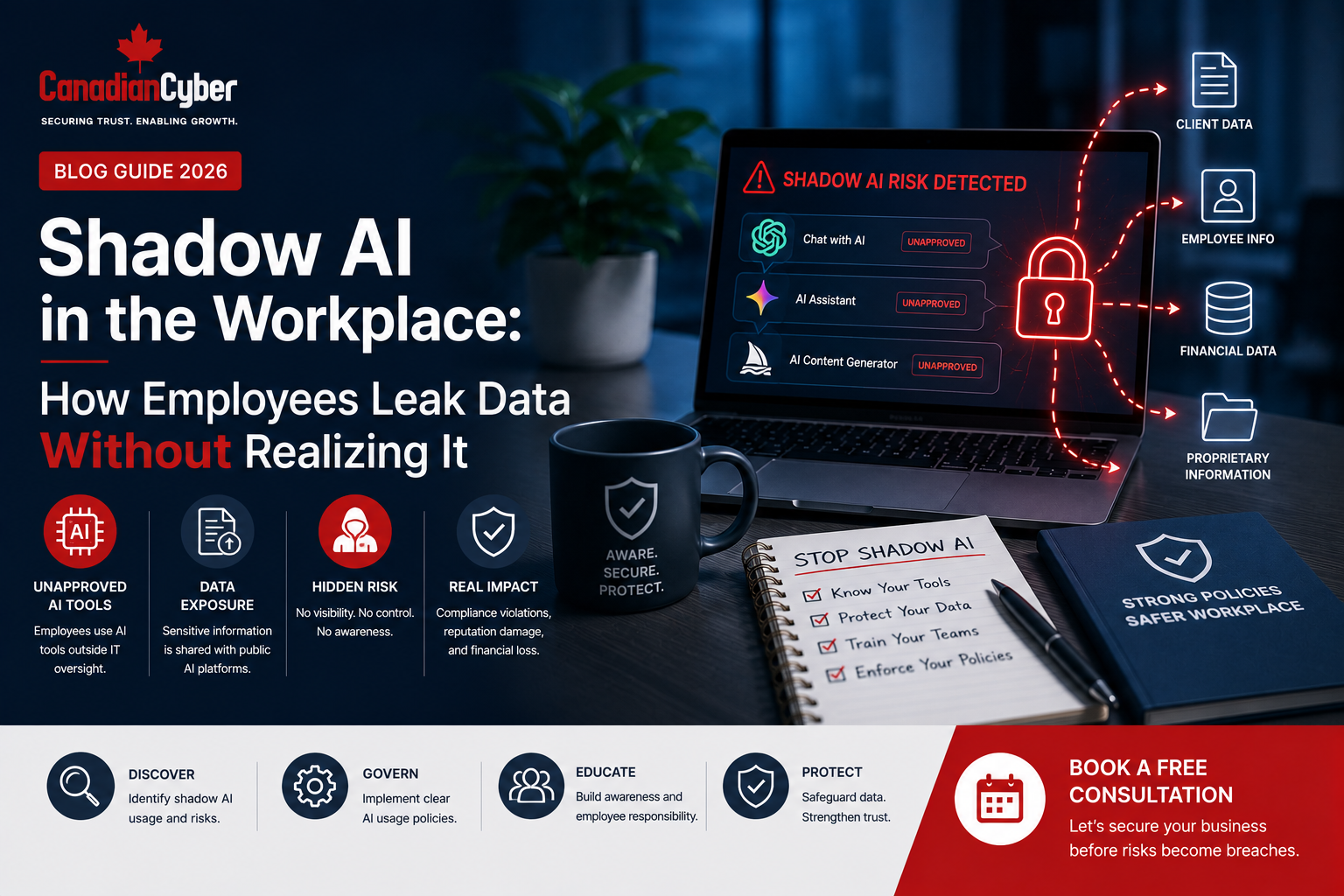
AI tools can help employees work faster, but unapproved AI use can quietly expose customer data, employee information, source code, contracts, financial records, healthcare details, and confidential business information.
Quick Answer
Shadow AI happens when employees use unapproved AI tools at work without the company’s knowledge, approval, monitoring, or governance.
It can create data leakage, privacy, confidentiality, compliance, legal, and customer trust risks. Employees may accidentally paste customer records, support tickets, source code, contracts, financial data, meeting notes, employee information, or confidential strategy into AI tools.
Practical takeaway: Organizations should create an AI acceptable use policy, approve safe tools, train employees, review AI vendors, limit sensitive data sharing, monitor risky usage, and define human review requirements.
Quick Snapshot
| Shadow AI Area | What Can Go Wrong |
|---|---|
| Support Tickets | Employees may paste customer data, screenshots, account details, or technical issues into unapproved AI tools. |
| Meeting Notes | AI note tools may capture sensitive discussions about customers, employees, incidents, legal issues, or strategy. |
| Source Code | Developers may expose proprietary code, secrets, tokens, logs, or architecture details. |
| Contracts and Finance | Employees may upload pricing, invoices, legal terms, forecasts, or confidential negotiations. |
| HR Information | Managers may expose employee personal information, performance notes, salary details, or complaints. |
| AI Governance | Without policy, vendor review, training, and monitoring, AI use becomes invisible risk. |
Why Shadow AI Is Becoming a Workplace Security Risk
Artificial intelligence tools are now part of everyday work. Employees use AI to write emails, summarize documents, clean up meeting notes, analyze spreadsheets, draft proposals, review code, and respond faster to customers.
For many teams, AI feels helpful, fast, and harmless. But there is a hidden risk. Employees may be using AI tools that the company has not approved, reviewed, monitored, or governed.
The employee may not be trying to break rules. They may not be trying to leak data. They may simply be trying to save time. But without clear rules, even well-meaning employees can accidentally expose sensitive company, customer, employee, financial, healthcare, legal, or confidential data.
Shadow AI happens when useful tools become invisible data-sharing channels.
Who This Guide Is For
- Employees using AI at work.
- Executives, founders, HR teams, IT teams, and security leaders.
- Compliance, privacy, and legal teams.
- Customer support, finance, sales, marketing, product, and software development teams.
- SaaS companies, professional services firms, Healthcare SaaS companies, and FinTech companies.
- Organizations preparing AI governance policies, ISO 42001 readiness, ISO 27001, or SOC 2 evidence.
What Is Shadow AI?
Shadow AI is the workplace use of AI tools without formal approval, visibility, or governance. The risk is not that AI is always bad. The risk is that the organization may not know which tools are being used, what data is being entered, where data is stored, whether the vendor uses data for training, who can access outputs, whether customer data is involved, or whether legal commitments are being violated.
Shadow AI may include employees using:
Practical rule: AI tools should be useful, but they should not become invisible data-sharing channels.
Why Employees Use Shadow AI
Most employees use AI for practical reasons. They want to work faster, write more clearly, summarize information, solve problems, and save time.
Employees may use AI to:
summarize meeting notes
explain a technical document
draft a policy
clean up spreadsheet data
generate code
debug an error
prepare a presentation
Often, the employee thinks, “I am not sharing anything serious,” “I removed the customer name, so it is fine,” “This tool is popular, so it must be safe,” or “Everyone is using AI anyway.” That is how accidental leakage happens.
Most Shadow AI risk comes from convenience, not bad intentions.
How Employees Leak Data Without Realizing It
| Workplace Action | Hidden Data Leakage Risk |
|---|---|
| Pasting Customer Support Tickets | Tickets may include customer names, account IDs, screenshots, billing details, system errors, healthcare-related details, employee information, or confidential complaints. |
| Uploading Documents for Summaries | Documents may contain pricing, legal terms, personal data, customer requirements, financial forecasts, security details, or internal strategy. |
| Using AI Meeting Note Tools | Meeting tools may capture sensitive discussions about customers, employees, incidents, legal matters, sales negotiations, roadmaps, or financial performance. |
| Asking AI to Review Source Code | Code, logs, API keys, error messages, architecture details, vulnerabilities, customer identifiers, and internal logic may be exposed. |
| Using AI for HR or Employee Issues | HR notes, salary details, complaints, disciplinary details, health-related information, or confidential employee matters may leave approved systems. |
Practical rule: If the information would not be posted publicly, it should not be pasted into an unapproved AI tool.
Common Data Types Employees Accidentally Share With AI
| Data Type | Example |
|---|---|
| Customer Data | Names, emails, account details, tickets, contracts. |
| Employee Data | HR notes, salary details, performance issues. |
| Financial Data | Forecasts, invoices, pricing, payment records. |
| Healthcare Data | Patient names, appointment details, care workflow notes. |
| Legal Data | Contracts, disputes, legal advice, negotiation terms. |
| Source Code | Proprietary code, secrets, API keys, system logic. |
| Security Data | Vulnerabilities, incident notes, audit findings. |
| Business Strategy | Roadmaps, sales plans, acquisition plans. |
Why Shadow AI Is a Business Risk
Shadow AI can create risks beyond cybersecurity. It can affect privacy, contracts, compliance, legal duties, customer trust, and business decisions.
Data Leakage Risk
Sensitive information may leave approved systems and enter an AI vendor platform.
Privacy Risk
Personal data may be processed without proper review, consent, contract, or retention controls.
Contract Risk
Customer contracts may restrict where data can be processed.
Compliance Risk
SOC 2, ISO 27001, ISO 42001, ISO 27017, ISO 27018, or cyber insurance evidence may be affected.
Legal Risk
Employees may paste legally sensitive information into tools not approved for privileged or confidential work.
Accuracy Risk
AI outputs can be wrong, incomplete, biased, or misleading if employees rely on them without review.
Shadow AI is not only an IT issue. It is a privacy, legal, compliance, customer trust, and business risk.
Warning Signs of Shadow AI in the Workplace
Organizations may already have Shadow AI if employees are using free AI tools with work content, uploading documents into AI summarizers, using AI meeting bots without approval, installing AI browser extensions, or using AI to answer customer emails.
- Employees paste support tickets into chatbots.
- Employees use AI to review source code.
- Employees summarize contracts with unapproved tools.
- Employees process HR information through AI.
- Employees use personal AI accounts for work tasks.
- Employees copy AI-generated answers into security questionnaires.
- Employees use AI without checking accuracy or policy rules.
What Employees Should Never Put Into Unapproved AI Tools
Practical rule: When in doubt, leave the sensitive details out and ask the security or compliance team what is allowed.
Awareness Message for Employees
- Use approved AI tools only.
- Do not paste customer, employee, financial, healthcare, legal, source code, security, or confidential information into unapproved AI tools.
- Remove sensitive details before using AI.
- Do not use AI outputs without human review.
- Report accidental sharing immediately.
- Ask before using a new AI tool for work.
How Organizations Can Reduce Shadow AI Risk
| Action | Why It Helps |
|---|---|
| Create an AI Acceptable Use Policy | Explains approved tools, prohibited data, review requirements, incident reporting, and employee responsibilities. |
| Build an Approved AI Tool List | Gives employees safe options instead of forcing them into hidden tool use. |
| Train Employees | Uses real examples such as support tickets, meeting notes, contracts, source code, HR records, and financial information. |
| Review AI Vendors | Checks security controls, privacy terms, retention, model training terms, subprocessors, location, access, and incident notification. |
| Monitor and Improve | Keeps AI usage risk under review as tools, teams, and data flows change. |
The goal is not to ban AI blindly. The goal is to use AI safely.
How Shadow AI Connects to ISO 27001, SOC 2, and ISO 42001
| Framework | Shadow AI Impact |
|---|---|
| ISO 27001 | May affect asset management, supplier relationships, information classification, acceptable use, incident management, risk assessment, awareness training, and data leakage prevention. |
| SOC 2 | May affect security controls, confidentiality commitments, privacy controls, vendor risk, change management, incident response, customer data protection, and employee training. |
| ISO 42001 | Connects directly to AI system inventory, AI risk assessment, AI vendor review, human oversight, AI acceptable use, monitoring, incident handling, and accountability. |
Practical Shadow AI Checklist
| Question | Ready? |
|---|---|
| Do we know which AI tools employees use? | |
| Do we have an AI acceptable use policy? | |
| Do employees know what data cannot be entered into AI tools? | |
| Do we have an approved AI tool list? | |
| Are AI vendors reviewed before use? | |
| Are AI meeting tools controlled? | |
| Are AI browser extensions reviewed? | |
| Are support teams trained on AI and customer data? | |
| Are developers trained on AI and source code handling? | |
| Do we have an AI incident reporting process? | |
| Is AI governance reviewed by leadership? |
Common Mistakes to Avoid
- Pretending employees are not using AI. If AI is useful, employees will find ways to use it. Ignoring it creates more risk.
- Only blocking tools without giving guidance. Blocking may reduce some risk, but employees still need clear rules and approved options.
- Not reviewing AI vendors. AI vendors may store, process, or reuse data in ways the company does not expect.
- No training for support teams. Support teams often handle customer tickets, screenshots, logs, and attachments.
- No rules for AI meeting notes. Meeting tools may capture sensitive discussions without proper approval.
- Letting AI write customer or legal answers without review. AI outputs may be inaccurate or create unsupported commitments.
- No incident process. Employees should know what to do if they accidentally share sensitive data with an AI tool.
How Canadian Cyber Helps
Canadian Cyber helps organizations reduce Shadow AI risk through practical cybersecurity governance, AI policy development, ISO 42001 readiness, ISO 27001 implementation, SOC 2 readiness, cybersecurity assessments, and vCISO support.
Canadian Cyber can support:
Canadian Cyber’s ISMS SharePoint Solution
Canadian Cyber’s ISMS SharePoint Solution can help organizations manage AI governance inside Microsoft 365.
It can organize an AI tool inventory, approved AI tool list, AI vendor register, AI risk register, AI acceptable use policy, AI incident register, employee training evidence, policy acknowledgment records, vendor review evidence, management review dashboard, corrective action tracker, and client-ready AI governance evidence.
Practical rule: This helps organizations move from uncontrolled Shadow AI to structured, evidence-backed AI governance.
Frequently Asked Questions
What is Shadow AI?
Shadow AI is the use of AI tools at work without approval, visibility, or governance from the organization.
Why is Shadow AI risky?
Shadow AI is risky because employees may accidentally share customer data, employee data, source code, contracts, healthcare-related data, financial records, or confidential information with unapproved AI tools.
Are employees intentionally leaking data through AI?
Usually no. Most Shadow AI risk comes from employees trying to work faster without realizing the data security, privacy, legal, or compliance impact.
What should employees avoid putting into AI tools?
Employees should avoid entering customer data, personal data, patient-related information, financial records, contracts, source code, passwords, API keys, security incidents, legal matters, and confidential business information into unapproved AI tools.
How can companies reduce Shadow AI?
Companies can reduce Shadow AI by creating an AI acceptable use policy, approving safe AI tools, training employees, reviewing AI vendors, monitoring usage risk, and creating an AI incident reporting process.
Can Canadian Cyber help with Shadow AI governance?
Yes. Canadian Cyber can support Shadow AI risk assessments, AI acceptable use policies, AI vendor reviews, ISO 42001 readiness, ISO 27001 and SOC 2 alignment, vCISO support, and SharePoint ISMS implementation.
Takeaway
AI can help employees work faster. But without governance, AI can also become an invisible data leakage channel.
Shadow AI happens when employees use AI tools without approval, training, or visibility. The risk is not always malicious. Often, it is accidental. An employee pastes a support ticket. A manager uploads meeting notes. A developer shares code. A finance team summarizes a contract. A healthcare team processes sensitive workflow details. A sales team drafts security answers.
The solution is not fear. The solution is awareness, approved tools, clear rules, vendor review, employee training, and AI governance.
Worried About Shadow AI in Your Workplace?
Canadian Cyber can help you create a safe and practical AI governance program. We support Shadow AI risk assessments, AI acceptable use policies, ISO 42001 readiness, ISO 27001 implementation, SOC 2 readiness, vCISO services, cybersecurity assessments, incident response planning, and ISMS SharePoint Solution implementation. You can also learn more about senior advisory support through Waqar Mehboob’s profile.
Stay Connected With Canadian Cyber
Follow Canadian Cyber for practical guidance on Shadow AI, AI governance, ISO 42001, ISO 27001, SOC 2, data leakage prevention, cybersecurity awareness, SharePoint ISMS, cybersecurity assessments, and vCISO support.