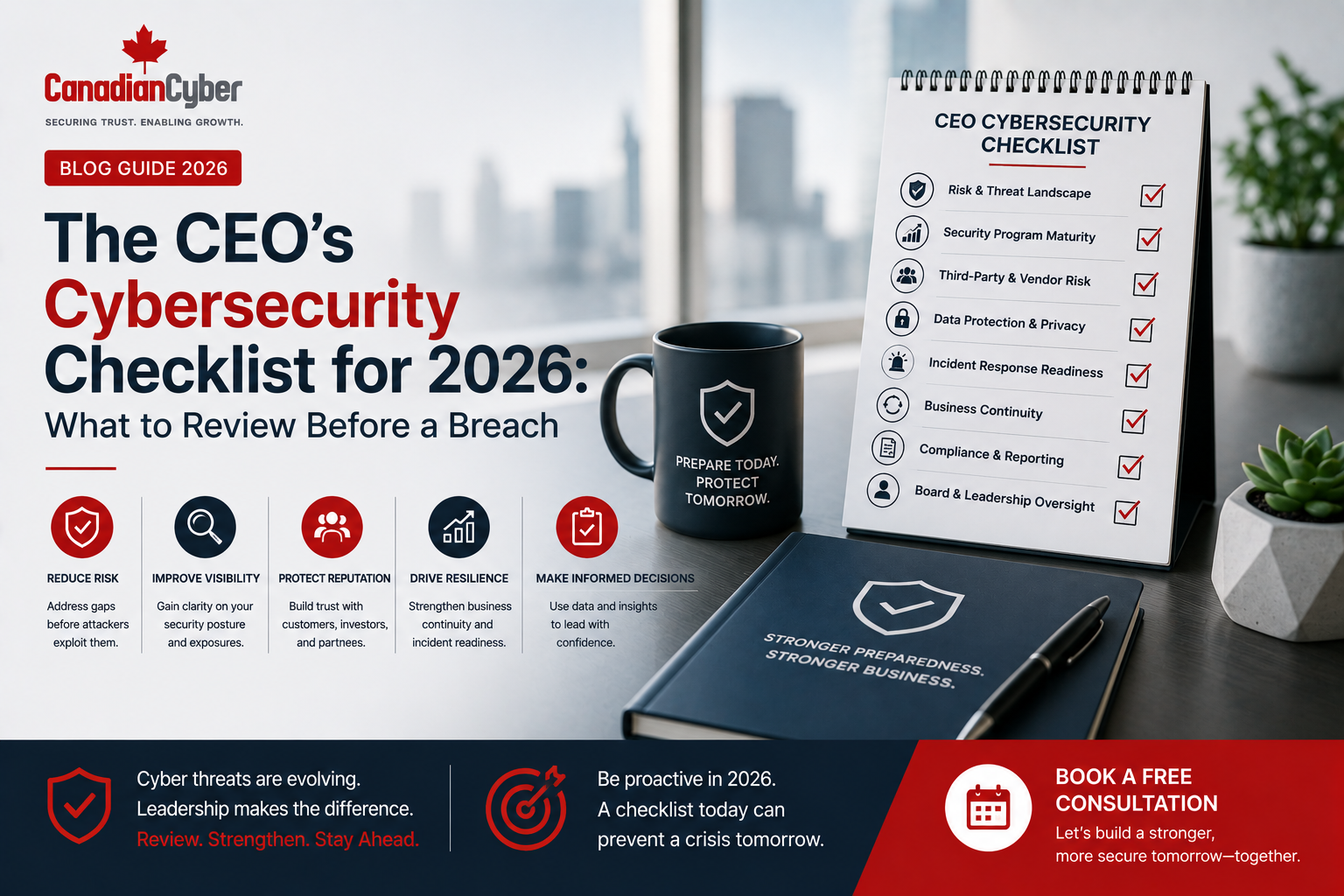
Cybersecurity Awareness • CEO Checklist • Breach Readiness • Executive Cyber Risk • 2026
The CEO’s Cybersecurity Checklist for 2026: What to Review Before a Breach
Most CEOs do not need to become cybersecurity engineers. But they do need to understand whether the organization’s most important cyber risks are owned, tested, evidenced, and reviewed before something goes wrong.
Quick Answer
A CEO should review cybersecurity by checking whether the organization has clear risk ownership, strong access controls, tested backups, an incident response plan, cyber insurance readiness, vendor risk management, employee training, secure cloud controls, AI governance, board-level reporting, and evidence that security controls are actually operating.
The goal is not for the CEO to manage every technical detail. The goal is to make sure the business is prepared, accountable, and able to respond quickly if a breach happens.
Practical takeaway: Cybersecurity is a business risk, and CEOs should review it before a breach, not after one.
CEO Cybersecurity Review Snapshot
| Area | CEO Review Question | What to Ask For |
|---|---|---|
| Cyber Risks | Do we know our top cyber risks? | Risk register and risk treatment plan. |
| Access Control | Can we prove access is reviewed? | MFA report and access review evidence. |
| Backups | Have restores been tested? | Backup reports and restore test evidence. |
| Incident Response | Have we practiced breach response? | Incident response plan and tabletop report. |
| AI Governance | Do we know how AI is used? | AI policy, inventory, and vendor review. |
Why CEOs Must Review Cybersecurity in 2026
Most CEOs do not need to configure firewalls, read every security log, or personally manage patches, passwords, backups, and cloud settings. But CEOs do need to understand one thing clearly: cybersecurity is a business risk.
A breach can affect revenue, customers, contracts, insurance, regulators, employees, board confidence, investor trust, and brand reputation. In 2026, cybersecurity is no longer just an IT discussion. It is an executive responsibility.
The better question is not, “Do we have security tools?” The better question is, “Can we prove that our most important risks are understood, owned, tested, and reviewed before something goes wrong?”
The CEO does not need to run cybersecurity, but the CEO must make sure cybersecurity is governed.
Who This Guide Is For
- CEOs, founders, COOs, CFOs, and board members.
- Startup leaders and SaaS executives.
- Professional services firms, FinTech leaders, and HealthTech leaders.
- AI company founders and MSP owners.
- Businesses preparing for enterprise customers.
- Companies worried about cyber insurance renewal.
- Organizations that want to review cybersecurity before a breach.
1. Do We Know Our Most Important Cyber Risks?
A CEO should not only ask, “Are we secure?” That question is too broad. A better question is, “What are our top cybersecurity risks right now?”
| Leadership Should Know | Evidence to Ask For |
|---|---|
| Top risks, risk owners, treatment actions, accepted risks, overdue risks, customer impact, revenue impact, and compliance impact. | Risk register, top risk summary, risk treatment plan, accepted risk list, management review notes, and risk owner assignments. |
CEO question: Can my team explain our top five cyber risks in plain English?
2. Are Access Controls Actually Reviewed?
Many breaches involve weak or excessive access. CEOs should ask whether the organization knows who has access to important systems.
This includes:
contractors
administrators
vendors
support users
developers
former employees
shared accounts
| What to Review | Evidence to Ask For |
|---|---|
| MFA, admin access, access reviews, former employee removal, contractor access, support access, and privileged account monitoring. | MFA report, privileged access review, user access review, offboarding evidence, admin account list, contractor review, and support access review. |
Trust starts with knowing who can access what.
3. Are Backups Tested, Not Just Configured?
Many companies believe they are protected because backups exist. That is not enough. A backup is only useful if it can be restored.
| What to Review | Evidence to Ask For |
|---|---|
| Backup coverage, ransomware protection, restore testing, recovery time, recovery ownership, and documented recovery steps. | Backup reports, restore test evidence, disaster recovery plan, recovery time expectations, backup owner list, and incident recovery procedure. |
CEO question: If ransomware hit today, could we restore critical systems?
4. Do We Have a Tested Incident Response Plan?
A breach response should not begin with confusion. The organization should know who does what before the breach happens.
| What to Review | Evidence to Ask For |
|---|---|
| Incident response plan, response team, roles, legal contacts, cyber insurance contacts, customer communication, tabletop exercises, and lessons learned. | Incident response plan, escalation matrix, severity levels, tabletop report, incident register, lessons learned, and corrective action tracker. |
An untested incident response plan is only a document.
5. Are We Ready for Cyber Insurance Questions?
Cyber insurance applications and renewals often ask about controls. CEOs should know whether the company can prove those controls.
Common areas reviewed include:
endpoint protection
backups
incident response
security training
access reviews
vendor risk
logging and monitoring
Practical rule: Cyber insurance answers should be based on proof, not assumptions.
6. Are Employees Trained for Real Risks?
Security awareness should not be a once-a-year checkbox. Employees should know how to handle phishing, suspicious activity, customer data, fraud, secure development, and AI tool use.
Security training should prepare employees for the risks they actually face.
7. Are Vendors and Cloud Providers Reviewed?
Your company’s risk includes your vendors. A vendor breach, outage, or weak control can affect your customers.
| What to Review | Evidence to Ask For |
|---|---|
| Critical vendors, customer data vendors, production vendors, AI tools, DPAs, vendor assurance reports, subprocessors, and repeat reviews. | Vendor register, critical vendor list, subprocessor list, vendor assessments, DPA records, SOC 2 or ISO reports, AI vendor reviews, and review dates. |
CEO question: Do we know which vendors could affect customer data or service availability?
8. Are Cloud Systems Securely Managed?
Most modern businesses rely on cloud systems. The CEO does not need to inspect cloud settings, but leadership should know cloud security is governed.
Using a major cloud provider does not automatically make the business secure.
9. Are AI Tools Being Governed?
AI use is now a business reality. Employees may use AI tools for writing, coding, support, analysis, meeting notes, customer communication, or document review. Without governance, AI can create data leakage, privacy, confidentiality, and trust risks.
| What to Review | Evidence to Ask For |
|---|---|
| Approved AI tools, customer data restrictions, prompt and output storage, vendor training terms, feature reviews, human oversight, AI risks, and AI incidents. | AI acceptable use policy, AI tool inventory, AI vendor review, AI risk assessment, AI feature review, prompt rules, AI training records, and human oversight procedure. |
AI governance should begin before sensitive data enters AI tools.
10. Are Security Metrics Reported to Leadership?
CEOs need a simple cybersecurity dashboard, not technical noise. Reporting should help leadership make decisions.
Useful leadership metrics may include:
11. Are We Prepared for Customer Security Reviews?
Enterprise customers may ask for security evidence before signing. This is common for SaaS, FinTech, HealthTech, AI platforms, MSPs, and professional services firms.
| What to Review | Evidence to Ask For |
|---|---|
| Approved questionnaire answers, SOC 2 or ISO 27001 evidence, security overview, client-ready evidence room, sales response process, legal review, and proof for access, vendors, incident response, and data protection. | Security questionnaire response library, client-ready evidence pack, SOC 2 roadmap, ISO 27001 certificate or roadmap, vendor list, incident response summary, and access control summary. |
Practical rule: Cybersecurity readiness can become a sales advantage when evidence is organized before buyers ask.
12. Have We Tested Our Controls Before Someone Else Does?
The worst time to discover weak controls is during a breach, customer review, insurance renewal, or certification audit. The CEO should ask whether independent testing has been performed.
Testing may include:
ISO 27001 internal audit
SOC 2 readiness review
Microsoft 365 security review
incident response tabletop
vendor risk review
cloud security review
penetration test
Finding gaps internally is better than explaining them externally.
CEO Cybersecurity Review Checklist for 2026
| Area | CEO Review Question | Ready? |
|---|---|---|
| Cyber Risks | Do we know our top cyber risks? | |
| Access Control | Can we prove access is reviewed? | |
| Backups | Have restores been tested? | |
| Incident Response | Have we practiced breach response? | |
| Cyber Insurance | Can we support insurance answers with evidence? | |
| Training | Are employees trained for real risks? | |
| Vendors | Do we review critical vendors? | |
| Cloud Security | Is cloud access and monitoring controlled? | |
| AI Governance | Do we know how AI is used? | |
| Testing | Have controls been tested before a breach? |
Common CEO Mistakes to Avoid
- Assuming IT has everything covered. IT may manage tools, but cybersecurity risk belongs to the business.
- Asking only “Are we secure?” Ask for risks, evidence, owners, and decisions.
- Ignoring vendor risk. A third-party failure can become your customer problem.
- Treating cyber insurance as protection. Insurance may help with recovery, but it does not prevent incidents.
- Not testing incident response. A plan that has never been practiced may fail under pressure.
- Waiting for a breach to review controls. Cybersecurity should be reviewed before the crisis.
- No AI governance. Uncontrolled AI use can create data, privacy, confidentiality, and customer trust risks.
- No evidence. If the company cannot prove controls operate, customers, auditors, and insurers may not trust the answer.
How Canadian Cyber Helps
Canadian Cyber helps executives and founders understand cybersecurity risk before a breach happens. We support practical cybersecurity governance, evidence readiness, compliance preparation, incident response planning, and executive-level security oversight.
Canadian Cyber can support:
Canadian Cyber’s ISMS SharePoint Solution
Canadian Cyber’s ISMS SharePoint Solution helps organizations manage cybersecurity governance and evidence inside Microsoft 365.
It can organize risk registers, policy libraries, control registers, evidence libraries, vendor registers, AI governance registers, access review trackers, incident registers, corrective action trackers, training evidence, management review dashboards, client-ready evidence rooms, Power Automate reminders, Teams notifications, and auditor-ready views.
Practical rule: This gives CEOs and leadership teams better visibility into risks, evidence, decisions, and readiness.
Frequently Asked Questions
What should a CEO review for cybersecurity in 2026?
A CEO should review top cyber risks, access controls, backups, incident response, employee training, vendor risk, cloud security, AI governance, cyber insurance readiness, customer security evidence, and control testing.
Does the CEO need to understand technical cybersecurity details?
No. The CEO does not need to manage technical tools, but they should understand business risk, ownership, evidence, response readiness, and leadership decisions.
Why is incident response important for CEOs?
During a breach, CEOs may need to make decisions about customers, legal, insurance, operations, communication, and reputation. A tested incident response plan helps leadership respond calmly.
What is the biggest cybersecurity mistake executives make?
One major mistake is assuming cybersecurity is only IT’s responsibility. Cybersecurity affects business risk, customer trust, contracts, insurance, and leadership accountability.
How often should leadership review cybersecurity?
Leadership should review cybersecurity regularly through management reporting, risk reviews, incident updates, vendor risk reviews, and formal management review meetings.
Can Canadian Cyber help executives review cybersecurity readiness?
Yes. Canadian Cyber supports CEO cybersecurity readiness reviews, cybersecurity assessments, vCISO services, incident response tabletop exercises, ISO 27001 internal audits, SOC 2 readiness, and ISMS SharePoint Solution implementation.
Takeaway
Cybersecurity in 2026 is a leadership issue. CEOs do not need to become technical specialists, but they do need to ask better questions.
Do we know our risks? Can we prove access is controlled? Have we tested backups? Have we practiced incident response? Are vendors reviewed? Are employees trained? Is AI governed? Can we support customer and insurance answers with evidence? Have we tested controls before a breach?
A breach is not the time to discover that the answers are unclear. The best CEOs review cybersecurity before the crisis.
Is Your Leadership Team Ready for a Breach?
Canadian Cyber can help. We provide cybersecurity assessments, CEO readiness reviews, vCISO services, incident response tabletop exercises, cyber insurance readiness, ISO 27001 implementation, ISO 27001 internal audits, SOC 2 readiness, ISO 42001 AI governance, and ISMS SharePoint Solution implementation.
Stay Connected With Canadian Cyber
Follow Canadian Cyber for practical guidance on cybersecurity readiness, executive cyber risk, data breach preparation, ISO 27001, SOC 2, ISO 42001, ISO 27017, ISO 27018, SharePoint ISMS, cybersecurity assessments, and vCISO support.