ISO 27001 • Canadian MSP • Lean Audit Plan • ISMS • Client Trust
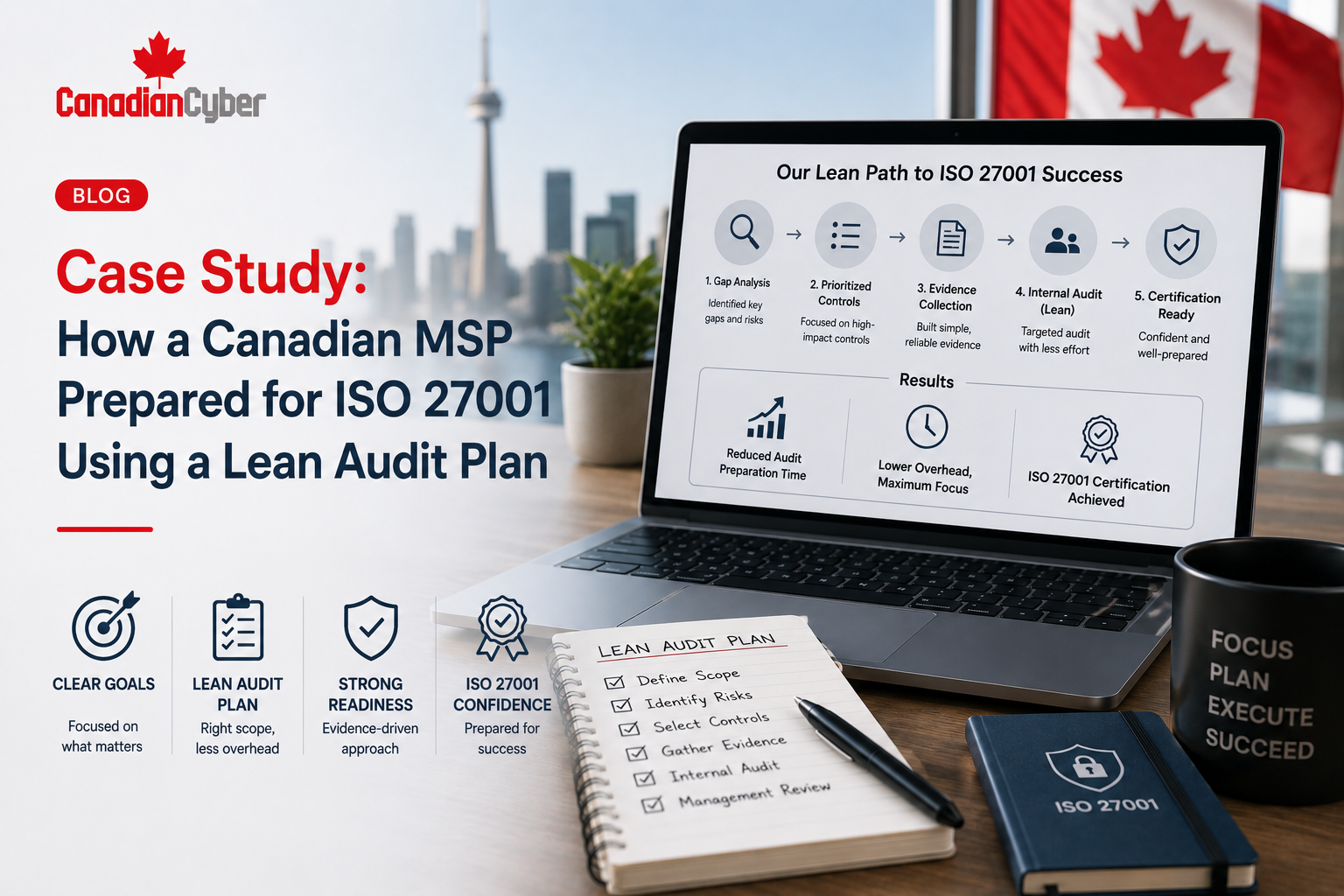
Case Study: How a Canadian MSP Prepared for ISO 27001 Using a Lean Audit Plan
A Canadian MSP does not need a bloated ISO 27001 project to prove client trust. A lean audit plan helps MSPs focus on the controls that matter most: privileged access, client environments, vendor tools, incident response, backups, evidence, and leadership review.
Quick Snapshot
| Case Study Area | What Improved |
|---|---|
| Business Context | Canadian MSP supporting small and mid-sized clients across Microsoft 365, endpoints, backups, and cloud tools. |
| Main Challenge | ISO 27001 readiness felt too large, expensive, and disruptive. |
| Lean Audit Strategy | Focus on high-risk controls first, assign owners, collect evidence monthly, and use SharePoint as the ISMS hub. |
| Biggest Risk | Technician access, remote management tools, vendor dependencies, client data, and backup recovery. |
| Outcome | The MSP built a practical ISO 27001 readiness path without overwhelming the team. |
Introduction
The Canadian MSP had a familiar problem.
Clients trusted them with privileged access. Technicians managed Microsoft 365 tenants. The helpdesk handled sensitive tickets. Backup tools protected client recovery. Remote management tools touched many endpoints.
Then larger clients started asking harder questions.
- Do you have ISO 27001?
- How do you control technician access?
- Do you review vendor tools?
- Can you prove your incident response process?
- Do you test backups?
- Where is your evidence stored?
- Does leadership review security risks?
The MSP knew ISO 27001 could help. But the team was worried about scope, cost, workload, and audit complexity.
So they chose a lean audit plan. Not a shortcut. Not a watered-down ISMS. A focused plan built around real MSP risk and client trust.
This case study shows how a Canadian MSP prepared for ISO 27001 using a lean audit plan that worked for a small team. The company is fictional, but the approach is realistic for MSPs, MSSPs, IT providers, and cloud service firms.
Want ISO 27001 Without Overwhelming Your MSP Team?
Canadian Cyber helps Canadian MSPs build lean ISO 27001 readiness plans, SharePoint ISMS workspaces, access review workflows, vendor registers, evidence vaults, internal audit trackers, and management review packs.
Meet the MSP
Let’s call the company MapleBridge Managed Services.
MapleBridge supported Canadian SMBs across:
- Microsoft 365 administration
- Entra ID support
- endpoint management
- backup monitoring
- helpdesk support
- patch management
- remote access tools
- cloud administration
- incident response support
The company had strong technical skills. But ISO 27001 required more than technical work.
It required a structured ISMS with scope, risk assessment, policies, control ownership, evidence, internal audit, management review, corrective actions, and continual improvement.
The Starting Problem
MapleBridge had many controls already. But they were not organized for ISO 27001.
Existing Strengths
| Area | Existing Practice |
|---|---|
| MFA | Enabled for internal users and admin accounts. |
| Endpoint Protection | Deployed on company devices. |
| Ticketing | Client requests tracked in the helpdesk system. |
| Backups | Client backups monitored through a backup platform. |
| Remote Management | RMM tool used for support. |
| Password Vault | Credentials stored in a vault. |
Readiness Gaps
| Gap | Why It Mattered |
|---|---|
| ISO scope not defined | The team did not know what was included. |
| Risk register missing | MSP-specific risks were not formally tracked. |
| Access reviews inconsistent | Technician access evidence was weak. |
| Vendor reviews informal | Critical MSP tool risk was not evidenced. |
| Restore testing evidence inconsistent | Recovery confidence was hard to prove. |
| Incident response untested | Client-impact scenarios were not rehearsed. |
| Evidence scattered | Audit preparation would be slow. |
The team did not need a massive project. It needed focus.
The Lean Audit Plan Strategy
The MSP created a lean ISO 27001 audit plan based on three rules.
| Rule | How It Worked |
|---|---|
| Focus on Client Trust Risk First | Prioritize technician access, remote tools, password vault, backup monitoring, vendor tools, incident response, and client data. |
| Collect Evidence Monthly | Owners collect evidence each month instead of waiting for audit season. |
| Use SharePoint as the ISMS Hub | Policies, risk register, evidence vault, vendor register, access reviews, audit tracker, corrective actions, and management review records live in one practical workspace. |
Lean does not mean weak. Lean means less waste, clear owners, focused evidence, simple dashboards, practical controls, and stronger client trust.
Step 1: Define a Practical ISO 27001 Scope
The MSP did not try to include every client system as if it owned them completely. Instead, the scope focused on the managed service processes MapleBridge controlled.
| Scope Area | Why It Was Included |
|---|---|
| Internal MSP Operations | Core business and security governance. |
| Helpdesk and Ticketing | Client information and support workflow. |
| Technician Access | Privileged access to client systems. |
| Remote Management Platform | High-risk MSP tool. |
| Password Vault | Sensitive credential storage. |
| Backup Monitoring Process | Client recovery support. |
| Incident Response | Internal and client-impacting incidents. |
Scope statement example:
“The ISMS covers MapleBridge Managed Services’ internal operations and managed service delivery processes, including helpdesk workflows, technician access management, remote monitoring and management tools, password vault usage, backup monitoring processes, vendor management, incident response, policy governance, risk management, and evidence management used to deliver services to Canadian business clients.”
Practical rule: For MSPs, ISO 27001 scope should explain both what the MSP controls and where client responsibility begins.
Step 2: Build an MSP Risk Register
The MSP created a simple risk register. It focused on real MSP risks, not generic textbook risks.
| MSP Risk | Treatment |
|---|---|
| Technician account compromise affects multiple clients | MFA, privileged access reviews, session logging. |
| Remote management tool misuse | RMM access review and admin restrictions. |
| Password vault compromise | MFA, role restrictions, vault access review. |
| Former technician retains access | Offboarding checklist and access removal evidence. |
| Critical MSP vendor breach | Vendor review and incident escalation plan. |
| Backup restore failure | Restore testing and backup exception tracking. |
Leadership could finally see which risks mattered most. That helped budget, planning, and audit readiness.
Step 3: Assign Control Owners Early
The MSP did not wait until audit time to assign owners. Each major control area had a named owner and backup owner.
| Control Area | Primary Owner | Backup Owner |
|---|---|---|
| Access Reviews | IT Operations Lead | Senior Technician |
| Vendor Reviews | Operations Manager | Finance Lead |
| Policy Reviews | ISMS Coordinator | vCISO |
| Backup Evidence | Backup Lead | Infrastructure Technician |
| Incident Response | vCISO | Service Manager |
| Management Review | Executive Sponsor | General Manager |
A lean audit plan works only when ownership is clear.
Need a Lean ISO 27001 Ownership Matrix?
Canadian Cyber helps MSPs map control owners, backup owners, evidence requirements, review dates, and SharePoint dashboards so ISO 27001 stays manageable.
Step 4: Prioritize Technician Access Reviews
For an MSP, access control is one of the highest-impact audit areas.
MapleBridge reviewed access to:
- Microsoft 365 admin accounts
- client tenant access
- remote management platform
- ticketing system
- password vault
- backup console
- endpoint security console
- cloud admin portals
| Monthly Access Evidence | Why It Mattered |
|---|---|
| MFA report | Shows access protection. |
| RMM admin export | Shows who can access endpoints. |
| Password vault access review | Shows credential control. |
| Ticketing system user list | Shows support data access. |
| Backup console user list | Shows recovery system access. |
| Offboarding samples | Proves access removal. |
The MSP could prove that privileged access was reviewed. This became a strong client trust point.
Step 5: Review Critical MSP Vendors
The MSP’s vendor tools were central to client service. That made vendor risk a priority.
Critical vendors included:
- remote monitoring and management tool
- ticketing platform
- password vault
- backup provider
- endpoint security platform
- email security provider
- cloud provider
- documentation platform
| Vendor Review Question | Evidence |
|---|---|
| What service does the vendor provide? | Vendor register. |
| Does the vendor handle client data? | Data handled field. |
| Does the vendor have privileged access? | Access level field. |
| Is the vendor critical? | Criticality rating. |
| Has assurance been reviewed? | SOC 2, ISO 27001, or questionnaire. |
| When is the next review? | Review date. |
Stronger client message:
“Our critical vendors are risk-rated, reviewed, assigned owners, and tracked through our ISMS.”
Step 6: Create a Lean Evidence Vault in SharePoint
Evidence was scattered before the project. The MSP created a SharePoint evidence vault with simple metadata.
| Evidence Folder / View | Examples |
|---|---|
| Access Control | MFA, access reviews, offboarding. |
| Vendor Risk | Vendor register, assurance reviews. |
| Incident Response | Plan, tabletop, lessons learned. |
| Backup Recovery | Backup reports, restore tests. |
| Risk Management | Risk register and treatment evidence. |
| Management Review | Minutes, decisions, action items. |
Evidence Naming Examples
- AccessControl-RMMAdminReview-2026-Q2.pdf
- AccessControl-PasswordVaultReview-2026-Q2.xlsx
- VendorRisk-BackupProviderReview-2026-Q2.pdf
- IncidentResponse-MSPTabletop-2026-Q2.docx
- ManagementReview-ISO27001-2026-Q2.pdf
Use SharePoint as Your MSP ISMS Hub
Canadian Cyber’s ISMS SharePoint solution helps MSPs manage ISO 27001 evidence, risks, controls, vendors, policies, internal audit, and management review in one practical workspace.
Step 7: Run a Lean Internal Audit
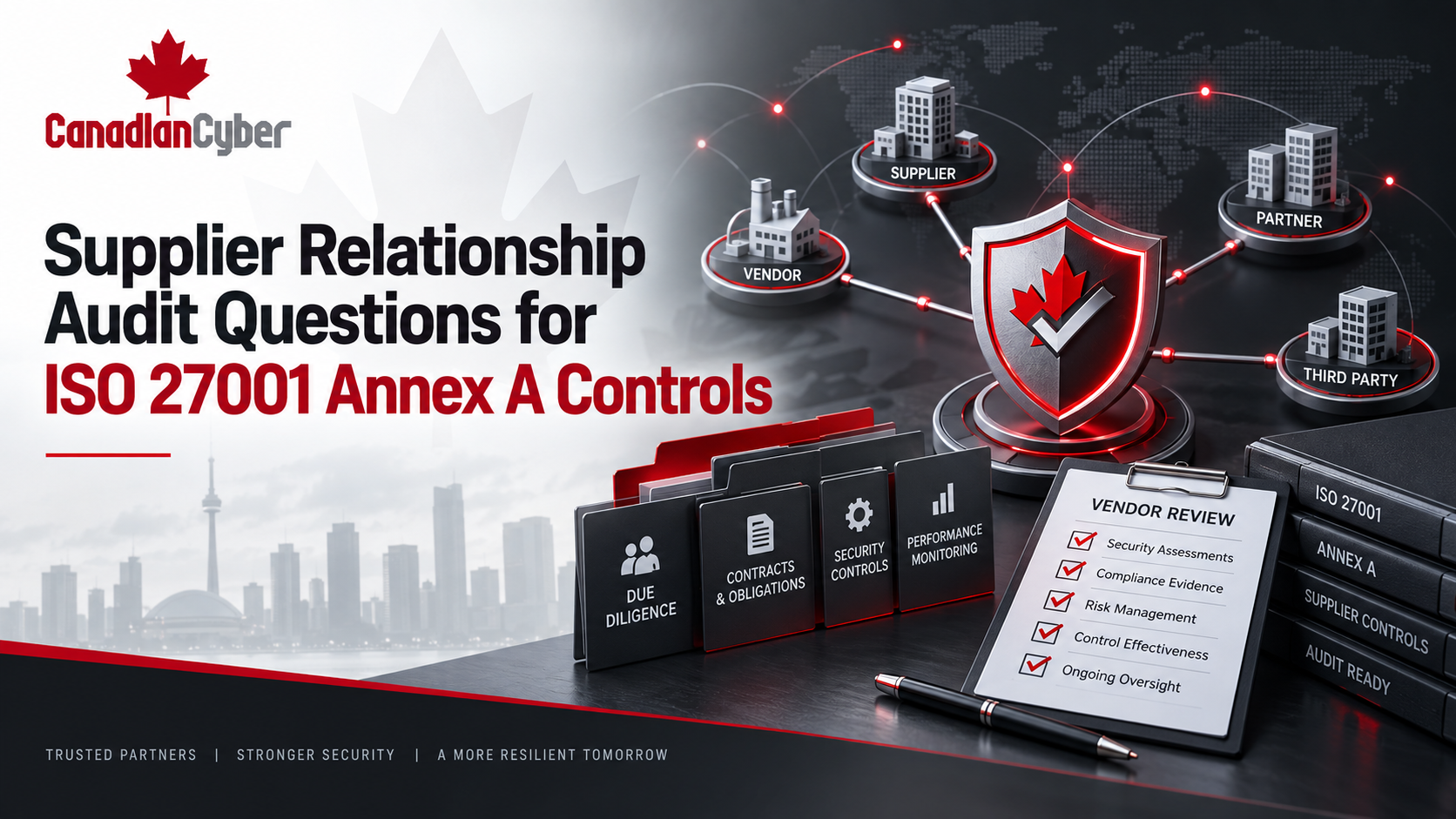
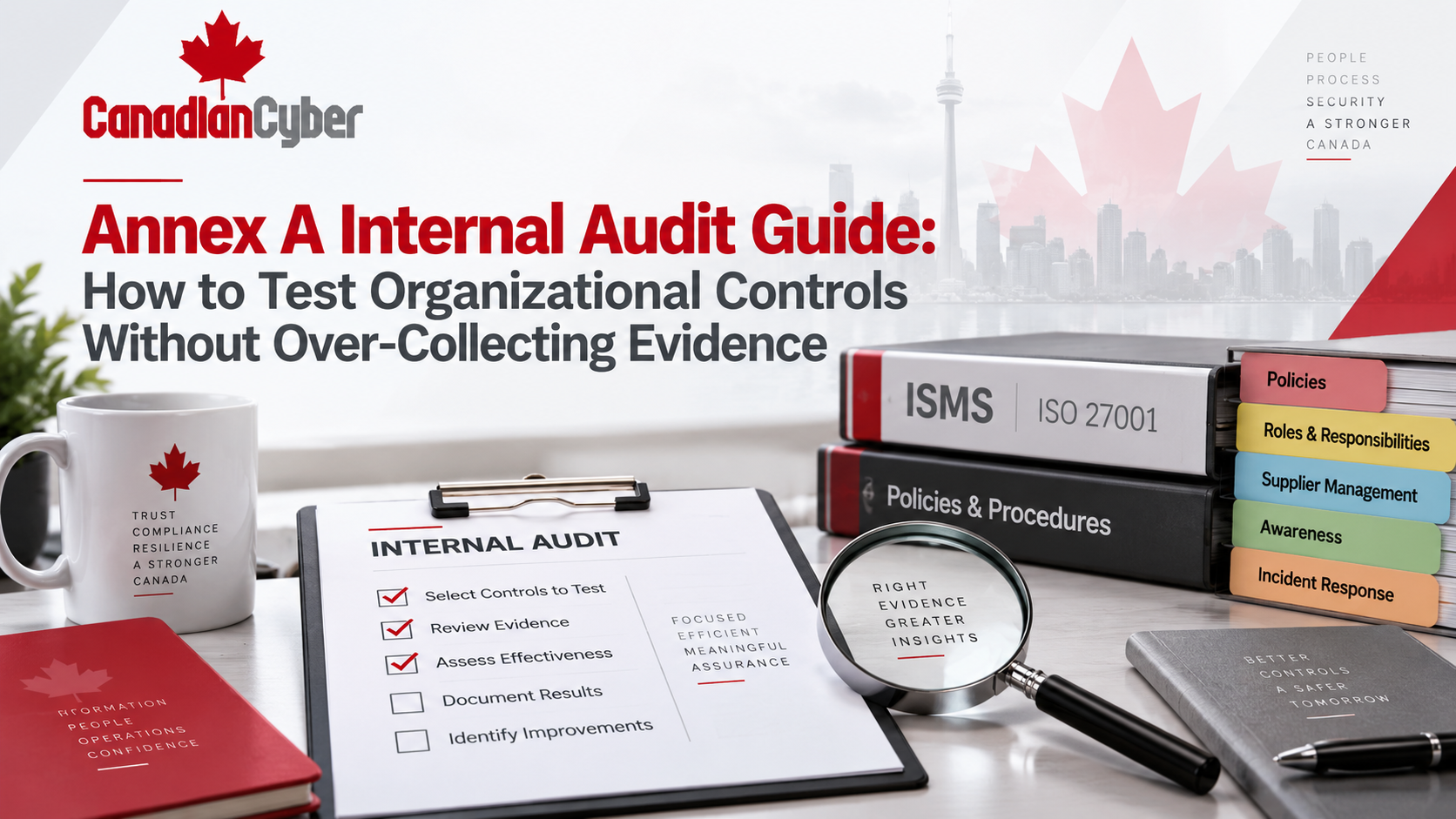
The internal audit plan was focused. It did not try to test everything at once with the same depth.
| Audit Area | Why It Was Prioritized |
|---|---|
| Technician Access | Highest client trust risk. |
| Remote Management Tool | High-impact MSP platform. |
| Password Vault | Sensitive credential control. |
| Vendor Risk | Critical supplier dependency. |
| Incident Response | Client-impact response readiness. |
| Backup Monitoring | Recovery support. |
The internal audit found gaps early. That gave the MSP time to fix issues before certification audit planning.
Step 8: Run an MSP Incident Tabletop
The MSP tested a realistic scenario.
Scenario:
A technician account is compromised. Suspicious activity appears in the remote management tool. Several client endpoints may have been accessed. One client asks whether their environment is affected.
| What the Exercise Tested | Evidence Created |
|---|---|
| Account containment | Tabletop scenario. |
| RMM log review | Attendance list. |
| Client impact assessment | Decision log. |
| Executive escalation | Lessons learned. |
| Client communication | Client communication template. |
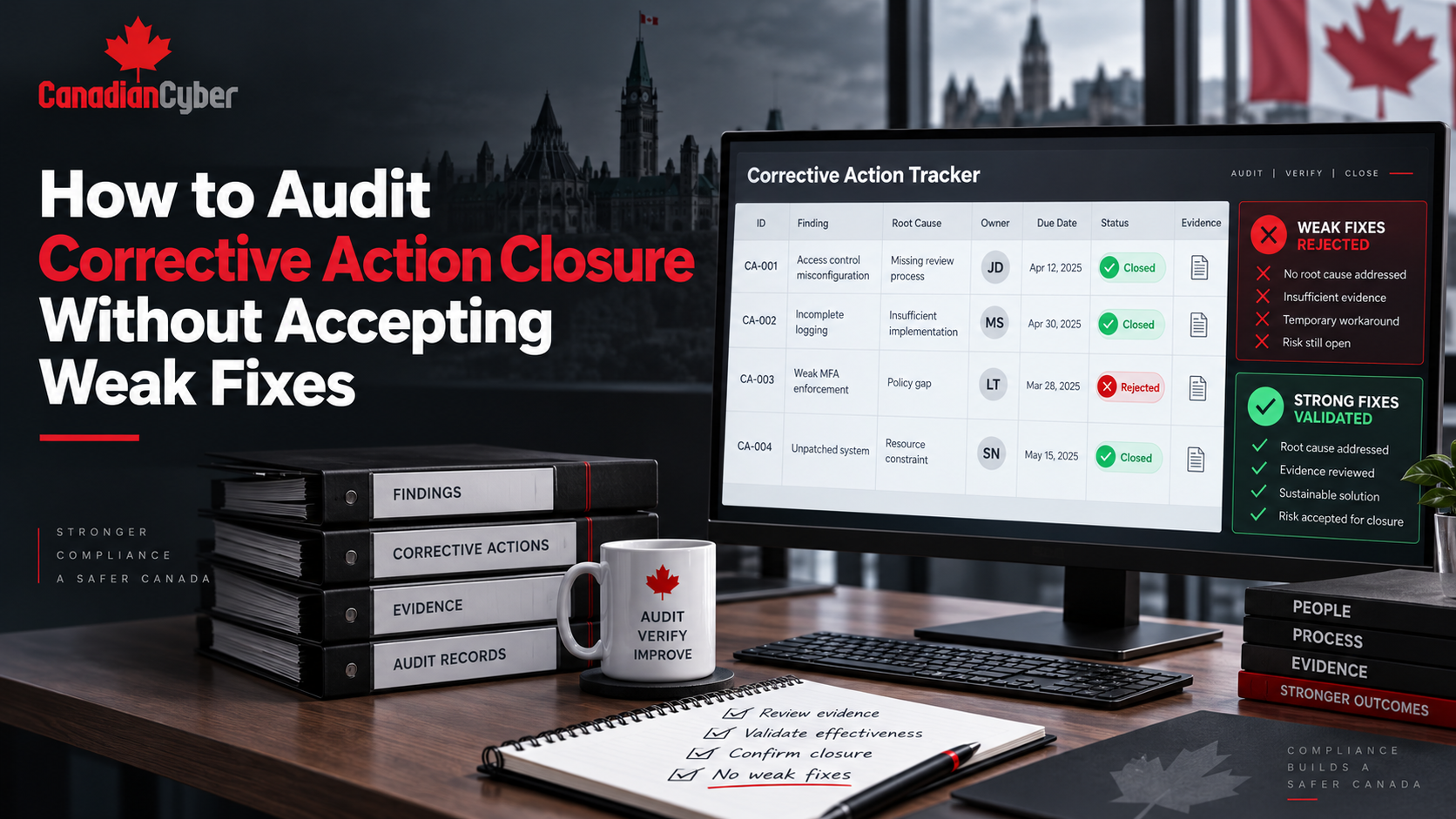
| Corrective actions | Corrective action tracker. |
The MSP found gaps in escalation and communication. Then it fixed them. That is exactly what a tabletop should do.
Step 9: Prepare Management Review
Leadership needed to review the ISMS. The management review was lean but useful.
| Management Review Topic | Why It Mattered |
|---|---|
| Top MSP Risks | Leadership visibility. |
| Access Review Results | Client trust. |
| Vendor Review Status | Supply chain risk. |
| Incident Tabletop Lessons | Readiness. |
| Internal Audit Findings | Improvement. |
| Resource Needs | Budget and staffing. |
Management review became a decision meeting, not a formality. Leadership approved actions, owners, and timelines.
Step 10: Build a Client Trust Pack
The MSP used ISO 27001 readiness to improve sales conversations.
| Client Trust Pack Item | Purpose |
|---|---|
| ISO 27001 Roadmap | Shows serious commitment. |
| ISMS Scope Summary | Explains what is covered. |
| Access Control Summary | Shows technician access governance. |
| Vendor Risk Summary | Explains MSP toolchain reviews. |
| Incident Response Summary | Shows tested response process. |
| Evidence Index | Shows proof available under NDA. |
The MSP could answer client security questions faster. ISO 27001 readiness became part of the sales story.
Results After the Lean Audit Plan
MapleBridge improved quickly without overwhelming the team.
| Before | After |
|---|---|
| ISO 27001 felt too large | Lean audit plan created. |
| Scope unclear | Practical MSP scope defined. |
| Risk informal | MSP risk register created. |
| Access reviews inconsistent | Technician access reviews scheduled. |
| Vendor reviews scattered | Critical vendor register built. |
| Evidence disorganized | SharePoint evidence vault created. |
| Sales lacked trust materials | Client trust pack prepared. |
The MSP improved client trust, audit readiness, access governance, vendor oversight, incident readiness, leadership visibility, evidence quality, sales confidence, and ISO 27001 momentum.
Lessons for Canadian MSPs
- Start with MSP-specific risk. Focus on technician access, remote tools, vendors, backups, and client trust.
- Keep scope practical. Define what the MSP controls versus what the client controls.
- Use SharePoint if you already live in Microsoft 365. A SharePoint ISMS can be practical and familiar for MSP teams.
- Collect evidence monthly. Monthly evidence collection prevents audit panic.
- Test incident response early. MSP incidents can affect multiple clients.
- Turn ISO 27001 into a sales asset. Clients want proof, so package readiness clearly.
Lean MSP ISO 27001 Checklist
| Question | Yes / No |
|---|---|
| Is ISO 27001 scope clearly defined? | |
| Does scope explain MSP and client responsibilities? | |
| Are MSP-specific risks documented? | |
| Are technician access reviews scheduled? | |
| Are RMM and password vault access reviewed? | |
| Are critical vendors risk-rated? | |
| Is incident response tested with MSP scenarios? | |
| Is backup monitoring evidence collected? | |
| Is evidence stored in a structured ISMS workspace? | |
| Is there a client-ready trust pack? |
If several answers are “no,” a lean audit plan can help you move faster.
Common Mistakes to Avoid
- Copying a generic ISO 27001 plan. MSPs have unique risks. Use an MSP-specific plan.
- Over-scoping client environments. Be clear about what the MSP controls versus what the client controls.
- Ignoring technician access. This is one of the highest-risk areas for MSPs.
- Treating vendor tools as low risk. RMM, backup, ticketing, and password vault tools are critical.
- Waiting too long for internal audit. Internal audit should find gaps while there is still time to fix them.
- Not preparing sales materials. ISO 27001 readiness can support client trust before certification is complete.
What Good Looks Like
A Canadian MSP preparing for ISO 27001 with a lean audit plan can show:
- clear scope
- MSP risk register
- control ownership matrix
- technician access review evidence
- RMM access review
- password vault review
- critical vendor register
- incident response tabletop evidence
- backup monitoring evidence
- approved policies
- SharePoint evidence vault
- internal audit tracker
- management review minutes
- client trust pack
This proves maturity without creating unnecessary complexity.
Canadian Cyber’s Take
At Canadian Cyber, we often see MSPs delay ISO 27001 because they assume it will be too heavy.
It does not have to be.
A lean audit plan helps MSPs focus on what matters most:
- technician access
- remote tools
- vendor risk
- incident response
- backups
- evidence
- leadership review
- client trust
For Canadian MSPs, ISO 27001 can be a powerful differentiator. But it has to be practical. The goal is not to build a giant compliance machine. The goal is to build a usable ISMS that clients can trust and technicians can actually follow.
Takeaway
A Canadian MSP can prepare for ISO 27001 without overwhelming the team.
Start lean:
- define scope
- map MSP-specific risks
- assign owners
- review technician access
- review critical vendors
- build a SharePoint evidence vault
- run an MSP incident tabletop
- conduct a focused internal audit
- hold management review
- create a client trust pack
That is how ISO 27001 becomes manageable, credible, and useful for client trust.
How Canadian Cyber Can Help
Canadian Cyber helps Canadian MSPs prepare for ISO 27001 using lean, practical audit plans.
- MSP ISO 27001 readiness assessments
- lean ISO 27001 audit planning
- ISMS scope definition
- MSP risk register setup
- SharePoint ISMS workspace setup
- technician access review workflows
- RMM and password vault access reviews
- vendor risk register setup
- incident response tabletop exercises
- backup monitoring evidence reviews
- policy library development
- internal audit preparation
- management review preparation
- client trust pack development
Stay Connected With Canadian Cyber
Follow Canadian Cyber for practical guidance on ISO 27001, MSP security, SharePoint ISMS, internal audit, vCISO leadership, vendor risk, evidence management, and client trust.