ISO 27001 • ISMS Implementation • Audit Readiness • Control Ownership • SharePoint ISMS
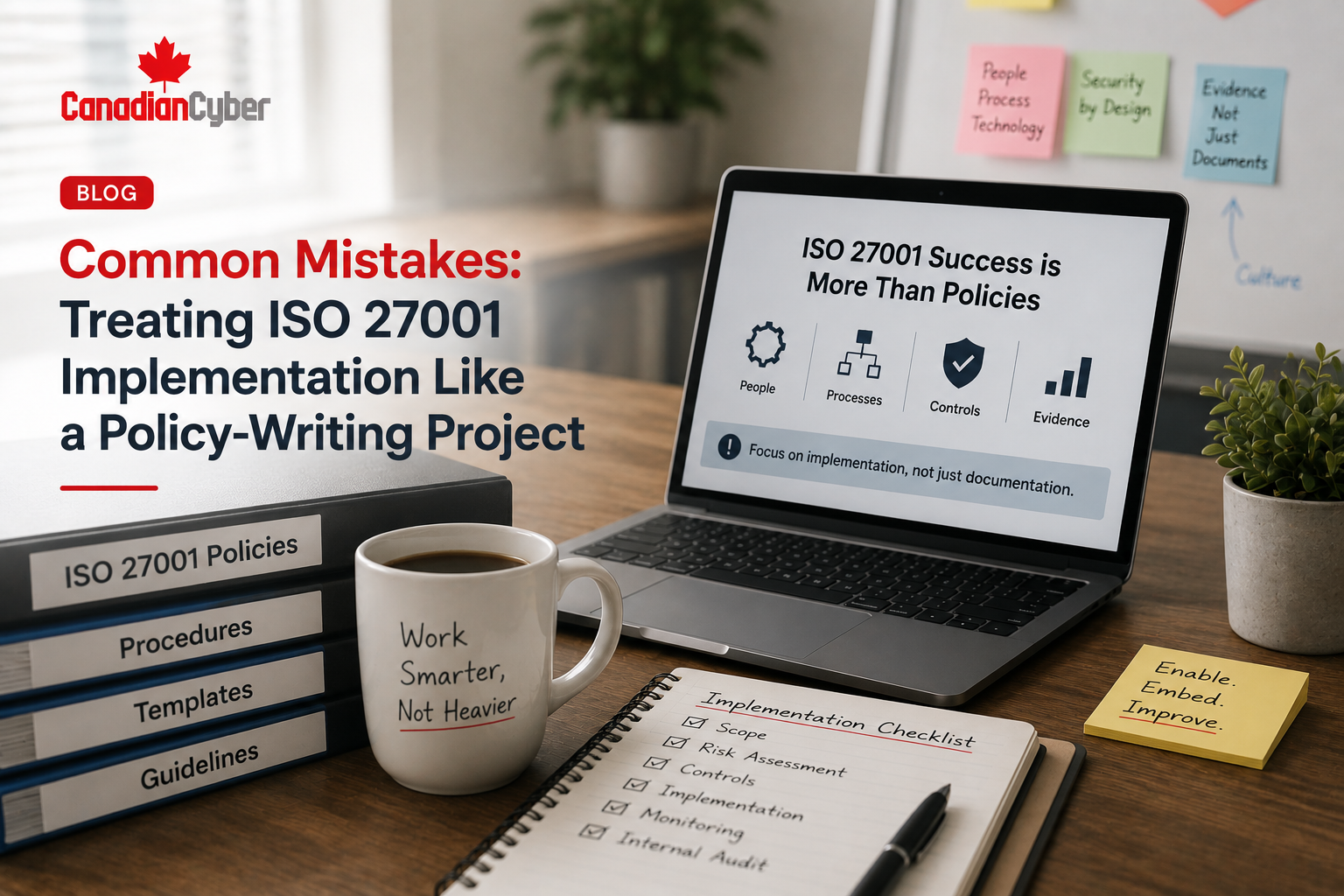
Common Mistakes: Treating ISO 27001 Implementation Like a Policy-Writing Project
ISO 27001 implementation is not a document project. It is an operating system for managing information security risk. If your team only writes policies, uploads them to SharePoint, and waits for the auditor, the ISMS may look complete but fail when real controls, evidence, ownership, and management review are tested.
Quick Snapshot
| Mistake | What Goes Wrong |
|---|---|
| Writing policies first | Documents exist before risks, scope, and controls are understood. |
| Ignoring ownership | Nobody operates or evidences the controls. |
| Weak evidence | The company cannot prove controls are working. |
| No risk connection | Policies do not support real risk treatment. |
| Best Outcome | ISO 27001 becomes a working ISMS, not a policy folder. |
Introduction
Many organizations start ISO 27001 with the same assumption: “We need policies.”
So they create a folder. It may include an Information Security Policy, Access Control Policy, Supplier Security Policy, Incident Response Plan, Risk Management Procedure, Backup Procedure, Acceptable Use Policy, and Business Continuity Plan.
The folder looks impressive. Leadership feels progress. The project manager sees completed documents. The team believes ISO 27001 is moving.
Then the auditor asks for proof.
- Can you show the last access review?
- Can you show vendor risk decisions?
- Can you show restore test evidence?
- Can you show risk treatment progress?
- Can you show management review minutes?
- Can you show internal audit findings and corrective actions?
- Can you show that control owners understand their responsibilities?
That is when the truth becomes clear. Policies were written, but the ISMS was not operating.
This is one of the most common ISO 27001 implementation mistakes: treating the project like a policy-writing exercise instead of building a working security management system.
Need ISO 27001 That Works Beyond Documents?
Canadian Cyber helps organizations build practical ISO 27001 programs with risk registers, control ownership, evidence workflows, SharePoint ISMS workspaces, internal audits, management reviews, and audit-ready governance.
Why ISO 27001 Is Not Just Policies
Policies are important. But they are only one part of ISO 27001.
A policy says what the organization expects. An ISMS proves that those expectations are managed, reviewed, improved, and evidenced.
| Policy Folder | Working ISMS |
|---|---|
| Documents stored in SharePoint. | Controls assigned to owners. |
| Policies written once. | Policies reviewed on schedule. |
| Risks listed separately. | Risks linked to treatment actions. |
| Evidence collected last minute. | Evidence collected throughout the year. |
| Compliance owns everything. | Business owners operate controls. |
| Management review is a formality. | Leadership makes risk decisions. |
A policy explains the requirement. A control proves the requirement is operating. ISO 27001 needs both.
Mistake 1: Writing Policies Before Defining Scope
Scope comes before policies. If your team does not know what the ISMS covers, your policies may become too broad, too vague, or impossible to operate.
Start with scope by asking:
- Which products or services are included?
- Which offices, teams, or business units are included?
- Which systems and cloud platforms are in scope?
- Which customer data is included?
- Which vendors support the service?
- Which legal, contractual, or client requirements apply?
For example, a SaaS company may include the production platform, cloud infrastructure, customer support process, CI/CD pipeline, source code repositories, identity provider, monitoring tools, vendor management, incident response, customer data handling, and management review process.
If the ISO 27001 scope is unclear, your policy library will likely become generic and hard to audit.
Mistake 2: Copying Templates Without Matching Real Operations
Templates can help. But copied policies can create audit risk when they promise controls your company does not actually operate.
| Template Promise | Audit Problem |
|---|---|
| Access is reviewed quarterly. | No access reviews happen or no sign-off exists. |
| Vendors are risk-rated before approval. | No vendor register exists. |
| Backups are restored twice a year. | No restore test evidence exists. |
| Incidents are tested annually. | No tabletop exercise has happened. |
| Management reviews ISMS performance. | No management review minutes exist. |
Before approving any policy, ask:
- Does this match how we actually work?
- Can we prove this control?
- Who owns it?
- How often will it happen?
- Where will evidence be stored?
- What exceptions are allowed?
Mistake 3: Treating the Risk Register as a Spreadsheet Exercise
ISO 27001 is risk-based. That means the risk register should drive control decisions.
A weak risk register lists risks, likelihood, impact, owner, and status. A strong risk register connects each major risk to a treatment action, control owner, evidence source, due date, residual risk, and management decision.
| Risk | Treatment | Evidence |
|---|---|---|
| Former employees retain access to systems. | Quarterly access reviews and offboarding checks. | Access review report and offboarding samples. |
| Critical vendor breach affects customer data. | Vendor risk review and contract controls. | Vendor register and assurance review. |
| Ransomware prevents recovery. | Backup protection and restore testing. | Restore test record. |
| Incident response delay affects customers. | Tabletop exercises and escalation plan. | Tabletop report and corrective actions. |
Mistake 4: No Control Ownership
This is where many ISO 27001 projects break. The policy exists, but nobody owns the control.
Compliance asks IT for access reviews. IT says access review is not scheduled. Operations says vendor reviews are in email. HR says training reports are in the platform. Engineering says change evidence is in GitHub. Leadership says management review is not planned yet.
Everyone is involved. Nobody is accountable.
| Control Area | Likely Owner |
|---|---|
| Access Control | IT Lead |
| Vendor Risk | Operations or Procurement |
| Security Training | HR |
| Secure Development | Engineering Lead |
| Backup and Recovery | Infrastructure Lead |
| Incident Response | vCISO or Security Lead |
| Management Review | Executive Sponsor |
Build a Control Ownership Matrix That Works
Canadian Cyber helps organizations build ISO 27001 control ownership matrices with owners, backup owners, evidence requirements, review dates, and escalation paths.
Mistake 5: Evidence Is Treated as an Audit-Time Task
Evidence should not be collected only when the auditor asks. By then, it may be too late.
| Control Area | Evidence |
|---|---|
| Access Control | MFA reports, access reviews, offboarding samples. |
| Vendor Risk | Vendor register, assurance review, approval decision. |
| Backup Recovery | Backup reports, restore test records. |
| Incident Response | Incident log, tabletop exercise report. |
| Policy Governance | Approval records, review dates, version history. |
| Risk Management | Risk register updates, treatment evidence. |
| Management Review | Agenda, minutes, decisions, action items. |
If the control operates regularly, evidence should be collected regularly.
Mistake 6: Not Building the Evidence System Early
Many companies write policies first and think about evidence storage later. That creates chaos.
Evidence ends up in email, SharePoint folders, personal drives, Slack messages, ticketing systems, cloud consoles, screenshots, spreadsheets, and GRC exports.
| Good Evidence System Requirement | Why It Matters |
|---|---|
| Clear library structure | Evidence is easy to find. |
| Metadata | Evidence can be filtered by control, owner, and period. |
| Naming rules | Files are consistent. |
| Owners | Accountability is clear. |
| Review status | Evidence can be approved or rejected. |
| Access control | Sensitive evidence is protected. |
| Audit views | Auditors can follow the evidence trail. |
A SharePoint ISMS can include:
- policy library
- risk register
- control library
- evidence vault
- vendor register
- access review tracker
- internal audit tracker
- corrective action register
- management review library
Organize Your ISO 27001 Evidence in SharePoint
Canadian Cyber’s ISMS SharePoint solution helps organizations organize ISO 27001 risks, controls, policies, evidence, vendors, internal audits, corrective actions, and management review in one practical workspace.
Mistake 7: Internal Audit Is Treated as a Final Check
Internal audit should not be a last-minute rehearsal before certification. It should test whether the ISMS is working.
| Area | Internal Audit Question |
|---|---|
| Access Control | Were access reviews completed and evidenced? |
| Vendor Risk | Were critical vendors reviewed and approved? |
| Backup Recovery | Was restore testing completed? |
| Incident Response | Was the response process tested? |
| Risk Management | Are risks reviewed and treatment actions tracked? |
| Management Review | Did leadership review ISMS performance? |
A strong internal audit tests control operation, interviews control owners, reviews evidence quality, identifies missing ownership, checks corrective actions, and reports findings to leadership.
Mistake 8: Management Review Becomes a Checkbox
Management review is not just a meeting to say ISO 27001 is going well. It is where leadership reviews ISMS performance and makes decisions.
| Leadership Should Review | Evidence to Keep |
|---|---|
| Top risks | Risk summary. |
| Control performance | Control status report. |
| Audit findings | Internal audit results. |
| Corrective actions | Action tracker. |
| Vendor issues | Vendor risk summary. |
| Resource needs | Decision log and assigned actions. |
| Improvement actions | Minutes and due dates. |
Management review should prove leadership involvement, not just attendance.
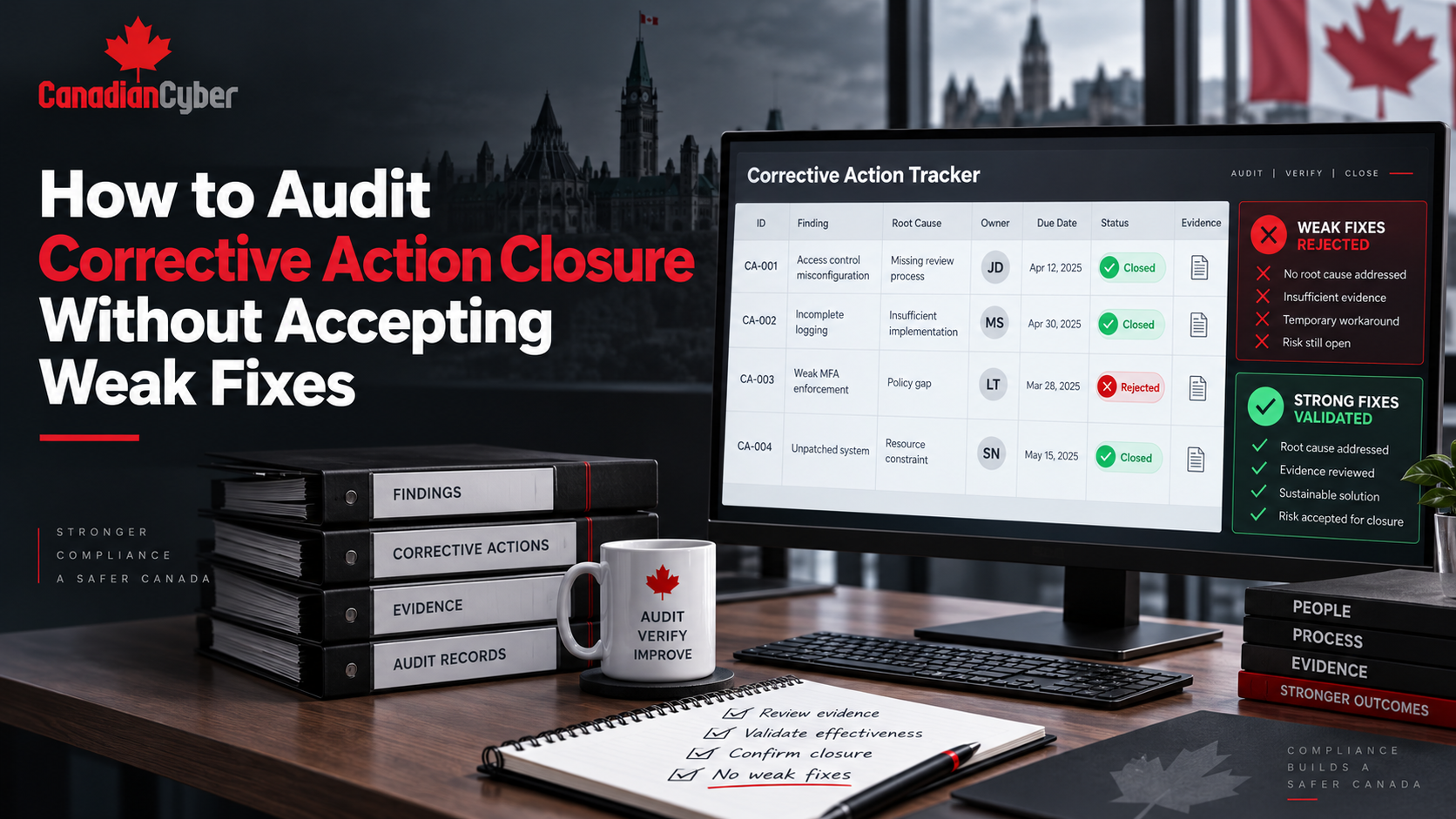
Mistake 9: Corrective Actions Are Not Tracked
ISO 27001 expects continual improvement. That means findings, gaps, and control failures need corrective action.
| Corrective Action Field | Purpose |
|---|---|
| Finding ID | Unique reference. |
| Source | Internal audit, incident, risk review, or customer review. |
| Finding Description | What went wrong. |
| Risk Rating | High, medium, or low. |
| Action Owner | Person responsible. |
| Due Date | Timeline. |
| Closure Evidence | Proof of completion. |
| Verified By | Confirms the fix worked. |
A finding is not closed because someone says it is fixed. It is closed when evidence proves it.
Mistake 10: ISO 27001 Is Separated From Business Operations
An ISMS should not live only with compliance. It should connect to how the business operates.
ISO 27001 should connect to:
- customer requirements
- vendor onboarding
- employee onboarding and offboarding
- cloud operations
- software development
- incident response
- risk management
- executive reporting
- procurement and legal review
- business continuity and internal audit
When ISO is isolated, teams ignore policies, evidence is hard to collect, control owners feel disconnected, leadership sees ISO as paperwork, audits become stressful, and findings repeat.
ISO 27001 Implementation Reality Checklist
Use this checklist to see whether your implementation is operational or document-heavy.
| Question | Yes / No |
|---|---|
| Is the ISMS scope clearly defined? | |
| Are risks linked to controls and treatment actions? | |
| Does each control have a named owner? | |
| Are evidence requirements defined? | |
| Is evidence collected regularly? | |
| Are access reviews completed and evidenced? | |
| Are vendor reviews completed and evidenced? | |
| Has incident response been tested? | |
| Has backup recovery been tested? | |
| Is internal audit testing control operation? | |
| Are corrective actions tracked to closure? | |
| Has management review been completed with decisions? | |
| Is evidence organized in SharePoint or another controlled system? |
If several answers are “no,” your ISO 27001 project may still be too policy-focused.
What Good Looks Like
A mature ISO 27001 implementation includes:
- clear scope
- risk register
- Statement of Applicability
- control ownership matrix
- approved policies
- evidence vault
- access review workflow
- vendor review process
- incident response testing
- backup restore testing
- internal audit program
- corrective action tracker
- management review process
- continual improvement actions
The documents matter. But the operating rhythm matters more.
Canadian Cyber’s Take
At Canadian Cyber, we often see organizations begin ISO 27001 by asking for templates.
Templates are useful. But templates do not make an ISMS work.
A real ISO 27001 implementation requires ownership, evidence, risk treatment, internal audit, management review, corrective actions, and continual improvement.
The strongest ISO 27001 programs are not the ones with the most documents. They are the ones where the business can prove controls are operating.
Policies should guide the ISMS. They should not be mistaken for the ISMS.
Takeaway
ISO 27001 implementation is not a policy-writing project. Policies are only the starting point.
To build a real ISMS, you need:
- scope
- risk assessment
- control ownership
- evidence workflows
- vendor reviews
- access reviews
- incident testing
- backup testing
- internal audit
- corrective actions
- management review
- continual improvement
Do not stop when the policy folder looks complete. That is when implementation truly begins.
How Canadian Cyber Can Help
Canadian Cyber helps organizations implement ISO 27001 in a practical, evidence-focused way.
- ISO 27001 implementation planning
- ISMS scope definition
- risk register development
- Statement of Applicability support
- control ownership mapping
- policy library development
- SharePoint ISMS setup
- evidence vault design
- vendor risk workflows
- access review workflows
- incident response tabletop exercises
- internal audit preparation
- management review preparation
- vCISO support for ISMS governance
Stay Connected With Canadian Cyber
Follow Canadian Cyber for practical guidance on ISO 27001, ISMS implementation, SharePoint ISMS, audit readiness, internal audits, risk management, and vCISO support.