ISO 27001 • Gap Assessment • Remediation Roadmap • ISMS • Audit Readiness
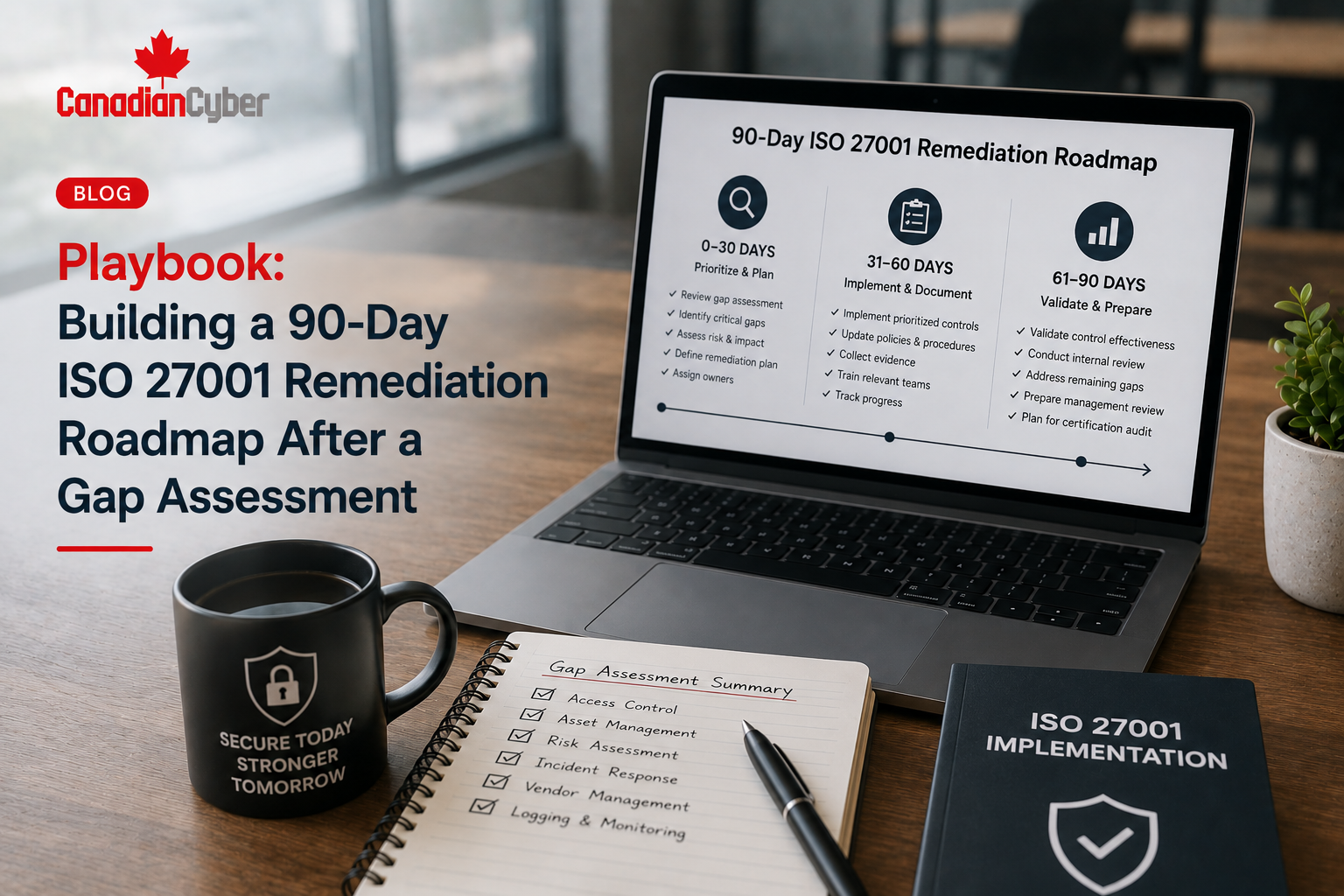
Playbook: Building a 90-Day ISO 27001 Remediation Roadmap After a Gap Assessment
An ISO 27001 gap assessment is only useful if it turns into action. The real value comes after the report, when your team prioritizes findings, assigns owners, fixes high-risk gaps, collects evidence, and builds a realistic 90-day remediation roadmap.
Quick Snapshot
| Roadmap Area | What to Do |
|---|---|
| Gap Assessment Output | Convert findings into risks, actions, owners, and evidence requirements. |
| First 30 Days | Fix high-risk basics, assign ownership, approve priority policies, and organize evidence. |
| Days 31–60 | Implement control improvements, run access/vendor/recovery reviews, and close quick wins. |
| Days 61–90 | Validate evidence, complete internal audit readiness, update leadership, and prepare the next phase. |
| Main Outcome | A practical ISO 27001 remediation plan that turns gaps into audit-ready progress. |
Introduction
The ISO 27001 gap assessment is complete.
The report is delivered. The findings are listed. The risks are visible. The policies are marked missing. The evidence gaps are clear. The control weaknesses are documented.
Then the team asks the real question: “Now what?”
This is where many ISO 27001 projects lose momentum.
A gap assessment identifies problems, but it does not fix them by itself. If the findings are not prioritized, they become a long list of anxiety. If owners are not assigned, nothing moves. If evidence is not defined, controls remain hard to prove.
A 90-day remediation roadmap turns the gap assessment into a practical action plan.
This playbook shows how to build that roadmap, what to fix first, how to assign owners, and how to collect evidence without creating audit chaos.
Need Help Turning an ISO 27001 Gap Assessment Into Action?
Canadian Cyber helps organizations convert ISO 27001 gap assessment findings into remediation roadmaps, SharePoint ISMS workflows, evidence packs, risk registers, internal audit plans, and management review dashboards.
Why the 90-Day Roadmap Matters
A gap assessment gives you a current-state view. A remediation roadmap gives you movement.
Without a roadmap, the team may:
- focus on easy but low-value tasks
- ignore high-risk findings
- write policies without operating controls
- delay evidence collection
- miss internal audit timelines
- fail to involve leadership
- lose track of corrective actions
| Gap Report | 90-Day Remediation Roadmap |
|---|---|
| Shows what is missing. | Shows what to fix first. |
| Lists findings. | Assigns owners and due dates. |
| Describes gaps. | Defines corrective actions. |
| Identifies evidence weaknesses. | Creates evidence requirements. |
| Ends with recommendations. | Drives implementation. |
A gap assessment without a remediation roadmap is just a diagnostic. The roadmap is the treatment plan.
Step 1: Sort Gaps by Business Risk
Do not start by fixing the easiest findings. Start by sorting gaps based on business risk.
Ask whether the gap affects:
- customer data
- critical systems
- audit readiness
- legal, contractual, or regulatory commitments
- cyber insurance
- enterprise sales or client trust
- incident response or recovery risk
| Priority | Description | Example |
|---|---|---|
| High | Could affect customer data, critical systems, audit readiness, or legal obligations. | No privileged access review. |
| Medium | Important control gap but not immediately critical. | Policy review schedule missing. |
| Low | Improvement item or documentation refinement. | Evidence naming inconsistent. |
High-priority ISO 27001 gaps usually include:
- unclear ISMS scope
- missing risk register
- no control ownership
- privileged access not reviewed
- vendor reviews missing
- incident response not tested
- backup restore testing missing
- no internal audit plan
- no management review evidence
High-risk gaps should drive the first 30 days. Do not spend the first month formatting documents while access control is failing.
Step 2: Convert Findings Into Corrective Actions
A finding is not an action. The roadmap needs clear corrective actions.
Weak finding: “Vendor management process is incomplete.”
Strong corrective action: “Create a vendor register, identify critical vendors, assign vendor owners, review assurance evidence for top 10 vendors, document approval decisions, and set next review dates.”
| Field | Purpose |
|---|---|
| Finding ID | Connects action to the gap assessment. |
| Gap Description | Explains the issue. |
| Risk Rating | High, medium, or low. |
| Corrective Action | What will be done. |
| Owner | Person accountable. |
| Due Date | Timeline. |
| Evidence Required | Proof needed. |
| Finding | Corrective Action | Evidence |
|---|---|---|
| Access reviews not performed. | Run access review for critical systems and document removals/exceptions. | Access review report. |
| Incident response untested. | Run tabletop exercise and track lessons learned. | Tabletop report. |
| Vendor reviews missing. | Build vendor register and review critical vendors. | Vendor register. |
| Restore testing missing. | Perform restore test for critical system. | Restore test record. |
Step 3: Assign Owners Before Starting Work
ISO 27001 remediation fails when ownership is unclear. A roadmap with no owners is a wish list.
| Owner Type | Responsibility |
|---|---|
| Executive Sponsor | Removes blockers and approves risk decisions. |
| ISMS Owner | Coordinates roadmap and evidence. |
| Control Owner | Operates the control and provides evidence. |
| Evidence Owner | Uploads or validates proof. |
| Risk Owner | Owns risk treatment decision. |
| Internal Auditor | Tests control operation. |
| Remediation Area | Primary Owner | Backup Owner |
|---|---|---|
| ISMS Scope | ISMS Owner | Executive Sponsor |
| Risk Register | vCISO / ISMS Owner | Compliance Lead |
| Access Reviews | IT Lead | Security Analyst |
| Vendor Reviews | Operations Manager | Finance Lead |
| Backup Restore Test | Infrastructure Lead | Cloud Engineer |
| Management Review | Executive Sponsor | ISMS Owner |
Use named people, not departments. “IT” does not close findings. A person does.
Plan Your First 30 Days With Clear Owners
Canadian Cyber can help your team build the first 30-day ISO 27001 remediation sprint, including owners, evidence folders, SharePoint trackers, and priority actions.
Step 4: Build the 90-Day Roadmap Structure
A good 90-day roadmap should be realistic. It should not try to fix everything at once.
| Phase | Focus |
|---|---|
| Days 1–30 | Stabilize and prioritize. |
| Days 31–60 | Implement and evidence. |
| Days 61–90 | Validate and prepare for internal audit. |
Days 1–30: Stabilize, Prioritize, and Organize
The first 30 days should focus on foundations and high-risk gaps.
Main goals include confirming scope, assigning owners, creating a remediation tracker, organizing the evidence workspace, approving critical policies, starting the risk register, fixing obvious access gaps, planning tabletop and restore testing, and identifying critical vendors.
| Action | Owner | Evidence |
|---|---|---|
| Confirm ISMS scope | ISMS Owner | Scope statement |
| Create remediation tracker | ISMS Owner | Corrective action register |
| Assign control owners | Executive Sponsor / ISMS Owner | Ownership matrix |
| Build evidence vault | SharePoint Owner | Evidence library |
| Create risk register | vCISO / ISMS Owner | Risk register |
| Review privileged access | IT Lead | Admin access review |
| Identify critical vendors | Operations | Vendor register draft |
| Schedule restore test | Infrastructure Lead | Test plan |
Priority Policies to Approve First
- Information Security Policy
- Access Control Policy
- Risk Management Procedure
- Supplier Security Policy
- Incident Response Plan
- Backup and Recovery Procedure
- Acceptable Use Policy
- Change Management Procedure
Days 31–60: Implement Controls and Collect Evidence
The second month should focus on operating the controls. This is where the roadmap moves from planning to proof.
| Action | Owner | Evidence |
|---|---|---|
| Complete access reviews | IT Lead | User exports, sign-off, removals |
| Review critical vendors | Operations | Vendor review records |
| Run restore test | Infrastructure Lead | Restore test report |
| Finalize incident response plan | vCISO / IT Lead | Approved plan |
| Collect change management samples | Engineering Lead | PR/ticket/deployment evidence |
| Review training completion | HR | Training report |
| Review evidence quality | ISMS Owner | Evidence review notes |
During days 31–60, do not just create documents. Generate evidence that proves controls are operating.
Need Help Collecting Audit-Ready Evidence?
Canadian Cyber helps teams collect access review evidence, vendor review records, restore test reports, policy approvals, risk updates, and corrective action proof in one structured ISMS workspace.
Days 61–90: Validate, Audit, and Prepare Leadership
The final 30 days should focus on validation. This is where your team checks whether the remediation work is actually audit-ready.
| Action | Owner | Evidence |
|---|---|---|
| Run tabletop exercise | vCISO / Incident Lead | Tabletop report |
| Review evidence vault | ISMS Owner | Evidence completeness report |
| Conduct internal audit readiness review | Internal Auditor | Audit readiness notes |
| Update SoA | ISMS Owner | Updated Statement of Applicability |
| Verify corrective actions | ISMS Owner | Closure evidence |
| Hold management review | Leadership | Minutes and decisions |
| Create next-phase roadmap | vCISO / ISMS Owner | 90-day plan |
Management Review Topics
- top risks
- status of remediation roadmap
- internal audit readiness
- open corrective actions
- evidence gaps
- vendor risks
- incident response readiness
- backup and recovery status
- resource needs
- next-phase priorities
How to Decide What Gets Fixed First
Not all gaps deserve equal attention. Use a scoring model to avoid wasting time on low-value work.
| Factor | Score 1–5 |
|---|---|
| Customer Data Impact | Does this affect sensitive or customer data? |
| Audit Impact | Will this create a major audit issue? |
| Business Impact | Does this affect operations or revenue? |
| Legal / Contract Impact | Could this trigger obligations? |
| Ease of Fix | Can this be fixed quickly? |
| Evidence Value | Does this produce useful proof? |
| Gap | Priority |
|---|---|
| No privileged access review | High |
| No restore test | High |
| Vendor register incomplete | High |
| Policy formatting inconsistent | Low |
| No tabletop exercise | High |
| Missing management review | High |
Fix high-risk, high-evidence-value gaps first.
What to Put in the Remediation Tracker
A remediation tracker is the heart of the 90-day roadmap. Use SharePoint, Excel, or a GRC tool, but keep the structure clear.
| Field | Purpose |
|---|---|
| Finding ID | Links to gap assessment. |
| Requirement / Control | ISO 27001 clause or Annex A control. |
| Gap Description | What is missing. |
| Risk Rating | High, medium, low. |
| Corrective Action | What will be fixed. |
| Owner | Accountable person. |
| Due Date | Timeline. |
| Evidence Link | Where proof is stored. |
| Verified By | Closure reviewer. |
Useful status values include:
- Open
- In progress
- Blocked
- Ready for review
- Closed
- Deferred
- Accepted risk
SharePoint ISMS Setup for Remediation
SharePoint can be a practical ISO 27001 remediation hub when it is structured around ownership, evidence, due dates, and audit readiness.
| Area | Purpose |
|---|---|
| Remediation Tracker | Tracks all gap assessment actions. |
| Risk Register | Links gaps to business risk. |
| Control Library | Maps controls to owners and evidence. |
| Evidence Vault | Stores proof by control and period. |
| Policy Library | Stores approved policies and review dates. |
| Vendor Register | Tracks supplier reviews. |
| Management Review Library | Stores leadership review records. |
Manage ISO 27001 Remediation in SharePoint
Canadian Cyber’s ISMS SharePoint solution helps organizations manage ISO 27001 remediation, evidence, controls, risks, owners, internal audit, and management review in one structured workspace.
Common Mistakes to Avoid
- Trying to fix everything at once. This creates overload. Prioritize based on risk.
- Starting with policy formatting. Policy polish is not more important than access reviews, vendor risk, restore testing, or incident readiness.
- No owners. A roadmap without owners will stall.
- No evidence requirements. A task is not complete until evidence proves it.
- Ignoring leadership decisions. Some gaps need funding, risk acceptance, or priority decisions.
- Not updating the risk register. Gap remediation should connect to risk treatment.
- Waiting until internal audit to validate evidence. Review evidence as it is collected.
- No next-phase plan. A 90-day roadmap should lead into the next 90 days.
90-Day ISO 27001 Remediation Checklist
Use this checklist after your gap assessment.
| Question | Yes / No |
|---|---|
| Are findings sorted by risk priority? | |
| Is each finding converted into a corrective action? | |
| Does every action have an owner? | |
| Does every action have a due date? | |
| Is evidence required for each action defined? | |
| Is the remediation tracker stored in one place? | |
| Are high-risk access gaps addressed in the first 30 days? | |
| Are critical vendor reviews scheduled? | |
| Is restore testing planned or completed? | |
| Is incident response testing scheduled? | |
| Is management review scheduled? | |
| Is the next 90-day roadmap planned? |
If several answers are “no,” your gap assessment may not yet have become a true remediation plan.
What Good Looks Like
A strong 90-day ISO 27001 remediation roadmap has:
- prioritized findings
- corrective action tracker
- clear control owners
- evidence requirements
- risk register updates
- policy approvals
- access review evidence
- vendor review evidence
- restore test evidence
- incident tabletop evidence
- internal audit readiness review
- management review pack
- blocked item escalation
- next-phase roadmap
The goal is not to close every gap in 90 days. The goal is to create measurable, audit-ready progress.
Canadian Cyber’s Take
At Canadian Cyber, we often see organizations complete ISO 27001 gap assessments and then stall.
The report is useful. But the team is overwhelmed. There are too many findings, too many documents, too many controls, and not enough ownership.
A 90-day remediation roadmap solves that. It turns the report into action.
It helps the team focus on the gaps that matter most, assign owners, collect evidence, involve leadership, and prepare for internal audit.
ISO 27001 readiness is built through rhythm. Not panic.
Takeaway
A gap assessment is only the beginning. The next step is a 90-day remediation roadmap.
Start by prioritizing risk. Then:
- convert gaps into corrective actions
- assign owners
- define evidence
- fix high-risk access, vendor, backup, incident, policy, and risk gaps first
- use SharePoint or a tracker to manage progress
- validate evidence
- hold management review
- plan the next phase
That is how ISO 27001 moves from assessment to implementation.
How Canadian Cyber Can Help
Canadian Cyber helps organizations turn ISO 27001 gap assessments into practical remediation roadmaps and audit-ready progress.
- ISO 27001 gap assessment remediation
- 90-day roadmap development
- SharePoint ISMS setup
- corrective action trackers
- risk register updates
- control ownership mapping
- evidence vault design
- access review workflows
- vendor review workflows
- restore test evidence planning
- incident response tabletop exercises
- internal audit readiness reviews
- management review preparation
- vCISO support for ISO 27001 governance
Stay Connected With Canadian Cyber
Follow Canadian Cyber for practical guidance on ISO 27001, gap assessments, remediation roadmaps, SharePoint ISMS, audit readiness, internal audits, and vCISO support.