SOC 2 • AI SaaS • LLM Security • GRC • Customer Data Protection
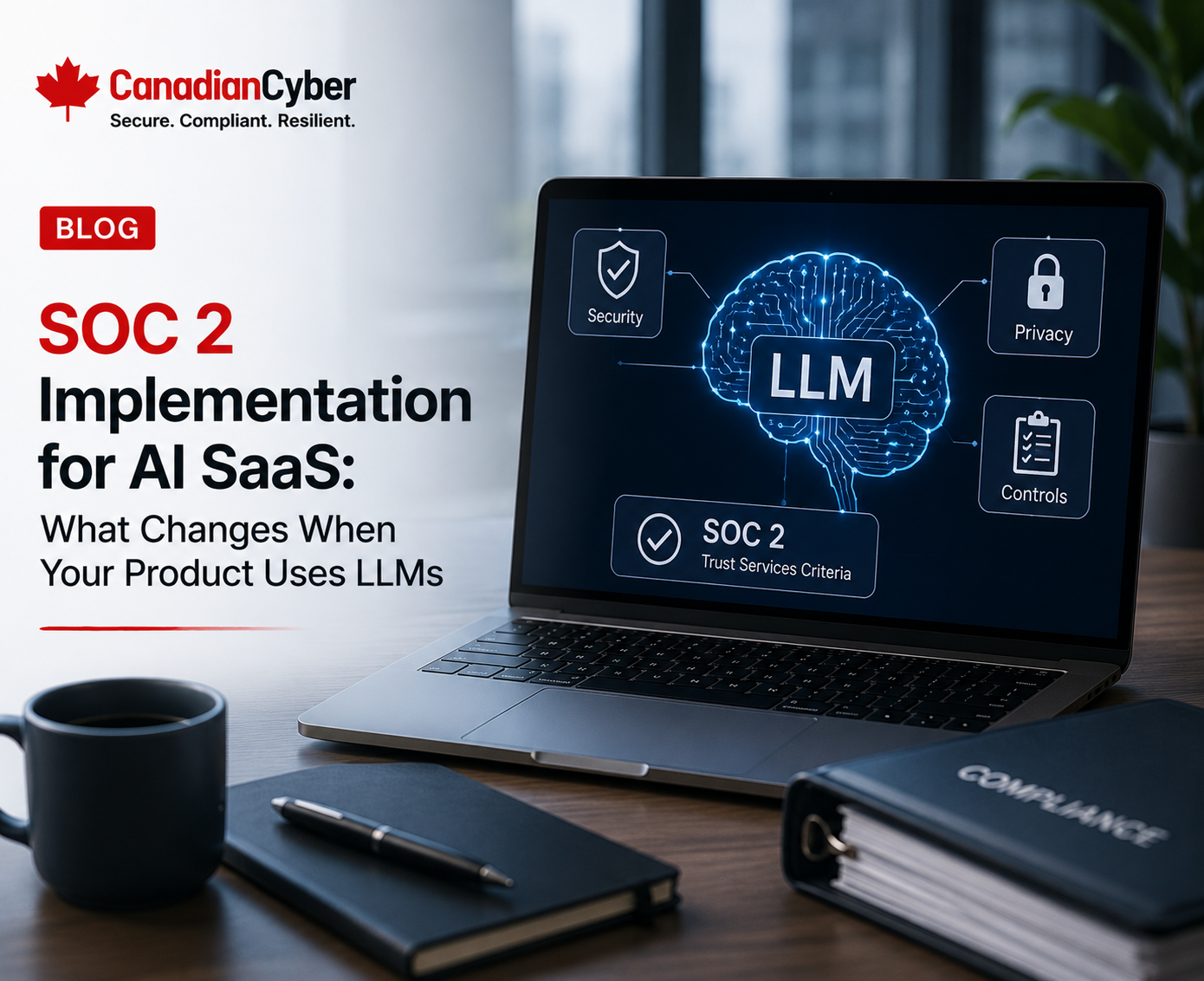
SOC 2 Implementation for AI SaaS in Canada: What Changes When Your Product Uses LLMs
SOC 2 implementation for AI SaaS is not the same as SOC 2 for a standard cloud application. When your product uses large language models, buyers and auditors want to know how customer prompts, uploaded files, model outputs, embeddings, AI vendors, training data, support access, and logs are controlled.
Quick Snapshot
| SOC 2 Area | What Changes for AI SaaS |
|---|---|
| Scope | LLM workflows, prompts, outputs, embeddings, vector databases, and AI vendors may need to be included. |
| Customer Data | Buyers want clear answers on whether customer data is used for training or model improvement. |
| Vendor Risk | Model providers, embedding services, MLOps tools, and AI monitoring vendors need review. |
| Access Control | Staff access to prompts, outputs, logs, datasets, and model settings must be limited. |
| Evidence | SOC 2 proof must show AI governance, human review, logging, retention, and data protection controls. |
Introduction
AI SaaS companies are under pressure from two sides.
Customers want innovation. Auditors want proof.
Your product may use LLMs to summarize documents, generate insights, answer questions, classify records, draft content, analyze tickets, review contracts, write code, or automate workflows.
That can create real value. But it also changes the SOC 2 conversation.
A normal SaaS buyer may ask about MFA, encryption, vendors, backups, incident response, and access reviews. An AI SaaS buyer asks all of that, plus questions about prompts, outputs, embeddings, training data, model providers, support access, and AI change control.
SOC 2 implementation for AI SaaS needs a different level of planning because LLM workflows change data flows, vendor risk, access control, change management, and evidence.
This blog explains what changes when your product uses LLMs and how Canadian Cyber can help AI SaaS companies build a SOC 2 program that supports enterprise trust.
Building SOC 2 for an AI SaaS Product?
Canadian Cyber helps AI SaaS companies prepare for SOC 2 with scope definition, control mapping, AI vendor reviews, customer data governance, evidence packs, SharePoint evidence workspaces, and vCISO support.
Why SOC 2 Is Different for AI SaaS
SOC 2 for a standard SaaS product usually focuses on system security, access control, vendor management, change management, incident response, backup recovery, logging, and policies.
AI SaaS still needs all of that. But LLMs add new questions.
| AI SaaS Data Type | Why It Matters |
|---|---|
| Prompts | May contain customer data, personal information, confidential business details, or regulated content. |
| Uploaded Files | May include contracts, reports, financial data, legal files, source code, or sensitive records. |
| Model Outputs | May reveal sensitive input data or customer-specific insights. |
| Embeddings | May be derived from customer content and stored in vector databases. |
| Fine-Tuning Data | May create training, consent, retention, and customer commitment concerns. |
| Logs | May accidentally store prompts, outputs, metadata, or sensitive payloads. |
If an AI data type can reveal customer information, treat it like customer data until proven otherwise.
What Changes in SOC 2 Scope
Scope is the first major difference. For AI SaaS, the auditor and buyer need to understand the full AI processing flow.
| Standard SaaS Scope May Include | AI SaaS Scope May Also Include |
|---|---|
| Application and cloud infrastructure | LLM provider integration and prompt processing workflow. |
| Database and identity provider | Model output storage, embeddings, and vector database. |
| CI/CD pipeline and monitoring tools | Prompt and model change process. |
| Support platform and vendor management | AI vendor management and AI support access workflow. |
| Incident response and security policies | AI incident response scenarios and customer data use rules. |
Example scope statement:
The SOC 2 scope includes the AI SaaS platform used to process customer prompts, uploaded files, model outputs, embeddings, customer account data, API requests, and supporting metadata. The scope includes the production application, cloud infrastructure, identity provider, CI/CD pipeline, vector database, LLM provider integration, logging and monitoring systems, customer support workflows, vendor management, incident response, and AI governance processes.
Common scope mistake: Excluding AI components because they feel like product features instead of security-relevant systems. If the LLM workflow processes customer data, it belongs in the SOC 2 scope discussion.
What Changes in Customer Data Governance
For AI SaaS, customer data governance becomes one of the highest-impact SOC 2 topics.
Buyers want a direct answer to this question: “Do you use our data to train your models?”
| Customer Data Question | Evidence Needed |
|---|---|
| Are prompts stored? | Data flow map and retention rules. |
| Are uploaded files stored? | Storage map and access controls. |
| Are outputs stored? | Output handling policy. |
| Are embeddings stored? | Vector database review. |
| Is customer data used for training? | Customer data use policy. |
| Can staff access customer AI data? | Access review and support access logs. |
Strong customer answer:
Customer prompts, uploaded files, model outputs, and embeddings are not used to train shared models unless explicitly agreed in writing. AI data is processed according to our data handling policy, vendor review process, access controls, retention rules, and customer commitments.
What Changes in Vendor Risk
AI SaaS vendors are not normal background suppliers. Some may process customer data directly.
AI vendors to review may include LLM providers, embedding providers, vector databases, MLOps platforms, data labeling vendors, AI monitoring tools, content moderation vendors, analytics providers, cloud providers, support platforms, fine-tuning services, and AI security tools.
| AI Vendor Review Question | Why It Matters |
|---|---|
| What data is sent to the vendor? | Defines customer exposure. |
| Are prompts retained? | Impacts confidentiality and privacy. |
| Is data used for training? | Critical buyer concern. |
| Where is data processed? | Data residency and contractual risk. |
| Can data be deleted? | Customer and privacy requirements. |
| Does the vendor provide SOC 2 or ISO 27001 evidence? | Supplier assurance. |
Evidence to keep:
- AI vendor register
- vendor risk rating
- SOC 2 or ISO report review notes
- data processing terms
- DPA or contract link
- approval decision
- next review date
What Changes in Access Control
Access control becomes more sensitive when staff can view prompts, outputs, logs, embeddings, or uploaded files.
| AI Access Area | Why It Matters |
|---|---|
| AI application admin console | Customer account and AI workflow access. |
| Prompt logs | May contain sensitive customer information. |
| Model output store | May contain confidential generated content. |
| Vector database | May contain derived customer context. |
| Support platform | May contain screenshots, prompts, outputs, or customer AI issues. |
| Fine-tuning workflow | High-risk data use area. |
SOC 2 evidence needed:
- MFA report
- admin role export
- privileged access review
- support access logs
- service account register
- AI system access review
- model provider console access review
If staff can access customer AI data, that access must be limited, logged, reviewed, and justified.
What Changes in Change Management
AI SaaS change management is different because product behavior can change without a traditional code release.
| AI Change Type | Evidence Needed |
|---|---|
| Prompt template update | Review record, test result, and approval. |
| Model version update | Risk review, testing, and approval. |
| LLM provider change | Vendor review and security approval. |
| RAG source update | Source permission review. |
| Fine-tuning dataset change | Data approval and training record. |
| Guardrail update | Test results and release notes. |
If a change can affect customer outcomes, data handling, security, or production behavior, it should be controlled.
What Changes in Logging and Monitoring
AI SaaS teams need enough logging to investigate misuse and incidents. But they must avoid logging sensitive content unnecessarily.
| What to Log | Be Careful Logging |
|---|---|
| User login and API request metadata | Full prompts and outputs. |
| File upload events and model output generation events | Secrets, API keys, and passwords. |
| Admin actions and support access | Personal information or regulated data. |
| Data export activity and deletion requests | Customer confidential content. |
Practical rule: Log enough to investigate. Do not create a new sensitive data repository through careless logging.
What Changes in Incident Response
AI SaaS incident response should include AI-specific scenarios.
| AI Incident Scenario | Why It Matters |
|---|---|
| Customer data entered into unapproved AI tool | Shadow AI and data leakage risk. |
| LLM provider breach | Third-party processing risk. |
| Prompt logs exposed | Confidentiality risk. |
| Model output reveals another customer’s data | Cross-tenant and trust risk. |
| Vector database misconfigured | Sensitive derived data exposure. |
| Customer data used for training without approval | Contractual and privacy risk. |
Run an AI Incident Tabletop Before Buyers Ask
Canadian Cyber can run AI-specific tabletop exercises for SOC 2, customer trust, cyber insurance, and executive readiness.
What Changes in SOC 2 Evidence
AI SaaS needs a stronger evidence pack. Generic SaaS evidence may not be enough.
| Evidence Area | Examples |
|---|---|
| Scope | AI architecture diagram, data flow map, system description. |
| Customer Data | Data use policy, training data statement, retention rules. |
| Vendor Risk | AI vendor reviews, model provider terms, DPAs. |
| Access Control | AI admin access review, support access logs, MFA report. |
| Change Management | Prompt change records, model change approvals, PR samples. |
| Incident Response | AI incident tabletop and corrective actions. |
| Management Review | AI risk decisions, open actions, and resource needs. |
Evidence naming examples:
AIGovernance-DataFlowMap-2026-Q2.pdf
VendorRisk-LLMProviderReview-2026-Q2.pdf
AccessControl-AIPlatformAdminReview-2026-Q2.xlsx
ChangeManagement-PromptTemplateReview-2026-05.pdf
IncidentResponse-AIDataExposureTabletop-2026-Q2.docx
Where a SOC 2 GRC Tool Fits
Many AI SaaS teams search for a SOC 2 platform when buyer pressure starts. That can help. But tools do not replace control design.
| SOC 2 Tool Can Help With | Your Team Still Needs to Define |
|---|---|
| Evidence requests | What evidence is valid. |
| Control tracking | Which controls apply to AI workflows. |
| Reminders | Who owns the control. |
| Auditor collaboration | What the scope includes. |
| Dashboards | Which risks leadership should review. |
Canadian Cyber can help AI SaaS teams use SharePoint, a GRC platform, or a hybrid approach. The key is choosing based on maturity, budget, audit timeline, buyer pressure, and control complexity.
Choose the Right SOC 2 Evidence Strategy
Need help deciding between SharePoint, a SOC 2 GRC tool, or a hybrid evidence model? Canadian Cyber can help you choose the right approach for your AI SaaS maturity, budget, and timeline.
90-Day SOC 2 Implementation Plan for AI SaaS
| Timeline | Focus | Outputs |
|---|---|---|
| Days 1–30 | Scope and Data Flow | SOC 2 scope statement, AI data flow map, vendor register, customer data use answer, access gap list, evidence workspace. |
| Days 31–60 | Controls and Evidence | AI vendor reviews, access review evidence, AI data policy, prompt/model change process, AI risk register, log source inventory. |
| Days 61–90 | Validate and Package | AI incident tabletop, evidence readiness report, customer AI FAQ, updated SOC 2 roadmap, management review notes, corrective action evidence. |
Do not wait for the auditor to discover AI gaps. Find and fix them during readiness.
AI SaaS SOC 2 Readiness Checklist
Use this checklist before starting SOC 2 fieldwork.
| Question | Yes / No |
|---|---|
| Is the SOC 2 scope clear for the AI SaaS product? | |
| Are prompts, outputs, files, embeddings, and logs mapped? | |
| Is customer data use for training clearly defined? | |
| Are AI vendors reviewed? | |
| Are model provider terms documented? | |
| Is staff access to prompts and outputs controlled? | |
| Are prompt and model changes reviewed? | |
| Are RAG sources and permissions controlled? | |
| Is there an AI incident response scenario? | |
| Can sales answer AI security questions consistently? |
If several answers are “no,” your SOC 2 implementation may not be ready for AI SaaS scrutiny.
Common Mistakes to Avoid
- Treating LLMs like a normal feature. LLMs change data flows, vendor risk, output risk, and customer trust.
- Forgetting model outputs. Outputs may contain sensitive information and should be protected like customer data when appropriate.
- Giving vague training data answers. Buyers want a clear, approved, evidence-backed answer.
- Excluding AI vendors from vendor risk. If a model provider processes customer data, it belongs in vendor review.
- Ignoring embeddings. Embeddings may be derived from customer content and need storage, access, retention, and deletion review.
- Letting prompt changes bypass review. Prompt changes can affect production behavior.
- Waiting until SOC 2 audit fieldwork to discover AI gaps.
What Good Looks Like
A strong SOC 2 implementation for AI SaaS can show:
- clear AI system scope
- AI data flow map
- customer data use statement
- AI vendor register
- LLM provider review
- prompt and output handling rules
- access review evidence
- support access controls
- prompt and model change process
- AI risk register
- logging and retention rules
- AI incident tabletop evidence
- customer AI security FAQ
- evidence vault and leadership review
This gives buyers confidence that your AI SaaS product is not only innovative. It is governed.
Canadian Cyber’s Take
At Canadian Cyber, we see AI SaaS teams move fast and then get surprised by buyer questions.
The product works. The demo is strong. The customer wants to buy. Then the security review starts.
The buyer asks about prompts, outputs, training data, model providers, embeddings, deletion, support access, and AI incident response.
That is where generic SOC 2 preparation often falls short. AI SaaS companies need SOC 2 implementation that reflects how LLM products actually work.
The goal is not to slow innovation. The goal is to prove that innovation is controlled, secure, and trustworthy.
Takeaway
SOC 2 implementation changes when your SaaS product uses LLMs.
You still need the core SaaS controls:
- access control
- vendor risk
- change management
- incident response
- logging
- policies
- risk management and evidence
But AI adds new focus areas:
- prompts
- outputs
- embeddings
- model providers
- training data rules
- RAG sources
- AI logs
- prompt and model changes
- AI incidents
Build the SOC 2 program around the real AI data flow. That is how AI SaaS companies earn buyer trust.
How Canadian Cyber Can Help
Canadian Cyber helps AI SaaS companies implement SOC 2 programs that reflect LLM-specific risks and evidence needs.
- AI SaaS SOC 2 readiness assessments
- SOC 2 scope definition
- AI data flow mapping
- AI vendor risk reviews
- LLM provider security reviews
- customer data use policy development
- prompt and output handling controls
- AI risk register development
- access review workflows
- prompt and model change management
- AI incident tabletop exercises
- SharePoint evidence workspace setup
- SOC 2 GRC tool strategy
- vCISO support for AI governance
Stay Connected With Canadian Cyber
Follow Canadian Cyber for practical guidance on SOC 2, AI SaaS security, LLM governance, customer data protection, SharePoint ISMS, GRC tools, ISO 27001, ISO 42001, and vCISO support.