ISO 27001 • CleanTech Security • Engineering Evidence • Audit Readiness • SaaS Compliance
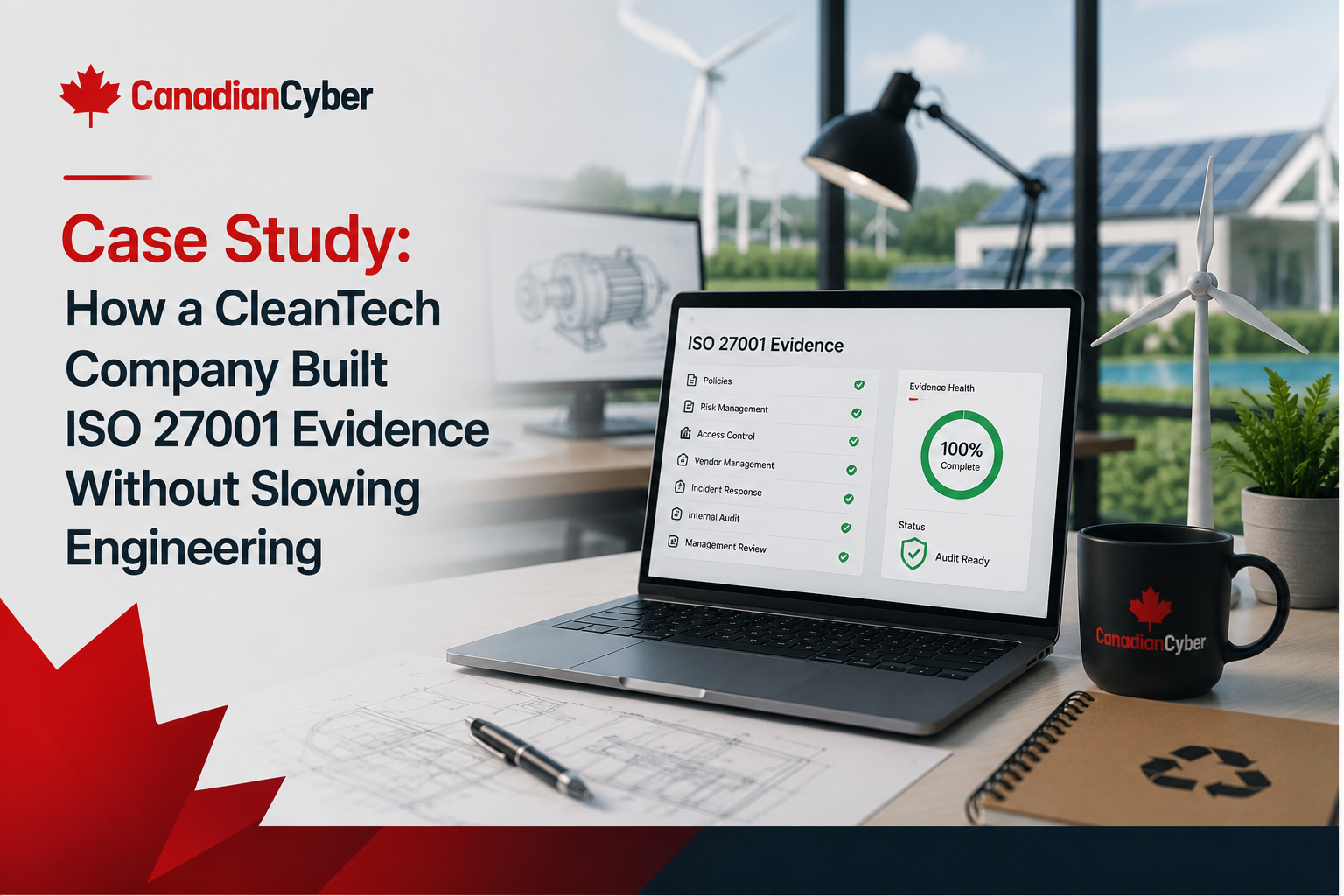
Case Study: How a CleanTech Company Built ISO 27001 Evidence Without Slowing Engineering
CleanTech companies often run lean engineering teams. They move fast, support customers, manage cloud platforms, maintain integrations, and improve product features every week. When ISO 27001 implementation begins, the biggest fear is simple: “Will compliance slow engineering down?”
Quick Snapshot
| Case Study Area | What Improved |
|---|---|
| Business Context | CleanTech SaaS company supporting energy, sustainability, and operational data customers. |
| Main Challenge | ISO 27001 evidence was needed, but engineering capacity was already tight. |
| Biggest Risk | Manual evidence collection could interrupt product delivery and delay customer commitments. |
| Solution | Build lightweight evidence workflows, assign owners, use SharePoint ISMS, and collect proof from existing engineering tools. |
| Outcome | Stronger ISO 27001 readiness, less engineering disruption, faster evidence collection, and better customer trust. |
Introduction
The CleanTech company had a strong mission.
Its platform helped customers track energy data, monitor sustainability performance, review operational trends, and make better environmental decisions.
The product was growing. Customers were asking for stronger security evidence. Enterprise buyers wanted proof of controls. Investors wanted risk visibility. Leadership wanted ISO 27001 readiness. Engineering wanted to keep shipping.
That created tension.
The company needed ISO 27001 evidence, but the engineering team was already busy with:
- product releases and API integrations
- cloud improvements and infrastructure changes
- customer requests and bug fixes
- data pipeline updates and dashboard enhancements
- security patches and product improvements
The CTO was worried: “If ISO 27001 becomes a weekly screenshot project, engineering will lose momentum.”
That concern was valid.
Many ISO 27001 projects fail because evidence collection becomes too manual, too late, and too disconnected from how teams actually work.
This case study shows how a CleanTech company built ISO 27001 evidence without slowing engineering. The company is fictional, but the scenario is realistic for CleanTech, SaaS, energy technology, climate technology, and software companies preparing for ISO 27001 in Canada.
Need ISO 27001 Evidence Without Slowing Your Product Team?
Canadian Cyber helps CleanTech and SaaS companies build practical ISO 27001 evidence workflows, SharePoint ISMS workspaces, control ownership models, internal audit trackers, and vCISO-led readiness roadmaps.
Meet the CleanTech Company
Let’s call the company EcoGrid Insights.
EcoGrid Insights provided a cloud-based platform for sustainability and energy operations teams. Its platform helped customers:
- track energy usage and monitor environmental performance
- review facility data and operational trends
- generate sustainability reports
- manage operational dashboards
- connect IoT and cloud data sources
- export customer reports and support ESG reporting
The company handled:
- customer account data and facility metadata
- energy performance records and API integration data
- uploaded reports and support tickets
- cloud logs and user activity records
- dashboard exports and customer configuration data
EcoGrid was not huge. It had a lean engineering team, a CTO, a small operations team, and growing enterprise interest. ISO 27001 became important because larger customers wanted proof that EcoGrid could protect operational and customer data.
The Starting Problem
EcoGrid had real controls. But evidence was not organized.
Engineering could prove many things if asked, but proof lived across GitHub, Jira, cloud consoles, CI/CD logs, monitoring tools, identity provider reports, support tickets, Slack threads, email, spreadsheets, and SharePoint folders.
The control existed, but the evidence was scattered.
Common Evidence Gaps
| Control Area | Evidence Problem |
|---|---|
| Change Management | Pull requests existed, but were not mapped to ISO controls. |
| Access Control | Admin access was controlled, but review evidence was informal. |
| Cloud Security | Settings existed, but screenshots were collected manually. |
| Incident Response | Plan existed, but tabletop evidence was missing. |
| Backup Recovery | Backups were configured, but restore test proof was incomplete. |
| Vendor Risk | Vendors were known, but review decisions were not centralized. |
| Risk Management | Risks were discussed, but not always tracked formally. |
| Policy Governance | Policies existed, but review dates and owners were inconsistent. |
The company did not need to invent everything from scratch. It needed an evidence system.
Why Engineering Teams Resist ISO 27001 Evidence Collection
Engineering teams usually do not resist security. They resist bad process.
| What Engineers Do Not Want | What Engineers Usually Accept |
|---|---|
| Manual screenshots every week. | Evidence pulled from existing tools. |
| Duplicate audit requests. | Clear requirements and one evidence workspace. |
| Unclear evidence expectations. | Templates, examples, and context. |
| Long compliance meetings. | Lightweight review workflows. |
| Random evidence deadlines. | Monthly and quarterly evidence calendars. |
| Engineers pulled away from product work. | Control owners outside engineering where appropriate. |
Practical rule: ISO 27001 evidence should fit engineering workflows, not fight them.
The Goal: Build Evidence Without Creating Friction
EcoGrid set three rules for the ISO 27001 evidence project.
Rule 1: Use Existing Tools
If evidence already existed in GitHub, Jira, cloud logs, CI/CD, or monitoring tools, the team would link or export it instead of recreating it manually.
Rule 2: Assign Owners Clearly
Engineering would not own every evidence item. Owners would be assigned across IT, security, operations, HR, vendor management, and leadership.
Rule 3: Store Evidence in SharePoint
Evidence would not live in email or random folders. It would be stored in a structured SharePoint ISMS with metadata and review status.
Workstream 1: Mapping ISO 27001 Controls to Existing Engineering Evidence
The team started by identifying evidence that already existed. This helped reduce new workload.
| Evidence Source | ISO 27001 Use |
|---|---|
| GitHub Pull Requests | Change review and approval. |
| Jira Tickets | Change requests, bug fixes, and security tasks. |
| CI/CD Logs | Deployment records. |
| Cloud Console Exports | Configuration and access evidence. |
| Monitoring Alerts | Logging and monitoring evidence. |
| Incident Tickets | Incident response evidence. |
| Security Scan Results | Vulnerability management evidence. |
| Architecture Diagrams | Scope and system understanding. |
Example Mapping
| ISO 27001 Control Area | Existing Evidence |
|---|---|
| Change Management | GitHub PR approvals and Jira tickets. |
| Access Control | Entra ID access exports and admin role reviews. |
| Logging and Monitoring | Alert review tickets and log source inventory. |
| Backup Recovery | Backup success reports and restore test records. |
| Incident Management | Incident tickets and post-incident reviews. |
| Risk Treatment | Risk register and corrective action tracker. |
Result: Engineering saw that ISO 27001 was not asking for completely new work. It was asking the company to organize proof of work already happening.
Workstream 2: Creating a Lightweight Evidence Request System
Before the project, evidence requests were informal. The ISO lead would message someone: “Can you send proof of this?” That created confusion.
EcoGrid created a simple evidence request process.
| Evidence Request Field | Purpose |
|---|---|
| Evidence Title | Clear name of the requested proof. |
| Control Area | Access, change, backup, vendor, incident. |
| Evidence Owner | Person responsible. |
| Source System | GitHub, Jira, Azure, AWS, Entra ID, SharePoint. |
| Period Covered | Month, quarter, or year. |
| Review Status | Requested, uploaded, approved, rejected. |
| Evidence Link | Direct link to proof. |
Evidence status values used:
Uploaded
Under Review
Approved
Rejected
Expired
Not Applicable
Practical rule: A clear evidence request saves more engineering time than a long meeting.
Workstream 3: Building a SharePoint ISMS Evidence Vault
EcoGrid already used Microsoft 365, so SharePoint became the evidence hub. But the team avoided creating a basic folder dump. They built a structured evidence vault.
| SharePoint Evidence Metadata | Purpose |
|---|---|
| Evidence Area | Access, change, cloud, vendor, incident, backup. |
| Control ID | Maps evidence to ISO 27001 control. |
| Evidence Owner | Shows accountability. |
| Period Covered | Shows audit period. |
| Source System | GitHub, Jira, Azure, AWS, Entra ID. |
| Review Status | Shows whether evidence is approved. |
| Related Risk | Links evidence to risk treatment. |
| Sensitivity | Internal, confidential, auditor-only. |
Useful SharePoint views included:
- evidence by owner and evidence due this month
- evidence under review and rejected evidence
- missing evidence and audit-ready evidence
- engineering evidence and access control evidence
- change management evidence and management review evidence
Explore the ISMS SharePoint Solution
Canadian Cyber’s ISMS SharePoint solution helps CleanTech and SaaS companies manage ISO 27001 risks, controls, policies, evidence, audits, corrective actions, and management review in one practical Microsoft 365 workspace.
Workstream 4: Reducing Manual Screenshots
The company wanted fewer screenshots. Screenshots are sometimes useful, but they are not always the best evidence.
| Instead of Screenshot | Use This |
|---|---|
| Screenshot of pull request | Link or export of PR approval. |
| Screenshot of Jira ticket | Ticket export or controlled link. |
| Screenshot of user list | Access export with review sign-off. |
| Screenshot of cloud setting | Configuration export where possible. |
| Screenshot of alert | Alert-to-ticket record. |
| Screenshot of policy | Approved policy with version history. |
| Screenshot of backup status | Backup report and restore test evidence. |
Practical rule: Use screenshots only when better system evidence is not available.
Workstream 5: Assigning Control Owners Outside Engineering
Engineering should not own every ISO 27001 control. EcoGrid assigned ownership based on function.
| Control Area | Owner |
|---|---|
| Secure Development | Engineering Lead |
| Change Management | Engineering Manager |
| Cloud Configuration | Cloud Engineer |
| Access Control | IT Lead |
| Security Training | HR / Operations |
| Vendor Risk | Operations Manager |
| Incident Response | vCISO / Security Lead |
| Risk Register | ISMS Owner |
| Management Review | Executive Sponsor |
Practical rule: If engineering owns every control, your ISO 27001 program is not properly distributed.
Workstream 6: Creating an Engineering Evidence Calendar
Evidence collection became easier when it followed a predictable rhythm.
Monthly Engineering Evidence
| Evidence | Owner |
|---|---|
| Security-related Jira tickets | Engineering Manager |
| Pull request approval samples | Engineering Lead |
| Deployment records | DevOps |
| Vulnerability scan summary | Security / DevOps |
| Cloud change records | Cloud Engineer |
Quarterly Engineering Evidence
| Evidence | Owner |
|---|---|
| Production admin access review | IT / Engineering |
| Service account review | DevOps |
| Cloud configuration review | Cloud Engineer |
| Backup restore test | Infrastructure |
| Risk treatment update | ISMS Owner + Control Owners |
Result: Engineering knew what evidence would be needed and when. There were fewer surprise requests.
Workstream 7: Connecting ISO 27001 Evidence to Customer Trust
EcoGrid did not build evidence only for the auditor. It used evidence to answer customer security questions faster.
| Customer Question | Evidence |
|---|---|
| Do you review access? | Access review evidence. |
| Do you approve code changes? | Pull request and deployment evidence. |
| Do you monitor cloud systems? | Alert review and log inventory. |
| Do you test backups? | Restore test record. |
| Do you review vendors? | Vendor register and review notes. |
| Do you have incident response? | Incident plan and tabletop evidence. |
| Do executives review security risk? | Management review minutes. |
Result: ISO 27001 evidence became useful for sales, procurement, enterprise trust, and customer security reviews.
Workstream 8: Using vCISO Support to Protect Engineering Focus
The company used fractional security leadership to manage the ISO 27001 project.
The vCISO helped:
- define scope and map controls
- assign owners and review evidence
- translate audit asks and prioritize gaps
- brief leadership and prepare management review
- support customer questions and reduce engineering interruptions
The vCISO acted as the bridge between engineering, leadership, operations, IT, auditors, customers, and vendors.
Add vCISO Support to Your ISO 27001 Project
Canadian Cyber provides vCISO support for CleanTech and SaaS companies that need ISO 27001 readiness without overwhelming engineering teams.
Results After the Evidence Project
EcoGrid improved ISO 27001 readiness without slowing engineering.
| Before | After |
|---|---|
| Evidence scattered across tools. | Evidence stored in SharePoint ISMS. |
| Engineering got random requests. | Evidence calendar created. |
| Controls lacked owners. | Ownership matrix assigned. |
| Screenshots collected manually. | Existing system evidence reused. |
| Change evidence hard to find. | GitHub and Jira evidence mapped. |
| Access reviews informal. | Access review workflow created. |
| Vendor evidence scattered. | Vendor register organized. |
| Leadership had limited visibility. | Management review pack prepared. |
Business impact:
- improved ISO 27001 readiness and audit confidence
- stronger engineering focus and less disruption
- better evidence quality and customer trust
- clearer control ownership and management visibility
- faster security questionnaire responses
Most importantly, the ISO 27001 project did not become an engineering bottleneck.
Lessons for CleanTech Companies
- Evidence should come from existing workflows. Use GitHub, Jira, cloud tools, identity platforms, and monitoring systems where possible.
- Engineering should not own every control. ISO 27001 is a business system, not only an engineering task.
- SharePoint needs structure. Do not create random folders. Use metadata, owners, review status, and control mapping.
- Evidence collection needs a rhythm. Monthly and quarterly evidence calendars reduce last-minute pressure.
- Customer trust improves when evidence is ready. The same evidence can support audits, customer reviews, cyber insurance, and leadership reporting.
CleanTech ISO 27001 Evidence Checklist
Engineering and Cloud Evidence
| Question | Yes / No |
|---|---|
| Are pull request approvals easy to locate? | |
| Are deployment records available? | |
| Are security tickets tracked? | |
| Are cloud admin changes logged? | |
| Are vulnerability findings reviewed? | |
| Are service accounts reviewed? | |
| Are cloud configuration reviews documented? |
Access and Support Evidence
| Question | Yes / No |
|---|---|
| Is MFA evidence available? | |
| Are privileged users reviewed? | |
| Are support users reviewed? | |
| Are offboarding samples collected? | |
| Are access exceptions tracked? | |
| Are customer data access rules documented? |
Governance Evidence
| Question | Yes / No |
|---|---|
| Is there a risk register? | |
| Are control owners assigned? | |
| Are policies approved and version-controlled? | |
| Is vendor risk evidence organized? | |
| Are backup restore tests documented? | |
| Is incident response tested? | |
| Is management review documented? | |
| Is evidence stored in a structured workspace? |
If several answers are “no,” your ISO 27001 evidence process may create unnecessary engineering friction.
Common Mistakes to Avoid
- Asking engineers for evidence without context. Explain what is needed and why.
- Waiting until internal audit. Collect evidence monthly or quarterly.
- Using screenshots for everything. Use system exports, links, tickets, and reports where possible.
- No evidence owner. Every evidence item needs a named owner.
- No review status. Uploaded evidence is not automatically audit-ready.
- Keeping evidence in email. Use SharePoint or a structured evidence workspace.
- Making ISO 27001 an engineering-only project. Leadership, IT, HR, vendors, operations, and security all have roles.
What Good Looks Like
A CleanTech company with strong ISO 27001 evidence can show:
- clear ISMS scope and risk register
- control ownership matrix and SharePoint evidence vault
- approved policies and GitHub change evidence
- Jira security tickets and cloud configuration evidence
- access review records and vendor reviews
- backup restore evidence and incident response evidence
- internal audit tracker and corrective action register
- management review minutes and customer trust pack
This helps the company prove security without slowing product delivery.
Canadian Cyber’s Take
At Canadian Cyber, we often see CleanTech companies with strong engineering culture and limited compliance capacity.
They are not ignoring security. They are moving fast.
The challenge is turning good security work into ISO 27001 evidence without creating friction. The best approach is practical:
- use evidence from existing tools
- assign owners clearly
- avoid duplicate requests
- use SharePoint as the ISMS hub
- collect evidence regularly
- prepare leadership summaries
- support customer trust
ISO 27001 should help CleanTech companies mature. It should not bury engineering under manual audit work.
Takeaway
CleanTech companies can build ISO 27001 evidence without slowing engineering.
Start by mapping controls to existing workflows. Use GitHub, Jira, cloud tools, identity platforms, monitoring systems, and support tools.
Then create:
- evidence owners and an evidence calendar
- SharePoint ISMS evidence vault
- control mapping and review status
- management review pack
- customer trust materials
The goal is simple. Make evidence collection part of the operating rhythm, not a last-minute engineering fire drill.
How Canadian Cyber Can Help
Canadian Cyber helps CleanTech and SaaS companies build ISO 27001 programs that protect engineering focus while improving audit readiness.
- ISO 27001 readiness assessments
- CleanTech ISO 27001 implementation
- SharePoint ISMS setup and evidence vault design
- control ownership mapping
- engineering evidence workflows
- GitHub and Jira evidence mapping
- access review workflows
- vendor risk register setup
- backup and restore evidence reviews
- incident response tabletop exercises
- internal audit preparation
- management review packs
- vCISO support for security governance in Canada
Stay Connected With Canadian Cyber
Follow Canadian Cyber for practical guidance on ISO 27001, CleanTech cybersecurity, SharePoint ISMS, evidence management, internal audits, SaaS security, and vCISO support.