SOC 2 • Security Awareness • Training Evidence • Audit Readiness • Behavior Change
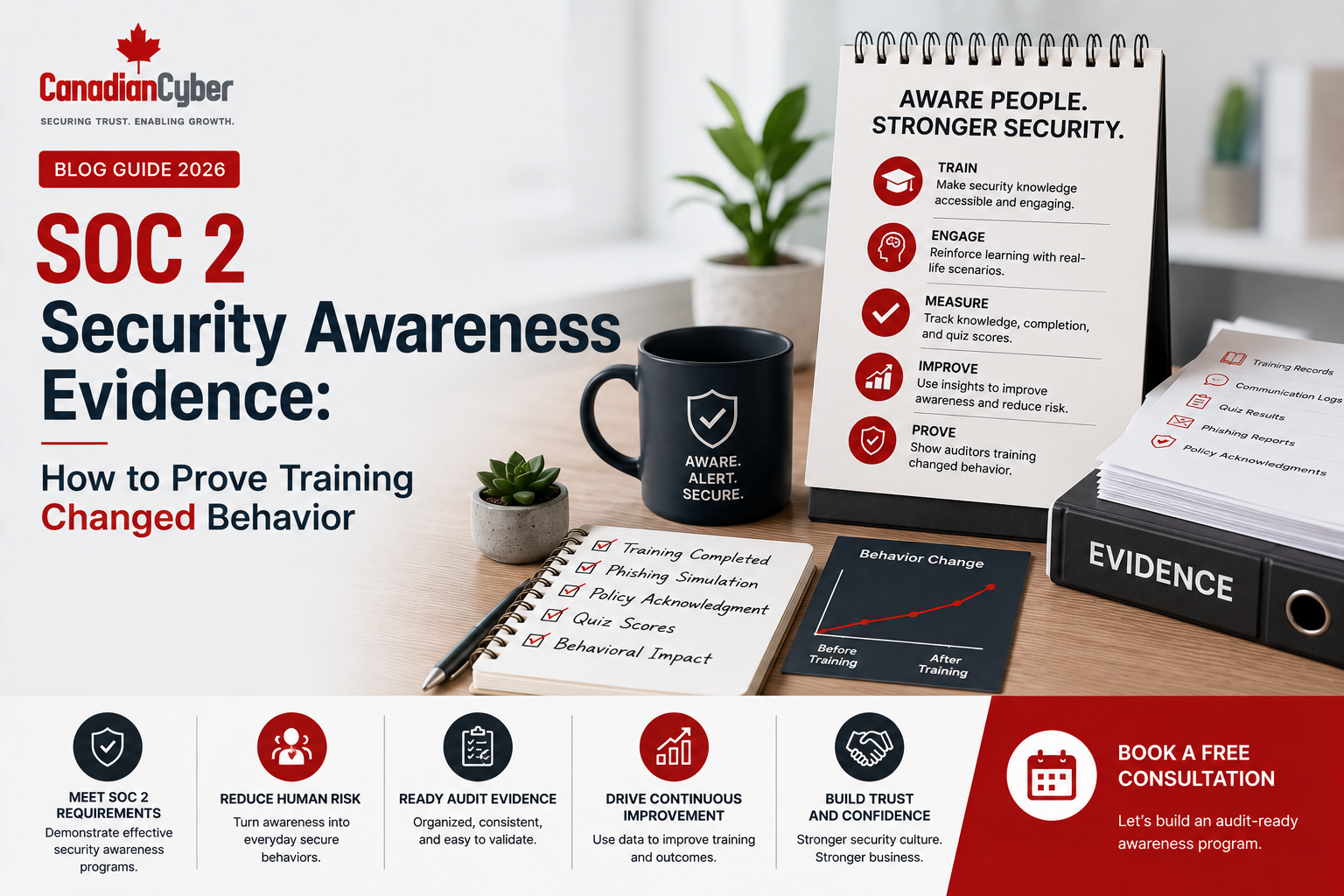
SOC 2 Security Awareness Evidence: How to Prove Training Changed Behavior
Security awareness training is easy to claim. The harder part is proving that it worked. SOC 2 auditors and enterprise buyers want evidence that employees understand security responsibilities and apply them in daily work.
Quick Snapshot
| Training Evidence Type | What It Proves |
|---|---|
| Training Completion Report | Employees completed assigned training. |
| Policy Acknowledgment | Employees accepted security responsibilities. |
| Quiz Results | Employees understood key concepts. |
| Phishing Simulation Results | Employees applied awareness in realistic scenarios. |
| Incident Reporting Records | Employees know when and how to report issues. |
| Trend Metrics | Behavior improved over time. |
Quick Answer
SOC 2 security awareness evidence should prove more than course completion. Strong evidence includes training assignments, completion records, policy acknowledgments, quiz scores, phishing simulation results, incident reporting trends, role-based training records, onboarding training, refresher campaigns, corrective actions, and management review metrics.
To show that training changed behavior, companies should track measurable outcomes such as fewer phishing clicks, faster incident reporting, improved policy acknowledgment rates, better quiz scores, reduced repeat violations, and stronger support or engineering handling of sensitive data.
Practical takeaway: Completion proves activity. Behavior metrics prove impact.
Why Security Awareness Matters in SOC 2
SOC 2 focuses heavily on whether controls are designed and operating. People are part of that control environment.
Even if a company has strong technical tools, employee behavior can still create risk. Employees may click phishing emails, share passwords, use unauthorized AI tools, upload customer data into unapproved systems, send sensitive files through personal email, fail to report suspicious activity, mishandle support screenshots, or ignore change management procedures.
Security awareness training helps reduce these risks. But in an audit, the company must prove the training program operates consistently and leads to better security behavior.
SOC 2 does not reward security awareness slogans. It rewards evidence that training is assigned, completed, measured, and improved.
Who This Guide Is For
- SaaS companies preparing for SOC 2.
- Startups building their first audit evidence program.
- CTOs and security leaders managing training controls.
- HR teams responsible for onboarding and training evidence.
- Compliance leads preparing SOC 2 audit records.
- Support teams handling customer data.
- Engineering teams managing production and code access.
- AI, HealthTech, and FinTech companies handling sensitive data.
What Auditors Usually Expect From Security Awareness Evidence
Auditors may test whether the organization provides security awareness training to relevant personnel and whether employees acknowledge key policies. The evidence should show who was assigned training, when it was assigned, when it was completed, what content was covered, who did not complete it, what follow-up occurred, whether new hires were trained, and whether high-risk roles received relevant training.
| Evidence Auditors May Request | Why It Matters |
|---|---|
| Training policy and schedule | Shows the program is planned and controlled. |
| Training completion report | Shows employees completed assigned training. |
| New hire training records | Shows onboarding controls operate. |
| Policy acknowledgments | Shows employees accepted expected behavior. |
| Quiz results | Shows understanding, not just attendance. |
| Phishing test results | Shows awareness applied in realistic scenarios. |
| Overdue training follow-up | Shows management of exceptions. |
| Role-based training records | Shows high-risk teams received relevant guidance. |
Practical rule: A training program is stronger when it shows coverage, completion, understanding, and follow-up.
The Problem With “Everyone Completed Training”
A completion report is useful, but it is not enough by itself. It may answer whether employees finished the course, but it may not prove whether employees understood the content, improved their behavior, reported incidents faster, stopped using unapproved tools, or handled customer data more safely.
| Weak Evidence | Stronger Evidence |
|---|---|
| “100% of employees completed annual security training.” | “100% completed training. Average quiz score improved from 78% to 91%. Phishing click rate decreased from 14% to 5% over two quarters. Support staff completed role-based training on customer screenshot handling.” |
Completion proves activity. Behavior metrics prove impact.
What “Training Changed Behavior” Means
Training changed behavior when employees act differently after receiving awareness guidance. This should be measured through evidence, not assumed because training was delivered.
Examples of behavior change include:
SOC 2 Security Awareness Evidence Categories
| Evidence Category | What to Keep | What It Proves |
|---|---|---|
| Training Assignment | Campaign record, employee assignment list, due dates, new hire rules. | Employees were expected to complete training. |
| Training Completion | Completion report, completion dates, overdue list, manager follow-up. | Training was completed within the required timeframe. |
| Policy Acknowledgment | Acknowledgment report, policy version, dates, exception list. | Employees were informed of expected behavior. |
| Quiz and Knowledge Checks | Average score, pass rate, failed attempts, retesting evidence. | Employees understood key messages. |
| Phishing Simulation | Click rate, reporting rate, repeat clickers, department trends. | Employees applied awareness in realistic conditions. |
| Incident Reporting | Employee reports, time to report, escalation records, repeat training. | Employees know how to report suspicious activity. |
Role-Based Training Evidence
Not every employee needs the same training depth. High-risk roles should receive targeted training because their daily work creates different security risks.
| Team | Training Focus |
|---|---|
| Support | Customer data, screenshots, ticket privacy, escalation. |
| Engineering | Secure coding, secrets handling, change management. |
| IT | Access reviews, admin accounts, endpoint security. |
| HR | Onboarding, offboarding, confidentiality, training records. |
| Finance | Fraud, phishing, payment changes, vendor risk. |
| Product | Privacy by design, AI features, data flows. |
| Sales | Security claims, questionnaire accuracy, evidence sharing. |
| Leadership | Incident decisions, risk ownership, management review. |
Role-based training shows that awareness is connected to real job risks.
How to Prove Training Changed Behavior
1. Compare Before and After Metrics
Track baseline performance before training and compare it with later results. Useful examples include phishing click rate before and after training, quiz score improvement, incident reporting volume, policy acknowledgment completion, and support ticket handling errors.
2. Track Repeat Issues
If the same issue keeps happening, training may not be working. Repeat issues should trigger targeted training, coaching, procedure updates, and corrective action.
3. Link Training to Incidents and Corrective Actions
If an incident or audit finding reveals a people-related issue, training may be required. For example, if an employee uploads customer data into an unapproved AI tool, the company may update the AI acceptable use policy, deliver refresher training, require acknowledgment, review approved tools, and include the issue in management review.
4. Use Department-Level Metrics
Company-wide completion may hide team-level risk. For example, 98% completion overall may look strong, but if the support team is only 70% complete, that matters.
5. Show Management Review of Training Metrics
Security awareness should be visible to leadership. Management review can include training completion rate, overdue training, phishing simulation trends, incident reporting trends, role-based training gaps, and planned improvements.
SOC 2 Security Awareness Metrics to Track
| Metric | Why It Matters |
|---|---|
| Annual training completion rate | Shows coverage. |
| New hire training completion time | Shows onboarding control. |
| Overdue training count | Shows follow-up needs. |
| Quiz pass rate | Shows understanding. |
| Phishing click rate | Shows risky behavior. |
| Phishing reporting rate | Shows positive reporting behavior. |
| Repeat clicker count | Shows targeted coaching need. |
| Role-based training completion | Shows high-risk team readiness. |
| Incidents reported by employees | Shows awareness in action. |
Security Awareness Evidence Pack Structure
A strong evidence pack tells the story from assignment to behavior change. It should show the full training control lifecycle, not only a single screenshot.
1. Training Program Overview
Training frequency, who receives training, onboarding process, annual refresher process, role-based training approach, tracking method, and follow-up process.
2. Completion Evidence
Training completion report, overdue list, manager reminders, and completion dates.
3. Understanding Evidence
Quiz results, pass rates, common wrong answers, and retesting evidence.
4. Behavior Evidence
Phishing simulation metrics, incident reporting trends, repeat issue reduction, and corrective action links.
5. Governance Evidence
Policy acknowledgment, management review discussion, and training improvement plan.
Common Mistakes in SOC 2 Security Awareness Evidence
- Only keeping completion screenshots. Screenshots may not show full coverage, dates, users, or overdue follow-up.
- No new hire evidence. SOC 2 auditors may test whether new employees completed training during onboarding.
- No policy acknowledgment. Training and policies should connect.
- No follow-up for overdue training. Missed training should show reminders or escalation.
- No role-based training. Generic annual training may not address support, engineering, AI, finance, or leadership risks.
- No behavior metrics. Completion alone does not prove reduced risk.
- No management review. Leadership should see awareness metrics and approve improvements.
- No evidence retention. Training reports should be stored in a controlled evidence library, not lost in email.
How SharePoint Can Help Manage Security Awareness Evidence
A structured SharePoint evidence workspace can help manage SOC 2 training evidence continuously, rather than collecting it manually during audit week.
Canadian Cyber’s ISMS SharePoint Solution can help organize:
How Canadian Cyber Helps
Canadian Cyber helps organizations prepare SOC 2 evidence that can stand up to auditor and enterprise buyer review. We help teams move from simple training completion reports to a stronger awareness evidence program that shows assignment, completion, understanding, behavior change, and continual improvement.
Canadian Cyber can support:
Canadian Cyber’s ISMS SharePoint Solution
Canadian Cyber’s ISMS SharePoint Solution helps organizations manage SOC 2 and ISO evidence inside Microsoft 365.
It can include a policy library, procedure library, evidence library, SOC 2 control register, training evidence folder, policy acknowledgment tracker, security awareness dashboard, incident register, corrective action tracker, management review dashboard, client-ready evidence room, Power Automate reminders, Teams notifications, and auditor-ready views.
Practical rule: This helps organizations prove that training was not only completed, but managed as part of the security program.
Frequently Asked Questions
What security awareness evidence is needed for SOC 2?
Common evidence includes training completion reports, new hire training records, policy acknowledgments, training content summaries, quiz results, phishing simulation results, overdue training follow-up, and role-based training records.
Is a training completion report enough for SOC 2?
It may be enough for basic evidence, but stronger evidence shows understanding and behavior change through quiz scores, phishing simulation trends, incident reporting, and follow-up actions.
How can we prove training changed behavior?
Track metrics such as phishing click rate reduction, phishing reporting improvement, quiz score improvement, fewer repeat violations, faster incident reporting, and better role-based compliance.
Should support and engineering teams receive special training?
Yes. Support teams may handle customer data and screenshots. Engineering teams manage code, secrets, changes, and production risks. Role-based training makes the evidence stronger.
Can SharePoint manage SOC 2 training evidence?
Yes. SharePoint can organize training reports, policy acknowledgments, role-based evidence, phishing results, corrective actions, and management review inputs in a controlled evidence workspace.
Can Canadian Cyber help prepare SOC 2 awareness evidence?
Yes. Canadian Cyber can help design security awareness evidence packs, review SOC 2 controls, build SharePoint evidence workspaces, support vCISO programs, and prepare for audit readiness.
Takeaway
Security awareness training should not be treated as a checkbox. For SOC 2, strong evidence should show that employees were trained, understood expectations, followed policies, reported issues, and improved behavior over time.
The strongest awareness evidence includes training assignments, completion reports, policy acknowledgments, quiz results, phishing simulation trends, incident reporting metrics, role-based training, corrective action links, and management review discussion.
SOC 2 buyers and auditors want to see that security awareness is part of how the company operates, not just something employees click once a year.
Is Your SOC 2 Security Awareness Evidence Strong Enough?
Canadian Cyber can help you build evidence that proves more than completion. We support SOC 2 readiness, SOC 2 evidence planning, SharePoint evidence workspaces, vCISO services, cybersecurity assessments, ISO 27001 implementation, ISO 27001 internal audits, incident response tabletop exercises, ISO 27017, ISO 27018, and ISO 42001 AI governance.
Stay Connected With Canadian Cyber
Follow Canadian Cyber for practical guidance on SOC 2 evidence, security awareness training, ISO 27001, ISO 42001, ISO 27017, ISO 27018, SharePoint ISMS, audit readiness, cybersecurity assessments, and vCISO support.