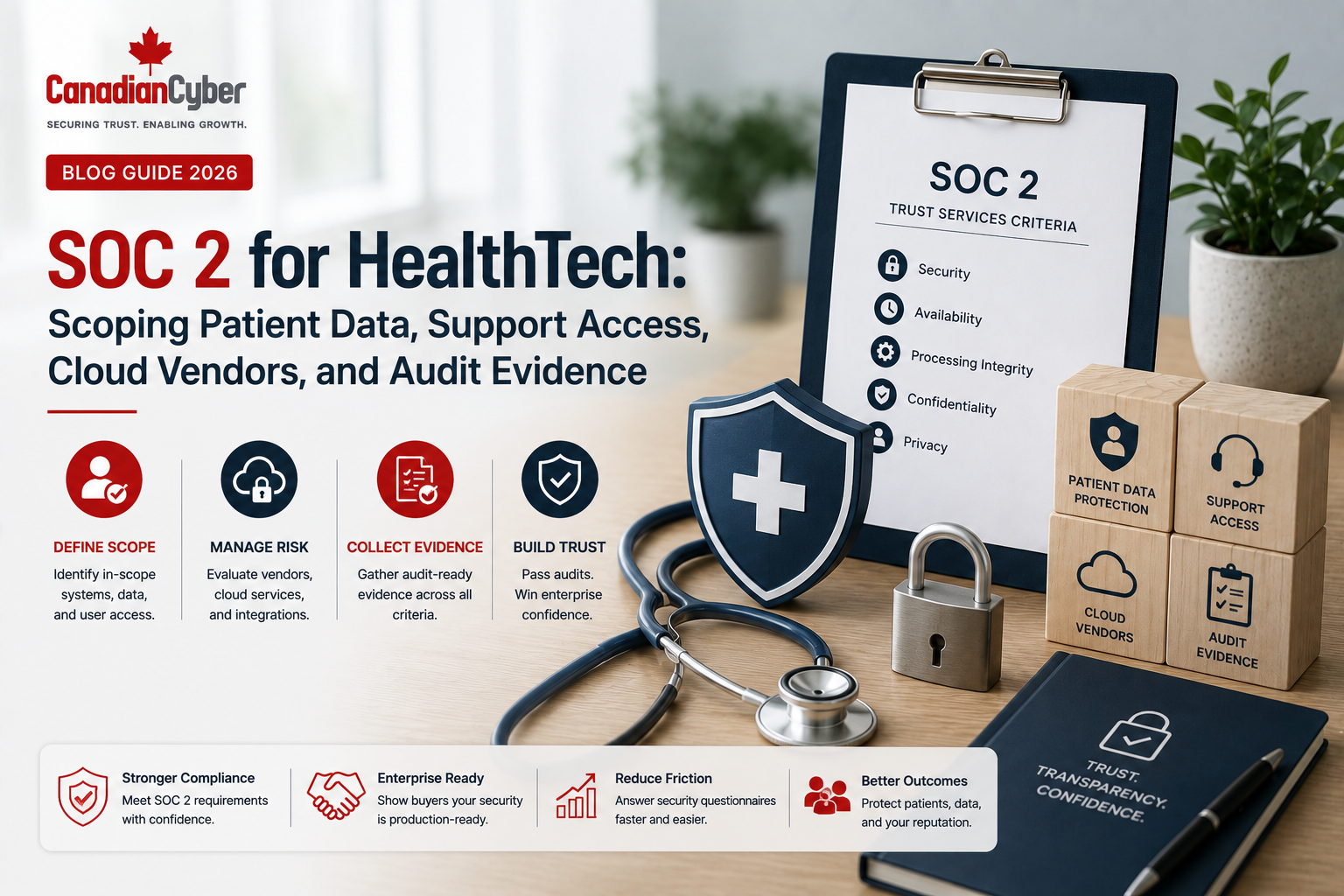
SOC 2 • HealthTech • Patient Data • Support Access • Cloud Vendors • Audit Evidence
SOC 2 for HealthTech: Scoping Patient Data, Support Access, Cloud Vendors, and Audit Evidence
HealthTech companies may not be hospitals or traditional healthcare providers, but their platforms can still touch sensitive patient-related data through workflows, support tickets, screenshots, logs, APIs, analytics, cloud vendors, and AI tools.
Quick Snapshot
| SOC 2 Scoping Area | Why It Matters for HealthTech |
|---|---|
| Patient Data | Buyers want to know what sensitive healthcare-related data is collected, stored, processed, or viewed. |
| Support Access | Support teams may see screenshots, tickets, logs, attachments, or customer records. |
| Cloud Vendors | Cloud hosting, monitoring, AI, analytics, backups, and support tools may process sensitive data. |
| Audit Evidence | SOC 2 requires proof that controls are designed and operating. |
| AI Tools | AI features may process prompts, outputs, notes, tickets, or healthcare workflow data. |
| Evidence Room | A structured workspace helps reduce audit panic and procurement delays. |
Quick Answer
SOC 2 for HealthTech should be scoped around the systems, data, people, vendors, and processes that support the product and handle patient or PHI-adjacent information.
HealthTech companies should identify where patient-related data appears, how support teams access customer information, which cloud vendors and subprocessors are involved, and what audit evidence proves controls are operating.
Practical takeaway: Key evidence includes access reviews, MFA records, support access procedures, vendor reviews, cloud security evidence, incident response records, backup evidence, change approvals, training records, and client-ready security documentation.
Why SOC 2 Scoping Is More Complicated for HealthTech
HealthTech companies face a different kind of SOC 2 challenge. They may not be a hospital. They may not directly provide medical care. They may not store complete medical records. They may not consider themselves a traditional healthcare organization.
But their platform may still touch sensitive healthcare-related information. A HealthTech SaaS company may process patient names, appointment details, provider records, workflow notes, billing references, insurance-related information, support screenshots, API logs, analytics records, AI-generated summaries, customer messages, or clinical workflow metadata.
That means SOC 2 scoping cannot be treated like a generic SaaS checklist. For HealthTech, SOC 2 must answer four important questions: what patient or PHI-adjacent data is in scope, who can access that data, which cloud vendors support the service, and what evidence proves controls are operating.
HealthTech SOC 2 scope should be accurate, evidence-based, and tied to real data flows.
Who This Blog Is For
- HealthTech SaaS companies preparing for SOC 2.
- Healthcare workflow platforms and patient engagement platforms.
- Medical scheduling, remote care, and telehealth software providers.
- Healthcare analytics companies and AI-enabled HealthTech platforms.
- HealthTech companies selling to hospitals, clinics, insurers, or healthcare networks.
- CTOs, founders, compliance leads, support leaders, and product teams.
- Organizations using Microsoft 365 or SharePoint for evidence management.
What Buyers Want to See From HealthTech SOC 2
Healthcare buyers are careful. They may ask detailed questions before signing a contract, especially if the product touches patient-related workflows, clinical operations, provider information, personal data, appointment details, or support records.
Buyers usually want to know:
Practical rule: HealthTech buyers do not only want to hear that security exists. They want to see how sensitive data is protected in daily operations.
Scoping Area 1: Patient Data and PHI-Adjacent Data
The first SOC 2 scoping question is simple: what data does the platform handle? For HealthTech, the answer may not be simple. Some companies handle full protected health information. Others handle data that is not a complete medical record but still has healthcare sensitivity.
| Data Type | Where It May Appear |
|---|---|
| Patient names | Scheduling systems, support tickets, exports. |
| Appointment details | Calendars, workflow records, notifications. |
| Uploaded files | Intake forms, attachments, support records. |
| Screenshots | Support tickets and troubleshooting requests. |
| API payloads | Integration logs and error reports. |
| AI prompts and outputs | AI support tools, chatbots, summaries. |
| Metadata | Logs, user activity, audit trails. |
Internal questions to ask:
If data can reveal a person’s healthcare-related interaction, treat it carefully during SOC 2 scoping.
Scoping Area 2: Support Access
Support access is one of the most overlooked HealthTech SOC 2 risks. Support teams may need to troubleshoot customer issues, but that legitimate business need can also create access risk.
Support may access:
admin panels
support tickets
screenshots
attachments
error logs
API error messages
AI summaries
| What SOC 2 Should Test | Evidence to Prepare |
|---|---|
| Is support access approved and role-based? | Support access policy and role matrix. |
| Are support users reviewed regularly? | Support access review evidence. |
| Can support access production data? | Production access procedure and approval records. |
| Are screenshots and attachments controlled? | Screenshot handling and redaction guidance. |
| Are AI support tools approved? | AI vendor review and AI use procedure. |
Practical rule: For HealthTech SOC 2, support access should be treated as a high-value audit area.
Scoping Area 3: Cloud Vendors and Subprocessors
Most HealthTech SaaS platforms depend on cloud vendors. Healthcare buyers want to know which vendors support the service and whether those vendors are reviewed.
This may include:
| Vendor Questions to Answer | Evidence to Prepare |
|---|---|
| Which vendors process customer or patient-related data? | Vendor register and subprocessor list. |
| Which vendors are critical to service delivery? | Critical vendor list and review records. |
| Which vendors store support tickets or screenshots? | Support tool vendor review. |
| Which vendors process AI prompts or outputs? | AI vendor review evidence. |
| Are vendor SOC 2 reports or ISO certificates reviewed? | Vendor assurance records and review dates. |
HealthTech SOC 2 scope should include the vendors that support sensitive data processing, not only the main product database.
Scoping Area 4: Cloud Security Evidence
Using a major cloud provider does not automatically satisfy SOC 2. The HealthTech company must prove how it secures its side of cloud responsibility.
| What to Evidence | Evidence Examples |
|---|---|
| Cloud architecture | Architecture diagram and responsibility matrix. |
| Cloud admin access | Cloud admin access review and MFA evidence. |
| Backups and restore testing | Backup report and restore test report. |
| Logging and monitoring | Logging configuration and alert review evidence. |
| Change approval | Change management record and release evidence. |
| Vulnerability management | Vulnerability scan summary and remediation tracker. |
Scoping Area 5: Secure Development and Product Changes
HealthTech product teams often build features that affect sensitive workflows. SOC 2 should review how product changes are designed, approved, tested, and released.
| What to Test | Evidence to Prepare |
|---|---|
| Are code changes reviewed? | Pull request approval records. |
| Are product changes linked to tickets? | Change records and release notes. |
| Are security reviews performed for sensitive features? | Security review checklist and risk records. |
| Are AI features reviewed before launch? | AI feature review and AI governance record. |
| Are logs checked for sensitive data exposure? | Log review record and remediation tracker. |
In HealthTech, product decisions can create privacy and security risk before IT ever sees it.
Scoping Area 6: Incident Response and Breach Readiness
HealthTech buyers want confidence that the company can respond quickly if something goes wrong. SOC 2 evidence should show that incident response is documented, tested, and understood.
| What to Test | Evidence to Prepare |
|---|---|
| Is there an incident response plan? | Incident response plan and severity matrix. |
| Are roles and escalation contacts assigned? | Escalation contact list. |
| Are healthcare-related data incidents considered? | Incident procedure and customer notification process. |
| Are tabletop exercises performed? | Tabletop exercise report and lessons learned. |
| Are corrective actions closed? | Corrective action tracker and closure evidence. |
Practical rule: A tested incident response process is stronger than a policy that no one has practiced.
Scoping Area 7: Audit Evidence and Evidence Quality
SOC 2 readiness depends on evidence quality. For HealthTech companies, evidence should be clear, current, mapped, and easy to explain.
| Control Area | Evidence Examples |
|---|---|
| Access Control | MFA report, access review, offboarding evidence. |
| Support Access | Support user review and ticket handling procedure. |
| Vendor Risk | Vendor register, vendor reviews, subprocessor list. |
| Cloud Security | Admin access review, backup report, logging evidence. |
| Change Management | Pull request approvals and release records. |
| Incident Response | Tabletop report and incident register. |
| Training | Security awareness completion and policy acknowledgment. |
| Corrective Actions | Issue tracker and closure evidence. |
Evidence should be prepared before the auditor asks for it.
SOC 2 Type I or Type II for HealthTech?
| SOC 2 Type I May Be Better When | SOC 2 Type II May Be Better When |
|---|---|
| Controls are newly implemented. | Enterprise healthcare buyers require stronger assurance. |
| Evidence history is limited. | Controls have operated for several months. |
| Buyers need an early trust signal. | Access reviews and vendor reviews are mature. |
| The company wants a baseline before Type II. | The company wants stronger assurance over time. |
Practical rule: Type I shows control design. Type II shows control operation over time.
HealthTech SOC 2 Readiness Checklist
| Readiness Area | Ready? |
|---|---|
| SOC 2 scope clearly defines product, systems, and services. | |
| Patient and PHI-adjacent data types are identified. | |
| Data flows are documented. | |
| Support access is reviewed and restricted. | |
| Support ticket and screenshot handling is documented. | |
| MFA is enforced for employees and admins. | |
| Access reviews are completed and evidenced. | |
| Cloud vendors and subprocessors are listed. | |
| Backups and restore tests are evidenced. | |
| Incident response plan is tested. | |
| AI tools and AI features are reviewed. | |
| Evidence is organized in a central workspace. |
Common SOC 2 Mistakes HealthTech Companies Should Avoid
- Under-scoping patient data. Patient-related data may appear in logs, tickets, screenshots, analytics, exports, and AI tools.
- Ignoring support access. Support workflows are often where sensitive data exposure risk appears.
- Assuming cloud vendor security covers everything. The SaaS company must still secure access, configurations, backups, monitoring, and data handling.
- No vendor register. HealthTech buyers expect visibility into subprocessors and critical vendors.
- Weak evidence history. SOC 2 Type II requires proof over time.
- No AI governance. AI tools and features should be reviewed before customer data is used.
- No tested incident response. A plan without a tabletop exercise may not satisfy buyer confidence.
- Scattered audit evidence. Evidence stored in emails, screenshots, chats, and personal drives creates audit stress.
How SharePoint Can Help Manage HealthTech SOC 2 Evidence
A structured SharePoint evidence workspace can help HealthTech teams manage SOC 2 readiness inside Microsoft 365. It helps teams avoid last-minute evidence collection and respond faster to healthcare buyer questionnaires.
Canadian Cyber’s ISMS SharePoint Solution can help organize:
Practical rule: A HealthTech SOC 2 program works better when evidence is collected continuously, not rebuilt during audit week.
How Canadian Cyber Helps
Canadian Cyber helps HealthTech companies prepare for SOC 2 audits, enterprise healthcare procurement, security questionnaires, and customer trust reviews. We help define the right scope, identify sensitive data workflows, review support access, assess vendors, organize evidence, and prepare for audit.
Canadian Cyber can support:
Canadian Cyber’s ISMS SharePoint Solution
Canadian Cyber’s ISMS SharePoint Solution helps HealthTech companies manage SOC 2 and ISO evidence inside Microsoft 365.
It can include a policy library, procedure library, risk register, control register, SOC 2 evidence workspace, ISO 27001 evidence workspace, vendor register, subprocessor tracker, support access tracker, access review tracker, incident register, corrective action tracker, AI governance register, cloud control evidence library, audit evidence dashboard, client-ready evidence room, Power Automate reminders, and Teams notifications.
Practical rule: This helps HealthTech companies prove controls faster and reduce audit and procurement stress.
Frequently Asked Questions
Is SOC 2 important for HealthTech companies?
Yes. SOC 2 is often requested by healthcare buyers, enterprise customers, partners, and procurement teams because it provides assurance over security and related controls.
What should be in scope for HealthTech SOC 2?
Scope should include the product, systems, cloud infrastructure, support workflows, vendors, data flows, and processes that handle or support patient-related or PHI-adjacent data.
Should support access be included in SOC 2?
Yes. Support access should be reviewed because support teams may access customer records, screenshots, logs, attachments, or sensitive healthcare-related information.
Do cloud vendors need to be reviewed for SOC 2?
Yes. HealthTech companies should maintain a vendor register, review critical vendors, collect assurance reports where appropriate, and understand which vendors process sensitive data.
What evidence is needed for HealthTech SOC 2?
Common evidence includes MFA reports, access reviews, support access records, vendor reviews, cloud security evidence, backup and restore test evidence, incident response records, change approvals, training records, and policy approvals.
Can Canadian Cyber help HealthTech companies prepare for SOC 2?
Yes. Canadian Cyber can support SOC 2 readiness, evidence planning, support access review, vendor review, ISO 27001 alignment, internal audits, vCISO services, incident response tabletop exercises, and SharePoint evidence workspace setup.
Takeaway
SOC 2 for HealthTech is not just a standard SaaS audit. It must reflect how patient-related and PHI-adjacent data actually flows through the product, support workflows, cloud systems, vendors, logs, analytics, and AI tools.
The most important scoping questions are: what sensitive data is handled, who can access it, which vendors support it, how it is protected, and what evidence proves controls are operating.
HealthTech companies that answer these questions early will be better prepared for SOC 2, healthcare customer due diligence, enterprise procurement, and security questionnaires.
Preparing for SOC 2 as a HealthTech Company?
Canadian Cyber can help you scope the audit properly and organize evidence before buyers or auditors ask for it. We support SOC 2 readiness, SOC 2 Type I and Type II preparation, ISO 27001 alignment, ISO 27001 internal audits, vCISO services, cybersecurity assessments, incident response tabletop exercises, ISO 27017, ISO 27018, ISO 42001 AI governance, and SharePoint evidence workspaces.
Stay Connected With Canadian Cyber
Follow Canadian Cyber for practical guidance on SOC 2 for HealthTech, patient data scoping, support access, cloud vendors, ISO 27001, ISO 42001, ISO 27017, ISO 27018, SharePoint ISMS, audit evidence, cybersecurity assessments, and vCISO support.