

vCISO • MSP Cyber Governance • Cybersecurity Leadership • ISO 27001 • SOC 2
vCISO in Canada: Building Cybersecurity Leadership Across Multiple MSP Client Environments
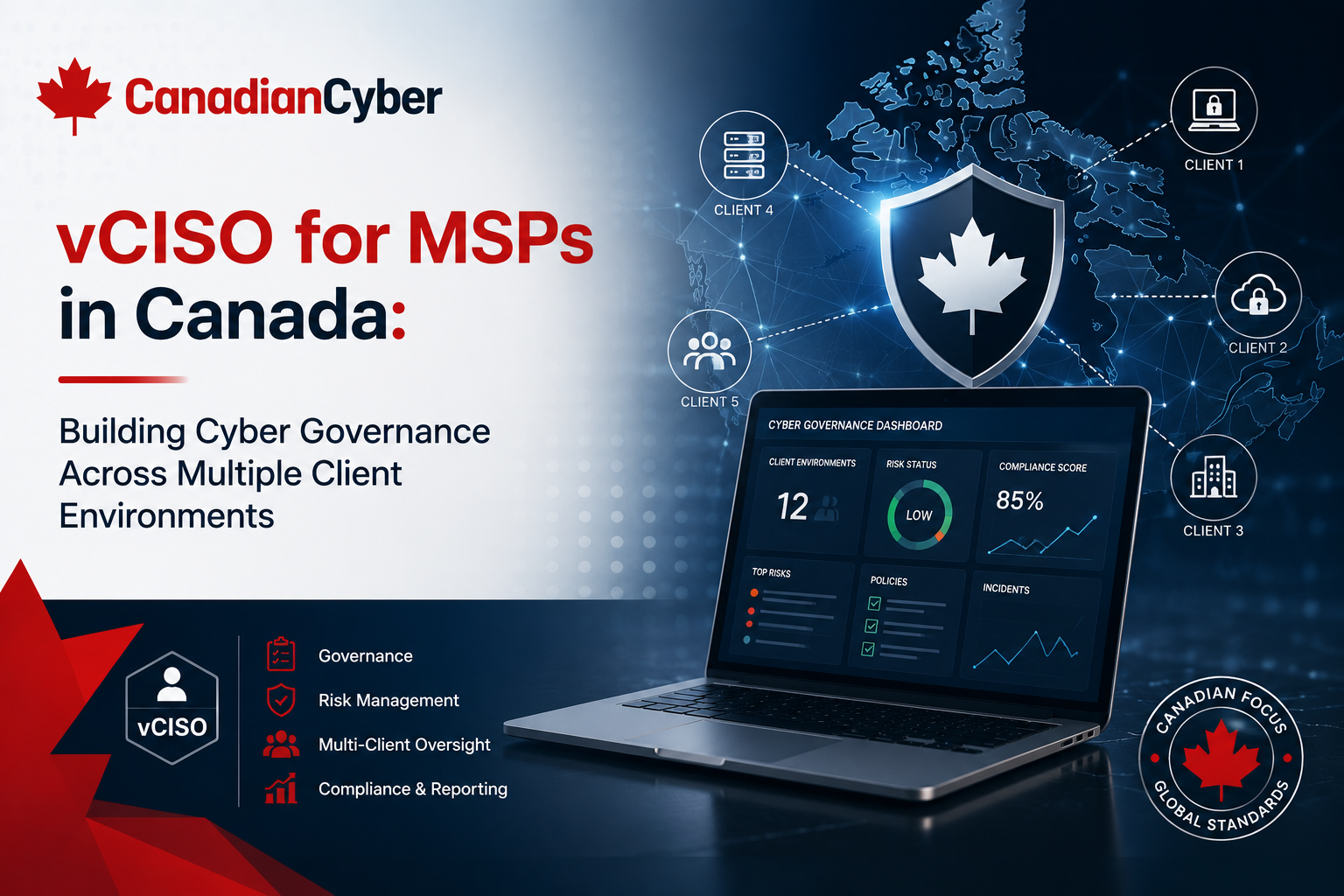
MSPs are trusted with access to many client environments. That makes cybersecurity governance more than an internal responsibility. A vCISO helps MSPs manage risk, prove accountability, strengthen client trust, and create repeatable security oversight across multiple customers, tools, vendors, and service teams.
Quick Snapshot
| MSP Governance Area | Why It Matters |
|---|---|
| Client Access | MSP technicians often hold privileged access across many client systems. |
| Toolchain Risk | RMM, ticketing, backup, password vault, endpoint, and cloud tools can affect multiple customers. |
| Client Governance | Each client may have different risk, compliance, access, and evidence expectations. |
| vCISO Role | Provides cybersecurity leadership, risk oversight, board/client reporting, and control ownership. |
| Evidence | Helps prove access reviews, vendor reviews, incident response, backups, and security decisions. |
| Business Outcome | Stronger client trust, better enterprise readiness, fewer security review delays, and more mature MSP operations. |
Introduction
MSPs are no longer just IT support providers.
They manage identity, configure cloud tenants, handle endpoints, monitor backups, respond to tickets, manage security tools, support remote access, and often hold admin credentials across many clients.
That makes MSPs powerful.
It also makes them high-risk.
If one MSP account is compromised, many clients may be affected. If one remote management tool is abused, attackers may move across customer environments. If one technician keeps access after leaving, the risk is not limited to one system.
This is why MSPs need cybersecurity leadership, not just more tools.
A vCISO in Canada helps MSPs build governance, ownership, evidence, risk visibility, client reporting, and repeatable controls across multiple client environments. This blog explains how MSPs can use vCISO support to reduce operational risk and turn security maturity into a competitive advantage.
Why MSP Cyber Governance Is Different
MSP cybersecurity is different because the MSP is both a business and a trusted service provider.
The MSP must protect its own systems, employees, vendors, tools, client systems, client data, client access paths, backup workflows, incident response support, and trust relationships.
| Standard Company | MSP |
|---|---|
| Protects one main environment. | Supports many client environments. |
| Reviews internal users. | Reviews technicians across many client tools. |
| Manages internal vendors. | Manages MSP toolchain and client-facing vendors. |
| Reports to one leadership team. | May need internal and client-facing reporting. |
| Owns its own systems. | Often has delegated access to client systems. |
An MSP does not only need cybersecurity controls. It needs cybersecurity governance that scales across clients.
The Problem: Tool-Heavy MSPs Without Governance
Many MSPs have strong technical tools: RMM, ticketing, password vaults, backup platforms, endpoint security, MDR or SIEM, documentation platforms, cloud admin portals, identity tools, and remote support tools.
But tools do not automatically create governance.
| Common MSP Governance Gap | Why It Matters |
|---|---|
| Technician access not reviewed consistently | Former or over-permissioned users may retain access. |
| Client environments handled differently | Service quality and risk vary by client. |
| Vendor risk not centralized | Critical MSP toolchain risks may be missed. |
| Incident response unclear | MSP and client roles may be confused during a breach. |
| Backup recovery evidence inconsistent | Client recovery confidence is weak. |
| No client security reporting | Clients do not see security value clearly. |
| Evidence scattered | ISO 27001, SOC 2, cyber insurance, and client reviews become painful. |
If security depends on individual technician habits instead of a governed process, the MSP is exposed.
What a vCISO Does for an MSP
A vCISO gives the MSP strategic cybersecurity leadership without requiring a full-time executive hire. The vCISO helps translate technical operations into risk governance.
| vCISO Area | What It Includes |
|---|---|
| Security Strategy | 90-day and 12-month cybersecurity roadmap. |
| Risk Management | MSP risk register and client-facing risk themes. |
| Access Governance | Technician access reviews, privileged access, offboarding. |
| Vendor Risk | RMM, backup, ticketing, cloud, password vault, and endpoint vendors. |
| Incident Response | MSP and client incident playbooks, tabletop exercises. |
| Client Reporting | Security summaries, trust packs, risk updates. |
| Compliance Readiness | ISO 27001, SOC 2, cyber insurance, customer reviews. |
| Evidence Management | SharePoint ISMS, evidence vault, control ownership. |
A vCISO helps the MSP move from “we manage tools” to “we govern risk.”
Governance Area 1: Technician Access Across Clients
Technician access is one of the biggest MSP risk areas. MSPs often have privileged access to Microsoft 365 tenants, Entra ID, endpoint tools, RMM systems, backup consoles, firewalls, cloud platforms, password vaults, client servers, security tools, ticketing systems, and documentation systems.
| Technician Access Governance Question | Yes / No |
|---|---|
| Is MFA enforced for all technician accounts? | |
| Are technician accounts named individually? | |
| Are shared accounts eliminated or tightly controlled? | |
| Is privileged access reviewed quarterly? | |
| Are client admin roles approved and documented? | |
| Are former technicians removed from all client tools? | |
| Are emergency access events logged? | |
| Are client access reviews evidenced? |
Evidence to keep:
- technician access export and privileged access review
- MFA report and offboarding checklist
- client admin access review and password vault review
- RMM access review, exception register, and emergency access record
Governance Area 2: MSP Toolchain Risk
An MSP’s toolchain can become a concentration risk. One platform may support many clients. That makes vendor risk critical.
| Critical MSP Tool | Why It Matters |
|---|---|
| RMM Platform | Remote access to endpoints and servers. |
| Ticketing System | Client data and support history. |
| Password Vault | Credentials and secrets. |
| Backup Platform | Recovery and ransomware resilience. |
| Endpoint Security | Detection and response. |
| Documentation Platform | Network diagrams, credentials, and procedures. |
| MDR / SIEM | Monitoring and alert handling. |
MSP Vendor Review Questions
| Question | Why It Matters |
|---|---|
| Does the vendor support multiple clients? | Concentration risk. |
| Does the vendor store credentials? | High confidentiality risk. |
| Does the vendor provide remote access? | High operational risk. |
| Does the vendor process client data? | Customer trust. |
| Does the vendor provide SOC 2 or ISO evidence? | Assurance. |
| Are incident notification terms defined? | Response readiness. |
Build My MSP Vendor Risk Register
Canadian Cyber helps MSPs build vendor risk registers for RMM, backup, password vault, ticketing, cloud, endpoint, MDR, SIEM, and security tool vendors.
Governance Area 3: Client Security Baselines
MSPs need consistency. Every client may be different, but the MSP should still define baseline security expectations.
| Baseline Area | Example Standard |
|---|---|
| Identity | MFA enabled for users and admins. |
| Admin Access | Named admin accounts and limited privileges. |
| Endpoint | Managed endpoint protection deployed. |
| Backup | Backup jobs monitored and failures reviewed. |
| Email Security | Anti-phishing and domain controls configured. |
| Remote Access | MFA and approval required. |
| Incident Response | Client escalation contacts documented. |
A vCISO helps define the MSP’s minimum acceptable security standard for managed clients.
Governance Area 4: Client Risk Register
For larger or regulated clients, the MSP may need a client-specific risk view. This does not have to be complicated.
| Client Risk Register Field | Purpose |
|---|---|
| Client Name | Identifies account. |
| Risk Title | Short description. |
| Risk Category | Access, backup, vendor, endpoint, cloud. |
| Risk Rating | High, medium, low. |
| Owner | MSP or client owner. |
| Client Decision | Approved, deferred, accepted risk. |
| Evidence Link | Proof or supporting record. |
Example client risks:
- MFA not enforced for all users
- legacy server unsupported
- backup restore not tested
- admin accounts shared
- external vendor access not reviewed
- cloud logs not retained
Governance Area 5: Incident Response Across Multiple Clients
MSPs need incident response plans that cover both internal and client-impacting incidents.
| MSP Incident Scenario | Why It Matters |
|---|---|
| MSP technician account compromised | Potential multi-client access risk. |
| RMM platform alert indicates abuse | Client-wide response may be needed. |
| Password vault compromise | Credential exposure risk. |
| Backup platform outage | Recovery confidence risk. |
| Client ransomware event | MSP coordination and evidence support. |
| Vendor breach affects MSP tool | Supply chain impact. |
Incident response questions:
- Who declares an MSP security incident?
- Who checks which clients may be affected?
- Who contacts the client?
- Who preserves logs?
- Who disables technician access?
- Who coordinates vendors and tracks corrective actions?
Book My MSP Incident Tabletop
Canadian Cyber helps MSPs run tabletop exercises for technician account compromise, RMM abuse, ransomware response, vendor breach, and multi-client impact scenarios.
Governance Area 6: Backup and Recovery Oversight
Backups are a major client trust area. MSPs often monitor backups, but governance requires more than status checks.
| Backup Governance Question | Yes / No |
|---|---|
| Are backup jobs monitored? | |
| Are backup failures reviewed and resolved? | |
| Are critical clients prioritized? | |
| Are restore tests performed? | |
| Are restore results documented? | |
| Are backup exceptions escalated? | |
| Are backup vendors reviewed? |
A backup dashboard shows activity. Restore evidence shows confidence.
Governance Area 7: Security Evidence and Client Trust Packs
MSPs need to prove their governance. Evidence should be organized, reusable, and client-ready.
| MSP Evidence Area | Examples |
|---|---|
| Access Control | Technician access reviews, MFA reports, offboarding samples. |
| Vendor Risk | RMM, backup, ticketing, password vault vendor reviews. |
| Incident Response | Tabletop reports, runbooks, escalation matrix. |
| Backup Recovery | Restore tests, backup exception reviews. |
| Risk Management | MSP risk register and client risk registers. |
| Management Review | Leadership decisions and action items. |
Client trust pack contents:
- security overview and access control summary
- vendor risk summary and incident response summary
- backup governance summary and security baseline statement
- ISO 27001 or SOC 2 roadmap
- evidence index available under NDA
Governance Area 8: SharePoint ISMS for MSPs
MSPs need one place to manage internal governance and client-facing evidence. A SharePoint ISMS can help.
| SharePoint ISMS Area for MSPs | Purpose |
|---|---|
| MSP Risk Register | Tracks internal MSP risks. |
| Client Risk Register | Tracks client-specific risks where needed. |
| Control Library | Maps controls to owners and evidence. |
| Evidence Vault | Stores audit and client-ready proof. |
| Vendor Register | Tracks MSP toolchain vendors. |
| Access Review Tracker | Tracks technician and client access reviews. |
| Incident Tracker | Tracks incidents, tabletops, lessons learned. |
| Client Trust Pack Library | Stores approved client-facing materials. |
Explore the ISMS SharePoint Solution for MSPs
Canadian Cyber’s ISMS SharePoint solution helps MSPs manage risks, controls, evidence, vendors, access reviews, internal audits, corrective actions, and client trust packs in one Microsoft 365 workspace.
Governance Area 9: vCISO Reporting for MSP Leadership
MSP leadership needs simple reporting. Not endless technical dashboards.
| Monthly vCISO Report Section | What to Show |
|---|---|
| Top Risks | Internal MSP and client-impacting risks. |
| Access Reviews | Completed, overdue, exceptions. |
| Vendor Risk | Critical vendor status. |
| Backup Recovery | Failures, restore tests, client exceptions. |
| Incident Readiness | Tabletops, incidents, open actions. |
| Client Trust | Questionnaires, security reviews, trust pack requests. |
| Decisions Required | Risk acceptance, investment, prioritization. |
A vCISO report should help MSP leadership make decisions, not just review activity.
Governance Area 10: Compliance Readiness for MSPs
MSPs are increasingly asked for security proof. Common requests include ISO 27001, SOC 2, cyber insurance evidence, customer security questionnaires, vendor security reviews, ransomware readiness proof, incident response evidence, access review proof, and backup testing evidence.
| MSP Compliance Readiness Question | Yes / No |
|---|---|
| Is the MSP’s own security scope defined? | |
| Are technician access reviews documented? | |
| Are critical MSP vendors reviewed? | |
| Is incident response tested? | |
| Is backup recovery evidence available? | |
| Is there a risk register? | |
| Is evidence stored centrally? | |
| Is there a client-ready trust pack? |
90-Day vCISO Roadmap for MSPs
| Timeline | Focus | Actions |
|---|---|---|
| Days 1–30 | Discover and Stabilize | Identify MSP toolchain, review technician access, create MSP risk register, build vendor register, define client security baseline, create evidence workspace. |
| Days 31–60 | Govern and Evidence | Run privileged access review, review RMM and password vault access, review critical MSP vendors, document backup governance, create client escalation matrix. |
| Days 61–90 | Test and Report | Run MSP incident tabletop, review corrective actions, prepare leadership report, finalize client security baseline, package client trust materials, create next roadmap. |
The first 90 days should create visibility, ownership, evidence, and leadership rhythm.
Common Mistakes MSPs Should Avoid
- Treating client security as only a technical service. Cyber governance requires risk decisions, evidence, and accountability.
- Not reviewing technician access. Technician access is one of the highest-risk areas for MSPs.
- Ignoring MSP toolchain vendors. RMM, backup, ticketing, and password vault tools are critical vendors.
- No client security baseline. Without baselines, client environments become inconsistent.
- No multi-client incident plan. An MSP incident can affect many clients.
- No evidence pack. Clients increasingly want proof.
- Making the CTO or owner carry security alone. vCISO support gives strategic leadership without needing a full-time CISO.
What Good Looks Like
A mature MSP cyber governance program can show:
- vCISO-led security roadmap and MSP risk register
- client security baseline and technician access reviews
- RMM access review and password vault review
- critical vendor register and backup governance evidence
- incident response playbooks and multi-client tabletop evidence
- client escalation matrix and corrective action tracker
- SharePoint evidence vault and monthly leadership reporting
- client trust pack and ISO 27001 or SOC 2 readiness roadmap
That is how an MSP turns security into a competitive advantage.
Canadian Cyber’s Take
At Canadian Cyber, we often see MSPs with strong technical teams but limited security governance structure.
They can fix systems, deploy tools, support clients, and respond to tickets. But as clients become more security-conscious, technical service is not enough.
Clients want to know:
- Who provides cybersecurity leadership?
- How is technician access reviewed?
- How are MSP vendors assessed?
- How are incidents handled?
- How are backups tested?
- Can the MSP prove its own controls?
A vCISO in Canada helps answer those questions. For MSPs, cyber governance is not just internal compliance. It is a trust signal that helps win better clients, reduce risk, and prepare for ISO 27001, SOC 2, cyber insurance, and enterprise security reviews.
Takeaway
MSPs need cybersecurity governance that works across multiple client environments.
That means more than tools. It means:
- clear cybersecurity leadership
- technician access reviews
- vendor risk management
- client security baselines
- incident response playbooks
- backup recovery evidence
- client risk registers
- SharePoint evidence management
- leadership reporting and client trust packs
A vCISO helps MSPs build this structure without hiring a full-time security executive too early. The result is stronger client trust, better risk visibility, and a more mature managed services business.
How Canadian Cyber Can Help
Canadian Cyber helps MSPs build practical cyber governance programs with fractional vCISO leadership in Canada.
- vCISO services for MSPs
- MSP cyber governance roadmaps
- technician access reviews
- RMM and password vault access reviews
- MSP vendor risk registers
- client security baseline development
- client risk register templates
- incident response tabletop exercises
- backup recovery evidence reviews
- SharePoint ISMS setup
- ISO 27001 readiness for MSPs
- SOC 2 readiness for MSPs
- client trust pack development
- security questionnaire support
- monthly leadership reporting
Stay Connected With Canadian Cyber
Follow Canadian Cyber for practical guidance on vCISO services, MSP cybersecurity, client trust, ISO 27001, SOC 2, vendor risk, SharePoint ISMS, incident response, and cyber governance.