SOC 2 • API Security • Change Management • Logging • Fintech SaaS
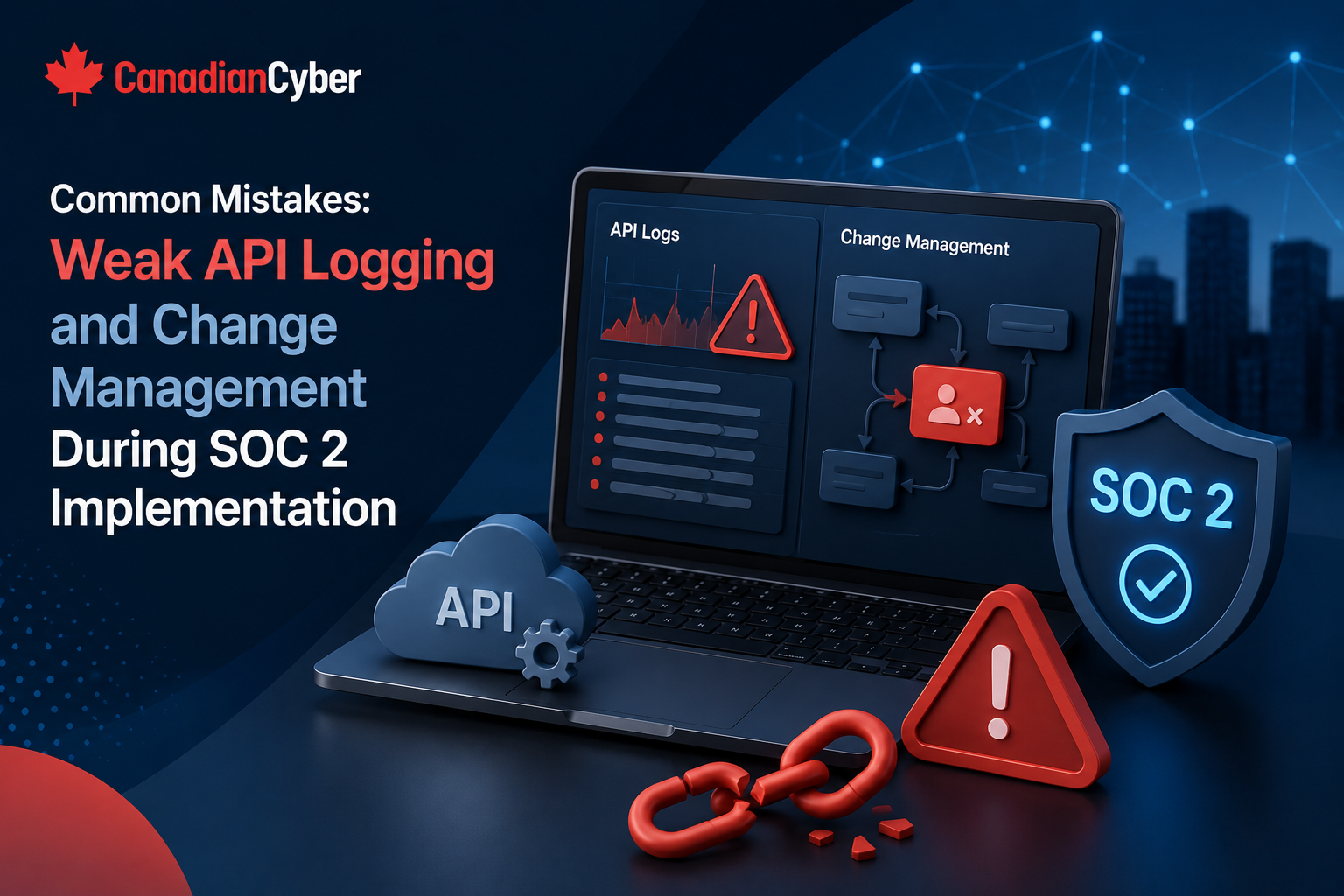
Common Mistakes: Weak API Logging and Change Management During SOC 2 Implementation
Weak API logging and poor change management can create serious SOC 2 readiness gaps. Auditors and enterprise buyers want proof that API activity is traceable, security events are monitored, production changes are reviewed, and incidents can be investigated.
Quick Snapshot
| SOC 2 Risk Area | Why It Matters |
|---|---|
| API Logging | Helps investigate access, errors, abuse, transactions, support actions, and security events. |
| Change Management | Proves production changes are reviewed, tested, approved, and traceable. |
| Buyer Confidence | Enterprise customers want evidence that APIs are secure, reliable, and controlled. |
| Audit Readiness | SOC 2 evidence must show controls are operating, not only documented. |
| Common Gap | Teams have logs and tickets, but they are not structured, reviewed, retained, or linked to controls. |
| Better Outcome | API logs and change records become audit-ready evidence instead of last-minute screenshots. |
Introduction
APIs are at the center of modern SaaS.
They connect customers, process requests, move data, trigger workflows, support integrations, power fintech products, connect AI features, send webhooks, handle admin actions, and support customer support teams.
That makes API logging and change management critical during SOC 2 implementation.
But many teams underestimate these areas. They focus on policies, MFA, access reviews, vendor lists, and incident response plans. Those controls matter, but they are not enough if the team cannot answer:
- Can you trace API activity?
- Can you investigate a failed request?
- Can you detect API abuse?
- Can you show who changed production?
- Can you prove code was reviewed?
- Can you show test evidence before release?
- Can you show emergency changes were controlled?
- Can you prove transaction-impacting changes were reviewed?
This blog explains the common mistakes companies make with API logging and change management during SOC 2 implementation, and how to fix them before audit evidence requests start.
Need SOC 2 Evidence for API Logging and Change Management?
Canadian Cyber helps SaaS, fintech, and API-first companies prepare SOC 2 evidence for API security, logging, monitoring, change management, incident response, vendor risk, and SharePoint evidence workspaces.
Why API Logging and Change Management Matter for SOC 2
SOC 2 is not only about having policies. It is about proving controls work. For API-first companies, logs and change records are two of the strongest evidence sources.
Why API Logging Matters
- Shows who accessed the API.
- Shows which client made the request.
- Supports abuse investigation.
- Shows webhook failures and errors.
- Supports incident response.
Why Change Management Matters
- Proves changes are reviewed.
- Shows production releases are approved.
- Shows testing before deployment.
- Tracks emergency changes.
- Connects releases to risk and control impact.
Practical rule: API logs show what happened. Change records show why the system changed. SOC 2 needs both.
Mistake 1: Logging Too Little API Activity
Some teams log only basic server events. That may help engineering, but it may not support audit, incident response, API abuse detection, or customer trust.
| API Event Type | Why It Matters |
|---|---|
| Authentication attempts | Detects failed logins and token misuse. |
| Authorization failures | Shows blocked access attempts. |
| API token creation | Tracks credential lifecycle. |
| API token revocation | Supports access control evidence. |
| Admin API actions | Supports privileged activity review. |
| Sensitive data access | Supports investigation. |
| Rate limit events | Shows abuse controls. |
| Webhook failures | Supports availability and processing integrity. |
| Error spikes | Supports monitoring and incident response. |
Practical rule: If an event could affect security, availability, confidentiality, or processing integrity, consider whether it should be logged.
Mistake 2: Logging Sensitive Data Without Controls
Logging too little is a problem. Logging too much can also be a problem. API logs should not become a hidden data leak.
Sensitive data that should usually be avoided in logs includes:
API keys
Tokens
Secrets
Full payment data
Authentication headers
Session cookies
Private keys
| Safer Logging Practice | Benefit |
|---|---|
| Mask sensitive fields. | Reduces exposure. |
| Log identifiers instead of full payloads. | Supports traceability without overexposure. |
| Restrict log access. | Protects sensitive event data. |
| Define log retention. | Prevents uncontrolled storage. |
| Monitor log access. | Supports investigation. |
| Use correlation IDs. | Helps trace events safely. |
Mistake 3: No Clear Log Retention Period
Auditors and buyers may ask how long logs are retained. If the answer is unclear, SOC 2 readiness suffers.
| Log Retention Evidence | Purpose |
|---|---|
| Log retention policy | Defines expectations. |
| Logging platform configuration | Shows actual retention. |
| Log source inventory | Shows what is collected. |
| Access review for logging tool | Shows logs are protected. |
| Retention exception register | Documents deviations. |
| Customer commitment review | Aligns retention to contracts. |
Mistake 4: Logs Exist, But Nobody Reviews Them
Having logs is not the same as monitoring. SOC 2 readiness often requires evidence that logs or alerts are reviewed.
Weak control: “We collect logs.”
Stronger control: “We collect logs from defined sources, monitor alerts for key events, review security and operational alerts, track issues in tickets, and escalate incidents based on severity.”
| Log Review Evidence | Purpose |
|---|---|
| Alert rule list | Shows what is monitored. |
| Monthly alert review | Shows review happens. |
| Alert-to-ticket samples | Shows follow-up. |
| Incident escalation record | Shows response. |
| False positive review | Shows tuning. |
| Monitoring owner assignment | Shows accountability. |
Turn API Logs Into SOC 2 Evidence
Canadian Cyber helps API-first teams define log sources, retention rules, alert reviews, abuse monitoring, log access reviews, and evidence workflows that support SOC 2 readiness.
Mistake 5: No API Abuse Detection
API-first SaaS companies need abuse monitoring. This is especially important for fintech, AI, and data-heavy platforms.
API abuse examples include:
Token misuse
Bulk export abuse
Scraping
Rate limit bypass attempts
Webhook replay attempts
Tenant enumeration
Suspicious admin API activity
| API Abuse Control | Evidence |
|---|---|
| Rate limits | API gateway configuration. |
| Failed authentication alerts | Alert rule. |
| Abuse runbook | Response process. |
| Client suspension process | Procedure. |
| Bulk export monitoring | Alert or report. |
| Incident tickets | Investigation records. |
Mistake 6: No Log Source Inventory
Many teams do not know which logs are collected. This creates audit and incident response gaps.
Log sources to inventory include:
Application logs
Authentication provider
Cloud infrastructure
Database audit logs
CI/CD pipeline
Admin console
Support tool
Secrets manager
Firewall or WAF
| Log Source Inventory Field | Purpose |
|---|---|
| Log Source | System name. |
| Owner | Responsible person. |
| Events Collected | What is logged. |
| Retention Period | How long logs are kept. |
| Access Group | Who can view logs. |
| Alert Rules | Key monitoring logic. |
| Related SOC 2 Area | Security, Availability, Processing Integrity. |
| Review Frequency | Monthly, quarterly, or event-based. |
Mistake 7: Treating Change Management as a Ticketing Exercise Only
A ticket is useful. But a ticket alone may not prove strong change management. SOC 2 evidence should show review, testing, approval, deployment, and traceability.
| Strong Change Evidence | What It Proves |
|---|---|
| Change ticket | Business and technical context. |
| Pull request approval | Code review. |
| Test results | Validation. |
| Deployment record | Traceability. |
| Release notes | What changed. |
| Rollback plan | Recovery readiness. |
| Emergency change record | Control of urgent changes. |
Mistake 8: No Clear Definition of Production Change
Some teams only document major releases. That creates gaps. Define what counts as a production change before the auditor asks.
Production changes may include:
Infrastructure changes
Database changes
API endpoint changes
Permission model changes
Configuration updates
Feature flag changes
Webhook behavior changes
Rate limit changes
Logging changes
Mistake 9: Emergency Changes Are Not Documented
Emergency changes happen. SOC 2 does not usually expect zero emergency changes. It expects control.
| Emergency Change Evidence | Purpose |
|---|---|
| Emergency change reason | Explains urgency. |
| Approver | Shows accountability. |
| Time of change | Shows traceability. |
| Systems affected | Defines impact. |
| Testing performed | Shows validation. |
| Rollback notes | Shows recovery planning. |
| Post-change review | Shows follow-up. |
Strengthen Change Management Before Audit
Canadian Cyber helps teams map GitHub, Jira, deployment, emergency change, rollback, testing, and post-release monitoring evidence to SOC 2 controls.
Mistake 10: No Link Between Change Management and API Risk
API changes can affect security, availability, and processing integrity. That is especially important for fintech APIs and platforms handling customer data.
API changes that need extra review include:
Authorization logic changes
Token handling changes
Rate limit changes
Webhook changes
Transaction status changes
Payment processing changes
Bulk export changes
Tenant isolation changes
| Additional Review Question | Why It Matters |
|---|---|
| Does this change affect authentication? | Security. |
| Does this change affect authorization? | Security. |
| Does this change affect transaction processing? | Processing integrity. |
| Does this change affect uptime or performance? | Availability. |
| Does this change affect logs or monitoring? | Incident response. |
| Does this change affect customer data? | Confidentiality and privacy. |
| Is rollback possible? | Availability. |
Mistake 11: No Change Approval Evidence
Some teams say, “We review every change,” but they cannot prove it. If the review happened, make sure the evidence can be found.
Evidence auditors may request:
- approved pull requests
- change tickets
- reviewer comments
- deployment records
- test results
- release approvals
- segregation of duties evidence
- emergency change logs
- rollback evidence
- change calendar
Mistake 12: No Post-Deployment Monitoring
Change management should not end at deployment. Teams should monitor after release, especially for critical API changes.
| Post-Deployment Monitoring Signal | Why It Helps |
|---|---|
| API error rate | Detects production issues. |
| Latency | Shows performance impact. |
| Failed authentication | Shows access or auth issues. |
| Transaction failures | Supports processing integrity. |
| Webhook failures | Supports integration reliability. |
| Customer support tickets | Shows customer impact. |
| Rollback events | Shows release recovery. |
API Logging and Change Management Evidence Pack
A strong SOC 2 evidence pack should include both logging and change evidence.
API Logging Evidence
- Log source inventory
- Log retention configuration
- API gateway logs
- Authentication failure alerts
- Rate limit evidence
- Webhook delivery logs
- Log access review
- Incident-linked log samples
Change Management Evidence
- Change management procedure
- Pull request samples
- Approval evidence
- Test results
- Deployment records
- Emergency change records
- Rollback evidence
- High-risk API change checklist
SharePoint Evidence Workspace for API SOC 2 Controls
Evidence should not stay scattered across GitHub, Jira, Slack, cloud consoles, and screenshots. A structured SharePoint evidence workspace can help.
| Recommended SharePoint Area | Evidence |
|---|---|
| API Logging Evidence | Logs, retention, source inventory, alert reviews. |
| API Abuse Monitoring | Rate limits, abuse alerts, incident tickets. |
| Change Management Evidence | PRs, tickets, test results, deployments. |
| Emergency Changes | Urgent change records and post-review. |
| Processing Integrity Evidence | Validation, reconciliation, failed job reviews. |
| Incident Response | Log-linked investigations and lessons learned. |
| Corrective Actions | Findings and remediation. |
| Audit Requests | Auditor and buyer evidence requests. |
Useful metadata includes:
SOC 2 criteria
Evidence owner
Source system
Period covered
Review status
Related change ticket
Related incident
Audit request ID
Explore the ISMS SharePoint Solution
Canadian Cyber’s ISMS SharePoint solution helps teams organize SOC 2 evidence, API logging records, change evidence, risks, audit requests, corrective actions, and management reviews in one Microsoft 365 workspace.
API Logging and Change Management Checklist
Use this checklist during SOC 2 implementation.
API Logging
| Question | Yes / No |
|---|---|
| Do we have a log source inventory? | |
| Are API authentication attempts logged? | |
| Are authorization failures logged? | |
| Are admin API actions logged? | |
| Are API token events logged? | |
| Are rate limit events logged? | |
| Are webhook failures logged? | |
| Are sensitive fields masked? | |
| Is log retention documented? | |
| Is log access reviewed? | |
| Are incident-linked logs easy to retrieve? |
Change Management
| Question | Yes / No |
|---|---|
| Is production change defined? | |
| Are changes linked to tickets or records? | |
| Are pull requests approved? | |
| Are tests documented? | |
| Are deployments traceable? | |
| Are emergency changes recorded? | |
| Are high-risk API changes reviewed carefully? | |
| Are rollback plans documented? | |
| Is change evidence stored centrally? |
If several answers are “no,” SOC 2 evidence gaps are likely.
Common Warning Signs
Your API logging and change management controls may be weak if:
- no one owns log retention
- API logs contain sensitive payloads
- failed authentication is not monitored
- rate limit events are not reviewed
- webhook failures are not tracked
- admin API actions are not logged
- production changes are not clearly defined
- emergency changes happen through chat only
- pull requests are merged without approval
- test evidence is missing
- deployment records are hard to find
- processing-impacting changes are not flagged
What Good Looks Like
A strong SOC 2-ready API logging and change management program can show:
- log source inventory
- API event logging
- sensitive data masking
- log retention evidence
- log access review
- alert rules
- monthly alert review
- API abuse monitoring
- rate limit evidence
- webhook failure tracking
- change management procedure
- approved pull requests
- test evidence
- deployment records
- emergency change records
- rollback plans
- post-deployment monitoring
- SharePoint evidence workspace
This gives auditors and buyers confidence.
Canadian Cyber’s Take
At Canadian Cyber, we often see SaaS and fintech teams with strong engineering practices but weak SOC 2 evidence.
The team may already review code. The team may already collect logs. The team may already monitor API performance. But if the evidence is not structured, reviewed, retained, and mapped to controls, SOC 2 readiness becomes harder.
API logging and change management are not just technical topics. They support security, availability, processing integrity, incident response, customer trust, and audit readiness.
The best approach is simple: define what needs to be logged, protect sensitive log data, review important alerts, document approvals, test before release, monitor after deployment, and centralize evidence.
That is how API-first companies reduce SOC 2 surprises.
Takeaway
Weak API logging and change management can slow SOC 2 implementation. Do not wait until audit evidence requests arrive.
Build strong proof for:
- API logs
- authentication events
- authorization failures
- rate limits
- webhook failures
- log retention
- alert reviews
- production changes
- pull request approvals
- test results
- deployments
- emergency changes
- post-release monitoring
When logs and changes are structured, SOC 2 readiness becomes much easier.
How Canadian Cyber Can Help
Canadian Cyber helps SaaS, fintech, and API-first companies prepare for SOC 2 with practical evidence and governance support.
- SOC 2 readiness assessments
- API logging evidence reviews
- log source inventory development
- API abuse monitoring evidence
- change management evidence mapping
- GitHub and Jira evidence workflows
- emergency change process design
- processing integrity evidence planning
- incident response evidence reviews
- SharePoint evidence workspace setup
- SOC 2 audit preparation
- vCISO support for SaaS and fintech security governance
Stay Connected With Canadian Cyber
Follow Canadian Cyber for practical guidance on SOC 2, API security, logging, change management, fintech SaaS, SharePoint ISMS, processing integrity, and vCISO support.