ISO 27001 • Law Firm Cybersecurity • Audit Preparation • Client Confidentiality • Sensitive Client Data
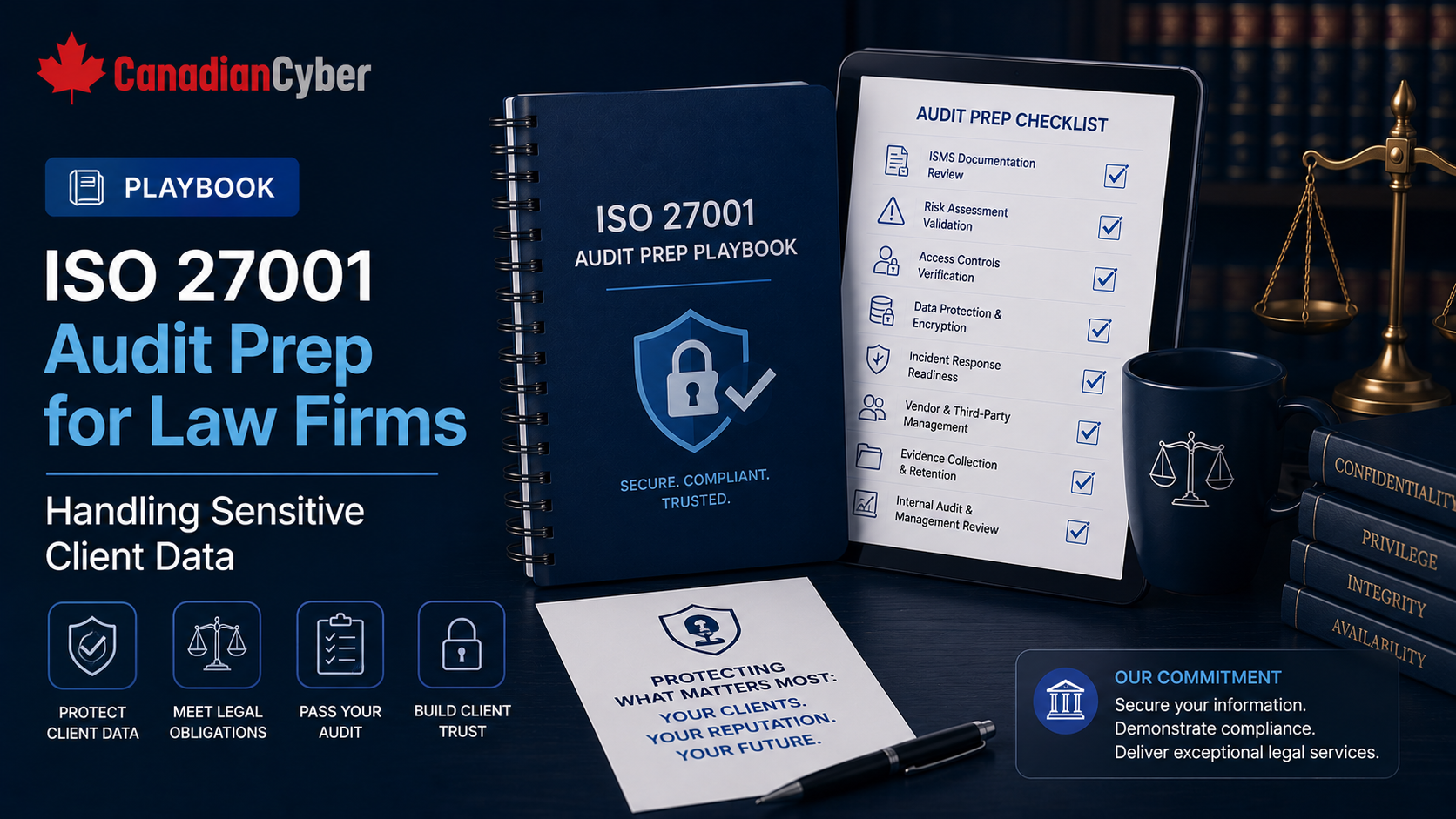
Playbook: ISO 27001 Audit Prep for Law Firms Handling Sensitive Client Data
Law firms handling sensitive client data need more than policies before an ISO 27001 audit. They need clear scope, client matter access evidence, document management controls, ethical wall testing, vendor reviews, incident response records, management review evidence, and audit-ready proof that confidentiality controls work in practice.
Canadian Cyber for Law Firm ISO 27001 Audit Readiness
Prepare Sensitive Client Data Evidence Before Audit Week
Canadian Cyber helps law firms prepare for ISO 27001 audits with scope reviews, confidentiality control testing, client matter access reviews, DMS permission checks, vendor risk reviews, audit evidence workspaces, and internal audit readiness support.
Quick Snapshot
| Audit Prep Area | Why It Matters for Law Firms |
|---|---|
| ISMS Scope | Confirms which legal services, systems, offices, and client data are covered. |
| Client Matter Access | Proves only authorized lawyers, paralegals, support staff, and vendors can access sensitive matters. |
| Document Management | Tests DMS, SharePoint, Teams, OneDrive, and client portal controls. |
| Ethical Walls | Shows restricted matters are protected from unauthorized internal access. |
| Vendor Risk | Reviews eDiscovery, IT, cloud, DMS, data room, transcription, and support vendors. |
| Evidence Readiness | Helps the firm answer auditor questions with proof, not last-minute screenshots. |
Introduction
Law firms hold highly sensitive information.
Client files may include:
Litigation strategy
Settlement documents
M&A records
Financial statements
Employment records
Regulatory investigation files
Intellectual property
Personal information
Contracts
Board materials
Court filings
This makes ISO 27001 audit preparation especially important. A law firm cannot rely only on general IT controls.
Auditors may want to understand how the firm protects client matters in real workflows:
- Who can access matter files?
- How are ethical walls enforced?
- How is external sharing controlled?
- Are legal document management systems included in scope?
- Are vendors reviewed?
- Are former staff removed from systems?
- Are backup and recovery tests completed?
- Are incidents tracked?
- Can the firm prove controls are operating?
This playbook gives law firms a practical ISO 27001 audit preparation approach for sensitive client data.
Need ISO 27001 Audit Prep for Your Law Firm?
Canadian Cyber helps law firms prepare for ISO 27001 audits with scope reviews, confidentiality control testing, client matter access reviews, DMS permission checks, vendor risk reviews, audit evidence workspaces, and internal audit readiness support.
Step 1: Confirm the ISMS Scope
Audit preparation starts with scope. The scope must explain what the ISO 27001 Information Security Management System covers.
For law firms, scope should be based on where sensitive client data is stored, processed, accessed, shared, and protected.
| Scope Question | Why It Matters |
|---|---|
| Which offices or locations are included? | Defines physical and operational boundary. |
| Which practice groups are included? | Identifies legal service areas. |
| Which client matter systems are included? | Defines confidentiality controls. |
| Which cloud services are included? | Captures Microsoft 365, DMS, CRM, and finance tools. |
| Which vendors support client data? | Defines supplier risk. |
| Are eDiscovery or data room platforms included? | Captures high-sensitivity workflows. |
Systems often included:
Microsoft 365
SharePoint
Teams
OneDrive
Case management tools
Client portals
eDiscovery platforms
Virtual data rooms
CRM
Backup platform
Practical rule: Scope should follow sensitive client data, not only IT infrastructure.
Step 2: Review the Asset Inventory and Data Flows
Law firms should be able to show where sensitive client data lives. An asset inventory helps auditors understand key systems. A data flow map helps show how client data moves.
| Asset Inventory Field | Example |
|---|---|
| Asset Name | Legal document management system. |
| Asset Owner | Records / IT. |
| Data Type | Client matter data and privileged documents. |
| Criticality | High. |
| Users | Lawyers, paralegals, and support teams. |
| Access Method | SSO / MFA. |
| Related Risk | Unauthorized matter access. |
Data flow areas to map:
Matter opening
Document storage
Email communication
External sharing
Client portal upload
eDiscovery transfer
Vendor access
Matter closure
Archive and retention
Map Sensitive Client Data Before the Auditor Asks
Canadian Cyber helps law firms review ISO 27001 scope, asset inventories, client data flows, DMS repositories, Microsoft 365 collaboration paths, and vendor access points.
Step 3: Prepare Client Matter Access Evidence
Client matter access is one of the most important audit areas for law firms. Auditors may test whether access is limited to authorized personnel.
| Evidence to Prepare | Purpose |
|---|---|
| Matter access list | Shows who can access a matter. |
| Matter owner approval | Shows accountability. |
| DMS permission export | Shows technical access. |
| SharePoint / Teams membership | Shows collaboration access. |
| Access review sign-off | Shows periodic review. |
| Offboarding sample | Shows access removal. |
| External user list | Shows client or vendor access. |
| Access Review Question | Yes / No |
|---|---|
| Are matter teams documented? | |
| Are permissions based on need-to-know? | |
| Are former team members removed? | |
| Are support staff access rights justified? | |
| Are external users reviewed? | |
| Is review evidence retained? |
Practical rule: Matter access evidence should show who had access, why they needed it, and when it was reviewed.
Step 4: Test Ethical Wall Controls
Ethical walls protect restricted matters. For law firms, ethical walls are often central to confidentiality and conflict management.
Ethical wall evidence to prepare:
Restricted matter list
Approval record
DMS permission evidence
Restricted group membership
Test access evidence
Exception approvals
Review sign-off
| Audit Prep Question | Yes / No |
|---|---|
| Are restricted matters identified? | |
| Are ethical walls approved before setup? | |
| Are restricted users documented? | |
| Are permissions configured correctly? | |
| Are exceptions approved? | |
| Can the firm show test evidence? |
Step 5: Review Legal Document Management System Controls
The legal document management system is often the core repository for client matter information. It should be included in audit preparation.
| DMS Control | Evidence |
|---|---|
| User access | User list and access review. |
| Matter permissions | Sample matter permission export. |
| Admin access | Privileged access review. |
| Ethical walls | Restricted matter evidence. |
| External sharing | Sharing report. |
| Logging | Audit log sample. |
| Vendor assurance | SOC 2, ISO 27001, or security review. |
Test DMS and Ethical Wall Controls Before Audit
Canadian Cyber helps law firms review DMS permissions, ethical wall evidence, privileged DMS access, external sharing controls, DMS vendor assurance, and matter-level confidentiality safeguards.
Step 6: Prepare Microsoft 365 and Collaboration Evidence
Sensitive client data often moves through Microsoft 365 tools. Law firms should prepare evidence for email, Teams, SharePoint, and OneDrive.
Evidence to prepare:
Conditional access settings
Teams membership review
SharePoint permission report
External sharing report
Guest user review
DLP policy evidence
Email forwarding rule review
Audit log configuration
Step 7: Prepare Joiner, Mover, and Leaver Evidence
Access changes are a major audit focus. Law firms should prepare evidence for onboarding, role changes, matter transfers, and departures.
Role change approval
Matter team change record
Termination notification
Offboarding checklist
Account disablement timestamp
DMS access removal
Vendor portal access removal
Practical rule: Leaver testing should include DMS, Microsoft 365, client portals, vendor systems, and privileged access.
Step 8: Review Vendor and Third-Party Evidence
Law firms depend on vendors that may handle sensitive client data. Auditors may ask how these vendors are reviewed and monitored.
Vendors to review:
Managed IT provider
Cloud provider
eDiscovery platform
Data room provider
Transcription provider
Backup provider
Client portal provider
Contract lawyers or consultants
| Vendor Evidence | Ready? |
|---|---|
| Vendor register | |
| Critical vendor list | |
| Vendor risk review | |
| Contract or confidentiality terms | |
| Vendor assurance report | |
| Vendor offboarding evidence |
Step 9: Prepare Incident Response Evidence
Law firms should be ready to show how confidentiality incidents are handled.
Incident scenarios to consider:
Misconfigured sharing link
Unauthorized matter access
Ethical wall breach
Lost laptop
Vendor breach
DMS outage
Ransomware
Evidence to prepare:
- incident response plan
- incident register
- severity classification matrix
- notification decision process
- legal and client escalation contacts
- tabletop exercise report
- lessons learned
- corrective action tracker
Step 10: Prepare Backup, Recovery, and Continuity Evidence
| Audit Prep Question | Yes / No |
|---|---|
| Are critical systems identified? | |
| Are backups monitored? | |
| Are restore tests documented? | |
| Are DMS recovery expectations understood? | |
| Are corrective actions tracked after failed tests? |
Practical rule: Backup evidence shows backups run. Restore evidence shows recovery works.
Step 11: Prepare Risk Register and Risk Treatment Evidence
Example law firm risks:
- unauthorized access to client matter files
- ethical wall failure
- external sharing misconfiguration
- DMS vendor outage
- former staff access not removed
- eDiscovery vendor breach
- lost laptop containing client data
- ransomware affecting matter availability
- weak client portal permissions
Step 12: Prepare Management Review Evidence
Management review shows leadership oversight. Law firm leadership should be ready to discuss security risk, audit findings, objectives, resources, and continual improvement.
Meeting minutes
Risk review summary
Audit results
Corrective action updates
Security objectives
Incident summary
Supplier risk updates
Resource decisions
Step 13: Prepare Audit Interview Participants
Audit preparation includes preparing people. Lawyers, paralegals, legal assistants, records teams, IT, HR, vendor managers, practice leaders, and management should understand their part of the ISMS.
Practical rule: People do not need memorized scripts. They need to understand the real process and know where evidence lives.
Step 14: Build an Audit Evidence Workspace
Audit evidence should not be scattered in email and folders. A SharePoint ISMS workspace can help organize everything.
| Evidence Section | Evidence Stored |
|---|---|
| ISMS Scope | Scope statement, asset inventory, data flows. |
| Risk Register | Risks, treatment plans, accepted risks. |
| Matter Access | DMS exports, access reviews, exceptions. |
| Ethical Walls | Registers, approvals, test evidence. |
| Microsoft 365 | MFA, sharing, guest access, DLP evidence. |
| Vendors | Vendor register, reviews, contracts. |
| Incidents | Incident plan, tabletop, tickets. |
| Internal Audit | Audit plan, findings, corrective actions. |
| Management Review | Minutes, decisions, resources. |
Organize ISO 27001 Evidence in SharePoint ISMS
Canadian Cyber’s ISMS SharePoint solution helps law firms organize ISO 27001 evidence, risk registers, internal audit records, management reviews, access reviews, vendor reviews, and corrective actions in one Microsoft 365 workspace.
30-Day ISO 27001 Audit Prep Plan for Law Firms
Week 1: Scope and Evidence Inventory
Confirm ISMS scope, review asset inventory, map sensitive client data flows, identify key systems, collect policy approvals, and create the evidence workspace.
Week 2: Access and Confidentiality Testing
Review matter access, test ethical walls, review DMS permissions, review Microsoft 365 sharing, test leaver samples, and document exceptions.
Week 3: Vendors, Incidents, and Recovery
Review critical vendors, collect vendor assurance evidence, review incident response, document tabletop exercises, collect backup reports, and verify restore evidence.
Week 4: Risk, Management Review, and Interview Prep
Update the risk register, track corrective actions, prepare management review evidence, brief audit interview participants, build the final evidence index, and resolve high-risk gaps.
Practical rule: Do not wait until audit week to collect evidence.
Law Firm ISO 27001 Audit Prep Checklist
Scope and Governance
| Question | Yes / No |
|---|---|
| Is the ISMS scope approved? | |
| Are sensitive client data flows documented? | |
| Is the asset inventory current? | |
| Is the risk register updated? | |
| Are management review records ready? |
Client Confidentiality
| Question | Yes / No |
|---|---|
| Are matter access reviews completed? | |
| Are ethical walls tested? | |
| Are DMS permissions reviewed? | |
| Are external sharing reports reviewed? | |
| Are confidentiality incidents tracked? |
Access and Vendors
| Question | Yes / No |
|---|---|
| Is MFA evidence available? | |
| Are privileged accounts reviewed? | |
| Are leaver samples tested? | |
| Are vendor reviews completed? | |
| Are external users reviewed? |
Evidence
| Question | Yes / No |
|---|---|
| Are policies approved and current? | |
| Are backup and restore records available? | |
| Are incident response records available? | |
| Are corrective actions tracked? | |
| Is evidence stored centrally? |
Common Mistakes to Avoid
- Preparing policies but not testing controls. Policies are important, but auditors need evidence.
- Ignoring matter-level access. Firm-wide access reviews may miss client matter confidentiality risk.
- Leaving the DMS out of scope. Legal document management systems often hold the most sensitive client data.
- Not testing ethical walls. Restricted matters need proof of control effectiveness.
- Forgetting external sharing. SharePoint, Teams, OneDrive, email, and portals can expose client data if not reviewed.
- No vendor evidence. eDiscovery, DMS, cloud, and IT vendors should be reviewed.
- No interview preparation. Audit participants should understand their roles and evidence.
What Good Looks Like
A law firm ready for ISO 27001 audit can show:
- approved ISMS scope
- asset inventory
- client data flow map
- risk register
- risk treatment plan
- policy approvals
- matter access reviews
- ethical wall testing
- DMS permission evidence
- Microsoft 365 sharing reviews
- guest access reviews
- privileged access review
- leaver testing
- vendor reviews
- incident response evidence
- backup and restore evidence
- internal audit records
- management review minutes
- corrective action tracker
- SharePoint ISMS evidence workspace
This gives auditors confidence. It also supports stronger client trust.
Canadian Cyber’s Take
At Canadian Cyber, we often see law firms underestimate audit preparation because they have already written the policies.
But ISO 27001 is not only a policy exercise. For law firms, the audit should show that sensitive client data is protected in practice.
A strong audit preparation process helps the firm find gaps before the auditor does.
That means testing matter access, DMS permissions, ethical walls, vendor access, external sharing, offboarding, incidents, backups, and management oversight. It also gives lawyers, paralegals, IT teams, and leadership more confidence during audit interviews.
Takeaway
ISO 27001 audit prep for law firms should focus on sensitive client data.
Prepare evidence for:
- ISMS scope
- asset inventory
- client data flows
- matter access
- ethical walls
- DMS controls
- Microsoft 365 sharing
- joiner, mover, leaver controls
- vendors
- incident response
- backup recovery
- risk management
- management review
- audit interviews
The goal is simple: show that client confidentiality is protected by real controls, tested evidence, and accountable ownership.
How Canadian Cyber Can Help
Canadian Cyber helps law firms prepare for ISO 27001 audits and certification readiness.
- ISO 27001 audit readiness reviews
- law firm ISMS scope reviews
- client matter confidentiality testing
- DMS permission reviews
- ethical wall testing
- Microsoft 365 and SharePoint access reviews
- vendor risk reviews
- incident response readiness
- backup and restore evidence reviews
- risk register development
- internal audit support
- management review preparation
- corrective action tracking
- audit interview preparation
- SharePoint ISMS evidence workspace setup
Stay Connected With Canadian Cyber
Follow Canadian Cyber for practical guidance on ISO 27001, law firm cybersecurity, audit preparation, client confidentiality, document management controls, SharePoint ISMS, SOC 2, ISO 42001, and vCISO support.