vCISO • Law Firm Cyber Governance • Managing Partners • Client Confidentiality • ISO 27001
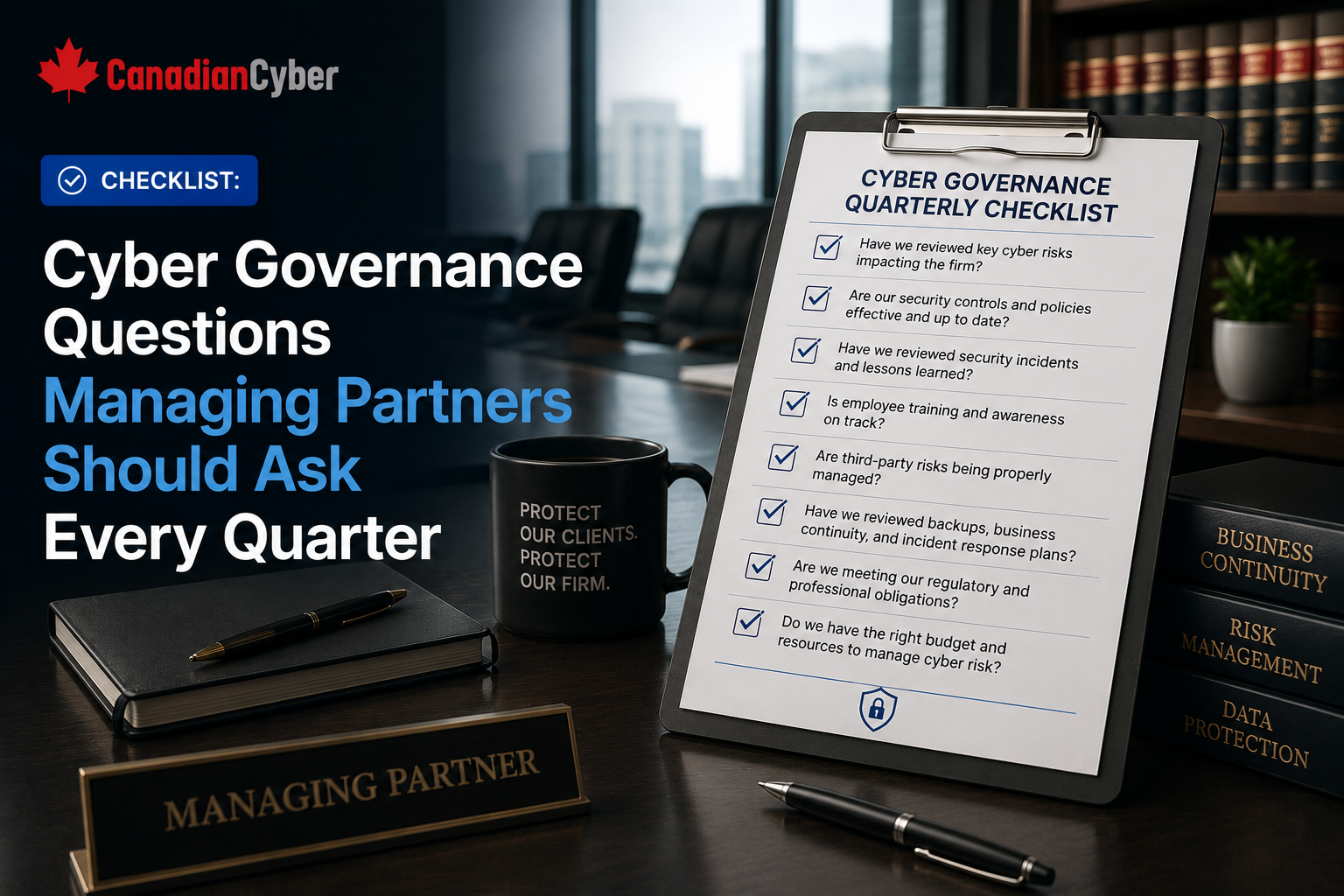
Checklist: Cyber Governance Questions Managing Partners Should Ask Every Quarter
Managing partners do not need to review every firewall alert or technical configuration. But they do need clear visibility into cyber risk, client confidentiality, matter access, vendor exposure, incident readiness, audit evidence, and security investment.
Canadian Cyber vCISO Governance Support for Law Firms
Quarterly Cyber Governance Reviews for Managing Partners
Canadian Cyber provides vCISO services for law firms, helping managing partners review cyber risk, client confidentiality controls, matter access, third-party risk, ISO 27001 readiness, incident response, cyber insurance evidence, and executive security reporting.
Quick Snapshot
| Governance Area | Why Managing Partners Should Ask |
|---|---|
| Client Confidentiality | Confirms sensitive client matters, case files, and privileged records are protected. |
| Access Reviews | Checks whether lawyers, staff, vendors, and guests still have appropriate access. |
| Third-Party Risk | Reviews vendors, portals, eDiscovery tools, data rooms, and outsourced support. |
| Incident Readiness | Ensures the firm can respond to confidentiality, ransomware, or email compromise events. |
| Audit and Compliance | Supports ISO 27001, client security reviews, cyber insurance, and internal audit readiness. |
| Business Outcome | Better leadership visibility, stronger client trust, and fewer security surprises. |
Introduction
Law firm cybersecurity is a leadership issue.
It is not only an IT issue.
Managing partners, executive committees, practice leaders, and firm administrators need regular visibility into cyber risk because the impact can be serious.
A cyber incident can affect:
Privileged communications
Case files
Court deadlines
Billing operations
Client portals
Document management systems
Professional reputation
Cyber insurance
Regulatory obligations
Client trust
Firm revenue
Many law firms have IT teams or outsourced IT support. That is important. But cybersecurity governance requires leadership questions.
Managing partners do not need every technical detail. They need clear risk, ownership, decisions, and evidence.
This quarterly checklist gives managing partners practical cyber governance questions to ask before clients, insurers, auditors, or attackers do.
Need Quarterly Cyber Governance Support for Your Law Firm?
Canadian Cyber provides vCISO services for law firms, helping managing partners review cyber risk, client confidentiality controls, matter access, third-party risk, ISO 27001 readiness, incident response, and executive security reporting.
Why Quarterly Cyber Governance Matters
Annual reviews are not enough. Cyber risk changes quickly.
New matters open. New lawyers join. Staff leave. Vendors are added. Client portals are created. Documents are shared externally. Attackers target email accounts. Insurance requirements change. Clients ask tougher security questions. Audit evidence expires.
A quarterly governance review helps leadership stay ahead.
| Review Goal | What It Helps Prevent |
|---|---|
| Confirm risks | Security issues hidden from leadership. |
| Review access | Over-permissioned users and former staff access. |
| Check vendors | Unreviewed third-party exposure. |
| Review incidents | Missed lessons learned. |
| Track remediation | Repeated audit findings. |
| Support investment | Underfunded or misdirected security priorities. |
1. Client Confidentiality Questions
Client confidentiality should be the first quarterly topic. It connects cybersecurity directly to the firm’s professional duty, client trust, and business reputation.
| Question Managing Partners Should Ask | Why It Matters |
|---|---|
| What are our top client confidentiality risks this quarter? | Focuses leadership on core legal risk. |
| Have any sensitive matters required special restrictions? | Identifies high-risk matters. |
| Are ethical walls documented and tested? | Confirms restricted matter protection. |
| Are confidential client documents stored only in approved systems? | Reduces shadow storage. |
| Have there been accidental disclosures or near misses? | Supports lessons learned. |
| Are client-specific security requirements being tracked? | Supports contractual commitments. |
Evidence to review:
Ethical wall register
Restricted matter list
Incident register
Near-miss records
Client requirement tracker
Practical rule: Client confidentiality should appear in the firm’s risk register and management review.
2. Matter and Case File Access Questions
Access to case files should be reviewed regularly because matter teams change often. Managing partners do not need every access list, but they should see trends, exceptions, and unresolved issues.
| Question Managing Partners Should Ask | Why It Matters |
|---|---|
| Have matter access reviews been completed for high-risk matters? | Confirms need-to-know access. |
| Are former matter team members removed promptly? | Reduces unnecessary access. |
| Are external guests reviewed? | Controls client, expert, vendor, or co-counsel access. |
| Are privileged access rights reviewed separately? | Controls administrator risk. |
| Are exceptions approved and documented? | Supports accountability. |
| Are access review findings remediated? | Prevents repeated gaps. |
Evidence to review:
DMS permission review
SharePoint / Teams access review
External guest review
Privileged access review
Remediation tracker
Turn Access Reviews Into Leadership Visibility
Canadian Cyber helps law firms review matter access, DMS permissions, privileged accounts, external guests, ethical walls, and unresolved access findings so managing partners can make informed decisions.
3. Legal Document Management System Questions
The legal document management system is usually one of the firm’s most critical systems. If the DMS stores client matter data, it belongs in quarterly cyber governance.
| Question Managing Partners Should Ask | Why It Matters |
|---|---|
| Is our DMS included in the security risk review? | Protects core client data. |
| Are DMS permissions reviewed? | Confirms appropriate matter access. |
| Are DMS admin accounts reviewed? | Controls privileged access. |
| Are audit logs available for investigations? | Supports incident response. |
| Are external sharing settings controlled? | Reduces data leakage. |
| Are DMS vendor assurance reports reviewed? | Supports supplier risk. |
Evidence to review:
DMS access review
DMS admin review
Vendor assurance report
External sharing report
Recovery or uptime evidence
4. Third-Party Portal Questions
Law firms often use third-party portals outside the main IT environment. These portals can create hidden risk because client data may leave the firm’s primary systems.
Portals to review:
Virtual data rooms
Client portals
Court filing systems
Expert witness portals
Document review platforms
Secure file transfer tools
Regulatory submission portals
| Question Managing Partners Should Ask | Why It Matters |
|---|---|
| Which third-party portals currently hold client data? | Creates visibility. |
| Who owns each portal? | Assigns accountability. |
| Are user lists reviewed? | Prevents stale access. |
| Are portals closed after matters end? | Reduces lingering exposure. |
| Are vendors assessed before use? | Supports due diligence. |
| Are MFA and logging available? | Improves security and investigation. |
Practical rule: If client data leaves the firm’s main systems, leadership should know where it went.
5. Vendor Risk Questions
Vendors can affect confidentiality, availability, and compliance. Vendor risk should not be handled only when procurement happens. It should be reviewed quarterly.
| Question Managing Partners Should Ask | Why It Matters |
|---|---|
| Who are our critical vendors? | Identifies dependency risk. |
| Which vendors access client matter data? | Identifies confidentiality exposure. |
| Have high-risk vendors been reviewed? | Supports due diligence. |
| Are vendor contracts and confidentiality terms current? | Supports legal protection. |
| Have any vendors reported incidents? | Supports response planning. |
| Are vendor access rights reviewed? | Reduces third-party access risk. |
Evidence to review:
Critical vendor list
Vendor risk assessments
Vendor assurance reports
Contract / DPA tracker
Vendor access review
Review Vendors, Portals, and Client Data Exposure Quarterly
Canadian Cyber helps law firms build vendor registers, third-party portal reviews, access review evidence, vendor assurance tracking, and management-ready risk reports.
6. Incident Response Questions
Managing partners should know whether the firm is ready for major cyber events. Leadership should review incidents before a serious crisis forces the conversation.
| Question Managing Partners Should Ask | Why It Matters |
|---|---|
| Have there been security incidents or near misses this quarter? | Provides visibility. |
| Were incidents resolved and reviewed? | Supports improvement. |
| Are lessons learned documented? | Prevents repeat issues. |
| Is our incident response plan current? | Keeps response ready. |
| Have we tested ransomware, email compromise, or data leakage scenarios? | Improves preparedness. |
| Are corrective actions tracked to closure? | Shows accountability. |
Evidence to review:
Near-miss report
Tabletop exercise report
Incident response plan
Lessons learned
Escalation matrix
7. Email Security and Business Email Compromise Questions
Law firms are common targets for email attacks. Business email compromise can affect invoices, client instructions, settlement funds, and confidential communication.
| Question Managing Partners Should Ask | Why It Matters |
|---|---|
| Are MFA and conditional access enforced? | Protects accounts. |
| Have there been suspicious login attempts? | Shows threat activity. |
| Are external forwarding rules reviewed? | Detects compromise. |
| Are users trained to report phishing? | Supports detection. |
| Are payment instruction changes verified? | Reduces fraud risk. |
| Are compromised mailbox scenarios tested? | Improves response. |
8. Backup, Recovery, and Continuity Questions
Law firms need access to documents and systems to serve clients. Quarterly governance should include resilience.
| Question Managing Partners Should Ask | Why It Matters |
|---|---|
| Are critical systems backed up? | Supports recovery. |
| Have restore tests been completed? | Proves recovery works. |
| Are backup failures reviewed? | Prevents silent risk. |
| Are DMS and Microsoft 365 recovery expectations understood? | Clarifies dependencies. |
| Are ransomware recovery scenarios considered? | Improves preparedness. |
| Are recovery objectives documented? | Sets expectations. |
Practical rule: Do not ask only whether backups exist. Ask whether restores have been tested.
9. ISO 27001 and Audit Readiness Questions
Many law firms pursue ISO 27001 because clients require stronger assurance. Even without certification, ISO 27001-style governance is useful.
| Question Managing Partners Should Ask | Why It Matters |
|---|---|
| Is our ISMS scope still accurate? | Ensures coverage of sensitive data. |
| Are key risks reviewed and updated? | Supports risk management. |
| Are policies approved and current? | Shows governance. |
| Are internal audit findings being closed? | Supports readiness. |
| Is evidence organized? | Reduces audit scramble. |
| Are management reviews documented? | Supports ISO 27001 expectations. |
10. Cyber Insurance Questions
Cyber insurance requirements can change. Managing partners should understand whether the firm still meets key controls.
| Question Managing Partners Should Ask | Why It Matters |
|---|---|
| Are cyber insurance control requirements documented? | Supports renewal. |
| Do we have evidence for MFA, backups, EDR, and access reviews? | Supports underwriting. |
| Have any claims, incidents, or material changes occurred? | Supports disclosure. |
| Are exclusions or coverage gaps understood? | Supports risk planning. |
| Are ransomware controls reviewed? | Reduces claim friction. |
11. Security Training and Culture Questions
People play a major role in law firm security. Security culture improves when leadership asks about it regularly.
| Question Managing Partners Should Ask | Why It Matters |
|---|---|
| Is security awareness training completed? | Supports staff readiness. |
| Are lawyers and staff trained on client confidentiality risks? | Aligns security with legal obligations. |
| Are phishing results reviewed? | Identifies risk areas. |
| Are high-risk teams given extra guidance? | Supports targeted improvement. |
| Are incident reporting expectations clear? | Improves response. |
12. Security Investment and Roadmap Questions
Cyber governance should support decisions. Managing partners should review whether the firm is investing in the right areas.
| Question Managing Partners Should Ask | Why It Matters |
|---|---|
| What are our top three cyber risks this quarter? | Focuses investment. |
| Which risks need budget or leadership decision? | Removes blockers. |
| Which controls are underperforming? | Supports improvement. |
| Which audit findings are overdue? | Drives accountability. |
| Which security projects support client trust? | Aligns spending to business value. |
| What should we prioritize next quarter? | Creates roadmap discipline. |
Practical rule: Cybersecurity spending should follow risk, not fear.
Organize Quarterly Governance Evidence in SharePoint ISMS
Canadian Cyber’s ISMS SharePoint solution helps law firms organize risk registers, policy libraries, access reviews, vendor evidence, incident response records, audit findings, management reviews, and quarterly vCISO reports in one Microsoft 365 workspace.
Quarterly Managing Partner Cyber Governance Checklist
Use this checklist every quarter to keep cyber risk visible, evidence organized, and leadership decisions documented.
Client Confidentiality
| Question | Yes / No |
|---|---|
| Have top confidentiality risks been reviewed? | |
| Are ethical walls documented and tested? | |
| Are confidentiality incidents or near misses reviewed? | |
| Are client-specific security requirements tracked? |
Access and Matters
| Question | Yes / No |
|---|---|
| Are matter access reviews completed? | |
| Are DMS permissions reviewed? | |
| Are external guests reviewed? | |
| Are privileged accounts reviewed? | |
| Are access exceptions documented? |
Vendors and Portals
| Question | Yes / No |
|---|---|
| Are critical vendors reviewed? | |
| Are third-party portals inventoried? | |
| Are vendor access rights reviewed? | |
| Are portals closed after matters end? |
Incidents and Resilience
| Question | Yes / No |
|---|---|
| Are incidents and near misses reviewed? | |
| Has incident response been tested? | |
| Are backups monitored? | |
| Are restore tests completed? |
Governance and Compliance
| Question | Yes / No |
|---|---|
| Is the risk register updated? | |
| Are audit findings being closed? | |
| Is ISO 27001 readiness on track? | |
| Is cyber insurance evidence ready? | |
| Are leadership decisions documented? |
What Good Looks Like
A mature quarterly cyber governance review for law firms can show:
- updated cybersecurity risk register
- client confidentiality risk summary
- matter access review results
- ethical wall review evidence
- DMS permission review
- third-party portal register
- vendor risk summary
- incident and near-miss review
- backup and restore evidence
- cyber insurance evidence status
- ISO 27001 readiness update
- corrective action tracker
- security roadmap
- vCISO quarterly report
- management decisions and approvals
This helps managing partners lead security without becoming technical administrators.
Common Mistakes to Avoid
- Treating cyber governance as an IT update. Leadership needs risk, business impact, decisions, and accountability.
- Not reviewing client confidentiality risks. For law firms, confidentiality should be a standing agenda item.
- Ignoring third-party portals. Client data often leaves the main DMS through portals, vendors, and data rooms.
- Asking only about backups, not restore tests. Recovery must be proven.
- No corrective action tracking. Findings should be assigned, due-dated, and closed with evidence.
- Waiting for audits or insurance renewals. Quarterly governance prevents last-minute evidence panic.
- No vCISO-level reporting. Managing partners need clear summaries, not raw technical data.
Canadian Cyber’s Take
At Canadian Cyber, we see many law firms with strong technical teams but limited cyber governance rhythm.
That creates a visibility gap. Managing partners may not know which risks are rising, which access reviews are overdue, which vendors are high risk, which audit findings remain open, or whether the firm is ready for client security reviews.
A quarterly cyber governance review brings the right questions to leadership, connects security controls to client confidentiality, and turns risk into decisions.
The goal is not to overwhelm managing partners with technical details. The goal is to give them the right visibility to protect the firm and its clients.
Takeaway
Managing partners should ask cyber governance questions every quarter.
Focus on:
- client confidentiality
- matter access
- DMS controls
- ethical walls
- third-party portals
- vendor risk
- email security
- incident response
- backup recovery
- ISO 27001 readiness
- cyber insurance
- security roadmap
Quarterly governance helps law firms move from reactive IT updates to proactive security leadership. It protects client trust, improves accountability, and prepares the firm for audits, insurance, and client scrutiny.
How Canadian Cyber Can Help
Canadian Cyber provides vCISO and cybersecurity governance support for law firms and professional services organizations.
- quarterly cyber governance reviews
- vCISO reports for managing partners
- law firm cybersecurity risk registers
- client confidentiality control reviews
- matter access review programs
- DMS permission reviews
- ethical wall testing
- third-party portal reviews
- vendor risk management
- incident response tabletop exercises
- ISO 27001 readiness planning
- cyber insurance evidence preparation
- SharePoint ISMS workspace setup
- corrective action tracking
- management review preparation
Stay Connected With Canadian Cyber
Follow Canadian Cyber for practical guidance on vCISO services, law firm cybersecurity, cyber governance, client confidentiality, ISO 27001, SharePoint ISMS, SOC 2, ISO 42001, and third-party risk.