SOC 2 • Type I vs Type II • Startup Compliance • Enterprise Sales • SaaS Security
SOC 2 Type I or Type II First? A Decision Matrix for Startups Selling Upmarket
Startups selling to enterprise customers often hit the same wall. The product is ready, the demo goes well, and the buyer is interested. Then procurement, security, legal, or vendor risk asks: “Do you have SOC 2?”
Canadian Cyber SOC 2 Readiness Support
Choose the Right SOC 2 Path Before Enterprise Procurement Blocks the Deal
Canadian Cyber helps startups and SaaS companies decide whether SOC 2 Type I, Type II, or a staged approach makes the most sense based on buyer pressure, control maturity, evidence readiness, and enterprise sales goals.
Quick Answer
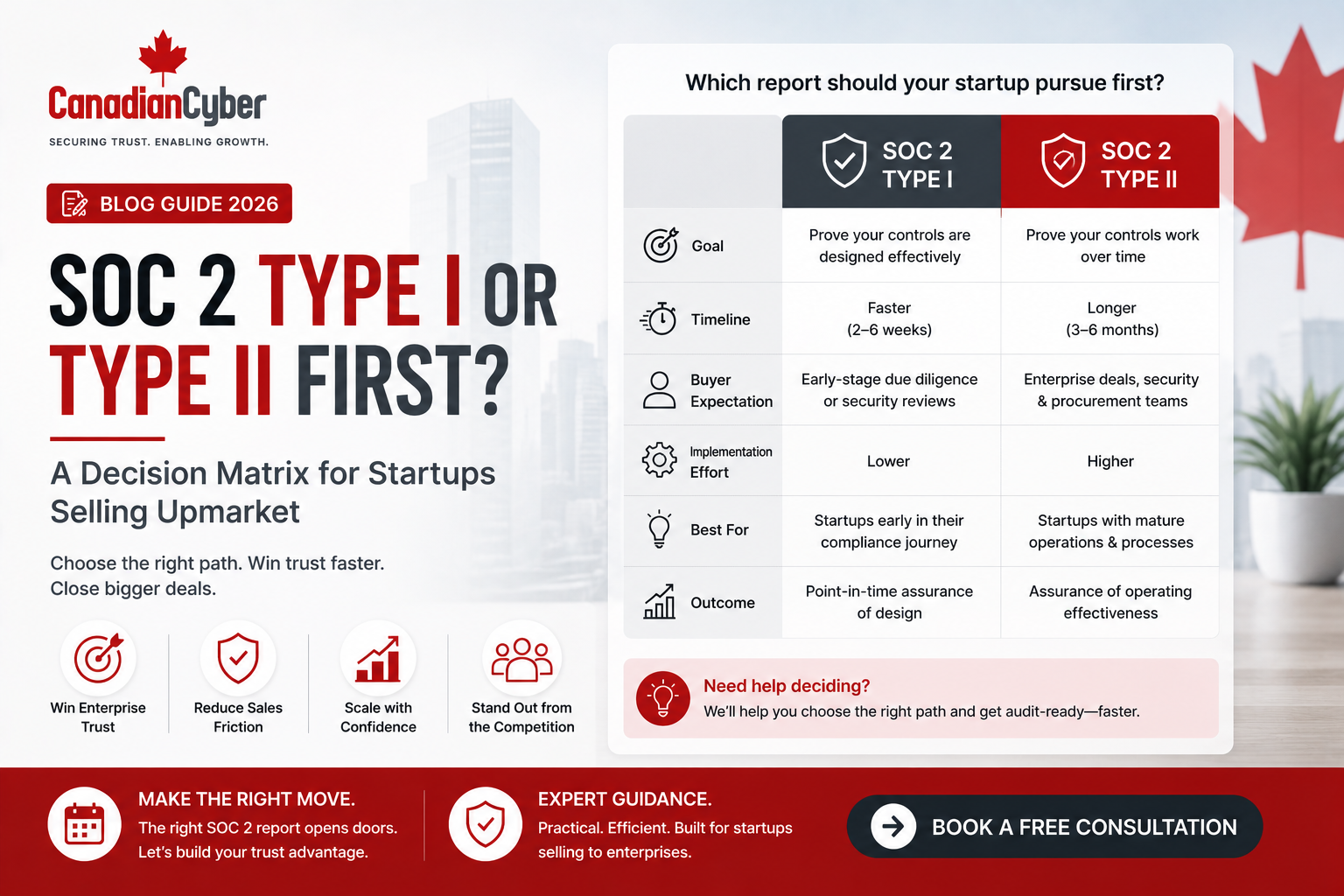
Startups selling upmarket should choose SOC 2 Type I first when they need a faster trust signal, are building their first formal control program, or do not yet have months of operating evidence.
SOC 2 Type II is usually better when enterprise buyers require stronger assurance, controls have already been operating, and the company can prove evidence across an observation period.
Practical takeaway: Type I answers whether controls are designed properly at a point in time. Type II answers whether controls operated effectively over time. Many startups begin with Type I, then move to Type II within the next audit cycle.
Quick Snapshot
| Decision Factor | SOC 2 Type I First | SOC 2 Type II First |
|---|---|---|
| Buyer urgency | Useful when a report is needed sooner. | Better when buyers demand operating evidence. |
| Control maturity | Good for early control design. | Better when controls already operate consistently. |
| Evidence history | Limited evidence is available. | Evidence is already collected over time. |
| Sales stage | First enterprise deals. | Active enterprise pipeline with strict procurement. |
| Procurement value | Shows readiness and direction. | Shows control performance over time. |
Why This Decision Matters for Startups Selling Upmarket
Enterprise customers do not buy SaaS products the same way SMBs do. They involve procurement, security, privacy, legal, and vendor risk teams. They often require documented proof before signing.
For startups moving upmarket, SOC 2 can become a sales accelerator or a deal blocker. But the next decision is just as important: should you start with SOC 2 Type I or go straight to SOC 2 Type II?
The answer depends on sales urgency, buyer expectations, current security maturity, available evidence, internal resources, audit timeline, and how quickly your startup needs a report to support enterprise procurement.
SOC 2 should be planned around your sales motion, not only your audit preference.
Who This Guide Is For
- SaaS startups selling to enterprise customers.
- Founders trying to unblock procurement.
- CTOs responsible for SOC 2 readiness.
- COOs managing compliance and operations.
- Sales leaders dealing with security questionnaires.
- Compliance leads planning SOC 2 timelines.
- AI, fintech, HealthTech, EdTech, and B2B software companies.
- Teams using SharePoint, Microsoft 365, or a GRC tool for evidence management.
Why SOC 2 Matters in Enterprise Sales
A startup may be technically secure but still fail procurement if it cannot prove controls through a recognized assurance report. SOC 2 can help support procurement approval, security questionnaire responses, vendor risk reviews, customer trust, contract negotiations, cyber insurance discussions, investor due diligence, partnership evaluations, and internal security maturity.
But choosing the wrong SOC 2 path can create problems. If you start with Type I when buyers require Type II, procurement may still delay the deal. If you go straight to Type II without evidence maturity, the audit may become stressful. If you wait too long, competitors with SOC 2 may look lower risk.
Practical rule: The right decision can help your startup build trust, answer security questionnaires faster, and sell into larger accounts with more confidence.
What Is SOC 2 Type I?
SOC 2 Type I evaluates whether your controls are designed appropriately at a specific point in time.
It answers questions such as:
- Do the right controls exist?
- Are they documented?
- Are they designed to address the relevant trust criteria?
- Are policies, processes, and control owners defined?
- Is the control environment ready to operate?
For startups, Type I is often useful when the company is building its first formal security program and needs a report to show progress to enterprise buyers.
SOC 2 Type I can help a startup move from “we are working on security” to “our control design has been reviewed.”
What Is SOC 2 Type II?
SOC 2 Type II evaluates whether controls operated effectively over a period of time.
It answers questions such as:
- Did controls actually run?
- Were access reviews performed?
- Was evidence collected?
- Were incidents handled?
- Were vendors reviewed?
- Were changes approved?
- Were exceptions tracked?
For startups selling to larger enterprise buyers, Type II usually carries more weight because it proves control operation, not only design.
Practical rule: SOC 2 Type II is stronger for enterprise trust because it proves the company can operate controls consistently.
SOC 2 Type I vs Type II: Core Difference
| SOC 2 Report Type | What It Tests | Buyer Message |
|---|---|---|
| SOC 2 Type I | Control design at a point in time. | “We have designed our controls.” |
| SOC 2 Type II | Control operation over a review period. | “We have operated our controls over time.” |
Type I is about design. Type II is about proof over time.
Decision Matrix: SOC 2 Type I or Type II First?
| Question | Choose Type I First If… | Choose Type II First If… |
|---|---|---|
| Are enterprise buyers asking for SOC 2 urgently? | They will accept Type I or roadmap evidence. | They specifically require Type II. |
| Do you have 3–12 months of control evidence? | No, evidence is limited. | Yes, evidence is already available. |
| Are controls newly implemented? | Yes, controls are still being formalized. | No, controls are mature and operating. |
| Is your team new to compliance? | Yes, you need a structured first step. | No, your team can manage audit demands. |
| Do you need a faster trust signal? | Yes, sales needs near-term support. | No, you can wait for the observation period. |
| Do you have a central evidence workspace? | Not yet, still building it. | Yes, evidence is organized and mapped. |
Not Sure Whether Type I or Type II Should Come First?
Canadian Cyber helps startups evaluate buyer requirements, control maturity, evidence readiness, sales urgency, and audit timelines so the SOC 2 path supports revenue instead of slowing procurement.
When SOC 2 Type I First Makes Sense
SOC 2 Type I first often makes sense for startups entering enterprise sales for the first time. The company may have good technical practices but limited formal documentation.
Type I first may be practical when the company needs to:
- define SOC 2 scope
- build the control register
- create policies
- document procedures
- assign owners
- prepare evidence structure
- get a faster trust signal
- start operating controls for Type II
| Benefits of Type I First | Limitations of Type I First |
|---|---|
| Faster trust signal for early buyer conversations. | Some buyers may still ask for Type II. |
| Clear control baseline. | Does not prove operating effectiveness over time. |
| Lower initial evidence burden. | May be seen as an early-stage report. |
| Helps structure the Type II journey. | Requires follow-through to Type II. |
Practical rule: Type I first is a bridge, not the final destination for most startups selling upmarket.
When SOC 2 Type II First Makes Sense
SOC 2 Type II first can make sense when the startup is already mature enough to prove control operation.
Type II first may be realistic when the company already has:
- documented security policies
- quarterly access reviews
- vendor review evidence
- incident response testing
- security training records
- change management evidence
- backup evidence
- a compliance owner or vCISO support
| Benefits of Type II First | Limitations of Type II First |
|---|---|
| Stronger enterprise procurement value. | Requires operating evidence. |
| Proves operating effectiveness. | Takes longer to complete. |
| Reduces repeated customer questions. | Needs stronger internal coordination. |
| May avoid doing two separate reports. | May delay short-term sales support. |
Type II first is best when the startup already behaves like a mature security organization.
What Enterprise Buyers Usually Prefer
Enterprise buyers usually prefer stronger assurance. That often means SOC 2 Type II. But buyer expectations vary by industry, deal size, data sensitivity, and procurement maturity.
| Buyer Type | Likely Expectation |
|---|---|
| Early mid-market customer | May accept Type I or roadmap. |
| Large enterprise | Often prefers Type II. |
| Financial services | Often expects stronger evidence. |
| Healthcare / HealthTech | Strong privacy and security evidence expected. |
| AI buyer | May ask about AI governance, prompts, outputs, and vendors. |
| Competitive procurement | Type II can be a differentiator. |
Practical rule: Ask the buyer what they require before choosing your SOC 2 path.
SOC 2 Timeline Comparison for Startups
SOC 2 timelines depend on readiness, evidence, auditor availability, and internal commitment. Type I can often move faster because it does not require proving control operation over a long period. Type II usually takes longer because controls must operate over time.
| Path | Best Use | Timeline Consideration |
|---|---|---|
| Type I First | Faster trust signal. | Useful when controls are newly designed. |
| Type II First | Stronger assurance. | Requires operating evidence over time. |
| Type I then Type II | Common startup path. | Builds trust now and stronger proof later. |
| Type II only after readiness | Lower audit risk. | Better when maturity is uncertain. |
Evidence Readiness: The Real Deciding Factor
The biggest difference between Type I and Type II is evidence readiness. Before choosing the path, ask whether you can prove controls have operated.
| Control Area | Evidence Needed |
|---|---|
| Access Control | MFA reports, access reviews, offboarding evidence. |
| Change Management | Pull requests, approvals, release records. |
| Vendor Risk | Vendor register, SOC 2 reports, DPAs, review records. |
| Incident Response | Incident response plan, tabletop evidence, incident log. |
| Security Training | Training completion report. |
| Backup and Recovery | Backup reports, restore test evidence. |
| Risk Management | Risk register and treatment plans. |
| Policies | Approved and communicated security policies. |
SOC 2 is not passed through good intentions. It is supported by evidence.
How a SharePoint Evidence Workspace Helps
A SharePoint evidence workspace can help startups prepare for either Type I or Type II. It creates a central place for controls, evidence, policies, access reviews, vendor reviews, incident response records, backup evidence, security training records, change management evidence, audit requests, corrective actions, and client-ready evidence packs.
| Benefit for Type I | Benefit for Type II |
|---|---|
| Organizes control design. | Tracks recurring evidence. |
| Stores policies and procedures. | Sends reminders. |
| Maps evidence to controls. | Shows overdue items. |
| Assigns control owners. | Supports auditor requests. |
| Builds readiness roadmap. | Creates evidence history. |
Practical Checklist: Choose Type I or Type II First
| Question | Yes / No |
|---|---|
| Are buyers specifically asking for SOC 2 Type II? | |
| Will buyers accept Type I with a Type II roadmap? | |
| Do you have approved security policies? | |
| Do you perform regular access reviews? | |
| Do you have vendor review evidence? | |
| Do you have incident response documentation and testing evidence? | |
| Do you track change approvals? | |
| Is evidence centralized and mapped to controls? | |
| Do you have a compliance owner or vCISO support? |
Decision rule: Choose Type I first if many answers are “no” and buyers will accept a staged approach. Choose Type II first if most answers are “yes” and buyers require stronger assurance.
Common Mistakes to Avoid
- Choosing Type I without asking buyers. Some enterprise buyers may require Type II. Confirm expectations before relying on Type I.
- Going straight to Type II without evidence. If evidence is missing, Type II can create avoidable stress and exceptions.
- Treating SOC 2 as only a compliance project. For startups selling upmarket, SOC 2 is part of sales, procurement, trust, and revenue strategy.
- No central evidence workspace. Scattered evidence slows the audit and weakens questionnaire responses.
- Overpromising during sales. Do not say “SOC 2 compliant” if the audit is not complete. Be accurate about readiness and timelines.
- Ignoring vendor risk. Enterprise buyers often care about vendors, subprocessors, and cloud providers.
- Not planning Type II after Type I. If you start with Type I, build a clear path to Type II immediately.
How Canadian Cyber Helps
Canadian Cyber helps startups and SaaS companies choose the right SOC 2 path based on sales goals, buyer expectations, security maturity, and evidence readiness.
Canadian Cyber can support:
SharePoint SOC 2 Evidence Workspace
Canadian Cyber’s ISMS SharePoint Solution can help organize SOC 2 controls, evidence tasks, policy approvals, access reviews, vendor evidence, incident response records, backup and monitoring reports, security training evidence, corrective actions, auditor requests, and client-ready evidence packs.
This helps startups support both audit readiness and enterprise sales.
Frequently Asked Questions
Should startups do SOC 2 Type I or Type II first?
Startups should choose Type I first if they need a faster trust signal and do not yet have months of operating evidence. They should choose Type II first if enterprise buyers require it and controls have already operated consistently.
Is SOC 2 Type I enough for enterprise customers?
Sometimes. Some enterprise customers may accept Type I with a clear Type II roadmap, especially for early-stage vendors. Larger or regulated buyers often prefer Type II.
How long does SOC 2 Type II take?
SOC 2 Type II takes longer than Type I because it reviews controls over an observation period. The timeline depends on readiness, evidence collection, auditor availability, and control maturity.
Can a startup skip SOC 2 Type I and go straight to Type II?
Yes, if the startup has mature controls and enough evidence to support the observation period. Skipping Type I may make sense when buyers specifically require Type II.
What if a customer asks for SOC 2 before we are ready?
Provide a clear roadmap, readiness status, target audit timeline, and interim evidence such as policies, access reviews, vendor reviews, incident response records, and security training evidence.
Can Canadian Cyber help us decide the right SOC 2 path?
Yes. Canadian Cyber can assess your current controls, buyer requirements, evidence readiness, and sales timeline to recommend whether Type I, Type II, or a staged approach makes the most sense.
Takeaway
The decision between SOC 2 Type I and Type II should be based on buyer expectations, evidence maturity, sales urgency, and internal readiness.
Type I helps startups establish control design and create an early trust signal. Type II provides stronger assurance because it proves controls operated over time.
For many startups selling upmarket, the practical path is to start with readiness, complete Type I if buyers need an earlier report, operate controls consistently, move to Type II, and maintain evidence continuously.
Enterprise Buyers Asking for SOC 2?
Canadian Cyber can help you choose the right SOC 2 path. We support SOC 2 Type I readiness, SOC 2 Type II preparation, evidence planning, SharePoint evidence workspaces, cybersecurity assessments, vCISO support, incident response tabletop exercises, vendor risk management, ISO 27001 alignment, ISO 27017 and ISO 27018 controls, and ISO 42001 AI governance.
Stay Connected With Canadian Cyber
Follow Canadian Cyber for practical guidance on SOC 2 Type I, SOC 2 Type II, startup compliance, SaaS security, enterprise procurement, ISO 27001, ISO 42001, ISO 27017, ISO 27018, SharePoint ISMS, audit evidence, and vCISO support.