ISO 27001 • FinTech • Bank Vendor Due Diligence • Compliance • Cybersecurity
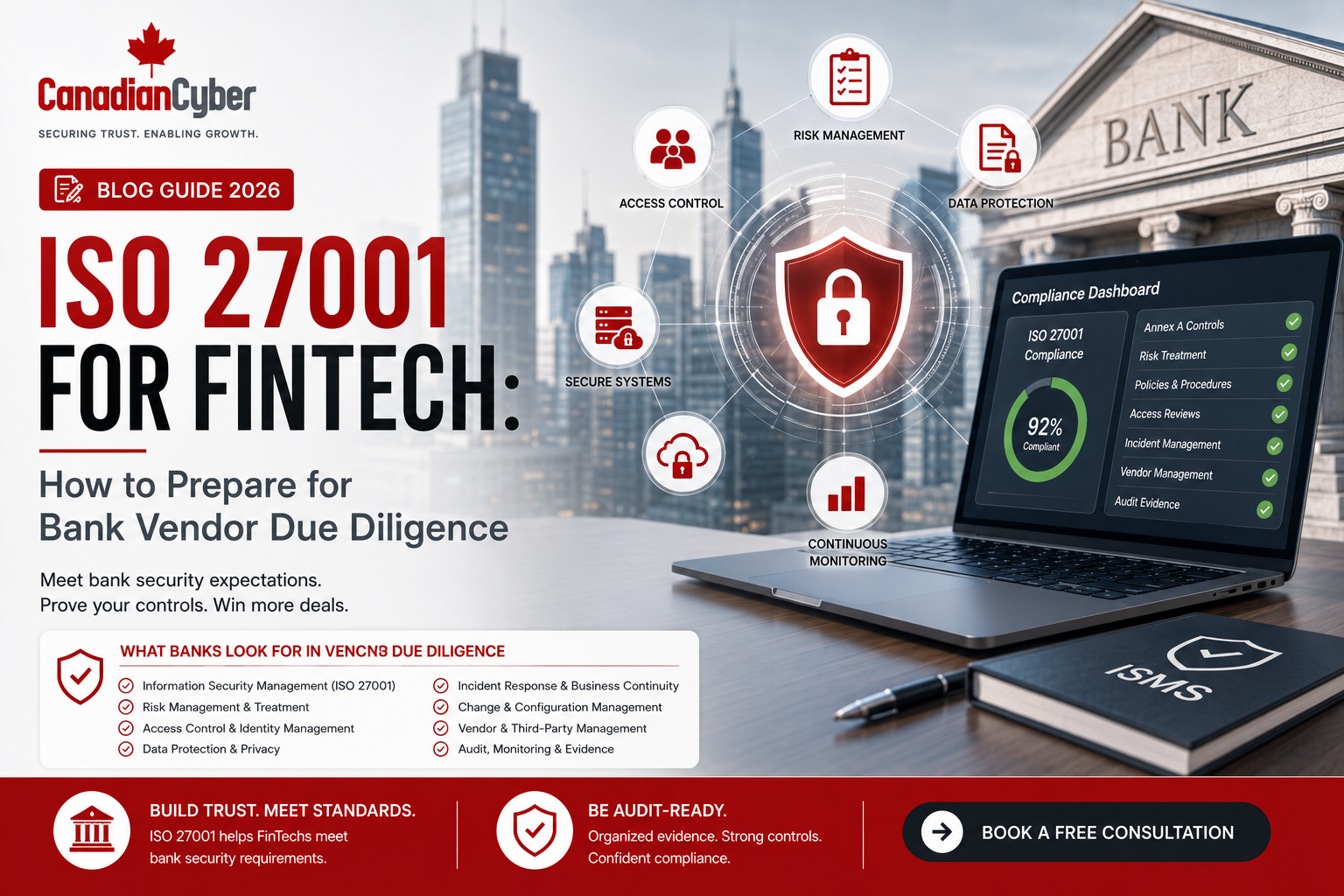
ISO 27001 for FinTech: How to Prepare for Bank Vendor Due Diligence
Banks ask deeper security questions, review privacy controls carefully, and expect strong evidence before onboarding FinTech vendors. ISO 27001 helps FinTech companies prove security governance, risk management, and audit readiness.
Canadian Cyber FinTech ISO 27001 Support
Prepare Your FinTech Before Bank Vendor Due Diligence Begins
Canadian Cyber helps FinTech companies build ISO 27001-ready governance, SOC 2 readiness, SharePoint evidence rooms, bank due diligence evidence packs, incident response evidence, cloud controls, privacy documentation, and vCISO reporting.
Quick Answer
ISO 27001 helps FinTech companies prepare for bank vendor due diligence by creating a structured Information Security Management System, or ISMS, that documents security governance, risk management, controls, policies, evidence, internal audits, management review, and continual improvement.
Banks usually want proof that the FinTech can protect sensitive financial data, manage access, review vendors, secure cloud services, respond to incidents, test recovery, and maintain strong governance.
Practical takeaway: A FinTech preparing for bank due diligence should build an ISO 27001 evidence pack, risk register, Statement of Applicability, vendor register, access review records, incident response evidence, business continuity documentation, and client-ready questionnaire responses.
Quick Snapshot
| Bank Due Diligence Concern | How ISO 27001 Helps |
|---|---|
| Information Security Governance | Defines ISMS scope, roles, policies, and leadership oversight. |
| Risk Management | Creates a documented risk assessment and treatment process. |
| Access Control | Supports MFA, least privilege, access reviews, and offboarding evidence. |
| Vendor Risk | Tracks cloud providers, processors, subprocessors, and critical suppliers. |
| Incident Response | Provides documented response procedures, escalation, and testing evidence. |
| Audit Evidence | Creates proof for bank security questionnaires and vendor reviews. |
Why Bank Vendor Due Diligence Is Different
FinTech companies do not sell into banks the same way they sell into ordinary businesses. Banks have deeper vendor risk programs. They ask more security questions, review privacy controls carefully, and want evidence before onboarding.
A bank vendor review may involve procurement, legal, cybersecurity, risk, compliance, privacy, architecture, business continuity, and business teams. The product may solve a real banking problem, but approval depends on whether the FinTech can prove security and operational maturity.
This is where ISO 27001 becomes valuable. It helps FinTech companies build a formal ISMS that banks can understand and review.
For FinTech companies selling to banks, ISO 27001 is not only a certification goal. It is a trust-building system for vendor due diligence.
Who This Guide Is For
- FinTech startups selling to banks.
- Payment technology companies.
- Lending, credit, WealthTech, RegTech, and open banking platforms.
- Banking infrastructure providers.
- SaaS companies serving financial institutions.
- Founders preparing for bank procurement.
- CTOs, CISOs, and compliance leads handling security reviews.
- Canadian and North American FinTech companies preparing enterprise deals.
Why Banks Review FinTech Vendors So Closely
Banks operate in a high-risk environment. They manage money, identity information, account data, transaction data, credit data, customer records, financial reporting, and regulatory obligations.
When a bank uses a FinTech vendor, the bank needs confidence that the vendor will not create unacceptable security, privacy, operational, or compliance risk.
Banks may ask about:
ISO 27001 certification status
SOC 2 reports
access management
cloud hosting
encryption
API security
incident response
business continuity
vendor risk
AI governance
audit history
Practical rule: Banks do not only want to know that your FinTech product works. They want to know that your company can be trusted as part of their risk ecosystem.
Why ISO 27001 Matters for FinTech Companies
ISO 27001 gives FinTech companies a structured way to prove security governance. It helps answer the bank’s underlying question: can this vendor manage information security risk in a disciplined and repeatable way?
ISO 27001 supports that answer through:
ISO 27001 helps convert security claims into documented, reviewable evidence.
What Banks Usually Want to See From FinTech Vendors
| Area | What the Bank Wants to Know |
|---|---|
| Governance | Who owns security and how leadership reviews risk. |
| Risk Management | How information security risks are identified and treated. |
| Access Control | How user, admin, support, and production access are managed. |
| Data Protection | How financial, customer, and personal information is protected. |
| Cloud Security | How cloud infrastructure, backups, monitoring, and admin access are secured. |
| Incident Response | How incidents are detected, escalated, contained, and reported. |
| Business Continuity | How services recover from disruption. |
| Secure Development | How code, APIs, changes, and vulnerabilities are managed. |
Need Senior Guidance for FinTech Due Diligence?
Canadian Cyber helps FinTech companies prepare for bank vendor reviews, ISO 27001 implementation, SOC 2 readiness, SharePoint evidence rooms, cloud controls, and vCISO reporting. For senior advisory support, you can also view Waqar Mehboob’s profile.
ISO 27001 Documents FinTech Companies Should Prepare
A FinTech preparing for bank vendor due diligence should have a controlled document set. Documents should be approved, current, owned, and supported by evidence.
| Document | Why Banks Care |
|---|---|
| ISMS Scope | Shows what business services, systems, data, and locations are covered. |
| Information Security Policy | Shows leadership-approved security expectations. |
| Risk Register | Shows current information security risks and owners. |
| Risk Treatment Plan | Shows how risks are being reduced or accepted. |
| Statement of Applicability | Shows which controls apply and why. |
| Access Control Policy | Shows how access is requested, approved, reviewed, and removed. |
| Incident Response Plan | Shows how the company handles security incidents. |
| Vendor Management Procedure | Shows how suppliers and processors are reviewed. |
| Business Continuity Plan | Shows resilience and recovery planning. |
| Internal Audit Report | Shows independent review of the ISMS. |
| Management Review Minutes | Shows leadership oversight and decisions. |
Evidence Banks May Request Before Approval
Policies alone are not enough. Banks usually want evidence that controls are operating.
| Evidence Area | Examples |
|---|---|
| Access Control | MFA reports, SSO configuration, privileged access review, offboarding evidence, contractor access review, admin account inventory. |
| Cloud Security | Cloud architecture diagram, responsibility matrix, admin access review, backup configuration, restore test evidence, logging records, ISO 27017 evidence. |
| Vendor Risk | Vendor register, critical supplier list, assurance reports, subprocessor list, DPAs, vendor ratings, AI vendor reviews. |
| Incident Response | IR plan, severity matrix, escalation contacts, breach notification procedure, tabletop report, incident register, lessons learned. |
| Secure Development | Change approvals, pull request reviews, vulnerability scans, penetration test summary, API testing evidence, dependency reviews. |
Practical rule: Bank due diligence evidence should show what happened, when it happened, who approved it, and what was fixed.
ISO 27001 Controls That Matter Most for FinTech Due Diligence
| Control Area | Why It Matters for FinTech |
|---|---|
| Access Management | Banks want proof that financial and customer data access is tightly controlled. |
| Cryptography | Sensitive data must be protected in transit and at rest. |
| Logging and Monitoring | Suspicious activity must be detectable. |
| Incident Management | Incidents must be escalated and handled quickly. |
| Supplier Relationships | Cloud, payment, API, AI, and data vendors must be reviewed. |
| Secure Development | APIs, code changes, and vulnerabilities must be controlled. |
| Business Continuity | Financial services buyers care about availability and resilience. |
| Privacy Controls | Personal and financial data handling must be documented. |
Preparing for the Bank Security Questionnaire
A bank security questionnaire can be long and detailed. The best way to prepare is to build a response system instead of answering from scratch each time.
Build these assets before procurement begins:
SharePoint Evidence Room for FinTech Bank Due Diligence
A SharePoint evidence room can help FinTech companies organize bank due diligence materials inside Microsoft 365. It should be structured around the buyer’s questions, not internal folder habits.
| Recommended Section | Purpose |
|---|---|
| Bank Due Diligence Pack | Client-ready security summaries and evidence. |
| ISO 27001 Evidence | ISMS documents, risk register, SoA, audit records. |
| SOC 2 Evidence | Control evidence and report support. |
| Access Reviews | MFA, privileged access, offboarding, support access. |
| Cloud Controls | Backups, monitoring, admin access, architecture. |
| Vendor Risk | Critical suppliers, DPAs, SOC 2 reports, subprocessors. |
| Incident Response | IR plan, tabletop evidence, incident records. |
| AI Governance | AI tools, AI risks, vendor reviews, ISO 42001 evidence. |
30-60-90 Day FinTech Due Diligence Preparation Plan
| Timeline | Focus |
|---|---|
| First 30 Days | Define ISMS scope, collect policies, identify key systems and data flows, start the risk register, build the vendor register, review access controls, and create the evidence workspace. |
| Days 31–60 | Complete risk assessment, update policies, prepare the SoA, review privileged access, collect MFA evidence, review vendors, document incident response, and create a questionnaire response library. |
| Days 61–90 | Complete internal audit readiness review, run a tabletop, prepare management review materials, close priority gaps, prepare the bank evidence pack, and create a corrective action tracker. |
The best time to prepare for bank due diligence is before the bank sends the questionnaire.
Common Mistakes FinTech Companies Should Avoid
- Treating bank due diligence like a normal SaaS questionnaire. Banks usually ask deeper questions and expect stronger evidence.
- Having policies without proof. Policies matter, but banks want operational evidence.
- No clear ISMS scope. If the scope is vague, buyers may question what systems, services, and data are covered.
- Weak vendor risk management. Cloud providers, payment processors, API providers, AI tools, and data vendors must be reviewed.
- Ignoring business continuity. Banks care about resilience, recovery, and service disruption.
- No secure development evidence. FinTech buyers often care about APIs, code changes, vulnerability management, and release controls.
- Waiting until procurement begins. Due diligence preparation should start before the enterprise sales cycle reaches procurement.
How Canadian Cyber Helps
Canadian Cyber helps FinTech companies prepare for ISO 27001, SOC 2, and bank vendor due diligence with practical cybersecurity governance, evidence readiness, and advisory support.
Canadian Cyber can support:
Senior Advisory Support
For organizations that need senior guidance around FinTech vendor due diligence, ISO 27001 implementation, SOC 2 readiness, bank evidence packs, SharePoint ISMS design, vCISO oversight, and cybersecurity governance, Canadian Cyber also provides advisory support.
Frequently Asked Questions
Why do banks ask FinTech vendors for ISO 27001?
Banks ask for ISO 27001 because it provides a recognized structure for managing information security risks, controls, governance, audit evidence, and continual improvement.
Is ISO 27001 required to sell to banks?
Not always, but many banks strongly prefer vendors with formal security programs, recognized certifications, SOC 2 reports, or strong evidence. ISO 27001 can make vendor approval easier.
What evidence should a FinTech prepare for bank due diligence?
A FinTech should prepare ISO 27001 documents, a risk register, Statement of Applicability, access reviews, vendor reviews, incident response evidence, business continuity evidence, cloud security evidence, privacy records, and security questionnaire responses.
Should FinTech companies do ISO 27001 or SOC 2 first?
It depends on buyer requirements. Banks may value ISO 27001 because it demonstrates a formal ISMS, while North American enterprise SaaS buyers often request SOC 2. Many FinTech companies align both.
Can SharePoint support ISO 27001 for FinTech?
Yes. A structured SharePoint ISMS can manage policies, risks, controls, evidence, vendors, internal audits, management review, and bank due diligence evidence inside Microsoft 365.
Can Canadian Cyber help prepare for bank vendor due diligence?
Yes. Canadian Cyber can support ISO 27001 implementation, SOC 2 readiness, evidence pack development, questionnaire responses, vCISO services, incident response tabletop exercises, and SharePoint ISMS setup.
Takeaway
Bank vendor due diligence is one of the most important trust barriers for FinTech companies selling into financial institutions.
Banks want more than product value. They want proof of security governance, risk management, data protection, cloud security, vendor oversight, incident response, business continuity, and audit readiness.
For FinTech companies selling to banks, ISO 27001 is not just a certificate. It is a way to make trust easier to prove.
Preparing for Bank Vendor Due Diligence?
Canadian Cyber can help your FinTech prepare before procurement slows the deal. We support ISO 27001 implementation, SOC 2 readiness, bank due diligence evidence packs, cybersecurity assessments, vCISO services, incident response tabletop exercises, ISO 27017 and ISO 27018 cloud controls, ISO 42001 AI governance, and SharePoint ISMS workspaces. You can also learn more about senior advisory support through Waqar Mehboob’s profile.
Stay Connected With Canadian Cyber
Follow Canadian Cyber for practical guidance on ISO 27001 for FinTech, bank vendor due diligence, SOC 2, ISO 42001, ISO 27017, ISO 27018, SharePoint ISMS, cybersecurity assessments, audit evidence, and vCISO support.