ISO 42001 • Fintech AI Governance • Investor Readiness • AI Risk • Responsible AI
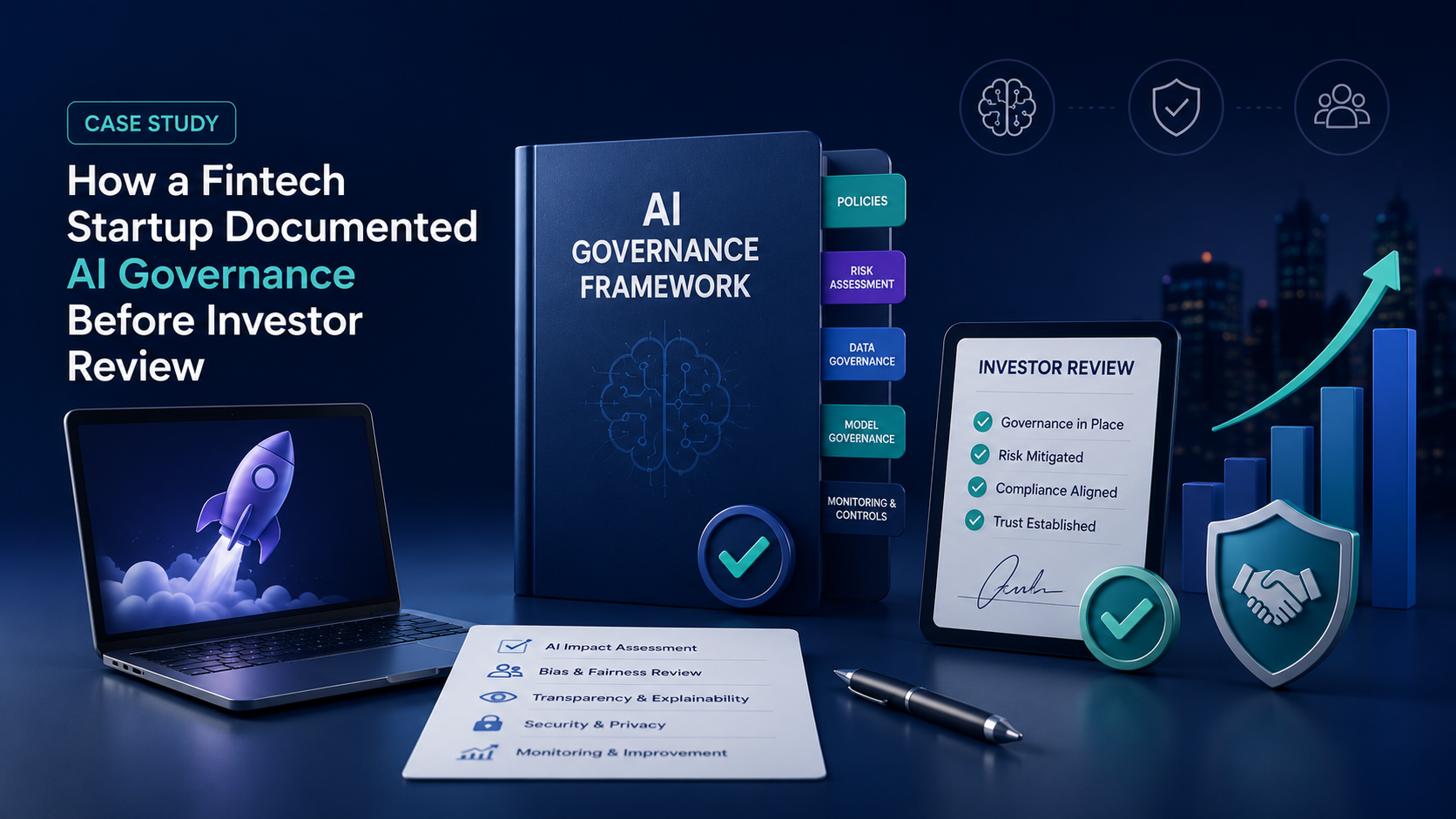
Case Study: How a Fintech Startup Documented AI Governance Before Investor Review
Investor reviews are changing for fintech startups using AI. It is no longer enough to say “we use AI responsibly.” Investors want to understand how AI is governed, what customer decisions it influences, how risks are assessed, how vendors are reviewed, how models are monitored, and what evidence exists.
New Canadian Cyber Service
Investor-Ready AI Governance and ISO 42001 Readiness
Canadian Cyber helps fintech, SaaS, and AI-driven companies document AI governance before investor reviews, bank due diligence, enterprise sales cycles, and ISO 42001 readiness work. We support AI inventories, AI impact assessments, AI risk registers, model documentation, AI vendor reviews, human oversight evidence, and SharePoint governance workspaces.
Quick Snapshot
| Case Study Area | What Improved |
|---|---|
| Business Context | Fintech startup using AI for fraud signals, onboarding review, and customer risk scoring. |
| Main Challenge | AI use was growing, but governance evidence was scattered and informal. |
| Investor Concern | Customer impact, explainability, bias risk, vendor AI, data use, model monitoring, and accountability. |
| Solution | AI inventory, AI risk register, impact assessments, vendor reviews, model documentation, and SharePoint evidence workspace. |
| Business Outcome | Stronger investor confidence, clearer AI governance, better ISO 42001 readiness, and improved leadership oversight. |
Introduction
The fintech startup was growing quickly.
Its product was gaining traction. Its API was being used by more customers. Its fraud detection workflows were improving. Its onboarding review process was becoming more automated. Its customer risk signals were becoming more sophisticated. Its investors were interested in the next funding round.
Then the investor review process began.
The investors asked expected business questions about market size, revenue model, customer growth, roadmap, and operational risks. But they also asked deeper AI governance questions:
- Which AI systems are used?
- What customer outcomes can AI influence?
- Is there an AI risk register?
- How do you monitor model performance?
- How do you review bias and fairness risk?
- Do humans review high-impact decisions?
- Which vendors provide AI functionality?
- Is customer data used for model training?
- Is there evidence of governance review?
The startup had some good answers. But the evidence was not organized.
This fictional case study shows how a fintech startup documented AI governance before investor review and prepared a stronger ISO 42001-ready governance story.
Preparing for Investor Review of AI Governance?
Canadian Cyber helps fintech, SaaS, and AI-driven companies document AI governance, build ISO 42001 readiness, create AI inventories, assess AI risks, review AI vendors, and prepare investor-ready evidence workspaces.
Meet the Fintech Startup
Let’s call the company LendSignal AI.
LendSignal AI provided a fintech platform that helped financial service providers improve customer onboarding, fraud screening, and risk review.
The company used AI in several ways:
Onboarding document review
Customer risk scoring
Transaction anomaly review
Support ticket classification
Customer profile enrichment
Internal compliance triage
The startup did not fully automate all decisions. Humans still reviewed high-risk cases. But AI influenced workflows, prioritization, risk signals, and review decisions.
That meant governance mattered.
The Starting Problem
LendSignal AI was not ignoring AI risk. The team had responsible people. Engineering reviewed models. Product leaders understood customer workflows. Security reviewed vendors. Compliance reviewed some high-risk use cases.
But the governance was informal.
| Gap | Why It Mattered |
|---|---|
| No complete AI inventory | Investors could not see every AI use case clearly. |
| No AI risk register | Risks were discussed but not formally tracked. |
| No impact assessment template | Customer impact was not reviewed consistently. |
| Informal vendor AI review | Third-party AI risks were not fully documented. |
| Scattered model documentation | Model purpose, data, and limitations were hard to find. |
| Weak monitoring evidence | Performance and drift reviews were not centralized. |
| No executive AI review record | Leadership oversight was not easy to prove. |
Practical rule: If AI governance exists only in conversations, it is not investor-ready.
Why Investors Care About AI Governance
Investors want growth. But they also want risk visibility.
For AI-driven fintech startups, AI governance can affect:
Product risk
Legal exposure
Regulatory readiness
Bank partnerships
Enterprise sales
Model reliability
Data protection
Valuation confidence
| Investor Question | What They Want to Understand |
|---|---|
| What AI systems are in use? | Visibility and inventory. |
| What decisions can AI influence? | Customer impact. |
| How is AI risk assessed? | Governance maturity. |
| Who owns AI systems? | Accountability. |
| How are models monitored? | Reliability. |
| How are vendors reviewed? | Third-party risk. |
| Is ISO 42001 readiness planned? | Future governance maturity. |
Practical rule: Investor confidence improves when AI governance is documented, not improvised.
Step 1: Creating an AI System Inventory
The first step was to identify every AI system and AI-assisted workflow. The startup created an AI system inventory that gave investors a clear view of AI use across the business.
| AI Inventory Field | Example |
|---|---|
| AI System Name | Fraud Signal Model. |
| Business Owner | Fraud Operations Lead. |
| Technical Owner | Data Science Lead. |
| Use Case | Detect suspicious transaction patterns. |
| Customer Impact | May flag account activity for review. |
| Human Oversight | Human review required before customer restriction. |
| Risk Rating | High. |
AI systems identified included:
- fraud signal model
- onboarding document classifier
- customer risk scoring model
- support ticket triage AI
- third-party identity verification AI
- internal compliance summarization tool
- transaction anomaly detection workflow
Practical rule: An AI inventory is the foundation of AI governance.
Step 2: Completing AI Impact Assessments
The startup then reviewed customer impact. Not every AI system carried the same risk, so the team separated low, medium, and high-impact AI systems.
| Impact Assessment Question | Why It Mattered |
|---|---|
| Does the AI affect customer access? | Customer impact. |
| Does it influence onboarding approval? | Financial services impact. |
| Does it flag fraud or risk? | Customer treatment. |
| Does a human review the output? | Oversight. |
| Can the decision be explained? | Transparency. |
| Could the output create unfair outcomes? | Bias risk. |
| Is monitoring defined? | Ongoing control. |
One example finding was that the onboarding document classifier was lower risk than the fraud signal model because it did not make final decisions. However, it still required monitoring because incorrect classification could delay onboarding.
Build AI Impact Assessments Before Due Diligence
Canadian Cyber helps fintech startups build AI impact assessment templates, classify customer impact, define human oversight, review fairness risk, and prepare evidence for investor and ISO 42001 readiness.
Step 3: Building an AI Risk Register
The startup created an AI risk register to track risks, owners, treatment plans, and evidence links.
| AI Risk Register Field | Purpose |
|---|---|
| Risk ID | Unique reference. |
| AI System | Links risk to AI inventory. |
| Risk Description | What could go wrong. |
| Customer Impact | How customers may be affected. |
| Controls in Place | Current safeguards. |
| Treatment Plan | Additional actions. |
| Evidence Link | Supporting documentation. |
Example AI risks included:
- fraud model creates excessive false positives
- onboarding classifier delays legitimate customers
- customer risk score is difficult to explain
- vendor AI processes sensitive data
- model drift reduces detection performance
- human reviewers over-rely on AI output
- customer complaints are not linked to AI workflows
Practical rule: AI risks should be tracked like business risks, not buried in product notes.
Step 4: Documenting Human Oversight
Investors were especially interested in whether AI made final decisions. LendSignal clarified human oversight rules and created supporting evidence.
| AI Use Case | Human Oversight Rule |
|---|---|
| Fraud Signal Model | Human review required before customer account restriction. |
| Customer Risk Score | Human approval required for high-risk escalation. |
| Onboarding Document Classifier | Human review required if confidence score is low. |
| Support Ticket Triage AI | Support agent reviews response before customer action. |
| Identity Verification Vendor AI | Manual review available for failed verification. |
Evidence created:
Override rules
Escalation matrix
Reviewer training note
Sample review record
Exception tracker
Complaint review process
Step 5: Reviewing Bias and Fairness Risk
The startup did not overclaim that every model was bias-free. Instead, it documented how fairness risk was reviewed and monitored.
| Fairness Review Question | Why It Mattered |
|---|---|
| Could the model affect customer groups differently? | Bias risk. |
| Are false positives reviewed? | Fraud impact. |
| Are false negatives reviewed? | Missed risk. |
| Are proxy variables present? | Hidden bias. |
| Are customer complaints reviewed? | Outcome monitoring. |
| Are remediation actions tracked? | Accountability. |
Evidence created:
- fairness risk assessment
- false positive review summary
- customer complaint trend review
- threshold review record
- model limitation note
- corrective action tracker
Practical rule: Investors do not expect perfect models. They expect responsible oversight.
Step 6: Documenting Model Performance and Drift Monitoring
AI systems change over time because data and behavior change. LendSignal created monitoring records for high-impact AI systems.
| Monitoring Evidence | Purpose |
|---|---|
| Performance dashboard | Tracks accuracy and output trends. |
| False positive review | Customer impact. |
| False negative review | Risk exposure. |
| Drift monitoring report | Detects model change over time. |
| Issue tracker | Tracks problems and fixes. |
| Model change log | Tracks updates. |
Step 7: Reviewing AI Vendor Risk
LendSignal used third-party AI tools, and investors asked about vendor governance.
AI vendors reviewed included:
Document extraction AI
Customer support AI tool
Analytics platform
LLM-based internal summarization tool
| AI Vendor Review Question | Why It Mattered |
|---|---|
| What data does the vendor process? | Privacy and confidentiality. |
| Is customer data used for training? | Model data risk. |
| Where is data stored? | Legal and operational risk. |
| What security evidence is available? | Assurance. |
| Does the vendor have SOC 2 or ISO 27001? | Security maturity. |
| How are model changes communicated? | Change control. |
Evidence created:
- AI vendor register
- vendor data use summary
- vendor assurance file
- sub-processor record
- vendor risk rating
- contract and DPA tracker
- open vendor issues list
Practical rule: AI vendor risk is not only cybersecurity risk. It includes data use, model behavior, customer impact, and change transparency.
Review AI Vendors Before Investors Ask
Canadian Cyber helps startups review AI vendors for security evidence, data use, training risk, sub-processors, model updates, customer impact, and contract visibility.
Step 8: Creating AI Governance Policies
The startup created a practical AI governance policy to define expectations and support evidence during investor review.
Defines where AI can and cannot be used.
Requires AI systems to be listed and owned.
Defines when impact reviews are required.
Defines when people must review AI output.
Defines how third-party AI tools are assessed.
Defines how AI performance is reviewed over time.
Step 9: Connecting AI Governance to ISO 42001 Readiness
The startup was not certified to ISO 42001, but it wanted to show readiness. The goal was to show that AI governance was consistent, evidence-backed, and scalable.
| ISO 42001-Ready Component | Purpose |
|---|---|
| AI inventory | Identifies AI systems. |
| AI risk register | Tracks risk and treatment. |
| AI governance policy | Defines expectations. |
| Impact assessments | Reviews customer and business impact. |
| Human oversight records | Shows review and accountability. |
| Monitoring reports | Shows ongoing performance review. |
| Management review | Shows leadership oversight. |
Practical rule: ISO 42001 readiness starts with evidence that AI is governed consistently.
Step 10: Building a SharePoint AI Governance Workspace
The startup needed one place for documentation. It created a SharePoint AI governance workspace that connected AI evidence, risk, vendors, monitoring, and investor-ready summaries.
| SharePoint Workspace Section | Purpose |
|---|---|
| AI System Inventory | Lists AI systems, owners, risk ratings, and use cases. |
| AI Impact Assessments | Stores completed assessments. |
| AI Risk Register | Tracks AI risks and treatment actions. |
| Model Documentation | Stores model summaries, limitations, and data sources. |
| Human Oversight | Stores review rules, overrides, and escalation records. |
| AI Vendor Register | Stores vendor reviews and assurance evidence. |
| Monitoring Evidence | Stores performance, drift, fairness, and error reviews. |
| Investor Review Pack | Stores approved summaries for investor due diligence. |
| Management Review | Stores leadership review notes and decisions. |
Build My Investor-Ready AI Governance Workspace
Canadian Cyber helps fintech startups create SharePoint AI governance workspaces for ISO 42001 readiness, investor reviews, AI inventories, AI impact assessments, risk registers, vendor reviews, model monitoring, and executive reporting.
Results Before Investor Review
The startup entered investor review with a stronger story. The investor review became a structured conversation, not a scramble.
| Before | After |
|---|---|
| AI use discussed informally. | AI inventory created. |
| Risks tracked in meetings. | AI risk register created. |
| Customer impact not assessed consistently. | Impact assessment template used. |
| Human oversight assumed. | Oversight matrix documented. |
| Vendor AI review scattered. | AI vendor register built. |
| Monitoring evidence scattered. | Performance and drift evidence organized. |
| Investor answers reactive. | Investor AI governance pack prepared. |
Business impact:
- stronger investor confidence
- better ISO 42001 readiness
- improved customer-impact visibility
- clearer AI vendor risk management
- better model monitoring discipline
- stronger executive oversight
- faster due diligence response speed
Lessons for Fintech Startups
1. AI Inventory Comes First
You cannot govern AI systems you have not identified.
2. Customer Impact Drives Governance Depth
High-impact AI needs stronger review, evidence, and oversight.
3. Human Oversight Must Be Clear
Investors want to know whether AI makes decisions or supports people.
4. Vendor AI Needs Special Review
Third-party AI can create hidden security, data, and model risk.
Investor-Ready AI Governance Checklist
Use this before investor review.
Governance
| Question | Yes / No |
|---|---|
| Is there an AI governance policy? | |
| Is leadership oversight documented? | |
| Are AI owners assigned? | |
| Is ISO 42001 readiness being considered? |
AI Inventory and Risk
| Question | Yes / No |
|---|---|
| Is there a complete AI system inventory? | |
| Are AI risks documented? | |
| Are customer-impacting systems identified? | |
| Are risks reviewed regularly? |
Customer Impact and Oversight
| Question | Yes / No |
|---|---|
| Are AI impact assessments completed? | |
| Are human oversight rules defined? | |
| Are bias and fairness risks assessed? | |
| Are AI-supported decisions explainable where needed? |
Vendor and Monitoring
| Question | Yes / No |
|---|---|
| Are AI vendors identified? | |
| Is vendor data use documented? | |
| Is vendor security evidence collected? | |
| Are model performance reviews documented? | |
| Are model changes tracked? |
If several answers are “no,” the startup may not be ready for investor AI governance questions.
Common Mistakes to Avoid
- Saying “we use AI responsibly” without evidence. Investors need documentation, not broad claims.
- No AI system inventory. AI use must be visible before it can be governed.
- Ignoring customer impact. Fintech AI can affect access, review, delay, escalation, or treatment.
- No vendor AI review. AI vendors may process sensitive data or change models without clear notice.
- No human oversight rules. Human review should be defined and documented.
- No monitoring after launch. Model drift and error patterns can create future risk.
- No investor-ready summary. Prepare a concise AI governance pack before due diligence starts.
What Good Looks Like
A fintech startup with strong AI governance documentation can show:
- AI governance policy
- AI system inventory
- AI risk register
- AI impact assessments
- customer impact classification
- human oversight matrix
- model documentation
- fairness review records
- performance monitoring reports
- model change logs
- AI vendor register
- vendor assurance evidence
- AI issue tracker
- management review notes
- SharePoint evidence workspace
- investor-ready AI governance summary
This helps show that AI is not only innovative. It is governed.
Canadian Cyber’s Take
At Canadian Cyber, we see more fintech startups using AI before their governance is fully documented.
That is understandable. Startups move fast. But investor questions are becoming more mature. Investors want to know how AI affects customers, data, decisions, vendors, compliance, and reputation.
A strong AI governance pack can help fintech startups build confidence before due diligence begins.
It also supports ISO 42001 readiness, customer trust, bank partnerships, and enterprise buyer reviews. The goal is not to slow AI innovation. The goal is to make AI easier to trust.
Takeaway
Fintech startups preparing for investor review should document AI governance before questions arrive.
Start with:
- AI inventory
- AI impact assessments
- AI risk register
- human oversight rules
- vendor AI reviews
- model documentation
- performance monitoring
- fairness review
- management review
- SharePoint evidence workspace
- investor-ready AI governance pack
For AI-driven fintech companies, governance is becoming part of the growth story.
How Canadian Cyber Can Help
Canadian Cyber helps fintech startups, SaaS companies, and AI-driven businesses prepare AI governance documentation for investors, banks, customers, and ISO 42001 readiness.
- AI governance readiness assessments
- ISO 42001 readiness planning
- AI system inventory creation
- AI impact assessment workshops
- AI risk register development
- customer decision control reviews
- fraud detection AI governance
- credit model governance
- AI vendor risk reviews
- model documentation templates
- human oversight design
- model monitoring evidence planning
- AI issue and incident tracking
- SharePoint AI governance workspace setup
- investor-ready AI governance packs
- executive AI risk reporting
- vCISO support for AI governance
Stay Connected With Canadian Cyber
Follow Canadian Cyber for practical guidance on ISO 42001, AI governance, fintech AI, investor readiness, AI impact assessments, fraud detection models, customer decision controls, SOC 2, ISO 27001, SharePoint ISMS, and vCISO support.