ISO 42001 • AI Impact Assessment • Financial Services • Responsible AI • Fintech Governance
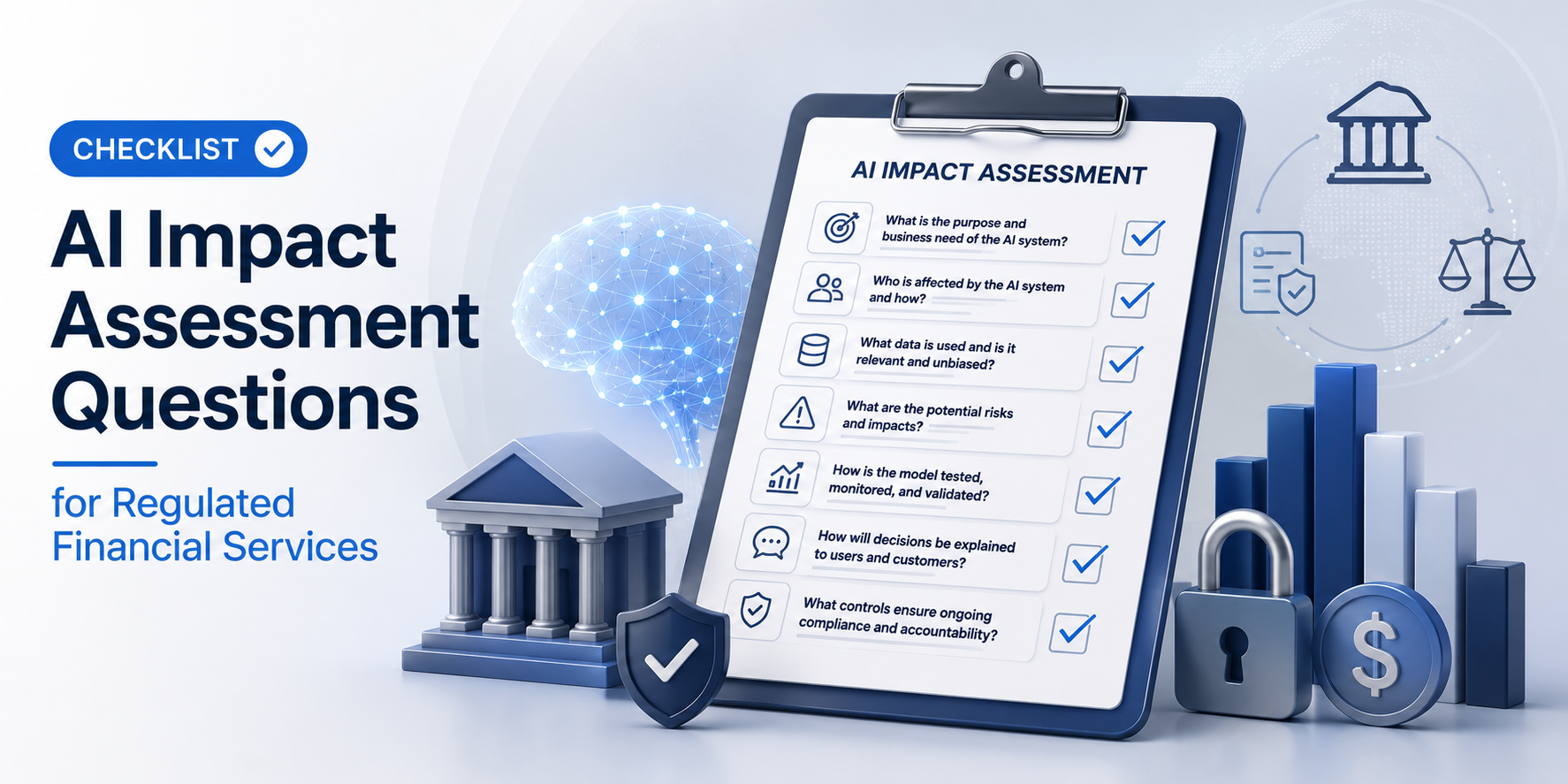
Checklist: AI Impact Assessment Questions for Regulated Financial Services
Regulated financial services firms are using AI for fraud detection, credit scoring, onboarding, transaction monitoring, risk scoring, document review, and support automation. But when AI affects customers, financial decisions, compliance workflows, or sensitive data, organizations need AI impact assessments that document risk, oversight, fairness, privacy, security, and accountability.
New Canadian Cyber Service
ISO 42001 and AI Governance Readiness for Financial Services
Canadian Cyber helps fintech, SaaS, banks, financial services firms, and AI-driven organizations build ISO 42001-ready AI governance programs. We support AI impact assessments, AI system inventories, AI risk registers, model governance, AI vendor reviews, customer decision controls, SharePoint AI governance workspaces, and executive AI risk reporting.
Quick Snapshot
| AI Impact Area | Why It Matters |
|---|---|
| Customer Impact | AI may influence approvals, holds, reviews, rejections, limits, or escalations. |
| Fairness and Bias | AI outcomes may affect customer groups differently. |
| Explainability | Teams may need to explain how AI-supported decisions are made. |
| Human Oversight | High-impact decisions need review, escalation, and override controls. |
| Security and Privacy | AI systems may process sensitive financial and personal data. |
| ISO 42001 Readiness | AI impact assessments support structured AI governance and audit-ready evidence. |
Introduction
AI is becoming normal in financial services.
Banks, fintech companies, lenders, payment platforms, insurance providers, wealth firms, credit unions, and financial technology vendors are using AI to improve speed, detection, personalization, and decision-making.
AI may support:
Credit risk scoring
Loan decision support
Transaction monitoring
Customer onboarding
Identity verification
Document review
Customer support chatbots
AML alerts
Financial recommendations
These use cases can create value. But they can also create risk. A fraud model may block a legitimate transaction. A credit model may produce unfair outcomes. An onboarding tool may reject a customer incorrectly. A chatbot may give inaccurate financial guidance. A vendor AI platform may process sensitive customer data. A model may drift after launch.
For regulated financial services, an AI impact assessment helps answer one important question: What could this AI system do to customers, operations, compliance, privacy, security, fairness, and trust?
Need AI Impact Assessments for Regulated Financial Services?
Canadian Cyber helps regulated financial services teams design AI impact assessment templates, conduct AI impact workshops, build AI inventories, document risks, review vendors, and prepare ISO 42001-ready evidence.
What Is an AI Impact Assessment?
An AI impact assessment is a structured review of how an AI system may affect people, data, operations, compliance, security, and business outcomes.
It helps teams understand:
- what the AI system does
- what data it uses
- who is affected
- what decisions it supports
- what could go wrong
- how serious the impact could be
- which controls reduce risk
- who owns the system
- what evidence must be retained
| Assessment Type | Main Focus |
|---|---|
| AI Impact Assessment | How the AI system affects customers, users, rights, decisions, operations, data, and trust. |
| AI Risk Assessment | What risks exist, how likely they are, how severe they are, and what controls reduce them. |
Practical rule: Use an AI impact assessment before high-impact AI systems go live. Use an AI risk assessment to prioritize controls and remediation.
When Financial Services Firms Should Perform an AI Impact Assessment
Not every AI tool has the same level of risk. A low-risk internal summarization tool may not need the same review as a credit decision model.
Trigger an AI impact assessment when AI is used for:
Credit scoring
Fraud detection
Transaction blocks
Eligibility decisions
Identity verification
AML alerts
Complaint triage
Financial recommendations
Vendor AI processing sensitive data
Practical rule: If AI can affect a customer’s money, access, account, eligibility, treatment, or rights, assess the impact.
1. AI Use Case and Purpose Questions
Start with the basics. If the use case cannot be explained clearly, it is not ready for approval.
| Question | Why It Matters |
|---|---|
| What is the AI system called? | Creates clear identification. |
| What business problem does it solve? | Confirms purpose. |
| What financial service process does it support? | Defines operational context. |
| Is the AI system customer-facing or internal? | Helps assess impact. |
| Does it make decisions or support human decisions? | Defines automation level. |
| Is the use case documented in the AI inventory? | Supports ISO 42001 readiness. |
2. Customer Impact Questions
Customer impact is central in regulated financial services. The higher the customer impact, the stronger the governance, oversight, and evidence should be.
| Question | Why It Matters |
|---|---|
| Could the AI system approve, reject, delay, block, flag, or escalate a customer? | Identifies customer-impacting decisions. |
| Could the AI affect credit access, account access, transaction processing, or service eligibility? | Identifies financial impact. |
| Could a customer experience harm from a wrong output? | Supports impact rating. |
| Can customers challenge or appeal an AI-supported decision? | Supports fairness and accountability. |
| Is human review required for high-impact outcomes? | Supports oversight. |
Examples of customer impact include:
- transaction blocked
- loan application rejected
- account flagged for review
- customer onboarding delayed
- identity verification failed
- risk score increased
- customer given inaccurate information
Build Customer-Impact AI Controls Before Launch
Canadian Cyber helps financial services teams identify high-impact AI use cases, document customer decision paths, define human oversight rules, and prepare evidence for ISO 42001 readiness.
3. Decision-Making and Human Oversight Questions
AI may automate decisions or support human judgment. Teams must understand which one applies.
| Question | Why It Matters |
|---|---|
| Does AI make the final decision? | Identifies automation risk. |
| Does AI recommend a decision to a human? | Identifies decision support risk. |
| Can a human override the AI output? | Supports control. |
| When is human review mandatory? | Defines escalation. |
| Are reviewers trained to challenge AI outputs? | Reduces automation bias. |
| Are override decisions logged? | Supports traceability. |
Practical rule: Human oversight is not just having a person nearby. The person must have authority, training, and evidence of review.
4. Data Use and Data Quality Questions
AI quality depends on data quality. In financial services, data issues can create serious downstream impact.
| Question | Why It Matters |
|---|---|
| What data does the AI system use? | Defines data scope. |
| Does it use customer personal information? | Privacy risk. |
| Does it use financial or transaction data? | Sensitivity and processing risk. |
| Is training data documented? | Supports model transparency. |
| Is input data quality checked? | Reduces incorrect outputs. |
| Is customer data used to train vendor models? | Vendor AI risk. |
5. Fairness and Bias Questions
Financial services AI can affect access and outcomes. Fairness review is critical for higher-impact systems.
| Question | Why It Matters |
|---|---|
| Could the AI system affect different customer groups differently? | Identifies bias risk. |
| Has fairness testing been performed? | Supports evidence. |
| Could proxy variables create unfair outcomes? | Detects hidden bias. |
| Are false positives and false negatives reviewed by segment where appropriate? | Supports fairness monitoring. |
| Are remediation actions documented? | Supports accountability. |
Example bias risks include:
- certain customers flagged more often for fraud
- identity verification fails more often for some groups
- credit model penalizes certain employment patterns
- customer support AI prioritizes some issues incorrectly
- document AI performs worse on certain formats or languages
Practical rule: Fairness should be reviewed before launch and monitored after launch.
6. Explainability and Transparency Questions
Financial services firms often need to explain decisions. Even if the model is complex, the organization should understand how it is used.
| Question | Why It Matters |
|---|---|
| Can the AI system’s purpose be explained in plain language? | Supports transparency. |
| Can the decision factors be summarized? | Supports internal and customer understanding. |
| Can support teams explain AI-supported outcomes? | Supports service quality. |
| Are model limitations documented? | Prevents overreliance. |
| Is there documentation for auditors, banks, or regulators? | Supports external review. |
7. Security, Privacy, and Vendor AI Questions
AI systems can create cybersecurity, privacy, and third-party risk, especially when they connect to sensitive data, APIs, customer workflows, or vendor platforms.
Security Questions
- Who can access the AI system?
- Is MFA required for admin access?
- Are prompts, outputs, and logs protected?
- Can the AI system be abused through prompts or API calls?
- Is AI activity logged?
Privacy Questions
- What personal information is processed?
- Is sensitive personal information included?
- Is data minimized?
- Is data shared with AI vendors?
- Is customer data used for model training?
Vendor AI Questions
- Is the AI built internally or vendor-provided?
- What data does the vendor process?
- Does the vendor provide SOC 2 or ISO 27001 evidence?
- How are model updates managed?
- Are sub-processors disclosed?
Practical rule: AI vendor review should cover security, privacy, model governance, and customer impact.
8. Model Performance and Drift Questions
AI approval is not one-time. High-impact AI needs ongoing monitoring, especially in fraud, credit, and risk scoring.
| Question | Why It Matters |
|---|---|
| What performance metrics are tracked? | Monitoring. |
| How often is performance reviewed? | Governance cadence. |
| Are false positives reviewed? | Customer impact. |
| Are false negatives reviewed? | Risk exposure. |
| Is model drift monitored? | Long-term reliability. |
| Are model changes approved? | Change control. |
9. Compliance, Incident, and Evidence Questions
Regulated financial services firms should connect AI governance to compliance obligations, incident response, and audit-ready documentation.
| Question | Why It Matters |
|---|---|
| Does the AI use case affect regulated activities? | Compliance scope. |
| Are legal or compliance teams involved? | Review support. |
| What counts as an AI incident? | Defines escalation. |
| Are customer complaints linked to AI systems? | Customer impact monitoring. |
| Are approvals recorded? | Governance evidence. |
| Is the assessment reviewed periodically? | Ongoing governance. |
Example AI incidents include:
- model blocks legitimate customers at an unusual rate
- credit decision engine applies the wrong threshold
- chatbot provides inaccurate financial instruction
- vendor AI service exposes customer data
- fraud model misses known attack pattern
- AI output is used without required human review
AI Impact Assessment Checklist Table
Use this as a quick readiness tool before approving, deploying, or expanding high-impact AI systems.
| Assessment Area | Key Question | Ready? |
|---|---|---|
| Use Case | Is the AI purpose documented? | |
| Inventory | Is the AI system listed in the AI inventory? | |
| Customer Impact | Could the AI affect customer access, money, or treatment? | |
| Human Oversight | Is human review required for high-impact outcomes? | |
| Fairness | Has bias or fairness risk been assessed? | |
| Security | Is AI access controlled and monitored? | |
| Privacy | Is personal data use reviewed and approved? | |
| Vendor Risk | Has the AI vendor been reviewed? | |
| Evidence | Is the assessment documented and stored? |
SharePoint AI Governance Workspace
AI impact assessments should not live in isolated documents. They should connect to AI inventory, risk registers, vendor reviews, model documentation, monitoring evidence, and executive reporting.
| SharePoint Section | Purpose |
|---|---|
| AI System Inventory | Lists AI systems, owners, risk level, and use cases. |
| AI Impact Assessments | Stores completed assessments and approvals. |
| AI Risk Register | Tracks risks, controls, and treatment actions. |
| Model Documentation | Stores model cards, summaries, limitations, and data sources. |
| AI Vendor Register | Tracks vendor reviews and assurance evidence. |
| Human Oversight Records | Stores review procedures, overrides, and escalation records. |
| Monitoring Evidence | Stores performance, drift, fairness, and error reviews. |
| Management Review | Stores leadership review notes and decisions. |
Build My SharePoint AI Governance Workspace
Canadian Cyber helps regulated financial services teams build ISO 42001-ready SharePoint AI governance workspaces for AI impact assessments, AI inventories, AI risk registers, vendor reviews, model evidence, monitoring, and executive reporting.
Common Mistakes to Avoid
- Launching AI without an impact assessment. High-impact financial services AI needs review before launch.
- Treating AI as only a technology issue. AI impact involves customers, compliance, operations, privacy, security, fairness, and leadership.
- No human oversight rules. Human review must be defined, trained, and documented.
- Ignoring vendor AI. Third-party AI tools can create major data, security, privacy, and model risk.
- No fairness review. Bias risk should be assessed where customer outcomes may be affected.
- No monitoring after launch. AI systems can drift or fail silently.
- No evidence. If the assessment, approval, and monitoring are not documented, the governance story is weak.
What Good Looks Like
A strong AI impact assessment program for regulated financial services can show:
- AI system inventory
- AI impact assessment template
- AI risk register
- customer impact classification
- human oversight rules
- fairness and bias review
- data quality review
- privacy review
- security review
- AI vendor due diligence
- model documentation
- performance monitoring
- model drift review
- AI issue tracker
- management review
- SharePoint evidence workspace
This helps financial services firms use AI with more trust, control, and ISO 42001 readiness.
Canadian Cyber’s Take
AI adoption in financial services is accelerating. Fraud detection, credit models, transaction monitoring, onboarding, customer support, and risk scoring are becoming more AI-driven.
But regulated financial services firms cannot treat AI like an experiment forever. They need structure. They need inventories, impact assessments, risk registers, vendor reviews, human oversight, monitoring, evidence, and leadership accountability.
Canadian Cyber’s ISO 42001 and AI governance services help financial services teams build practical AI governance programs without slowing innovation.
The goal is not to stop AI. The goal is to make AI trusted, controlled, explainable, and ready for serious review.
Takeaway
Regulated financial services firms should complete AI impact assessments before deploying or expanding high-impact AI systems.
Focus on:
- use case
- customer impact
- human oversight
- data quality
- fairness
- explainability
- security
- privacy
- vendor risk
- model performance
- compliance
- evidence
AI impact assessments help teams understand risk before customers, auditors, banks, regulators, or buyers ask hard questions. For financial services AI, governance is no longer optional. It is part of trust.
How Canadian Cyber Can Help
Canadian Cyber helps regulated financial services firms, fintech companies, SaaS platforms, and AI-driven teams build ISO 42001-ready AI governance programs.
- AI impact assessment templates
- AI impact assessment workshops
- ISO 42001 readiness assessments
- AI governance program design
- AI system inventory creation
- AI risk register development
- fraud detection AI governance
- credit model impact assessments
- customer decision control reviews
- AI vendor risk reviews
- human oversight design
- model monitoring evidence planning
- AI incident and issue tracking
- SharePoint AI governance workspace setup
- executive AI risk reporting
- vCISO support for AI governance
Stay Connected With Canadian Cyber
Follow Canadian Cyber for practical guidance on ISO 42001, AI impact assessments, regulated financial services, fintech AI, fraud detection, credit models, customer decision controls, SOC 2, ISO 27001, SharePoint ISMS, and vCISO support.