ISO 42001 • AI Governance • Model Register • AI Risk Management • Responsible AI
Template Blog: AI Model Governance Register for ISO 42001 Compliance
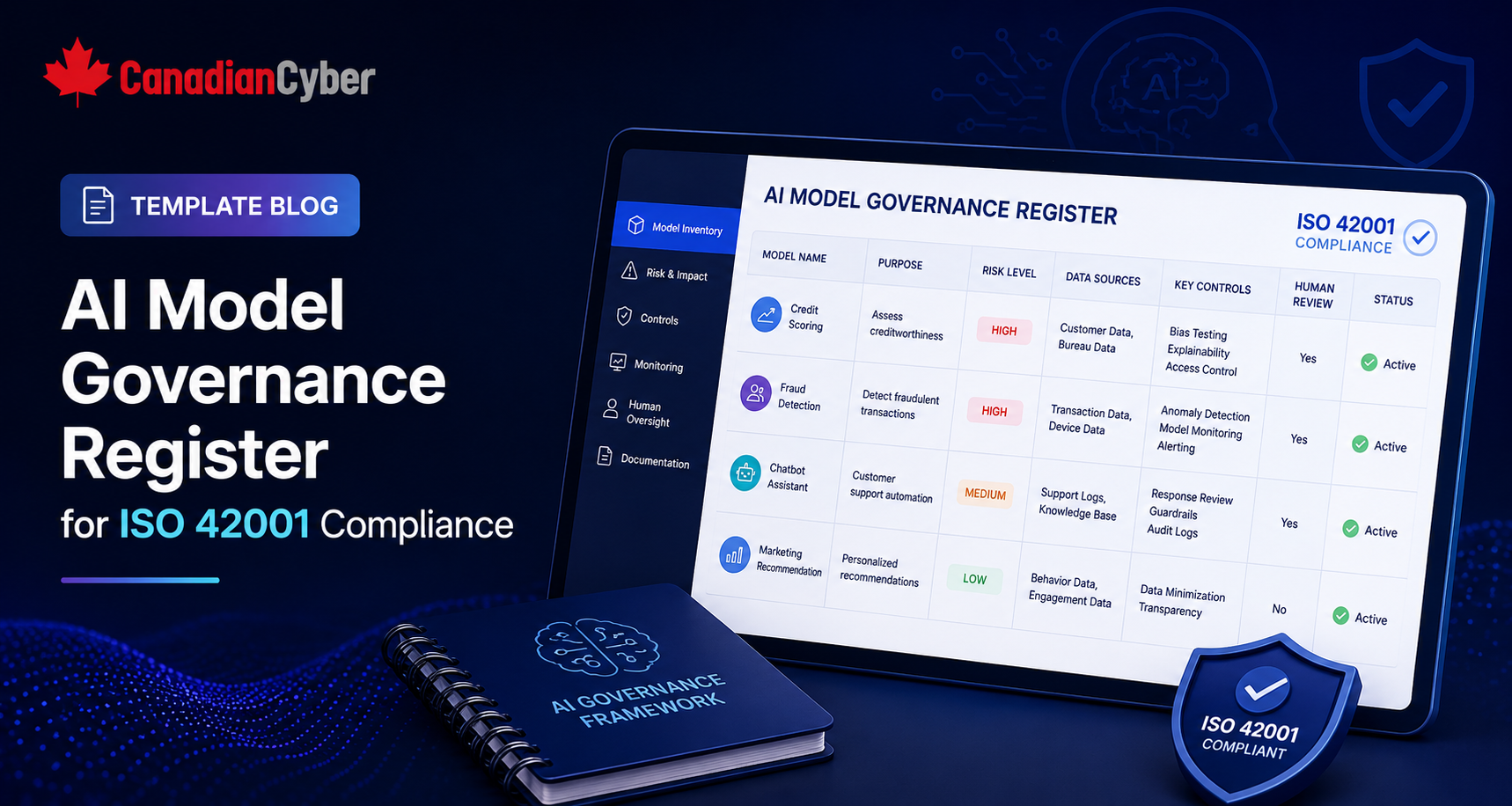
Organizations using AI need more than model performance notes and scattered technical documentation. For ISO 42001 readiness, they need a structured AI Model Governance Register that shows which AI systems exist, who owns them, what data they use, what risks they create, how they are monitored, and what evidence supports governance.
Canadian Cyber AI Governance Service
ISO 42001-Ready AI Governance Registers and SharePoint Workspaces
Canadian Cyber helps fintech, SaaS, financial services, AI platforms, and regulated organizations build AI model governance registers, AI inventories, AI risk registers, AI impact assessments, vendor reviews, model documentation libraries, and SharePoint AI governance workspaces.
Quick Snapshot
| Register Area | Why It Matters |
|---|---|
| AI Inventory | Shows which AI models, AI systems, and AI-assisted workflows exist. |
| Ownership | Assigns business, technical, risk, and compliance accountability. |
| Customer Impact | Identifies whether AI affects customers, employees, financial decisions, or regulated workflows. |
| Risk Rating | Prioritizes controls for high-impact AI systems. |
| Evidence | Supports ISO 42001 readiness, investor review, customer trust, and audit preparation. |
| Business Outcome | Helps leadership govern AI with clarity, consistency, and proof. |
Introduction
AI adoption is growing quickly.
Companies are using AI for fraud detection, credit scoring, customer support, document review, risk scoring, cybersecurity monitoring, transaction monitoring, sales automation, compliance review, workflow automation, data extraction, recommendation engines, and internal productivity tools.
But many organizations have the same problem: they do not have one clear view of their AI systems.
Product team AI tools
Vendor-provided AI
Embedded SaaS AI features
Support automation
Customer decision workflows
Experimental AI in production
That creates governance risk.
If leadership cannot answer “what AI do we use and how is it controlled?”, ISO 42001 readiness becomes difficult.
An AI Model Governance Register helps solve this. It creates a central inventory of AI systems, owners, use cases, risks, controls, vendors, data sources, monitoring, and evidence.
Need an ISO 42001 AI Model Register?
Canadian Cyber helps organizations build ISO 42001-ready AI governance registers, AI risk registers, impact assessments, vendor reviews, model documentation libraries, and SharePoint AI governance workspaces.
What Is an AI Model Governance Register?
An AI Model Governance Register is a structured record of AI models, AI systems, and AI-assisted workflows used across the organization.
It helps answer:
- What AI systems do we use?
- Who owns them?
- What business process do they support?
- What data do they use?
- Are they customer-impacting?
- Are vendors involved?
- What risks exist?
- What controls reduce those risks?
- How are models monitored?
- Where is the evidence stored?
| Item | Purpose |
|---|---|
| AI Inventory | Basic list of AI systems and use cases. |
| AI Model Governance Register | Expanded governance record with owners, risks, controls, data, monitoring, vendors, and evidence. |
Practical rule: An AI inventory tells you what exists. An AI model governance register tells you how it is controlled.
Why ISO 42001 Needs an AI Model Governance Register
ISO 42001 focuses on creating an Artificial Intelligence Management System. That means AI must be governed, risk-assessed, documented, monitored, reviewed, and improved.
| ISO 42001 Governance Need | How the Register Helps |
|---|---|
| AI System Identification | Lists AI systems and AI-assisted workflows. |
| Roles and Responsibilities | Assigns business, technical, and governance owners. |
| Risk Management | Links each AI system to risks and controls. |
| Impact Assessment | Identifies customer, employee, security, privacy, and business impact. |
| Supplier Management | Tracks AI vendors and third-party AI systems. |
| Monitoring | Records performance, drift, errors, and review cadence. |
| Change Management | Tracks model updates and approval needs. |
| Evidence Management | Links to policies, assessments, test results, and review records. |
Practical rule: ISO 42001 readiness starts with visibility. You cannot govern AI you have not identified.
Who Should Use This Template?
This AI Model Governance Register template is useful for organizations using AI in regulated, high-trust, or customer-impacting environments.
Banking
Insurance
Payments
SaaS
Health technology
Legal technology
Cybersecurity
Human resources
AI-enabled platforms
It is especially important when AI influences:
- customer decisions
- fraud reviews
- credit decisions
- transaction monitoring
- risk scoring
- identity verification
- employee decisions
- regulated workflows
- security alerts
- customer-facing responses
AI Model Governance Register Template
Use this table as the foundation for your AI governance register.
| Core Register Field | What to Capture |
|---|---|
| AI System ID | Unique reference number. |
| AI System Name | Clear system or model name. |
| Business Use Case | What the AI system does. |
| Business Owner | Accountable business owner. |
| Technical Owner | Engineering, data science, platform, or vendor owner. |
| Governance Owner | Risk, compliance, security, privacy, or vCISO owner. |
| Customer Impact | None, low, medium, or high. |
| Risk Rating | Low, medium, high, or critical. |
| Human Oversight | Required, optional, or not applicable. |
| Evidence Link | Link to supporting records. |
Practical rule: Every AI system should have an owner, impact rating, risk rating, review date, and evidence link.
Expanded AI Model Governance Register Template
For ISO 42001 readiness, use a more complete register that connects AI systems to risk, controls, monitoring, vendors, and evidence.
| Recommended Full Register Column | Example |
|---|---|
| AI System ID | AI-001 |
| AI System Name | Fraud Detection Model |
| Business Process | Transaction monitoring |
| Use Case Description | Flags suspicious transactions for review |
| Business Owner | Fraud Operations Lead |
| Technical Owner | Data Science Lead |
| Governance Owner | Compliance / vCISO |
| Model Type | Supervised machine learning |
| Data Sources | Transaction metadata, device signals, account behaviour |
| Customer Impact Level | High |
| Decision Role | Decision support |
| Human Review Requirement | Required before customer restriction |
| Overall Risk Rating | High |
| Monitoring Metrics | False positives, false negatives, drift, alerts |
| Evidence Link | SharePoint folder link |
Define AI Ownership Before Risk Grows
Canadian Cyber can help organizations define AI ownership models for ISO 42001 readiness, including business owners, technical owners, governance owners, risk owners, and executive reporting paths.
Field-by-Field Guidance
1. AI System ID
Give every AI system a unique identifier, such as AI-001, AI-002, or AI-003. This makes it easier to link the system to risks, impact assessments, vendor reviews, model changes, monitoring reports, and evidence.
Practical rule: Never rely only on model names. Use unique IDs for traceability.
2. AI System Name
Use clear names. “Model 3” is weak. “Customer Fraud Risk Scoring Model” is stronger because leadership, auditors, compliance teams, and investors can understand it quickly.
3. Business Use Case
Describe what the AI system does in business language, such as:
- detects suspicious transactions
- supports credit decision review
- classifies customer support tickets
- extracts data from onboarding documents
- summarizes compliance alerts
- prioritizes fraud investigation queues
4. Business Owner
Assign a business owner who is accountable for how the AI system is used in the business process. AI ownership should not sit only with engineering.
5. Technical Owner
Assign a technical owner who understands how the AI system works, how it is deployed, how it is maintained, and what technical evidence is available.
6. Governance Owner
Assign a governance owner who ensures the AI system is reviewed, risk-assessed, documented, monitored, and included in management review.
7. AI Type
Classify the type of AI. The AI type helps determine risk, monitoring, explainability, and control needs.
| AI Type | Example |
|---|---|
| Machine Learning Model | Fraud detection model |
| Large Language Model | Customer support assistant |
| Predictive Model | Credit risk scoring |
| Rules + AI Hybrid | Transaction monitoring workflow |
| Vendor AI | Identity verification platform |
| Generative AI | Document summarization |
8. Deployment Status
Track where the AI system is in its lifecycle. Pilot systems may still create risk if they use real data. Retired systems may still have stored outputs, logs, or vendor records. Production systems need stronger monitoring.
Under review
Pilot
Production
Paused
Retired
9. Customer Impact Level
Customer impact is one of the most important fields. High customer impact should trigger AI impact assessment and stronger human oversight.
| Level | Description |
|---|---|
| None | Internal productivity only, no customer effect. |
| Low | Supports internal work with limited customer effect. |
| Medium | Influences customer workflow, review, prioritization, or response. |
| High | Can affect approval, rejection, access, fraud action, credit decision, or financial outcome. |
10. Decision Role
Document how the AI output is used. An AI system that only summarizes internal notes has different risk than one that automatically blocks a transaction.
Decision support
Automated decision
Human-reviewed decision
Workflow prioritization
Alert generation
Content generation
11. Human Oversight Requirement
For higher-impact systems, human review matters. It should be meaningful, trained, documented, and empowered.
| Human Oversight Field | Example |
|---|---|
| Oversight Required | Yes |
| Review Trigger | High-risk fraud score |
| Reviewer Role | Fraud analyst |
| Override Allowed | Yes |
| Escalation Required | Yes for customer restriction |
| Review Evidence | Case review log |
12. Data Sources
Document what data the AI system uses before deployment.
Transaction metadata
Payment records
Device signals
Support tickets
Identity verification records
Credit application data
Security logs
13. Vendor Involvement
Many AI systems are vendor-supported. AI vendor review should cover security, privacy, model behaviour, data use, and customer impact.
| Vendor Field | What to Capture |
|---|---|
| Vendor Name | AI supplier or embedded AI provider. |
| Service Provided | What the vendor AI does. |
| Data Processed | Customer, employee, financial, operational, or sensitive data. |
| Customer Data Used for Training | Yes, no, or contractually restricted. |
| Security Assurance Evidence | SOC 2, ISO 27001, security questionnaire, or other evidence. |
| Last Vendor Review Date | Most recent review date. |
14. Risk Ratings
Do not use one generic risk score only. Capture the main risk dimensions so leadership can understand where AI risk is concentrated.
| Risk Category | What It Covers |
|---|---|
| Customer Impact Risk | Customer harm, unfair treatment, access issues. |
| Bias / Fairness Risk | Uneven outcomes across groups. |
| Privacy Risk | Personal or sensitive data processing. |
| Security Risk | Unauthorized access, prompt abuse, data leakage. |
| Operational Risk | Errors, downtime, workflow disruption. |
| Explainability Risk | Difficulty explaining outcomes. |
| Vendor Risk | Third-party AI dependency. |
Turn AI Visibility Into ISO 42001 Evidence
Canadian Cyber helps organizations connect AI model registers to AI risk ratings, impact assessments, vendor reviews, model documentation, monitoring reports, and leadership review records.
15. Controls in Place
Risk ratings should connect to controls. A high-risk AI system with weak controls needs action.
Human review
Access control
Model documentation
Bias review
Fairness testing
Data quality review
Drift monitoring
Vendor review
Change approval
Management review
16. Monitoring Metrics
High-impact AI should be monitored after launch, not only tested before launch.
| Monitoring Area | Examples |
|---|---|
| Performance | Accuracy, false positives, false negatives. |
| Reliability | Latency, error rates, processing failures. |
| Customer Impact | Complaints, appeals, override rates, disputed outcomes. |
| Fairness | Segment reviews and fairness indicators where appropriate. |
| Change | Model changes, vendor updates, threshold changes. |
17. Related Evidence Links
The register should act as a map to the evidence. Each AI system should link to the records that prove it is governed.
AI risk assessment
Model card
Bias review
Human oversight procedure
Vendor review
Monitoring report
Model change record
Management review minutes
Example AI Model Governance Register Entry
Example: Fraud Detection AI
| Field | Example Entry |
|---|---|
| AI System ID | AI-001 |
| AI System Name | Fraud Signal Model |
| Use Case | Flags suspicious transactions for human review |
| Business Owner | Fraud Operations Lead |
| Technical Owner | Data Science Lead |
| Customer Impact | High |
| Human Oversight | Required before customer restriction |
| Controls | Human review, drift monitoring, access control, false positive review |
| Evidence | Impact assessment, model summary, monitoring report, risk record |
Example: Customer Support AI
| Field | Example Entry |
|---|---|
| AI System ID | AI-002 |
| AI System Name | Customer Support AI Assistant |
| Use Case | Suggests draft replies for support agents |
| Decision Role | Human-reviewed content generation |
| Human Oversight | Support agent approves before sending |
| Vendor Involved | Yes |
| Evidence | Vendor review, usage policy, review procedure, quality samples |
SharePoint AI Governance Register Structure
A SharePoint list is a practical way to manage the AI Model Governance Register. It allows teams to create filtered views, assign owners, track evidence, and prepare leadership reporting.
| Recommended SharePoint List View | Purpose |
|---|---|
| All AI Systems | Complete register. |
| High-Risk AI Systems | Focus leadership attention. |
| Customer-Impacting AI | Shows systems affecting customers. |
| Vendor AI Systems | Tracks third-party AI use. |
| AI Systems Due for Review | Shows upcoming reviews. |
| AI Systems Missing Evidence | Finds governance gaps. |
| Production AI Systems | Shows live AI. |
| Management Review View | Supports executive reporting. |
Recommended SharePoint sections include:
AI Risk Register
AI Impact Assessments
AI Vendor Register
Model Documentation Library
Human Oversight Records
Monitoring Evidence
Model Change Records
Management Review Records
Build My SharePoint AI Governance Register
Canadian Cyber helps organizations build ISO 42001-ready SharePoint AI governance workspaces with model registers, AI risk registers, impact assessments, vendor reviews, model documentation, monitoring evidence, and executive dashboards.
AI Model Governance Register Checklist
Use this checklist to assess your current register.
| Question | Yes / No |
|---|---|
| Do we have a complete list of AI systems? | |
| Are AI owners assigned? | |
| Are customer-impacting AI systems identified? | |
| Are vendor AI systems identified? | |
| Are data sources documented? | |
| Are risk ratings assigned? | |
| Are human oversight requirements documented? | |
| Are bias and fairness risks considered? | |
| Are monitoring metrics defined? | |
| Are model changes tracked? | |
| Are evidence links included? | |
| Is the register reviewed by leadership? |
If several answers are “no,” the organization may not be ready for ISO 42001 review.
Common Mistakes to Avoid
- Listing only technical models. Include vendor AI, AI-assisted workflows, embedded AI features, and generative AI tools.
- No business owner. AI governance needs business accountability, not only technical ownership.
- No customer impact rating. High-impact systems need stronger review.
- Ignoring vendor AI. Third-party AI can create major privacy, security, and explainability risk.
- No evidence links. A register without evidence becomes a spreadsheet, not a governance tool.
- No review dates. AI systems change, so the register must stay current.
- No leadership view. Executives need a clear view of high-risk AI systems and open governance gaps.
What Good Looks Like
A strong AI Model Governance Register can show:
- all AI systems and AI-assisted workflows
- business owners
- technical owners
- governance owners
- customer impact levels
- data sources
- vendor involvement
- risk ratings
- bias and fairness considerations
- human oversight rules
- explainability notes
- monitoring metrics
- impact assessment links
- vendor review links
- review dates
- ISO 42001 readiness support
This helps organizations move from AI experimentation to AI governance.
Canadian Cyber’s Take
At Canadian Cyber, we see many organizations using AI faster than they can govern it.
That creates risk because:
- leadership may not know every AI system in use
- security may not know where sensitive data is going
- compliance may not know which AI affects customers
- investors may ask for evidence that does not exist yet
- enterprise buyers may ask how AI risk is controlled
- ISO 42001 readiness may feel overwhelming because the inventory is incomplete
The AI Model Governance Register is one of the best first steps. It gives the organization visibility, prioritizes risk, creates accountability, connects AI use to evidence, and supports ISO 42001 readiness.
For Canadian Cyber clients, we often pair the AI model register with an AI risk register, AI impact assessment template, vendor review process, and SharePoint AI governance workspace. That creates a practical AI governance program without slowing innovation.
Takeaway
An AI Model Governance Register is essential for ISO 42001 compliance readiness.
It helps organizations answer:
- What AI systems do we use?
- Who owns them?
- What data do they process?
- Do they affect customers?
- Are vendors involved?
- What risks exist?
- What controls are in place?
- How are models monitored?
- Where is the evidence?
Start with a simple register. Then expand it with risk, impact, monitoring, vendor, and evidence fields. The goal is not paperwork. The goal is trusted, controlled, and accountable AI.
How Canadian Cyber Can Help
Canadian Cyber helps organizations build ISO 42001-ready AI governance programs that are practical, evidence-based, and leadership-ready.
- AI Model Governance Register templates
- AI system inventory creation
- ISO 42001 readiness assessments
- AI governance program design
- AI risk register development
- AI impact assessment templates
- AI vendor risk reviews
- model documentation templates
- bias and fairness review templates
- human oversight control design
- model monitoring evidence planning
- model change management process
- SharePoint AI governance workspace setup
- executive AI risk dashboards
- investor-ready AI governance packs
- vCISO support for AI governance
Stay Connected With Canadian Cyber
Follow Canadian Cyber for practical guidance on ISO 42001, AI governance, AI model registers, AI risk management, fintech AI, SaaS AI, SOC 2, ISO 27001, SharePoint ISMS, and vCISO support.