ISO 42001 • AI Risk Management • Bias • Explainability • Human Review
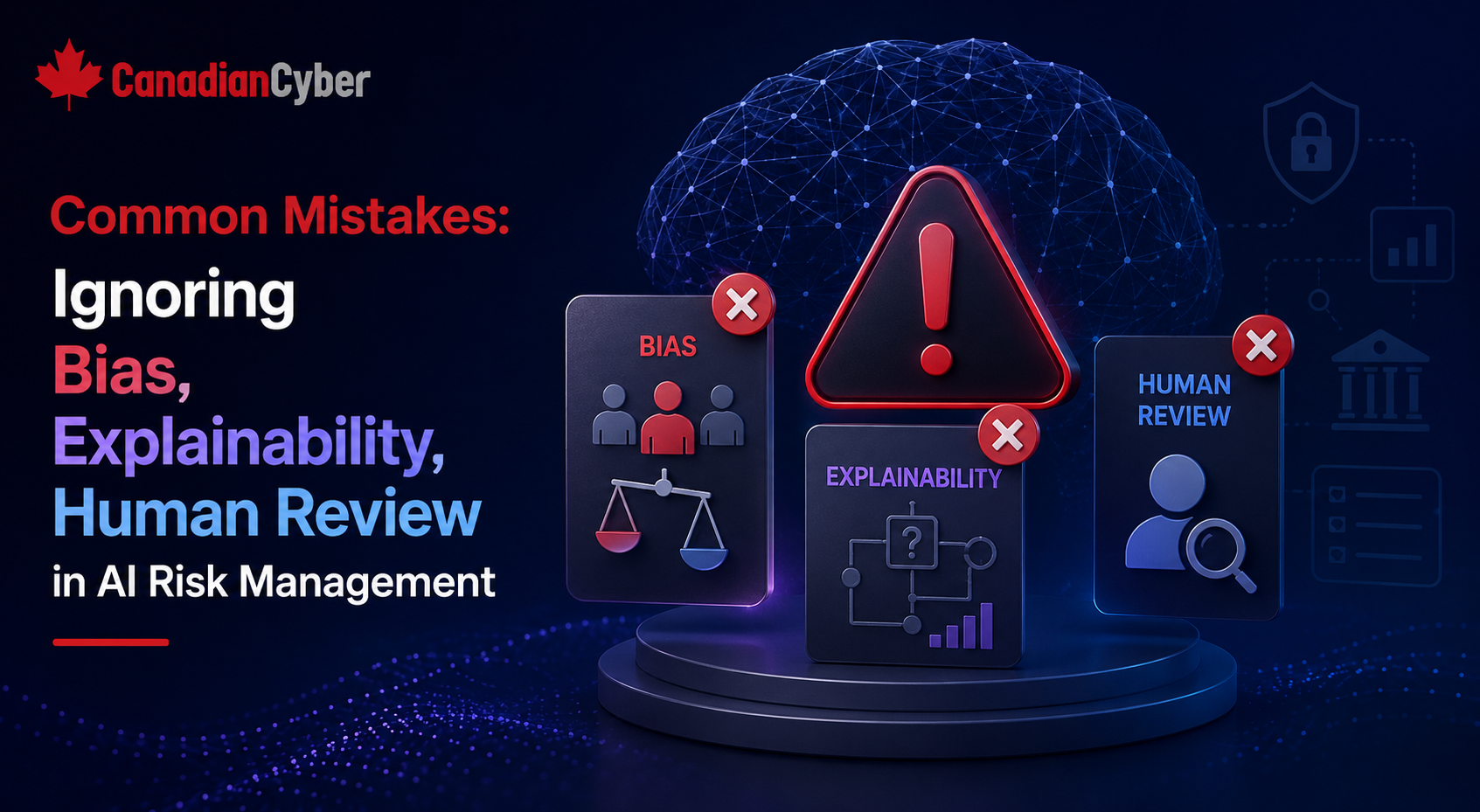
Common Mistakes: Ignoring Bias, Explainability, and Human Review in AI Risk Management
AI risk management is no longer just about model accuracy. Organizations using AI for fraud detection, credit scoring, customer decisions, document review, risk scoring, support automation, or regulated workflows must also manage bias, explainability, and meaningful human review.
Canadian Cyber AI Governance Service
ISO 42001 Readiness and AI Risk Management Support
Canadian Cyber helps fintech, SaaS, AI platforms, and regulated organizations build practical AI governance programs with AI risk registers, impact assessments, bias review templates, explainability documentation, human oversight controls, AI vendor reviews, model change control, and SharePoint AI governance workspaces.
Quick Snapshot
| AI Risk Area | Why It Matters |
|---|---|
| Bias | AI outcomes may affect customer groups unfairly or inconsistently. |
| Explainability | Teams may need to explain how AI-supported decisions are made. |
| Human Review | High-impact AI decisions need oversight, escalation, and override controls. |
| Evidence | AI governance must be documented, reviewed, and auditable. |
| Business Impact | Weak AI risk management can hurt trust, investor confidence, customer relationships, and regulatory readiness. |
Introduction
AI adoption is moving fast.
Companies are using AI to detect fraud, score risk, review documents, summarize cases, support customers, prioritize alerts, recommend actions, assess credit signals, automate workflows, classify tickets, monitor transactions, and review onboarding files.
These use cases can create value. They can reduce manual work, improve speed, help teams detect patterns, and support better decision-making.
But AI also creates risk.
Unfair credit outcomes
Inaccurate chatbot guidance
Rejected valid documents
Unexplainable risk scores
Overreliance on AI output
Vendor AI changes without review
This is why AI risk management must include bias, explainability, and human review. If these areas are ignored, AI governance becomes incomplete.
For organizations preparing for ISO 42001, investor review, bank due diligence, SOC 2, ISO 27001, or enterprise buyer scrutiny, these gaps can become serious findings.
Need AI Risk Management Support?
Canadian Cyber helps organizations build ISO 42001-ready AI governance programs with AI risk registers, impact assessments, model documentation, vendor reviews, human oversight controls, and SharePoint AI governance workspaces.
Why Bias, Explainability, and Human Review Matter
AI risk is not only technical. It can affect real people, business decisions, customer trust, and compliance obligations.
| Risk Area | What It Means |
|---|---|
| Bias | AI outcomes may unfairly affect certain customer groups, regions, profiles, behaviours, or data patterns. |
| Explainability | The organization may not be able to explain why an AI-supported output occurred. |
| Human Review | People may not review, challenge, override, or escalate high-impact AI outputs properly. |
Weak AI risk management can lead to:
- incorrect customer decisions
- unfair outcomes
- delayed onboarding
- blocked accounts
- wrong fraud flags
- poor credit decisions
- customer complaints
- lost investor trust
- bank review friction
- audit gaps
Practical rule: If AI can affect a customer, transaction, account, decision, eligibility, risk score, or escalation, it needs stronger governance.
Mistake 1: Treating AI Accuracy as the Only Risk
Many teams ask only one question: “Is the model accurate?”
That is not enough. A model can be accurate on average and still create unfair or harmful outcomes for specific groups or scenarios.
| Better Question | Why It Matters |
|---|---|
| Accurate for whom? | Identifies group-level performance issues. |
| Accurate under which conditions? | Identifies environment or data limitations. |
| What happens when it is wrong? | Defines customer and business impact. |
| Who reviews high-impact outputs? | Supports oversight. |
| Can the decision be explained? | Supports transparency. |
| Is performance monitored over time? | Detects drift. |
Practical rule: Accuracy is important, but it is not the full AI risk picture.
Mistake 2: Not Assessing Bias Before Launch
Bias review should not happen only after complaints arrive. It should happen before AI systems are approved for high-impact use.
| Bias Question | Yes / No |
|---|---|
| Could the AI system affect different customer groups differently? | |
| Are false positives reviewed? | |
| Are false negatives reviewed? | |
| Are proxy variables creating hidden bias? | |
| Are outcomes monitored by relevant segments where appropriate? | |
| Are bias risks documented in the AI risk register? |
Examples of bias risk include:
- fraud model flags certain customer types more often
- identity verification fails more frequently for some users
- credit scoring model penalizes non-traditional income patterns
- customer support AI misclassifies complaints from certain regions
- document review AI performs poorly on specific formats or languages
Practical rule: Bias risk should be reviewed before launch and monitored after launch.
Assess Bias Risk Before AI Scales
Canadian Cyber helps teams create bias review templates, AI impact assessments, customer impact classifications, false positive reviews, fairness evidence, and AI risk register entries for ISO 42001 readiness.
Mistake 3: Ignoring Proxy Variables
A model may not use sensitive attributes directly, but it may use proxy variables. A proxy variable is a data point that indirectly correlates with sensitive or protected characteristics.
Possible proxy variables include:
Device type
Employment pattern
Education history
Language preference
Transaction location
Income source
Account age
Merchant category
Document type
Common weak response: “We do not use sensitive attributes.”
Stronger response: “We review both direct inputs and proxy variables that could create uneven outcomes.”
Mistake 4: No Explainability Standard
Explainability does not always mean revealing every technical detail. It means the organization can explain the AI system appropriately for the audience.
| Audience | What They Need |
|---|---|
| Customer | Clear reason for an outcome where appropriate. |
| Support Team | Practical explanation to handle questions. |
| Compliance Team | Risk and control explanation. |
| Leadership | Business impact and accountability. |
| Investor | Governance maturity and risk posture. |
| Auditor or Regulator | Evidence of control design, review, oversight, and documentation. |
Explainability evidence can include:
Model card
Decision factor summary
Limitations documentation
Support playbook
Human review procedure
Risk assessment
Impact assessment
Mistake 5: Using Black-Box Models Without Governance Decisions
Some AI systems are hard to explain. That does not always mean they cannot be used. But the risk must be accepted knowingly.
| Question for Black-Box AI | Why It Matters |
|---|---|
| Why is this model appropriate for the use case? | Business justification. |
| What decisions does it influence? | Customer impact. |
| What are the limitations? | Risk visibility. |
| What monitoring is in place? | Ongoing control. |
| Is human review required? | Oversight. |
| Has leadership accepted the risk? | Governance. |
Make AI Decisions Explainable and Evidence-Ready
Canadian Cyber helps organizations prepare model summaries, model cards, explainability guidance, customer-impact documentation, black-box risk acceptance, and evidence packs for ISO 42001 readiness.
Mistake 6: Human Review Exists, But Is Not Defined
Many organizations say, “A human is involved.” That is not enough. Human review must be clear, meaningful, trained, documented, and empowered.
| Human Review Element | What Good Looks Like |
|---|---|
| Review Trigger | Defines when human review is required. |
| Reviewer Role | Defines who reviews. |
| Training | Reviewers understand AI limitations. |
| Override Authority | Humans can challenge or override AI. |
| Escalation Path | High-risk cases are escalated. |
| Review Evidence | Decisions are logged. |
| Complaint Link | Customer issues are reviewed. |
Weak human review: A person sees the AI output but cannot override it or does not record the review.
Strong human review: Review triggers, reviewer roles, override authority, training, escalation, and evidence are clearly defined.
Mistake 7: No Override or Appeal Process
If AI affects customer outcomes, there should be a way to review disputed decisions.
Examples where review may be needed:
Payment transaction delay
Customer onboarding rejection
Identity verification failure
Credit risk decision
Document rejection
Appeal and review evidence includes:
- customer review workflow
- manual review procedure
- case escalation record
- override record
- decision log
- complaint trend report
- corrective action tracker
Mistake 8: Not Monitoring AI Outcomes After Launch
AI risk does not end when the model is deployed. AI systems can drift. Data can change. Customer behaviour can change. Fraud patterns can change. Vendor models can update. Business rules can shift. Thresholds can become outdated.
| Monitoring Question | Yes / No |
|---|---|
| Are model performance metrics reviewed? | |
| Are false positives tracked? | |
| Are false negatives tracked? | |
| Is model drift monitored? | |
| Are customer complaints reviewed? | |
| Are thresholds reviewed periodically? | |
| Are model changes logged? |
Design Meaningful Human Review and AI Monitoring
Canadian Cyber helps teams define human review triggers, override workflows, appeal processes, AI monitoring evidence, model drift reviews, and corrective action tracking for high-impact AI systems.
Mistake 9: No AI Risk Register
AI risks should be tracked formally. If AI risk is discussed only in meetings or chat messages, it is not well controlled.
| AI Risk Register Field | Purpose |
|---|---|
| Risk ID | Unique reference. |
| AI System | Links to AI inventory. |
| Risk Description | What could go wrong. |
| Customer Impact | How people may be affected. |
| Business Impact | Financial, legal, operational, reputational. |
| Controls | Current safeguards. |
| Evidence Link | Supporting proof. |
Mistake 10: Ignoring AI Vendor Explainability
Many companies use third-party AI tools. They may not fully understand how those tools work. That creates governance risk.
| AI Vendor Question | Why It Matters |
|---|---|
| What data does the vendor process? | Privacy and confidentiality. |
| Is customer data used for training? | Data use risk. |
| Can the vendor explain outputs? | Explainability. |
| How are model updates controlled? | Change risk. |
| Are bias and fairness controls documented? | Customer impact. |
| Does the vendor provide security evidence? | Assurance. |
Mistake 11: No Model Change Control
AI systems change. Models are retrained. Thresholds are adjusted. Prompts are updated. Vendors change outputs. Data sources are added. Rules are modified.
Without change control, AI risk can change silently.
Risk impact review
Test results
Fairness review
Approval record
Deployment record
Rollback plan
Monitoring after release
Practical rule: High-impact AI changes should be treated like high-risk production changes.
Mistake 12: No Evidence of AI Governance
Many teams do some AI governance work, but cannot prove it. That becomes a problem during investor review, customer due diligence, ISO 42001 readiness, SOC 2 preparation, bank review, or regulatory inquiry.
AI governance evidence to keep:
- AI policy
- AI system inventory
- AI risk register
- AI impact assessments
- model documentation
- bias and fairness reviews
- human oversight procedures
- review and override records
- vendor AI reviews
- model monitoring reports
- model change records
- management review minutes
Bias, Explainability, and Human Review Checklist
Use this checklist during AI risk management.
Bias
| Question | Yes / No |
|---|---|
| Has bias risk been assessed? | |
| Are false positives reviewed? | |
| Are false negatives reviewed? | |
| Are proxy variables considered? | |
| Are remediation actions tracked? |
Explainability
| Question | Yes / No |
|---|---|
| Can the AI use case be explained clearly? | |
| Are model limitations documented? | |
| Can support teams explain customer outcomes where appropriate? | |
| Is there a model summary or model card? | |
| Are black-box risks documented and approved? |
Human Review
| Question | Yes / No |
|---|---|
| Are human review triggers defined? | |
| Are reviewers trained? | |
| Can humans override AI output? | |
| Are review decisions logged? | |
| Is there an appeal or review workflow for high-impact outcomes? |
If several answers are “no,” AI risk management needs improvement.
SharePoint AI Governance Workspace
AI governance evidence should not live in random folders, chat messages, notebooks, and vendor portals. A SharePoint AI governance workspace can help organize ISO 42001 readiness evidence in one place.
| Recommended Workspace Section | Purpose |
|---|---|
| AI System Inventory | Lists AI systems, owners, purpose, and risk level. |
| AI Risk Register | Tracks AI risks, controls, treatment, and owners. |
| AI Impact Assessments | Documents customer, fairness, privacy, security, and business impact. |
| Model Documentation | Stores model summaries, limitations, data sources, and change history. |
| Bias and Fairness Reviews | Stores testing and outcome review evidence. |
| Human Oversight Records | Stores review rules, override records, and escalation evidence. |
| AI Vendor Register | Stores vendor reviews, assurance evidence, and data use records. |
| Management Review | Stores leadership review notes and decisions. |
Build My SharePoint AI Governance Workspace
Canadian Cyber helps organizations build SharePoint AI governance workspaces for ISO 42001 readiness, AI risk registers, impact assessments, model documentation, vendor reviews, human oversight evidence, and executive reporting.
Common Warning Signs
Your AI risk management may be weak if:
- AI systems are not inventoried.
- Bias is not reviewed.
- Model limitations are not documented.
- Human review is assumed but not defined.
- Reviewers cannot override AI output.
- Customer complaints are not linked to AI issues.
- Vendors are not reviewed for AI risk.
- Model changes are not approved.
- AI risks are not in a risk register.
- Governance evidence is scattered.
What Good Looks Like
A strong AI risk management program can show:
- AI governance policy
- AI system inventory
- AI risk register
- AI impact assessments
- bias and fairness reviews
- model documentation
- model limitations
- explainability guidance
- human review triggers
- reviewer training
- override process
- appeal workflow
- AI vendor reviews
- model change control
- monitoring reports
- AI issue tracker
- management review records
- ISO 42001 readiness roadmap
This makes AI safer, clearer, and easier to trust.
Canadian Cyber’s Take
At Canadian Cyber, we see many organizations move quickly into AI before governance is fully mature. That is understandable. AI is useful.
But when AI influences customer decisions, fraud reviews, credit signals, support outcomes, risk scoring, or regulated workflows, governance must catch up.
Bias, explainability, and human review are not optional add-ons. They are central parts of AI risk management.
They help organizations answer serious questions from investors, banks, customers, auditors, regulators, and leadership. The goal is not to stop AI. The goal is to make AI trusted, controlled, explainable, and accountable.
Takeaway
Ignoring bias, explainability, and human review can weaken AI risk management.
Organizations should ask:
- Could AI create unfair outcomes?
- Can we explain AI-supported decisions?
- Do humans review high-impact outputs?
- Can humans override the AI?
- Are complaints and errors tracked?
- Are AI vendors reviewed?
- Are model changes controlled?
- Is evidence documented?
For organizations using AI in high-impact workflows, risk management must go beyond accuracy. It must include fairness, transparency, oversight, and accountability.
How Canadian Cyber Can Help
Canadian Cyber helps fintech, SaaS, AI platforms, and regulated organizations build AI governance and ISO 42001 readiness programs.
- AI governance readiness assessments
- ISO 42001 readiness planning
- AI system inventory creation
- AI risk register development
- AI impact assessments
- bias and fairness review templates
- explainability documentation
- model card templates
- human oversight design
- override and appeal workflow design
- AI vendor risk reviews
- model change control process
- AI monitoring evidence planning
- AI issue and incident tracking
- SharePoint AI governance workspace setup
- executive AI risk reporting
- vCISO support for AI governance
Stay Connected With Canadian Cyber
Follow Canadian Cyber for practical guidance on ISO 42001, AI risk management, bias, explainability, human review, fintech AI, SOC 2, ISO 27001, SharePoint ISMS, and vCISO support.