Board Reporting
Internal Audit
Executive Governance
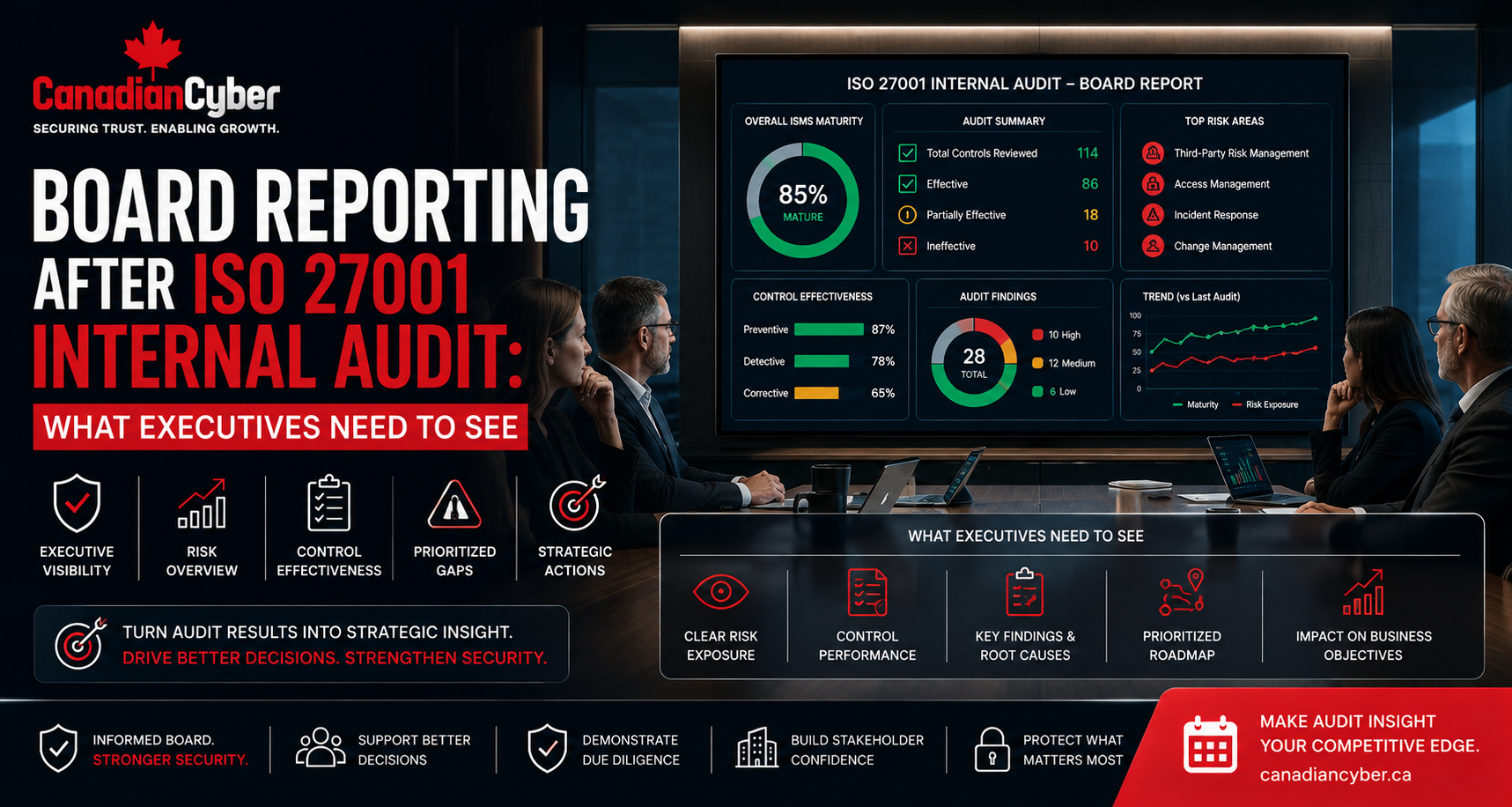
Board Reporting After ISO 27001 Internal Audit: What Executives Need to See
An ISO 27001 internal audit should not end in a compliance folder. Executives need a clear business view of risk, readiness, accountability, corrective actions, and decisions.
Quick Answer
What should executives see after an ISO 27001 internal audit?
Executives need a board-level report that summarizes audit scope, readiness status, high-risk findings, corrective action status, overdue actions, risk register impact, certification impact, resource needs, and improvement priorities.
They do not need every audit screenshot, checklist item, or technical note.
Bottom line: The board needs a clear view of business risk, accountability, timelines, and whether the ISMS is operating effectively.
Canadian Cyber Board Reporting Support
Turn ISO 27001 Audit Results Into Executive-Ready Reporting
Canadian Cyber helps organizations turn internal audit results into clear board reports, management review inputs, corrective action dashboards, risk updates, and certification readiness summaries.
We help leadership understand what findings mean, what needs to be fixed first, what could affect certification, and what decisions are required.
Quick Snapshot
| Board Reporting Area | What Executives Need to See |
|---|---|
| Audit Scope | What was reviewed and what was excluded. |
| Overall Result | Whether the ISMS is ready, partially ready, or needs work. |
| High-Risk Findings | Issues that affect security, certification, or customer trust. |
| Root Causes | Why findings happened. |
| Corrective Actions | What will be fixed, by whom, and by when. |
| Risk Register Impact | New or changed risks from the audit. |
| Certification Impact | Whether findings could affect Stage 2 or surveillance audit. |
| Improvement Roadmap | Next 30, 60, 90, and 180-day priorities. |
Why Board Reporting Matters After Internal Audit
Internal audit is not only a compliance activity.
It is a governance signal.
It tells leadership whether the Information Security Management System is working as intended.
The audit may be complete, but leadership still needs to know what the audit means for the business.
Board reporting turns internal audit findings into leadership decisions.
Who This Blog Is For
- Executives reviewing ISO 27001 internal audit results.
- Boards and advisory boards.
- CEOs, founders, COOs, CFOs, CTOs, and CIOs.
- Security leaders and vCISO teams.
- ISMS managers and compliance leads.
- Risk owners and control owners.
- Companies preparing for ISO 27001 certification.
- Organizations preparing for surveillance audits.
- SaaS, MSP, FinTech, HealthTech, AI, and professional services firms.
- Organizations using SharePoint or Microsoft 365 for ISMS evidence.
What Executives Do Not Need
A common mistake is giving leadership too much detail.
Raw audit material can hide what matters.
Practical rule: Board reporting should reduce noise, not transfer audit complexity to executives.
What Executives Do Need
Executives need a concise and decision-ready audit summary.
The report should answer clear business questions.
Section 1: Audit Scope and Coverage
Start the board report by explaining what the audit covered.
This helps executives understand whether the result is broad, narrow, or focused on specific risk areas.
Include:
- Audit period.
- Departments reviewed.
- Systems reviewed.
- Locations or remote teams reviewed.
- ISO 27001 clauses reviewed.
- Annex A control areas reviewed.
- Evidence types reviewed.
- Interviews performed.
- Areas excluded or limited.
Leadership should know what the audit result covers before making decisions from it.
Section 2: Overall Audit Result
Executives need a simple readiness view.
Avoid vague statements like “the audit went well.”
| Rating | Meaning |
|---|---|
| Green | ISMS is operating with minor improvements needed. |
| Amber | Some gaps require corrective action before external audit. |
| Red | Significant findings may affect certification or risk exposure. |
| Improving | Prior findings are being closed and maturity is increasing. |
| Watchlist | Specific areas need executive attention. |
Example: The ISMS is generally operating, but certification readiness depends on closing four high-priority corrective actions related to access review evidence, vendor reviews, management review decisions, and backup restore testing.
Section 3: Top Findings Executives Should Know
Not every finding belongs in the board report.
Focus on issues that affect risk, certification, operations, customers, or leadership decisions.
| Finding | Business Impact | Priority |
|---|---|---|
| Privileged access review incomplete. | Increased risk of excessive admin access. | High |
| Critical vendors not reviewed. | Supplier risk not fully assessed. | High |
| Restore test not performed. | Recovery capability not proven. | High |
| Management review lacks decisions. | Leadership oversight evidence is weak. | Medium |
| AI tools not included in risk register. | Emerging Shadow AI risk is not formally governed. | Medium |
Need a Board-Ready ISO 27001 Audit Summary?
Canadian Cyber helps convert audit findings into executive dashboards, corrective action roadmaps, risk summaries, and management review inputs.
Section 4: Root Cause Themes
Executives need more than the finding.
They need to know why findings are happening.
Group individual findings into root cause themes.
Root cause themes help leadership fund process improvements, not just individual fixes.
Section 5: Corrective Action Status
Executives need to know whether findings are being fixed.
The board report should show corrective action status clearly.
| Status | Count | Board Message |
|---|---|---|
| Closed and Verified | 6 | Evidence reviewed and closure confirmed. |
| In Progress | 8 | Owners assigned and target dates active. |
| Overdue | 3 | Requires escalation. |
| Blocked | 2 | Requires leadership decision or resource. |
| High Priority | 4 | Must close before external audit. |
Practical rule: A finding is not truly closed until closure evidence is verified.
Section 6: Risk Register Impact
Internal audit findings should feed the risk register.
Executives need to see whether the audit changed the organization’s risk picture.
| Audit Finding | Risk Register Impact |
|---|---|
| Vendor reviews incomplete. | Supplier risk likelihood increased. |
| Restore test missing. | Recovery risk remains untreated. |
| Privileged access review incomplete. | Access governance risk increased. |
| AI tools not assessed. | New Shadow AI risk added. |
| Corrective actions overdue. | ISMS improvement risk increased. |
Section 7: Certification or Surveillance Audit Impact
Executives want to know whether internal audit findings could affect certification.
Make this clear and simple.
| Impact | Meaning |
|---|---|
| No Material Impact | Findings are minor and manageable. |
| Watchlist | Findings should be closed before external audit. |
| Certification Risk | Findings may delay or complicate certification. |
| Immediate Action Required | High-risk gaps need leadership escalation. |
Section 8: Resource and Budget Needs
Some findings cannot be fixed by the control owner alone.
Leadership may need to approve budget, tools, staff time, consulting support, policy decisions, vendor changes, or workflow improvements.
| Need | Why It Matters |
|---|---|
| Access review automation | Reduces missed reviews and improves evidence. |
| Vendor risk workflow | Tracks critical vendors, owners, and review dates. |
| vCISO support | Provides independent review and leadership guidance. |
| Incident tabletop exercise | Tests response before a real event. |
| SharePoint ISMS workspace | Centralizes evidence, findings, and dashboards. |
| AI governance review | Assesses Shadow AI and approved AI tool use. |
Section 9: 30-60-90 Day Improvement Roadmap
Executives need to see what happens next.
A roadmap turns findings into action.
0–30 Days: Stabilize
- Close high-risk evidence gaps.
- Assign owners to all findings.
- Verify urgent corrective actions.
- Update risk register.
- Escalate overdue actions.
31–60 Days: Control
- Complete access review improvements.
- Update vendor reviews.
- Complete restore test evidence.
- Update policy communication records.
- Review corrective action progress.
61–90 Days: Improve
- Automate reminders.
- Build SharePoint audit dashboard.
- Improve leadership reporting.
- Align ISO 27001 and SOC 2 evidence.
- Review AI governance risks.
Section 10: Accountability by Owner
Board reporting should show ownership clearly.
Avoid vague labels like “IT” or “Compliance.” Use named roles.
| Owner | Open Actions | Overdue | High Priority |
|---|---|---|---|
| IT Manager | 4 | 1 | 2 |
| ISMS Manager | 5 | 0 | 1 |
| Procurement Lead | 3 | 2 | 1 |
| HR Lead | 2 | 0 | 0 |
| Security Lead | 4 | 1 | 2 |
| Executive Sponsor | 2 | 0 | 2 |
Section 11: Metrics Executives Should Track
A board report should include a few strong metrics.
Use metrics that drive decisions.
| Metric | Current Status | Target |
|---|---|---|
| Corrective Actions Closed | 65% | 90% before external audit |
| High-Risk Findings Open | 4 | 0 before Stage 2 |
| Vendor Reviews Complete | 72% | 100% critical vendors |
| Access Reviews Complete | 80% | 100% in-scope systems |
| Training Completion | 94% | 100% active employees |
| Restore Test Completed | No | Yes before certification |
Section 12: Questions the Board Should Ask
Executives and board members do not need to be technical experts.
But they should ask strong governance questions.
Board Reporting Template After ISO 27001 Internal Audit
| Section | What to Include |
|---|---|
| Executive Summary | Overall audit result and readiness status. |
| Audit Scope | What was reviewed and audit period. |
| Top Findings | High-risk and business-relevant findings. |
| Root Cause Themes | Patterns behind the findings. |
| Corrective Action Status | Closed, open, overdue, and blocked actions. |
| Risk Register Updates | New or changed risks. |
| Certification Impact | Stage 1, Stage 2, or surveillance readiness. |
| Owner Accountability | Action owners and overdue items. |
| Resource Needs | Decisions, funding, tools, or support needed. |
| Roadmap | 30-60-90 day improvement plan. |
| Decisions Required | What leadership must approve. |
| Next Review Date | When progress will be reported again. |
Common Board Reporting Mistakes
Executives need summaries, not raw audit workpapers.
Leadership needs visibility into high-risk findings.
Findings should connect to risk, customers, or operations.
Open actions need named owners.
A report without deadlines does not drive action.
Board reporting should include the next review point.
How SharePoint Can Help With Board Reporting
A structured SharePoint ISMS can turn audit data into leadership reporting.
It helps executives see what matters without digging through folders, spreadsheets, and email threads.
Canadian Cyber’s ISMS SharePoint Solution can organize:
- Internal audit report and finding register.
- NCR tracker and OFI tracker.
- Corrective action tracker and risk register.
- Control register and evidence library.
- Owner dashboard and deadline tracker.
- Management review dashboard and board reporting dashboard.
- Certification readiness view.
- Power Automate reminders, Teams notifications, closure evidence library, and client-ready evidence room.
Board reporting is stronger when audit findings, risks, owners, deadlines, and evidence are connected in one workspace.
How Canadian Cyber Helps
Canadian Cyber helps organizations turn ISO 27001 internal audit results into executive-ready reporting and practical action.
We help leadership understand what findings mean, what needs to be fixed first, what could affect certification, and what decisions are required.
Canadian Cyber can support:
- ISO 27001 internal audit reporting.
- Board-ready audit summaries.
- Management review preparation.
- Executive cybersecurity dashboards.
- NCR and OFI classification.
- Corrective action roadmap development.
- Closure evidence verification.
- Risk register updates.
- Certification readiness reporting.
- vCISO-led board briefings.
- SOC 2 readiness alignment.
- ISO 42001 AI governance reporting, ISO 27017, ISO 27018, cybersecurity assessments, and SharePoint ISMS implementation.
Canadian Cyber’s vCISO Board Reporting Support
Canadian Cyber’s vCISO team helps translate audit results into language executives can use.
Support can include:
- Audit finding prioritization.
- Business impact analysis.
- Risk reporting.
- Corrective action dashboards.
- Owner accountability tracking.
- Executive summary preparation.
- Board briefing support.
- Security roadmap development.
- Certification readiness scoring.
Frequently Asked Questions
What should executives see after an ISO 27001 internal audit?
Executives should see audit scope, overall readiness, key findings, high-risk issues, corrective action status, overdue actions, risk impacts, certification readiness, resource needs, owner accountability, and the improvement roadmap.
Should the board review all ISO 27001 audit findings?
Not every low-level finding needs board discussion. The board should focus on high-risk findings, repeat issues, certification blockers, overdue actions, business impact, and decisions requiring leadership support.
How should internal audit findings be reported to leadership?
Findings should be summarized by severity, business impact, root cause, owner, deadline, corrective action status, and certification impact.
Should audit findings update the risk register?
Yes. If findings create new risks, increase existing risks, or show ineffective treatments, the risk register should be updated.
How often should executives review corrective actions?
Executives should review high-risk and overdue corrective actions regularly until closure is verified, especially before certification or surveillance audits.
Can Canadian Cyber help prepare board reports after internal audit?
Yes. Canadian Cyber helps organizations prepare board-ready audit summaries, corrective action dashboards, management review inputs, risk updates, certification readiness reports, and SharePoint ISMS reporting dashboards.
Takeaway
An ISO 27001 internal audit should not end with a report.
It should lead to executive visibility and better decisions.
After internal audit, executives need to see what was reviewed, what the audit found, which findings matter most, which risks changed, which actions are overdue, who owns the fixes, what could affect certification, and what resources are needed.
The board does not need every technical detail.
It needs clear insight into risk, accountability, readiness, and improvement.
Need Board-Ready ISO 27001 Internal Audit Reporting?
Canadian Cyber can help turn internal audit findings into clear executive reporting, corrective action dashboards, and certification readiness summaries.
We provide ISO 27001 internal audit reporting, executive dashboards, management review preparation, vCISO board briefings, corrective action roadmaps, risk register updates, certification readiness reporting, SOC 2 alignment, ISO 42001 AI governance reporting, ISO 27017, ISO 27018, cybersecurity assessments, and SharePoint ISMS implementation.
Stay Connected With Canadian Cyber
Follow Canadian Cyber for practical guidance on ISO 27001 internal audits, board reporting, management review, corrective actions, cybersecurity governance, vCISO services, SOC 2, ISO 42001, ISO 27017, ISO 27018, SharePoint ISMS, and certification readiness.