ChatGPT
Microsoft Copilot
AI Governance
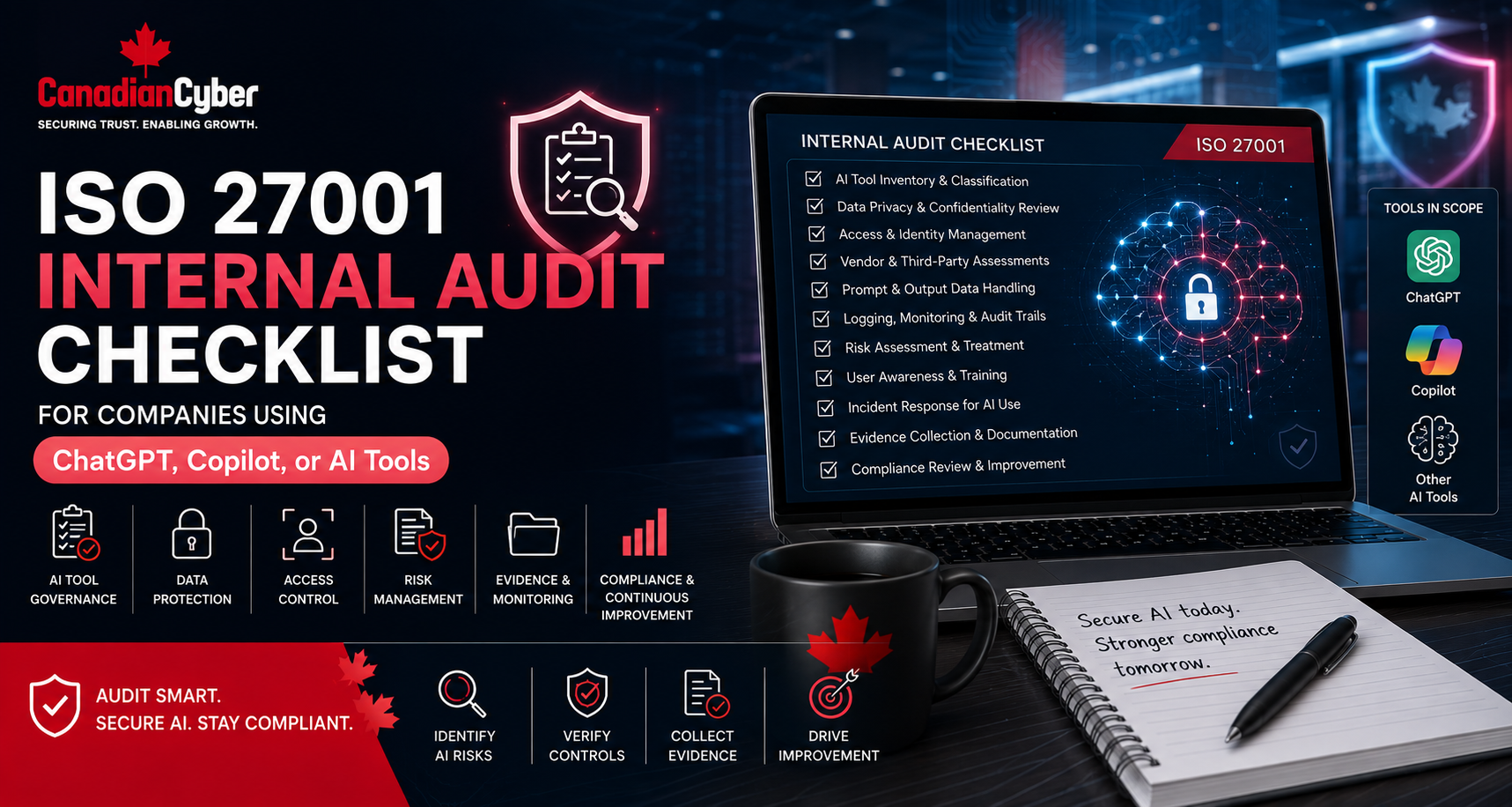
ISO 27001 Internal Audit Checklist for Companies Using ChatGPT, Copilot, or AI Tools
AI tools are now part of daily work. ISO 27001 internal audit should check whether AI use is visible, approved, secure, and audit-ready.
Quick Answer
Should ChatGPT, Copilot, and AI tools be included in ISO 27001 internal audit?
Yes. AI tools should be reviewed when employees use them for business work.
Auditors should check AI inventory, approved use cases, data rules, access, vendors, training, incidents, risks, and management review.
Bottom line: The goal is not to block AI. The goal is to make AI use visible, secure, approved, and controlled.
Quick Snapshot
| Audit Area | What to Check |
|---|---|
| AI Inventory | Which AI tools are used across the business. |
| Approved Use | Which AI tools and use cases are allowed. |
| Data Protection | What data cannot be entered into AI tools. |
| Access Control | Who can access approved AI platforms. |
| Vendor Risk | Whether AI vendors are reviewed. |
| Management Review | Whether leadership reviews AI risk. |
Why AI Tools Matter in ISO 27001 Internal Audit
AI tools are now part of daily work.
Employees use ChatGPT to draft content. Teams use Copilot to summarize meetings. Developers use AI coding assistants.
AI helps teams move faster.
However, speed can create new risk if AI use is not governed inside the ISMS.
If AI tools are used for business work, they should be visible inside the ISO 27001 risk and control environment.
Who This Blog Is For
- Companies using ChatGPT, Copilot, or AI tools.
- ISO 27001 implementation teams.
- ISO 27001 internal auditors and ISMS managers.
- Security leaders, IT managers, and compliance managers.
- SaaS, MSP, FinTech, HealthTech, and AI-enabled businesses.
- Microsoft 365-first organizations.
- Teams preparing for ISO 42001 readiness.
The Main Internal Audit Question
The auditor should not only ask, “Do we use AI?”
A better question is this:
Do we know which AI tools are used, what data they process, who approved them, what risks they create, and what evidence proves control?
ISO 27001 Internal Audit Checklist for AI Tools
1. AI Tool Inventory
The first audit step is visibility.
Check whether ChatGPT, Copilot, AI coding tools, meeting bots, browser extensions, and AI-enabled SaaS tools are listed.
Evidence: AI inventory, approved tool list, SaaS inventory, owner list, vendor register, and Shadow AI assessment.
2. Approved AI Use Cases
Not every AI use case has the same risk.
Check which use cases are approved, restricted, or prohibited.
Evidence: AI use case register, AI request form, AI risk assessment, approvals, and decision log.
3. AI Acceptable Use Policy
Employees need clear AI rules.
The policy should cover approved tools, prohibited data, prompt rules, output review, and contractors.
Evidence: AI policy, approval record, communication evidence, acknowledgments, and training records.
4. Data Classification and Prompts
Prompt content should be governed like business data.
Check rules for customer data, source code, contracts, HR data, tokens, logs, and screenshots.
Evidence: Data classification policy, prompt rules, DLP evidence, privacy review, and training records.
5. ChatGPT Use Review
ChatGPT use should be approved and bounded.
Check whether employees use personal accounts, company accounts, or approved team accounts.
Evidence: ChatGPT guidance, AI policy, risk assessment, training, restrictions, and incident reporting rules.
6. Microsoft Copilot Review
Copilot can surface internal content.
Review permissions, sensitive SharePoint sites, Teams access, labels, rollout controls, and user training.
Evidence: Copilot approval, license list, M365 access review, SharePoint review, rollout plan, and training records.
7. AI Vendor Risk
AI tools are vendors.
Review data processing, training terms, retention, subprocessors, privacy, contracts, and security evidence.
Evidence: AI vendor register, risk assessment, DPA, subprocessor list, security report, and vendor approval record.
8. AI Access Control
Approved AI still needs access control.
Review users, admins, contractors, MFA, SSO, offboarding, and license reviews.
Evidence: User list, license records, access approvals, admin review, MFA settings, and offboarding samples.
9. AI Coding Assistants
AI coding tools can improve speed.
They can also create source code, secrets, and secure development risk.
Evidence: AI coding policy, developer training, pull request approvals, code review, scans, and exception approvals.
10. AI Meeting Assistants
Meeting tools can create sensitive records.
Review transcripts, summaries, retention, access, participant notice, and customer meeting rules.
Evidence: Approved meeting AI list, recording policy, retention settings, access permissions, and privacy review.
11. AI in Support and Sales
Support and sales teams handle sensitive customer information.
Check ticket summaries, logs, screenshots, questionnaires, and response review.
Evidence: Support AI procedure, sales AI procedure, approved response library, training, and quality review records.
12. AI Output Review
AI outputs can be wrong or incomplete.
Check whether customer-facing, legal, HR, finance, security, and code outputs require review.
Evidence: Output review procedure, quality records, approval workflow, issue register, and training.
Using ChatGPT, Copilot, or AI Tools?
Canadian Cyber helps organizations prepare AI governance evidence before ISO 27001 internal audit.
More AI Audit Areas to Review
AI Incident Response
AI incidents should be reportable.
Examples include customer data in prompts, source code uploads, unsafe outputs, and AI vendor incidents.
AI Training
Training turns policy into behavior.
Use role-based examples for engineering, support, sales, HR, finance, legal, and leadership.
AI Risk Register
AI risks should be part of the ISMS risk process.
Include Shadow AI, data leakage, vendor risk, output accuracy, and AI coding risk.
Management Review
Leadership should review AI risk.
Review AI tools, vendors, incidents, training, corrective actions, and resource needs.
ISO 27001 AI Tool Audit Checklist
| Audit Question | Ready? |
|---|---|
| Do we have an AI tool inventory? | |
| Do we have an approved AI tool list? | |
| Are ChatGPT, Copilot, and AI tools covered by policy? | |
| Are approved and prohibited AI use cases documented? | |
| Are sensitive data restrictions defined? | |
| Are employees trained on prompt safety? | |
| Are AI vendors reviewed? | |
| Is AI access controlled and reviewed? | |
| Are AI coding assistants governed? | |
| Are AI meeting assistants controlled? | |
| Are AI-generated outputs reviewed where needed? | |
| Are AI incidents reportable? | |
| Are AI risks included in the risk register? | |
| Is AI risk included in management review? | |
| Is AI evidence stored in a central workspace? |
Common Internal Audit Findings for AI Tools
- No AI inventory. The organization cannot show which AI tools are used.
- No AI acceptable use policy. Employees have no clear AI rules.
- Sensitive data rules are missing. Prompt restrictions are unclear.
- AI vendors are not reviewed. AI tools are missing from supplier risk management.
- Copilot is enabled too early. Permissions are not reviewed before rollout.
- AI coding assistants are unmanaged. Secure development rules do not mention AI.
- Meeting transcripts are uncontrolled. Access and retention are unclear.
- AI incidents are not reportable. Employees do not know what to report.
- AI training is missing. Policies exist, but people are not trained.
- Leadership has not reviewed AI risk. AI exposure is missing from management review.
How to Prepare AI Evidence Before the Auditor Asks
- Discover AI use. Survey employees and review SaaS tools, browser extensions, and expenses.
- Create an AI tool inventory. List tools, owners, users, data types, use cases, and review dates.
- Define approved and prohibited use. Create clear use case categories.
- Update policies. Add AI rules to acceptable use, data classification, vendor management, secure development, and incident response.
- Review vendors. Check security, privacy, retention, subprocessors, data training, and contracts.
- Train employees. Use role-based examples for common AI tasks.
- Add AI to the risk register. Document owners, treatments, due dates, and residual risk.
- Add AI to management review. Report inventory, risk, incidents, training, vendors, and actions.
- Build an AI evidence pack. Organize evidence before audit week.
AI Evidence Pack for ISO 27001 Internal Audit
A strong AI evidence pack proves visibility, approval, risk review, training, reporting, and improvement.
- AI tool inventory and approved AI tool list.
- AI acceptable use policy and AI use case register.
- AI risk assessment and Shadow AI assessment.
- AI vendor register and vendor risk reviews.
- Data classification rules and prompt handling guidance.
- Copilot rollout evidence and ChatGPT use guidance.
- AI coding assistant policy and meeting tool policy.
- Support AI procedure and AI training records.
- AI incident procedure and AI incident register.
- AI corrective action tracker and management review summary.
How This Supports ISO 42001 Readiness
Companies using ChatGPT, Copilot, or AI tools may later consider ISO 42001.
ISO 27001 internal audit can help teams prepare early.
The same evidence can support AI inventory, AI risk, AI vendor review, AI acceptable use, AI incident handling, human oversight, management review, and corrective action.
AI governance evidence built for ISO 27001 can become a strong starting point for ISO 42001 readiness.
How SharePoint Can Help Manage AI Governance Evidence
A structured SharePoint ISMS can help companies manage AI governance evidence in one controlled workspace.
It can show AI tools, owners, risks, vendors, incidents, training, and actions.
Canadian Cyber’s ISMS SharePoint Solution can organize:
- AI tool inventory and approved AI tool list.
- AI use case register and AI vendor register.
- AI risk register and AI acceptable use policy.
- AI training tracker and AI incident register.
- AI corrective action tracker and Copilot readiness evidence.
- ChatGPT use guidance and AI coding assistant review.
- Management review dashboard, ISO 42001 workspace, Power Automate reminders, Teams notifications, and client-ready evidence room.
How Canadian Cyber Helps
Canadian Cyber helps organizations move from informal AI use to structured, auditable AI governance.
We support ISO 27001 internal audit and AI governance readiness for teams using ChatGPT, Copilot, and AI tools.
Canadian Cyber can support:
- ISO 27001 internal audits.
- AI governance readiness reviews.
- Shadow AI assessments.
- ChatGPT use risk reviews.
- Copilot readiness reviews.
- AI acceptable use policy development.
- AI tool inventory development.
- AI vendor risk reviews.
- AI coding assistant governance.
- AI incident response process design.
- ISO 42001 readiness, SharePoint AI governance, vCISO services, SOC 2 readiness, ISO 27017, and ISO 27018 support.
FAQ
Should ChatGPT and Copilot be included in ISO 27001 internal audit?
Yes. They should be reviewed when employees use them for business work. The audit should check approval, risk, data rules, access, training, and evidence.
What should auditors check for AI tools?
Auditors should check AI inventory, approved use cases, AI policy, sensitive data restrictions, vendor reviews, access controls, training, incident reporting, risks, management review, and corrective actions.
Is using AI tools a nonconformity?
No. AI use is not automatically a nonconformity. It becomes a concern when it is unapproved, unmanaged, risky, undocumented, or outside ISMS controls.
How does Copilot affect ISO 27001 readiness?
Copilot can surface internal content based on permissions. Teams should review SharePoint access, Teams permissions, sensitivity labels, DLP settings, training, and rollout controls.
Can AI governance support ISO 42001 readiness?
Yes. AI governance evidence can support ISO 42001 readiness by creating records for AI inventory, AI risk, AI vendors, incidents, human oversight, and management review.
Takeaway
AI tools are changing how companies work.
ChatGPT, Copilot, AI coding assistants, meeting tools, browser extensions, and AI-enabled SaaS tools can improve productivity.
They also create new risks when they are not governed.
The goal is not to stop AI. The goal is to make AI use visible, safe, approved, controlled, and audit-ready.
Using ChatGPT, Copilot, or AI Tools Before ISO 27001 Internal Audit?
Canadian Cyber can help you assess risk and build practical AI governance evidence.
We support ISO 27001 internal audits, Shadow AI assessments, ChatGPT and Copilot risk reviews, AI acceptable use policies, AI vendor reviews, ISO 42001 readiness, SharePoint AI governance workspaces, vCISO services, cybersecurity assessments, SOC 2 readiness, ISO 27017, and ISO 27018 support.
Stay Connected With Canadian Cyber
Follow Canadian Cyber for practical guidance on ISO 27001 internal audits, ChatGPT governance, Copilot readiness, Shadow AI, AI governance, ISO 42001, SOC 2, SharePoint ISMS, ISO 27017, ISO 27018, cybersecurity assessments, and vCISO support.