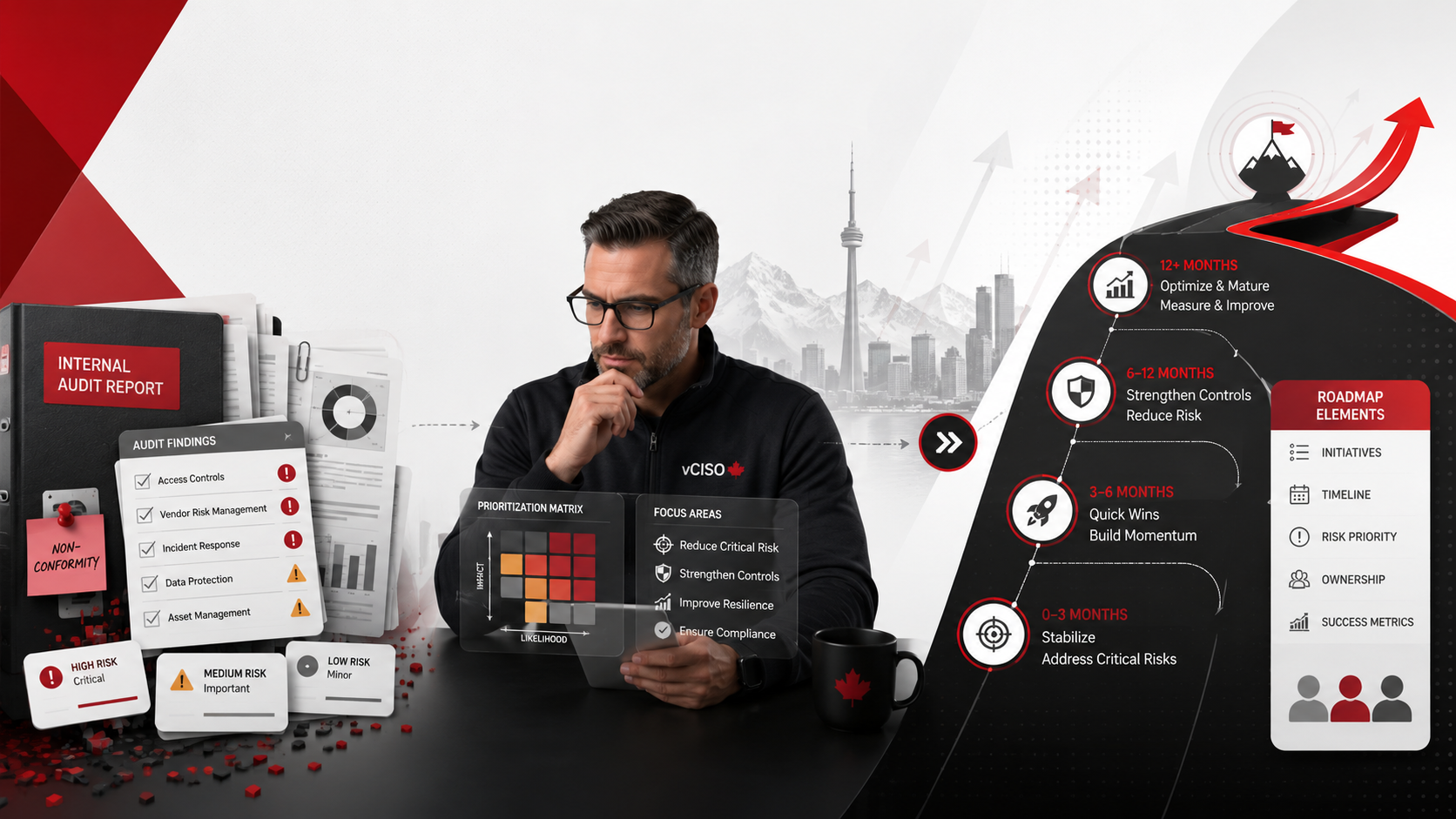
Internal Audit Findings
Security Roadmap
ISO 27001
How a vCISO Turns Internal Audit Findings into a Security Roadmap
Internal audit findings are not just problems. They are signals. A vCISO helps turn those signals into a clear, practical, leadership-ready cybersecurity roadmap.
Quick Answer
How does a vCISO turn audit findings into a security roadmap?
A vCISO reviews audit findings, identifies root causes, groups issues by risk area, and prioritizes actions based on business impact.
Then the vCISO assigns owners, sets deadlines, defines closure evidence, reports priorities to leadership, and tracks progress over time.
Bottom line: A vCISO does not only close audit gaps. A vCISO turns findings into a practical improvement plan for governance, evidence, controls, accountability, and certification readiness.
Canadian Cyber vCISO Roadmap Support
Turn Audit Findings Into a Real Security Roadmap
Canadian Cyber helps organizations turn ISO 27001 internal audit findings into clear, risk-based action plans.
We help review findings, classify NCRs and OFIs, identify root causes, assign owners, define closure evidence, build dashboards, and track corrective actions in SharePoint.
Quick Snapshot
| Audit Finding Type | Roadmap Action |
|---|---|
| Missing Access Review | Build a recurring access review process. |
| Weak Vendor Evidence | Create a vendor risk management workflow. |
| Outdated Risk Register | Establish a quarterly risk review cadence. |
| Policy Not Communicated | Build an approval and acknowledgment process. |
| No Restore Test | Add recovery testing to the security roadmap. |
| Weak Management Review | Create a leadership reporting dashboard. |
| Shadow AI Risk | Add AI governance and acceptable use controls. |
| Scattered Evidence | Build a SharePoint ISMS evidence workspace. |
Why Internal Audit Findings Should Not Sit in a Report
An internal audit report should not become a file that is saved, shared once, and forgotten.
Findings should drive action.
If findings sit without owners, deadlines, and leadership visibility, the same issues may return.
They may also appear during certification audits, customer reviews, SOC 2 readiness, cyber insurance renewals, vendor due diligence, board reporting, or AI governance assessments.
Internal audit findings only create value when they lead to measurable improvement.
Who This Blog Is For
- Growing companies preparing for ISO 27001.
- Companies that completed an internal audit.
- Organizations with open NCRs or OFIs.
- SaaS companies selling to enterprise buyers.
- MSPs and IT service providers.
- FinTech, HealthTech, AI, and technology companies.
- Professional services and industrial technology firms.
- Canadian businesses preparing for certification.
- Companies without a full-time CISO.
- Teams using Microsoft 365 or SharePoint for ISMS evidence.
The Common Problem: Findings Become Tasks, Not Strategy
Many companies turn audit findings into a simple task list.
That may help close the immediate audit gap.
But it may not fix the process that caused the gap.
| Task-Based Response | vCISO Roadmap Response |
|---|---|
|
Update the policy. Complete the vendor review. Run the access review. Upload the missing evidence. |
Why was the policy outdated? Why was vendor evidence incomplete? Why was the access review missed? Why did no one own the evidence? |
Practical rule: A task fixes the symptom. A roadmap fixes the system.
What Is a Security Roadmap?
A security roadmap is a structured improvement plan.
It shows what the organization will improve, why it matters, who owns it, when it will happen, and what evidence will prove completion.
A strong roadmap connects audit findings to risk, business priorities, customer requirements, certification goals, owners, deadlines, budget needs, and leadership decisions.
| Timeframe | Roadmap Focus |
|---|---|
| 0–30 Days | Urgent audit blockers and high-risk gaps. |
| 31–60 Days | Corrective actions and evidence cleanup. |
| 61–90 Days | Process improvements and owner accountability. |
| 91–180 Days | Governance maturity, automation, and leadership reporting. |
| 180+ Days | Long-term security program improvement. |
How a vCISO Reviews Internal Audit Findings
A vCISO does not only ask, “What did the auditor find?”
A vCISO asks what the finding means for risk, customers, leadership, certification, and long-term maturity.
A vCISO translates audit language into business action.
How a vCISO Builds the Security Roadmap
1. Classify Findings by Risk
Not every finding deserves the same attention.
A vCISO ranks findings by severity, likelihood, data sensitivity, customer impact, certification impact, repeat history, and resource needs.
2. Identify Root Cause
A finding is rarely caused by “someone forgot.”
A vCISO looks for process gaps, missing owners, weak reminders, unclear workflows, and evidence system failures.
3. Group Findings Into Themes
Audit reports list issues one by one.
A vCISO groups them into themes such as access governance, vendor risk, evidence management, incident readiness, AI governance, and leadership reporting.
4. Build a 30-60-90 Day Plan
A roadmap prevents teams from trying to fix everything at once.
It sequences urgent blockers, corrective actions, process improvements, and long-term governance upgrades.
5. Assign Real Owners
A roadmap without owners will not move.
A vCISO assigns named accountable owners, not vague departments.
6. Define Closure Evidence
Roadmap items should not close without proof.
A vCISO defines what evidence will show that each issue is fixed and verified.
Have Audit Findings but No Roadmap?
Canadian Cyber helps organizations move from audit reports to clear security roadmap actions.
The 30-60-90 Day Security Roadmap
A vCISO turns findings into a realistic sequence.
This helps teams fix what matters first.
| Timeframe | Roadmap Focus | Example Actions |
|---|---|---|
| 0–30 Days | Stabilize urgent gaps. | Close high-risk access findings, update risk register, complete missing vendor reviews, brief leadership. |
| 31–60 Days | Create repeatable processes. | Build access review schedule, approve policies, test backups, clean up evidence naming. |
| 61–90 Days | Improve maturity. | Automate reminders, build dashboards, align ISO 27001 and SOC 2 evidence, add AI governance controls. |
Example: Turning Findings Into Roadmap Themes
| Internal Audit Finding | vCISO Roadmap Theme | Roadmap Action |
|---|---|---|
| Access reviews missing sign-off. | Identity Governance | Implement quarterly access review workflow with sign-off and exception tracking. |
| Vendor reviews incomplete. | Third-Party Risk | Build vendor register with risk rating, owner, review frequency, and evidence links. |
| Risk register outdated. | Risk Management | Establish quarterly risk review and leadership reporting. |
| No tabletop exercise. | Incident Readiness | Schedule annual tabletop and lessons learned tracker. |
| Shadow AI not assessed. | AI Governance | Create AI tool inventory, acceptable use policy, and AI risk assessment. |
Assign Real Owners
A roadmap without owners will not move.
A vCISO helps assign accountable owners for each roadmap item.
| Weak Ownership | Strong Ownership |
|---|---|
| IT | IT Manager |
| Compliance | ISMS Manager |
| Security | Security Lead |
| Operations | Operations Manager |
| Management | Executive Sponsor |
Define Closure Evidence
A roadmap action should not be considered complete without proof.
A vCISO defines what evidence will prove completion.
| Finding | Roadmap Action | Closure Evidence |
|---|---|---|
| Access review incomplete. | Redesign quarterly access review process. | Completed review, sign-off, exception log, and removed access proof. |
| Vendor reviews missing. | Build vendor review workflow. | Vendor register, risk rating, review records, and owner assignments. |
| Policy outdated. | Create annual policy review process. | Approved policy, version history, review date, and acknowledgment. |
| AI tools unmanaged. | Create AI governance register. | AI inventory, approved tools, AI risk assessment, and policy. |
Practical rule: If closure evidence is not defined, completion becomes opinion-based.
Turn Repeat Findings Into Process Redesign
Repeat findings are powerful signals.
They show that the current process is not working.
A vCISO does not simply ask for another reminder. A vCISO asks whether the process needs redesign.
Access reviews are always late.
Automate reminders and assign backup owners.
Vendor reviews are always overdue.
Create a vendor review calendar and escalation workflow.
Corrective actions close without evidence.
Add required closure evidence and verification steps.
Build Leadership Reporting
Executives do not need a long tracker with technical notes.
They need a clear view of risk, blockers, owners, progress, and decisions required.
| Dashboard Area | What Leadership Sees |
|---|---|
| High-Risk Findings | Findings that could affect security or certification. |
| Roadmap Progress | Actions completed, in progress, and overdue. |
| Owner Accountability | Which teams are on track or blocked. |
| Risk Reduction | Which actions reduce major risks. |
| Certification Readiness | What must close before external audit. |
| Resource Needs | Budget, tools, people, or leadership decisions. |
Verify Corrective Actions
A finding should not be closed only because the owner says it is done.
A vCISO helps verify closure.
- Was the action completed?
- Is evidence sufficient?
- Was the root cause addressed?
- Is the process now repeatable?
- Were exceptions resolved?
- Is ownership clear?
- Was management informed?
- Would the evidence satisfy an auditor?
Correction says the task is done. Verification proves the risk was reduced.
Security Roadmap Template
| Roadmap Field | Example |
| Theme | Access Governance |
| Finding Source | ISO 27001 Internal Audit |
| Finding | Privileged access review incomplete |
| Risk | Excessive access may remain active |
| Root Cause | Privileged groups were not included in quarterly review schedule |
| Priority | High |
| Owner | IT Manager |
| Deadline | 30 days |
| Closure Evidence | Completed review, sign-off, removed access proof |
| Framework Impact | ISO 27001, SOC 2, customer due diligence |
Common Mistakes When Managing Audit Findings
High-risk issues should be prioritized.
The same issue may return.
Named owners are needed.
Completion should be supported by proof.
Management cannot support what it cannot see.
A task list does not show the security improvement journey.
How SharePoint Helps Turn Findings Into a Roadmap
A structured SharePoint ISMS can help turn internal audit findings into managed roadmap actions.
It gives leadership and control owners one place to track findings, owners, deadlines, evidence, and status.
Canadian Cyber’s ISMS SharePoint Solution can organize:
- Finding register, NCR tracker, and OFI tracker.
- Corrective action tracker and security roadmap tracker.
- Risk register and Statement of Applicability tracker.
- Control register and evidence library.
- Owner dashboard and deadline tracker.
- Management review dashboard.
- Closure evidence library and verification records.
- Power Automate reminders, Teams notifications, and client-ready evidence room.
Audit findings become easier to manage when owners, deadlines, evidence, and roadmap status are visible in one workspace.
How Canadian Cyber Helps
Canadian Cyber helps organizations turn internal audit findings into practical cybersecurity roadmaps.
Our vCISO team helps leadership understand what findings mean, what to fix first, what evidence is needed, and how improvements support ISO 27001, SOC 2, customer trust, AI governance, and long-term maturity.
Canadian Cyber can support:
- vCISO security roadmap development.
- ISO 27001 internal audit findings review.
- NCR and OFI classification.
- Root cause analysis support.
- Corrective action planning.
- Closure evidence verification.
- Security roadmap dashboard design.
- Management review preparation.
- Risk register and SoA updates.
- Access governance improvement.
- Vendor risk roadmap development.
- AI governance roadmap development.
- SOC 2 readiness alignment, ISO 42001 readiness, ISO 27017, ISO 27018, cybersecurity assessments, and SharePoint ISMS implementation.
Canadian Cyber’s vCISO Roadmap Approach
Canadian Cyber helps growing companies move from audit findings to structured security improvement.
Our approach includes:
- Finding review and risk prioritization.
- Root cause analysis and roadmap themes.
- Owner assignment and deadline planning.
- Closure evidence definition.
- Leadership reporting and corrective action verification.
- SharePoint tracking and certification readiness support.
Frequently Asked Questions
What happens after an internal audit finding?
After an internal audit finding, the organization should classify the finding, identify root cause, assign an owner, define corrective action, set a deadline, collect closure evidence, verify completion, and report status to management.
How does a vCISO help with audit findings?
A vCISO helps interpret findings, prioritize risks, identify root causes, assign owners, build a roadmap, report to leadership, verify closure evidence, and align corrective actions with ISO 27001, SOC 2, and business goals.
What is the difference between a corrective action plan and a security roadmap?
A corrective action plan fixes specific findings. A security roadmap groups findings into broader improvement themes, prioritizes actions over time, and connects audit results to business and maturity goals.
Why should leadership review internal audit findings?
Leadership should review findings because they may affect certification readiness, customer trust, cyber risk, resource needs, vendor risk, incident readiness, and business operations.
Can SharePoint track audit findings and roadmap actions?
Yes. SharePoint can be structured to track findings, owners, deadlines, corrective actions, closure evidence, verification status, management review items, and roadmap progress.
Can Canadian Cyber help turn audit findings into a roadmap?
Yes. Canadian Cyber provides vCISO-led findings reviews, security roadmap development, corrective action planning, closure evidence verification, ISO 27001 readiness support, and SharePoint ISMS implementation.
Takeaway
Internal audit findings should not be treated as isolated problems.
They should become a roadmap.
A vCISO helps organizations move from findings to priorities, tasks to strategy, audit gaps to risk reduction, and corrective actions to long-term maturity.
Internal audit shows what is not working.
The vCISO helps decide what to fix first. The roadmap turns that decision into action.
Ready to Turn Audit Findings Into a Security Roadmap?
Canadian Cyber can help you move from audit findings to practical, leadership-ready cybersecurity improvement.
We provide vCISO-led findings reviews, cybersecurity roadmap development, corrective action planning, closure evidence verification, ISO 27001 readiness support, SOC 2 alignment, ISO 42001 AI governance readiness, ISO 27017, ISO 27018, cybersecurity assessments, and SharePoint ISMS implementation.
Stay Connected With Canadian Cyber
Follow Canadian Cyber for practical guidance on vCISO services, ISO 27001 internal audits, corrective actions, security roadmaps, SOC 2, ISO 42001, ISO 27017, ISO 27018, SharePoint ISMS, cybersecurity assessments, and certification readiness.