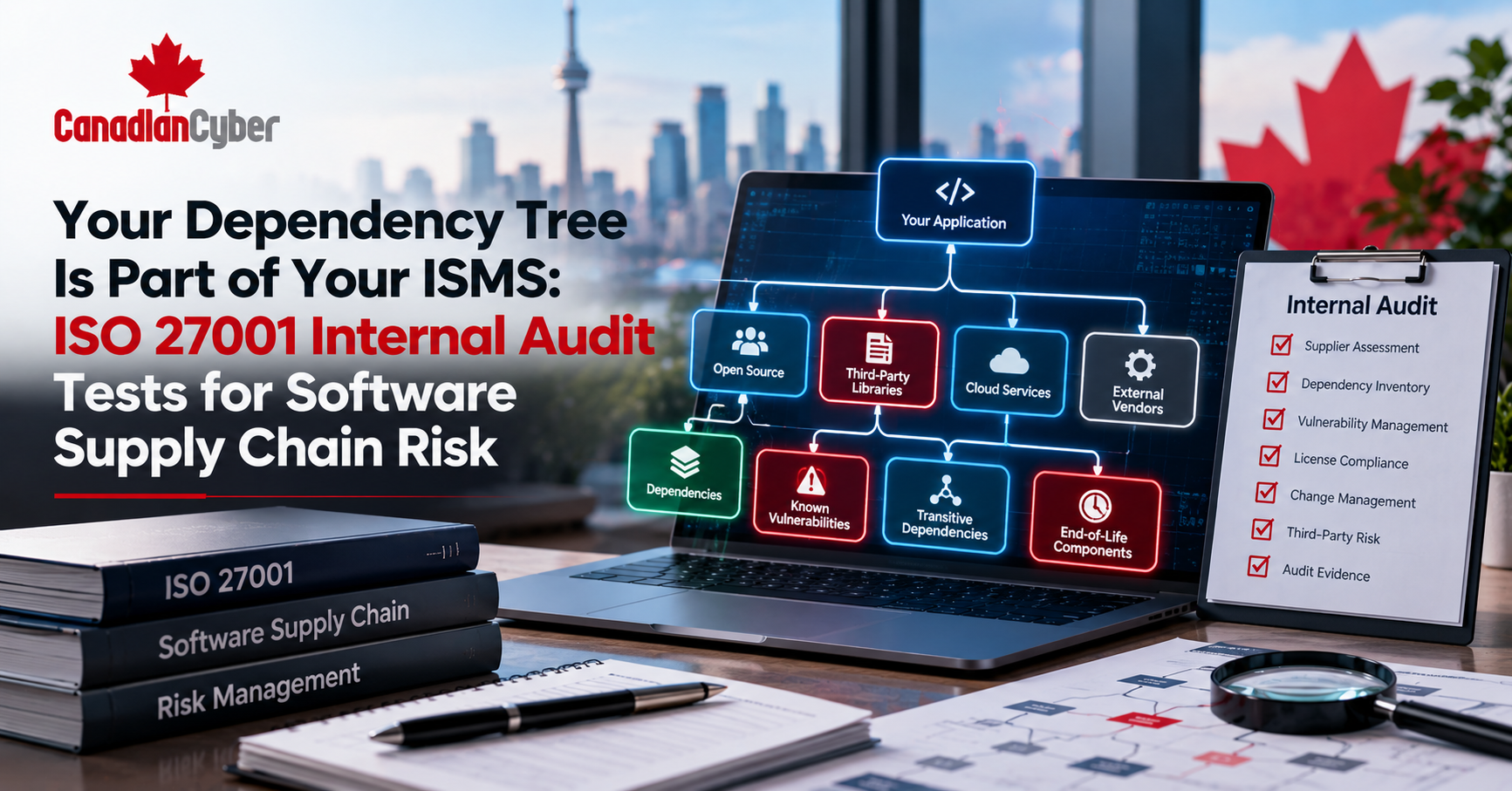
ISO 27001 Internal Audit • Healthcare SaaS • Healthcare Systems • Audit Interview Questions
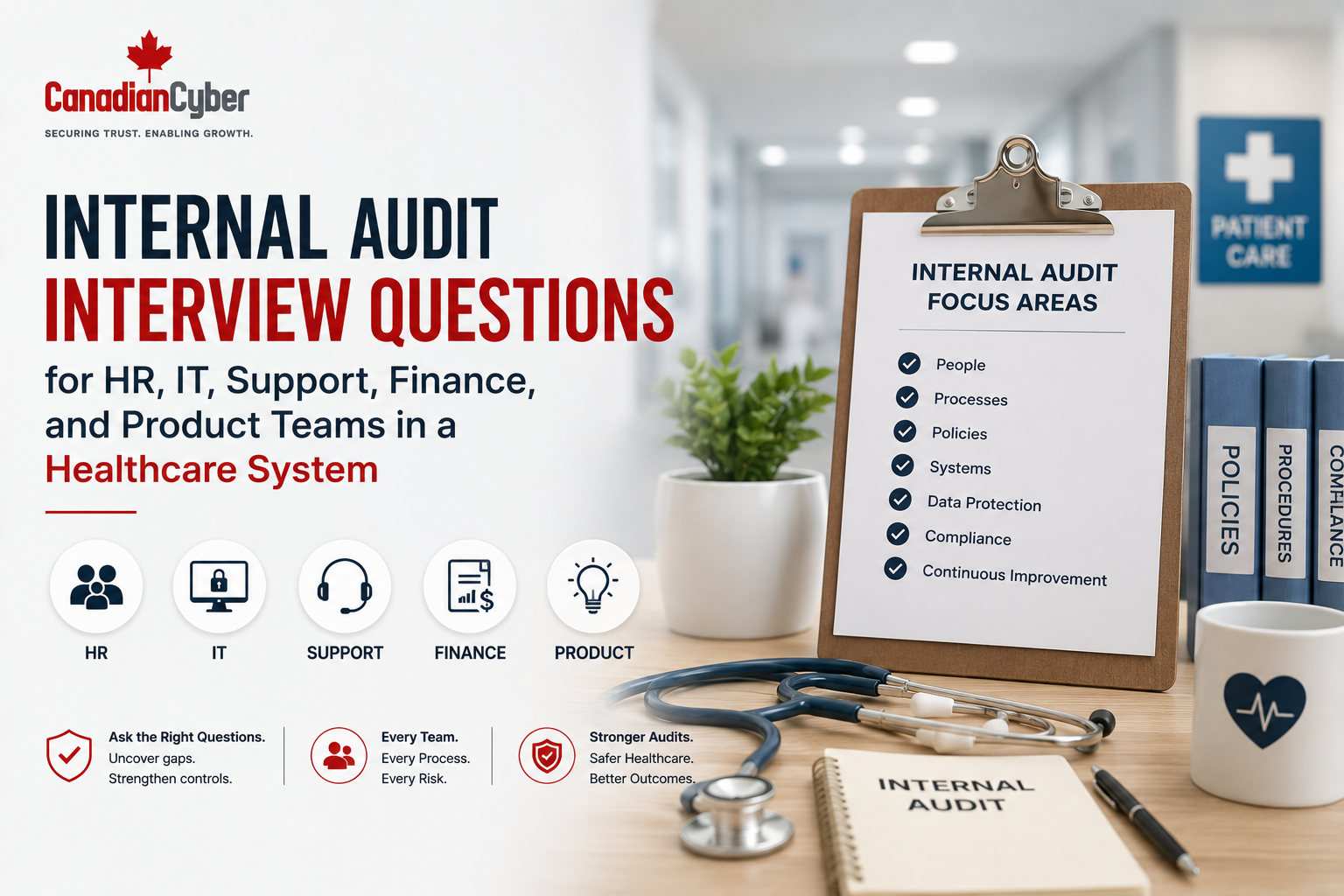
Internal Audit Interview Questions for HR, IT, Support, Finance, and Product Teams in a Healthcare System
Healthcare systems and Healthcare SaaS companies face a unique ISO 27001 internal audit challenge: security is not owned by one department. A strong audit must test HR, IT, Support, Finance, Product, Compliance, leadership, vendors, and control owners.
Canadian Cyber Healthcare Internal Audit Support
Interview the Right Teams Before the External Auditor Finds the Gaps
Canadian Cyber provides ISO 27001 internal audits for healthcare systems, Healthcare SaaS companies, and organizations handling sensitive or PHI-adjacent data. We interview department owners, test evidence, identify NCRs and OFIs, and help prepare corrective actions before certification or customer due diligence.
Quick Answer
An ISO 27001 internal audit in a healthcare system should include interviews with HR, IT, Support, Finance, Product, Compliance, and leadership because healthcare-related security risks exist across the business.
Internal auditors should ask each team about access control, sensitive data handling, training, onboarding, offboarding, vendor risk, incident reporting, cloud systems, backups, customer support tickets, product changes, AI tools, and evidence records.
Practical takeaway: The goal is to verify whether the ISMS is actually operating, whether PHI-adjacent data is protected, and whether audit evidence is complete before certification or customer due diligence.
Quick Snapshot
| Team | What Internal Audit Should Test |
|---|---|
| HR | Screening, onboarding, training, policy acknowledgment, offboarding. |
| IT | MFA, access reviews, devices, backups, cloud security, monitoring, logs. |
| Support | Ticket handling, screenshots, customer data, escalation, AI tools. |
| Finance | Billing data, vendor contracts, cyber insurance, payment security. |
| Product | Data flows, secure development, AI features, privacy by design. |
| Leadership | ISMS scope, risks, objectives, management review, resources. |
| Compliance | Evidence quality, corrective actions, SoA, internal audit readiness. |
Why Internal Audit Interviews Matter in Healthcare
An ISO 27001 internal audit is not only a document review. A proper internal audit tests whether people understand their responsibilities and whether controls are actually working in daily operations.
In healthcare environments, this matters because sensitive data can appear in unexpected places. HR may store training and screening evidence. IT may control production access and endpoint security. Support may see screenshots with patient identifiers. Finance may manage contracts, vendors, billing data, and cyber insurance evidence. Product may design features that collect appointment, provider, patient-related, or AI-generated data.
If interviews are weak, the internal audit may miss the real risk.
A healthcare ISO 27001 internal audit should follow the data, not just the organization chart.
Who This Blog Is For
- Healthcare SaaS companies preparing for ISO 27001 internal audit.
- Healthcare systems building or improving an ISMS.
- Digital health platforms preparing for certification.
- HealthTech startups selling to clinics, hospitals, insurers, or providers.
- Support teams handling sensitive customer tickets.
- Product teams building healthcare features, APIs, or AI workflows.
- Compliance leads preparing internal audit interviews.
- Organizations using SharePoint to manage ISO 27001 evidence.
The Biggest Internal Audit Risk: Everyone Thinks ISO 27001 Belongs to IT
This is one of the most common mistakes. ISO 27001 is not only an IT framework. It is a management system that includes people, processes, vendors, leadership, data, systems, risk decisions, training, incidents, documentation, and continual improvement.
For example, a support team may receive a screenshot from a healthcare customer. The screenshot includes patient names, appointment details, or provider notes. IT may secure the support platform, but Support decides how the ticket is handled. Compliance decides whether the process is documented. HR ensures support staff are trained. Product may need to reduce sensitive data exposure. Finance may manage the support platform contract. Leadership must ensure the risk is understood and treated.
Practical rule: If your internal audit only interviews IT, your ISO 27001 audit is incomplete.
Department 1: HR Internal Audit Interview Questions
HR is critical to ISO 27001 because people controls start before access is granted and continue until access is removed. In healthcare systems, HR controls are especially important because employees may handle sensitive data, patient-related information, customer records, and internal security responsibilities.
| HR Interview Questions |
|---|
| How are new employees screened before hiring? |
| Are background checks performed for roles with access to sensitive healthcare-related data? |
| Are confidentiality clauses signed before access is granted? |
| How does HR ensure employees receive security awareness training? |
| Do employees acknowledge acceptable use, privacy, access control, and AI use policies? |
| How does HR notify IT about terminations and role changes? |
| Are contractors, temporary staff, and consultants included in onboarding and offboarding controls? |
| Are employees trained on handling sensitive or PHI-adjacent data? |
Evidence to Request From HR
Employee onboarding checklist, confidentiality agreement template, background check procedure, security awareness training report, policy acknowledgment records, termination checklist, role change notification evidence, contractor onboarding records, HR security procedure, and training reminder evidence.
Department 2: IT Internal Audit Interview Questions
IT is usually the most heavily interviewed department during ISO 27001 internal audits. In healthcare systems, IT controls are central because access, devices, cloud services, backups, monitoring, and logging affect sensitive data protection.
| IT Interview Questions |
|---|
| How is MFA enforced for users and administrators? |
| How is privileged access approved and reviewed? |
| How is production access controlled? |
| How are terminated users removed from systems? |
| Is there an asset inventory for laptops, servers, cloud resources, and applications? |
| Are backups performed and are restore tests completed? |
| How are logs collected, reviewed, and escalated? |
| How is IT evidence stored for audits? |
Practical rule: IT interviews should test whether controls are operating, not whether tools exist.
Department 3: Support Internal Audit Interview Questions
Support is one of the most important departments in a healthcare system internal audit because support teams often see sensitive data during troubleshooting. A ticket may contain screenshots, patient names, error logs, identifiers, appointment details, or AI-generated summaries.
| Support Interview Questions |
|---|
| What types of customer data appear in support tickets? |
| Do customers upload screenshots containing patient or provider information? |
| Are support staff trained to avoid requesting unnecessary sensitive data? |
| Is there a process to redact sensitive information from tickets? |
| Who can access support tickets and how often is access reviewed? |
| Are AI tools used to summarize, categorize, or respond to support tickets? |
| How does support escalate suspected privacy or security issues? |
| Are support procedures documented and reviewed? |
Support Red Flags
Screenshots with sensitive data stored without redaction, support access not reviewed, AI tools used without vendor review, tickets retained indefinitely, support staff unaware of incident escalation, support exports stored outside approved systems, or support evidence missing from ISMS scope.
Need More Than a Generic ISO 27001 Checklist?
Canadian Cyber interviews HR, IT, Support, Finance, Product, Compliance, and leadership to test whether controls are actually operating across the organization.
Department 4: Finance Internal Audit Interview Questions
Finance is often overlooked during ISO 27001 internal audits. That is a mistake. Finance may manage billing information, customer contracts, vendor payments, cyber insurance, procurement approvals, payment systems, and sensitive financial records.
| Finance Interview Questions |
|---|
| What sensitive financial or customer data does Finance process? |
| Are billing systems included in the ISMS scope? |
| Who can access billing records and financial systems? |
| Are vendor contracts reviewed for security and privacy obligations? |
| Who owns cyber insurance renewal evidence? |
| Are payment approval workflows documented? |
| How are changes to banking or payment details verified? |
| Does Finance know how to report suspected fraud or security incidents? |
Department 5: Product Internal Audit Interview Questions
Product teams shape how data is collected, displayed, processed, logged, exported, retained, and shared. In healthcare systems, product decisions can create major security and privacy risks.
| Product Interview Questions |
|---|
| What healthcare-related data does the product collect? |
| Are data flows documented for key product features? |
| Are privacy and security requirements included in product design? |
| Are new features reviewed for security risk before release? |
| Are AI features used in the product? |
| Are customer exports controlled? |
| Are APIs secured and documented? |
| Are product-related risks included in the risk register? |
Product teams should be interviewed because many healthcare data risks are created during product design.
Leadership and ISMS Owner Interview Questions
Leadership involvement is required for a functioning ISMS. The ISMS owner ties the audit together and should understand scope, evidence, risks, controls, findings, corrective actions, and management review.
| Leadership Questions | ISMS Owner Questions |
|---|---|
| What is the ISMS scope and why was it selected? | How is ISO 27001 scope maintained? |
| What are the top information security risks? | How is the risk register updated? |
| How does leadership review risk treatment progress? | How is the Statement of Applicability maintained? |
| How are internal audit findings reviewed? | How are NCRs and OFIs classified? |
| Has management review been completed? | How is corrective action closure verified? |
Practical rule: ISO 27001 leadership evidence should show decisions, not just meeting attendance.
ISO 27001 Internal Audit Interview Matrix for Healthcare
| Department | Key Audit Focus | High-Value Evidence |
|---|---|---|
| HR | Screening, onboarding, training, offboarding. | Training records, policy acknowledgments, termination checklist. |
| IT | Access, devices, cloud, backups, logs. | MFA reports, access reviews, restore tests, monitoring records. |
| Support | Tickets, screenshots, sensitive data, escalation. | Ticket procedure, support access review, redaction evidence. |
| Finance | Billing data, vendors, insurance, payments. | Finance access review, vendor contracts, cyber insurance evidence. |
| Product | Data flows, secure development, AI, APIs. | Data flow diagrams, change records, AI risk assessments. |
| Compliance | Evidence, SoA, findings, corrective actions. | Risk register, SoA, internal audit report, evidence library. |
How to Use These Questions Before the Audit
Do not wait until audit day. Use these questions before the internal audit to prepare teams, collect evidence, and identify weak areas early.
| Preparation Step | Why It Matters |
|---|---|
| Identify departments in scope. | Ensures the audit covers real operations. |
| Assign interview owners. | Creates accountability. |
| Send interview topics in advance. | Helps teams prepare accurate evidence. |
| Review evidence before the meeting. | Makes interviews evidence-based. |
| Record findings, gaps, and OFIs. | Turns interviews into improvement actions. |
| Verify closure evidence. | Proves corrective actions are completed. |
Common Interview Findings in Healthcare ISO 27001 Internal Audits
- Support tickets contain sensitive data without clear handling rules.
- Access reviews are incomplete or late.
- Vendors are not risk rated.
- AI tools are used without review.
- Employees completed training but evidence is missing.
- Termination access removal is not documented.
- Cloud backups exist but restore testing is missing.
- Data flow diagrams are outdated.
- Management review lacks decisions.
- Client-ready evidence is not prepared.
Why Independent Internal Audit Helps Generate Trust
An independent internal audit gives healthcare customers and auditors more confidence because it shows that your organization tested itself objectively.
Internal teams may miss gaps because they are too close to the process. An independent internal auditor can ask harder questions, challenge assumptions, test evidence quality, interview multiple teams, identify cross-department gaps, review PHI-adjacent data risks, classify NCRs and OFIs, prepare corrective action plans, support certification readiness, and create client-safe audit summaries.
For healthcare systems, independent internal audit is often the difference between “we think we are ready” and “we have evidence that we are ready.”
How Canadian Cyber Helps
Canadian Cyber provides ISO 27001 internal audits for healthcare systems, Healthcare SaaS companies, and organizations handling sensitive or PHI-adjacent data. Our internal audit process is designed to generate real readiness, not just a checklist report.
Canadian Cyber can support:
Canadian Cyber’s ISMS SharePoint Solution
Canadian Cyber also provides an ISMS SharePoint Solution that helps healthcare organizations manage ISO 27001 internal audit evidence inside Microsoft 365.
Our ISMS SharePoint Solution can help organize policy libraries, procedure libraries, risk registers, control registers, Statement of Applicability trackers, internal audit plans, interview schedules, interview notes, department evidence folders, HR training evidence, IT access review evidence, support ticket privacy evidence, finance vendor evidence, product data flow evidence, AI governance records, audit findings registers, NCR and OFI trackers, corrective actions, management review dashboards, client-ready evidence rooms, Power Automate reminders, Teams notifications, and auditor-ready evidence views.
Practical rule: This means your healthcare organization can manage the entire internal audit lifecycle from one controlled SharePoint workspace.
Lead-Ready Internal Audit Offer
If your healthcare system or Healthcare SaaS company is preparing for ISO 27001 certification, external audit, customer due diligence, or enterprise healthcare procurement, Canadian Cyber can help you test readiness before the pressure increases.
Our ISO 27001 internal audit can help you answer whether HR onboarding and offboarding controls are documented, IT access reviews and cloud controls are ready, support tickets and screenshots are handled safely, finance vendor and cyber insurance records are organized, product data flows and AI tools are reviewed, leadership decisions and management review evidence are complete, NCRs and OFIs are tracked properly, and evidence is ready for the external auditor.
Frequently Asked Questions
Who should be interviewed during an ISO 27001 internal audit in a healthcare system?
A healthcare ISO 27001 internal audit should interview HR, IT, Support, Finance, Product, Compliance, leadership, risk owners, control owners, and vendor owners where relevant.
Why should Support be interviewed in a healthcare internal audit?
Support teams may handle screenshots, tickets, customer data, logs, and patient-related details. They are often close to PHI-adjacent data and should be tested during the internal audit.
What should HR be asked in an ISO 27001 internal audit?
HR should be asked about screening, onboarding, confidentiality agreements, security training, policy acknowledgments, role changes, termination notifications, contractor controls, and training evidence.
What should IT be asked in an ISO 27001 internal audit?
IT should be asked about MFA, privileged access, access reviews, offboarding, device security, endpoint protection, backups, restore testing, cloud admin access, logging, monitoring, and vulnerability management.
How does Product affect ISO 27001 in healthcare?
Product teams influence data flows, APIs, AI features, logs, exports, integrations, and secure development. Their decisions can create or reduce healthcare data risk.
Can Canadian Cyber perform ISO 27001 internal audits for healthcare organizations?
Yes. Canadian Cyber performs ISO 27001 internal audits for healthcare systems and Healthcare SaaS companies, including department interviews, evidence review, findings reporting, corrective action planning, and SharePoint ISMS setup.
Takeaway
ISO 27001 internal audit interviews are one of the best ways to test whether a healthcare system’s ISMS is truly working.
Documents matter, but interviews reveal reality. HR shows whether people controls work. IT shows whether technical controls operate. Support shows how sensitive customer data is handled. Finance shows vendor, billing, and contract risk. Product shows how data flows and features are designed. Leadership shows whether security is governed. Compliance shows whether evidence is audit-ready.
For healthcare systems and Healthcare SaaS companies, internal audit interviews can reveal gaps before they become certification findings, customer concerns, or procurement blockers.
Preparing for ISO 27001 Certification, External Audit, or Healthcare Customer Review?
Canadian Cyber can help. We provide ISO 27001 internal audits for healthcare systems and Healthcare SaaS companies, including HR, IT, Support, Finance, Product, Compliance, and leadership interviews. We also support cybersecurity assessments, vCISO services, SOC 2 readiness, ISO 27017 and ISO 27018 controls, ISO 42001 AI governance, incident response tabletop exercises, corrective action planning, and ISMS SharePoint Solution implementation.
Stay Connected With Canadian Cyber
Follow Canadian Cyber for practical guidance on ISO 27001 internal audits, healthcare security, Healthcare SaaS compliance, PHI-adjacent data, SOC 2, ISO 42001, ISO 27017, ISO 27018, SharePoint ISMS, audit evidence, cybersecurity assessments, and vCISO support.