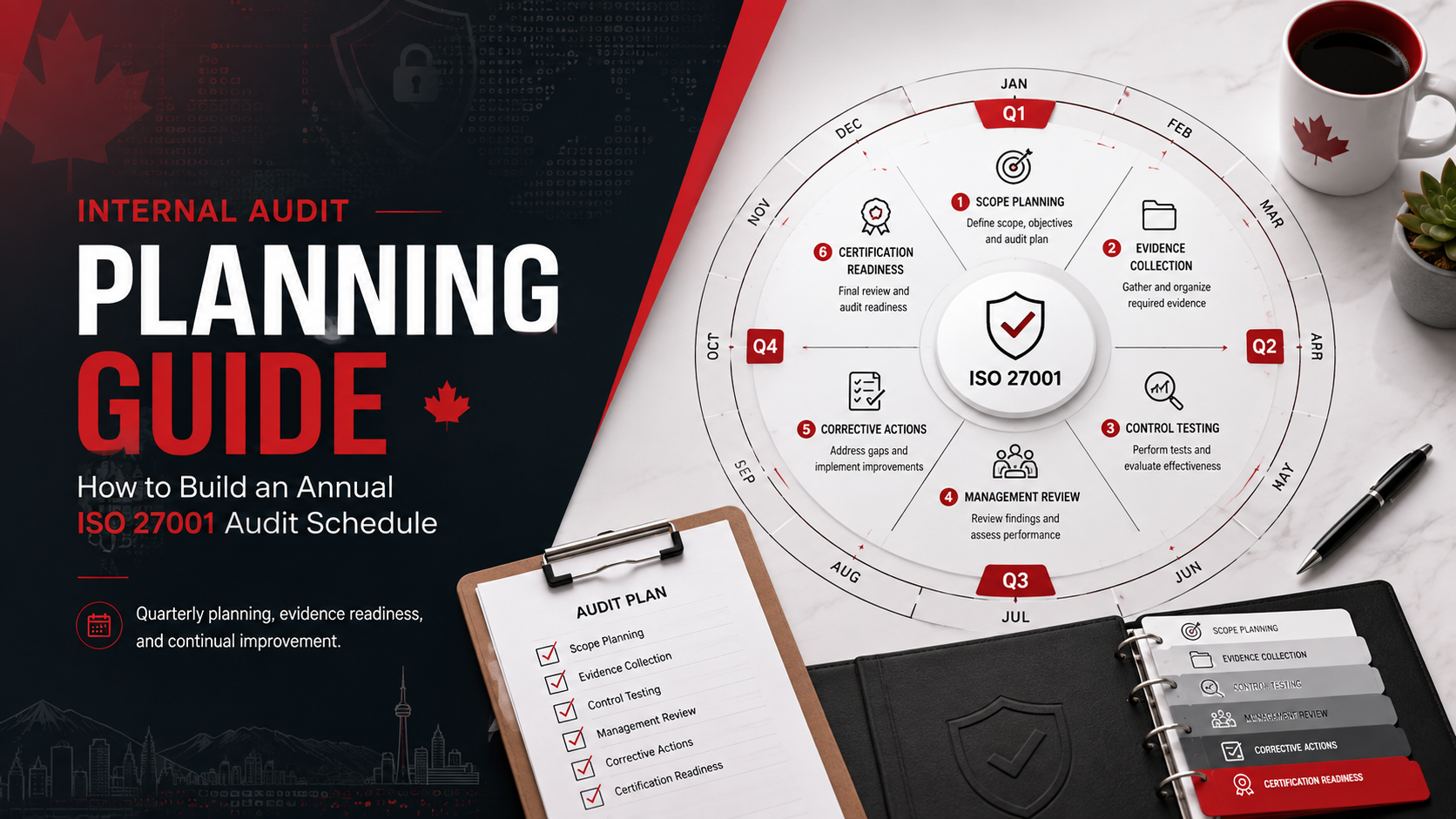
Internal Audit
Annual Audit Schedule
Certification Readiness
Internal Audit Planning Guide: How to Build an Annual ISO 27001 Audit Schedule
ISO 27001 internal audit should not become a once-a-year panic. A strong annual audit schedule turns audit work into a planned, risk-based, and evidence-driven process.
Quick Answer
What should an annual ISO 27001 internal audit schedule include?
It should define which ISMS areas, clauses, Annex A controls, departments, systems, vendors, and evidence sets will be audited during the year.
It should also include audit dates, evidence deadlines, auditor assignments, interviews, sampling, reporting, corrective action follow-up, and management review timing.
Bottom line: A strong schedule helps teams find gaps early and avoid audit panic.
Canadian Cyber ISO 27001 Audit Planning Support
Build an Audit Schedule That Works All Year
Canadian Cyber helps organizations design and perform ISO 27001 internal audits.
We build annual audit schedules, test evidence readiness, interview control owners, classify findings, verify corrective actions, and prepare teams for certification or surveillance audits.
Quick Snapshot
| Planning Area | What to Define |
|---|---|
| Audit Scope | Which ISMS areas, systems, teams, vendors, and controls will be audited. |
| Audit Timing | Which month or quarter each audit activity will happen. |
| Evidence Deadlines | When evidence must be submitted before interviews and testing. |
| Audit Owners | Who coordinates the audit and who owns each control area. |
| Corrective Actions | How findings, NCRs, OFIs, owners, due dates, and verification will be tracked. |
| Management Review | When audit results will feed leadership review and decisions. |
Why Annual Internal Audit Planning Matters
Many organizations treat internal audit as a last-minute event.
The certification audit gets close. Then everyone starts gathering evidence.
Access reviews may be incomplete. Vendor reviews may be overdue. Management review may not be ready.
That is not audit planning. That is audit panic.
An annual internal audit schedule turns ISO 27001 from a once-a-year scramble into a controlled governance process.
Who This Guide Is For
- Organizations preparing for ISO 27001 certification.
- Companies maintaining ISO 27001 certification.
- ISMS managers, compliance leads, and internal auditors.
- Security managers, IT managers, risk owners, and control owners.
- vCISO teams and cybersecurity leaders.
- SaaS, MSP, FinTech, HealthTech, manufacturing, and professional services firms.
- Organizations using SharePoint or Microsoft 365 for ISMS evidence.
Internal Audit Plan vs Internal Audit Schedule
Many teams use these terms as if they mean the same thing.
They are related, but they are not identical.
| Internal Audit Plan | Internal Audit Schedule |
|---|---|
|
Defines how the audit will be performed. It covers objectives, scope, criteria, methods, independence, sampling, interviews, reporting, findings, and corrective actions. |
Defines when audit activities will happen. It covers audit months, evidence due dates, interviews, report dates, follow-up dates, and management review timing. |
Practical rule: The audit plan explains the approach. The audit schedule explains the timing.
What Should an Annual ISO 27001 Internal Audit Schedule Cover?
A good schedule should cover the full ISMS over time.
It should include ISO 27001 clauses, Annex A controls, operational processes, high-risk systems, key departments, and recurring evidence areas.
| Audit Area | What to Review |
|---|---|
| ISMS Scope | Services, systems, locations, data, vendors, and exclusions. |
| Risk Assessment | Risk methodology, risk register, risk owners, and reviews. |
| Statement of Applicability | Control applicability, justification, and implementation status. |
| Access Control | MFA, privileged access, reviews, and offboarding. |
| Vendor Management | Vendor register, critical suppliers, DPAs, and assurance evidence. |
| Incident Response | Incident plan, reporting, tabletop exercises, and lessons learned. |
| Backup and Continuity | Backup reports, restore tests, and continuity planning. |
| Management Review | Inputs, metrics, decisions, actions, and follow-up. |
How to Build the Annual Audit Schedule
1. Define Audit Objectives
Start by defining what the audit program should achieve.
Common goals include ISO conformity, certification readiness, control testing, evidence quality, corrective action verification, and management review support.
2. Confirm ISMS Scope
The schedule must match the ISMS scope.
Review products, services, systems, teams, vendors, locations, remote workers, data types, and exclusions.
3. Use a Risk-Based Approach
Not every area needs the same audit depth.
Give more attention to high-risk areas, repeat findings, critical vendors, sensitive data, and fast-changing systems.
4. Decide Audit Frequency
Some areas may be reviewed annually.
Others may need quarterly, monthly, event-based, pre-certification, or surveillance readiness checks.
5. Build a 12-Month Calendar
Spread audit work across the year.
This keeps evidence current and gives control owners enough time to respond.
6. Assign Owners
Each audit area needs accountability.
Assign an audit owner, control owner, evidence owner, auditor, and corrective action owner where needed.
Example Annual ISO 27001 Internal Audit Schedule
This example spreads audit work across the year.
Your schedule should match your scope, risk, resources, and external audit dates.
| Month | Audit Focus | Main Evidence |
|---|---|---|
| January | Scope, context, interested parties. | Scope, interested parties, requirements register. |
| February | Risk assessment and treatment. | Risk register, treatment plan, accepted risks. |
| March | Access control and offboarding. | MFA, access reviews, termination records. |
| April | Vendor management. | Vendor register, supplier reviews, DPAs. |
| May | Policies and awareness. | Policy approvals, acknowledgments, training. |
| June | Incident response. | IR plan, tabletop report, lessons learned. |
| July | Backup, continuity, recovery. | Backup reports, restore test, BCP evidence. |
| August | Change management. | Change tickets, approvals, release evidence. |
| September | Logging, monitoring, vulnerability management. | Alerts, scans, remediation records. |
| October | Statement of Applicability. | SoA, control register, evidence mapping. |
| November | Management review readiness. | Agenda, metrics, decisions, action tracker. |
| December | Corrective actions and annual summary. | NCRs, OFIs, closure evidence, audit report. |
Need a Practical ISO 27001 Audit Calendar?
Canadian Cyber helps design annual audit schedules that are risk-based, realistic, and certification-ready.
We can also perform independent internal audits, test evidence, interview control owners, and verify corrective actions.
Plan Evidence Deadlines Before Audit Dates
Evidence should be ready before the audit interview.
Do not ask for evidence one day before testing.
| Timing | Activity |
|---|---|
| 4 weeks before audit | Send evidence request. |
| 3 weeks before audit | Control owner submits evidence. |
| 2 weeks before audit | Evidence quality review. |
| 1 week before audit | Schedule interviews. |
| Audit week | Testing and interviews. |
| 1 week after audit | Draft findings. |
| 2 weeks after audit | Final report. |
| 30–60 days after audit | Corrective action follow-up. |
Practical rule: Evidence deadlines should be earlier than audit dates.
Plan Interviews by Department
Internal audit should include people, not only files.
Control owners should be able to explain how controls operate.
Common Interviewees
- Leadership.
- ISMS manager.
- IT manager.
- HR representative.
- Security lead.
- Engineering lead.
Interview Topics
- Scope and risk.
- Access control and offboarding.
- Vendor reviews.
- Incidents and backups.
- Change management.
- Corrective actions.
Include a Sampling Strategy
Sampling should be planned before testing begins.
The auditor should know what evidence will be reviewed and why.
| Control | Frequency | Sample Approach |
|---|---|---|
| Management Review | Annual | Review full record. |
| Access Review | Quarterly | Test two quarters or all four if high risk. |
| Backup Review | Monthly | Test selected months across the year. |
| Offboarding | Event-based | Sample terminated employees and contractors. |
| Production Changes | Event-based | Sample standard and emergency changes. |
Schedule Corrective Action Follow-Up
Many internal audit programs fail after the report is issued.
Findings are documented, but fixes are not verified.
Your annual audit schedule should include follow-up dates.
- Review root cause.
- Confirm correction and corrective action.
- Check owner and deadline.
- Review closure evidence.
- Verify the fix.
- Escalate repeat findings where needed.
The audit schedule should include time to verify fixes, not only find problems.
Align Internal Audit With Management Review
Management review should use internal audit results.
This means the schedule must allow enough time for reporting before leadership review.
Management review should receive:
- Audit results and findings.
- NCRs and OFIs.
- Control weaknesses and evidence gaps.
- Corrective action status.
- Risk treatment issues.
- Resource needs and improvement opportunities.
Annual ISO 27001 Internal Audit Schedule Template
| Field | Example |
| Audit Area | Access Control |
| ISO Requirement | Annex A access control |
| Audit Month | March |
| Control Owner | IT Manager |
| Evidence Owner | Compliance Lead |
| Evidence Due Date | March 1 |
| Interview Date | March 10 |
| Sampling Plan | Q1 access review, privileged users, terminated user sample |
| Corrective Action Due Date | April 30 |
| Follow-Up Date | May 15 |
| Management Review Input | Q2 management review |
Practical Annual Audit Schedule Checklist
| Planning Question | Ready? |
|---|---|
| Is the ISMS scope confirmed? | |
| Are audit objectives documented? | |
| Are high-risk areas identified? | |
| Are ISO clauses and Annex A controls covered across the year? | |
| Are departments and control owners mapped? | |
| Is evidence due before each audit date? | |
| Is auditor independence considered? | |
| Is sampling strategy documented? | |
| Are interviews scheduled? | |
| Are corrective action follow-ups scheduled? | |
| Is management review timing aligned? | |
| Is certification or surveillance timing considered? | |
| Is evidence stored in one workspace? | |
| Are overdue items escalated? |
Common Internal Audit Planning Mistakes
- Auditing everything at the last minute. This creates pressure and weak evidence.
- No evidence deadlines. Control owners need time to prepare proof.
- Ignoring risk. High-risk areas should receive more attention.
- No corrective action follow-up. An audit schedule without follow-up is incomplete.
- No management review alignment. Internal audit results should feed leadership review.
- No sampling plan. The auditor should know what evidence will be sampled and why.
- No independence. Auditors should not audit their own work.
- No central evidence workspace. Scattered evidence creates audit stress.
How SharePoint Can Help Build an Annual Audit Schedule
A structured SharePoint ISMS can make annual audit planning easier.
It gives teams one controlled workspace for audit planning, evidence, findings, follow-up, and leadership reporting.
Canadian Cyber’s ISMS SharePoint Solution can organize:
- Annual audit calendar and internal audit plan.
- Audit schedule tracker and control register.
- Risk register and evidence library.
- Evidence due dates and control owner assignments.
- Audit request tracker and interview schedule.
- NCR register, OFI register, and corrective action tracker.
- Management review dashboard, Power Automate reminders, Teams notifications, and auditor-ready views.
An annual audit schedule works best when it is connected to evidence, owners, reminders, and corrective actions.
How Canadian Cyber Helps
Canadian Cyber helps organizations plan, perform, and improve ISO 27001 internal audits.
We do not only provide a checklist. We help build the annual audit program and test real evidence.
Canadian Cyber can support:
- Annual ISO 27001 internal audit schedule design.
- ISO 27001 internal audits and readiness reviews.
- Audit planning workshops.
- Risk-based audit program development.
- Sampling strategy design.
- Control owner interview planning.
- Evidence readiness reviews.
- NCR and OFI classification.
- Corrective action verification.
- Management review preparation.
- Certification readiness, surveillance readiness, vCISO services, SOC 2 alignment, ISO 42001 AI governance, ISO 27017, ISO 27018, and SharePoint ISMS implementation.
Frequently Asked Questions
What is an annual ISO 27001 internal audit schedule?
It is a calendar that defines when different ISMS areas, controls, departments, systems, and evidence sets will be audited throughout the year.
Does ISO 27001 require internal audits every year?
ISO 27001 requires internal audits at planned intervals. Many organizations use an annual audit program and review higher-risk areas more often.
Should every ISO 27001 control be audited every year?
The audit program should cover the ISMS over time. Higher-risk areas may need deeper or more frequent review.
Who should perform ISO 27001 internal audits?
Internal audits should be performed by competent auditors who are objective and independent from the work being audited.
What should be included in the audit schedule?
It should include audit area, ISO requirement, owner, auditor, evidence due date, audit date, sampling approach, report date, corrective action deadline, and follow-up date.
Can Canadian Cyber help build an annual ISO 27001 audit schedule?
Yes. Canadian Cyber can design the annual audit schedule, perform internal audits, review evidence, prepare findings, verify corrective actions, and build SharePoint audit tracking workspaces.
Takeaway
ISO 27001 internal audit should not be a once-a-year emergency.
A strong annual audit schedule helps teams test controls, prepare evidence, find gaps, track corrective actions, support management review, and reduce certification stress.
The best schedules are risk-based, practical, documented, and connected to evidence.
Internal audit planning is not admin work. It is how the ISMS stays alive.
Need an ISO 27001 Internal Audit Schedule That Actually Works?
Canadian Cyber can help you build a practical annual audit program and prepare for certification with confidence.
We provide annual audit planning, ISO 27001 internal audits, evidence readiness reviews, corrective action verification, management review preparation, certification readiness, vCISO services, SOC 2 alignment, ISO 42001 AI governance, ISO 27017, ISO 27018, and SharePoint ISMS implementation.
Stay Connected With Canadian Cyber
Follow Canadian Cyber for practical guidance on ISO 27001 internal audits, annual audit schedules, audit planning, evidence readiness, corrective actions, SOC 2, ISO 42001, ISO 27017, ISO 27018, SharePoint ISMS, cybersecurity assessments, and vCISO support.