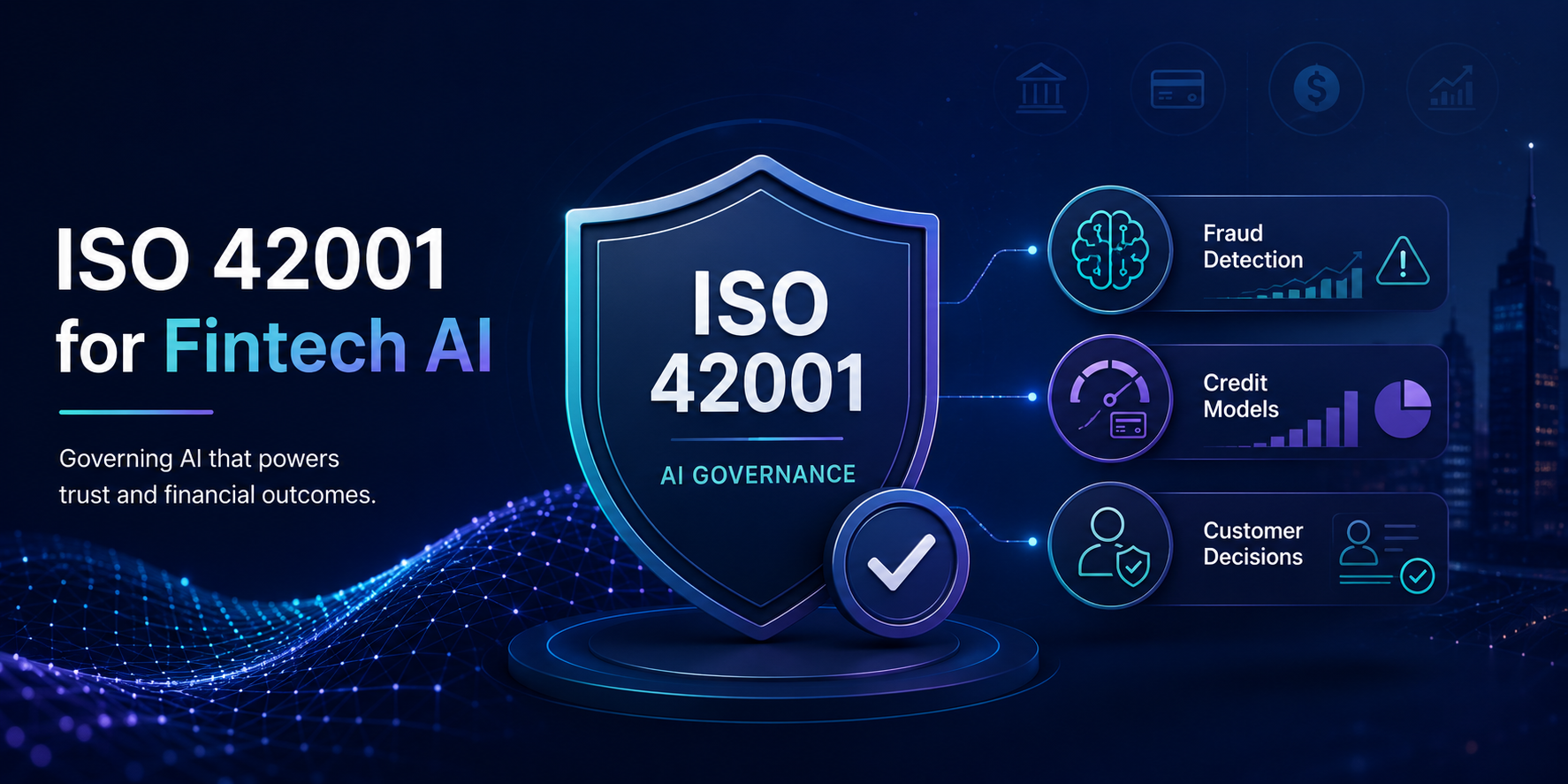
New Service • ISO 42001 • AI Governance • Fintech AI • Fraud Detection • Credit Models
ISO 42001 for Fintech AI: Governing Fraud Detection, Credit Models, and Customer Decisions
Fintech companies are using AI to detect fraud, assess credit risk, automate customer decisions, review transactions, and improve operations. ISO 42001 helps turn fast-moving AI use into a governed, accountable, auditable, and trust-ready AI management system.
New Canadian Cyber Service
ISO 42001 Readiness and AI Governance for Fintech, SaaS, and AI-Driven Companies
Canadian Cyber now supports organizations that need practical AI governance for fraud detection, credit models, customer decisioning, AI vendors, model risk, human oversight, and audit-ready evidence. This service helps companies build a structured AI Management System aligned with ISO 42001 readiness.
Quick Snapshot
| Topic | Why It Matters |
|---|---|
| New Service Focus | Canadian Cyber now supports ISO 42001 readiness and AI governance for fintech and SaaS companies. |
| Fintech AI Risk | Fraud detection, credit models, and customer decisions can affect real people and financial outcomes. |
| ISO 42001 Value | Creates a structured AI management system for governance, accountability, controls, risk, and evidence. |
| Buyer Confidence | Helps fintech companies answer AI security, compliance, risk, and customer trust questions. |
| Business Outcome | Better AI oversight, stronger vendor confidence, clearer model governance, and improved readiness for enterprise reviews. |
Introduction
Fintech AI is moving fast.
Companies are using AI for:
Credit scoring
Loan decision support
Transaction monitoring
Customer onboarding
Identity verification
Risk scoring
Payment anomaly detection
Customer support automation
Compliance monitoring
AI can help fintech teams move faster, detect patterns, reduce manual review, improve customer experience, and support better decisions.
But AI also introduces new risks. A fraud model may block a legitimate customer. A credit model may create unfair outcomes. A customer decision engine may be hard to explain. A vendor AI tool may process sensitive data. A model may drift over time. A human reviewer may overtrust AI output.
This is where ISO 42001 becomes important. It helps fintech companies turn AI from a fast-moving product feature into a controlled, explainable, and auditable business capability.
New Canadian Cyber Service: ISO 42001 Readiness for Fintech AI
Canadian Cyber helps fintech, SaaS, AI platforms, and technology companies build ISO 42001-ready AI governance programs. We support AI system inventories, AI risk assessments, model governance, AI vendor reviews, customer-impact decision controls, evidence workspaces, policy development, and executive AI oversight.
Why ISO 42001 Matters for Fintech AI
Fintech is a high-trust industry. Customers, banks, investors, regulators, partners, and enterprise buyers want confidence that AI is not being used carelessly.
They may ask:
- Which AI systems do you use?
- Which customer decisions are influenced by AI?
- How do you test fraud models?
- How do you review credit model fairness?
- How do humans oversee automated decisions?
- How do you detect model drift?
- Which AI vendors process sensitive data?
- Can customers challenge decisions?
- Who approves AI use cases?
Practical rule: If AI affects financial access, fraud outcomes, credit decisions, or customer treatment, it needs governance.
What Is ISO 42001?
ISO 42001 provides a management system framework for responsible AI. It helps organizations define how AI is governed, approved, monitored, risk-assessed, documented, and improved.
| ISO 42001 Area | What It Means for Fintech |
|---|---|
| Governance | Who is accountable for AI decisions and oversight. |
| Risk Management | How AI risks are identified, rated, and treated. |
| AI System Inventory | Which AI systems exist and what they do. |
| Impact Assessment | How AI affects customers, users, operations, and fairness. |
| Controls | What safeguards reduce AI risk. |
| Monitoring | How model performance, drift, errors, and outcomes are reviewed. |
| Evidence | What proof exists that AI is governed properly. |
ISO 42001 is not only a technical model standard. It is a business governance system for AI.
Why Fintech AI Needs Stronger Governance
Fintech AI is different from low-risk automation. A model may affect whether a customer is approved, flagged, delayed, reviewed, charged, blocked, escalated, or offered a financial product.
| AI Use Case | Governance Concern |
|---|---|
| Fraud Detection | False positives, customer lockouts, unfair flagging. |
| Credit Models | Bias, explainability, adverse customer impact. |
| Customer Decisioning | Transparency, appeal process, human oversight. |
| Transaction Monitoring | Accuracy, alert fatigue, missed suspicious activity. |
| Identity Verification | Fairness, false rejection, vendor risk. |
| Customer Support AI | Inaccurate advice, privacy, escalation controls. |
| AI-Generated Financial Guidance | Suitability, disclaimers, human review. |
Canadian Cyber ISO 42001 Service Includes
Identify AI tools, models, owners, use cases, vendors, and customer impact.
Rate AI risks across fairness, privacy, security, reliability, explainability, and vendor risk.
Create approval, review, monitoring, change control, and performance evidence workflows.
Assess third-party AI tools, data use, sub-processors, security evidence, and contract risk.
Build policies for responsible AI use, human oversight, risk review, and accountability.
Organize evidence, model records, risks, reviews, vendors, and management reporting.
ISO 42001 for Fraud Detection AI
Fraud detection is one of the most common fintech AI use cases. AI can identify suspicious transactions, account takeover patterns, unusual behavior, and payment anomalies. But poorly governed fraud AI can also create customer harm.
| Fraud Detection AI Risk | Example |
|---|---|
| False Positive | Legitimate customer blocked or delayed. |
| False Negative | Fraudulent activity missed. |
| Bias | Certain customer groups flagged more often. |
| Poor Explainability | Support team cannot explain why an action occurred. |
| Model Drift | Fraud patterns change but the model is not updated. |
| Vendor Risk | External fraud tool processes sensitive data. |
Evidence to keep:
- fraud model description
- AI risk assessment
- training or input data summary
- performance review report
- false positive analysis
- escalation records
- model change log
- vendor due diligence
Practical rule: Fraud detection AI should be monitored for both security effectiveness and customer impact.
ISO 42001 for Credit Models
Credit models require special care because they can influence access to loans, rates, limits, approvals, and financial opportunities. Even when AI is used only as decision support, governance is critical.
| Credit Model Governance Risk | Why It Matters |
|---|---|
| Bias | Customers may be treated unfairly. |
| Lack of Explainability | Decisions become difficult to justify. |
| Poor Data Quality | Inaccurate inputs may affect outcomes. |
| Model Drift | Performance changes over time. |
| Weak Human Oversight | Staff may over-rely on model output. |
| No Appeal Process | Customers may not be able to challenge outcomes. |
ISO 42001 controls for credit models can include:
- model approval process
- credit model risk assessment
- data quality review
- fairness review
- human oversight requirement
- customer decision explanation process
- appeal or review workflow
- periodic model review
Practical rule: Credit AI governance should focus on fairness, explainability, accountability, and customer impact.
Govern Fraud Models, Credit Models, and Customer Decisions With Confidence
Canadian Cyber’s ISO 42001 readiness service helps fintech teams document AI risks, model controls, human oversight, vendor reviews, fairness considerations, decision impact, and audit-ready evidence.
ISO 42001 for Customer Decisions
Fintech AI may support or automate customer decisions, including onboarding approval, transaction holds, account reviews, risk scoring, fraud escalation, document acceptance, or service eligibility.
| Customer Decision Control | Purpose |
|---|---|
| Decision Impact Assessment | Understands how AI affects customers. |
| Human Review Rules | Defines when people must review AI output. |
| Explanation Process | Helps explain decisions where appropriate. |
| Appeal Workflow | Allows review of disputed outcomes. |
| Bias and Fairness Review | Reduces unfair treatment. |
| Customer Complaint Review | Detects negative patterns. |
Questions fintech leaders should ask:
- Does AI make the decision or only support it?
- Can a human override the AI output?
- Can the customer request review?
- Are decision outcomes monitored by group or segment?
- Are errors tracked and corrected?
- Are customer complaints reviewed for AI issues?
- Are model updates approved before deployment?
AI System Inventory: The First Step Toward ISO 42001
Many fintech teams do not have a complete AI inventory. That is a problem because you cannot govern AI systems you cannot identify.
| AI Inventory Field | Example |
|---|---|
| AI System Name | Fraud scoring model. |
| Business Owner | Fraud operations lead. |
| Technical Owner | Data science lead. |
| Use Case | Transaction anomaly detection. |
| Customer Impact | May block or escalate transactions. |
| Human Oversight | Manual review required for high-risk cases. |
| Risk Rating | High, medium, low. |
Practical rule: Start ISO 42001 readiness by listing every AI system and AI-assisted workflow.
AI Risk Assessment for Fintech
ISO 42001 readiness should include AI risk assessment. This helps teams prioritize controls for high-impact AI systems.
| AI Risk Category | Fintech Example |
|---|---|
| Customer Harm | Wrong rejection, account block, poor advice. |
| Bias and Fairness | Disproportionate impact on customer groups. |
| Security | Model abuse, data leakage, prompt injection. |
| Privacy | Sensitive data used improperly. |
| Explainability | Decision cannot be explained. |
| Processing Integrity | Wrong transaction status or risk score. |
| Vendor Risk | Third-party AI tool lacks assurance. |
Model Change Management
AI models change. Data changes. Fraud patterns change. Credit criteria change. Vendor tools update. Prompt templates change. Thresholds change. Decision rules change.
Without change control, AI risk can increase silently.
| Model Change Control | Evidence |
|---|---|
| Model change request | Ticket or change record. |
| Risk impact review | Assessment before update. |
| Testing evidence | Validation and performance test. |
| Fairness review | Bias or impact check. |
| Approval record | Owner approval. |
| Monitoring after release | Performance and error tracking. |
| Customer impact review | Decision outcome analysis. |
Practical rule: AI model changes should be reviewed like high-risk production changes.
AI Vendor Governance
Many fintech companies use third-party AI tools. These may include fraud detection vendors, credit decisioning platforms, KYC tools, identity verification systems, customer support AI, document review AI, risk scoring tools, analytics platforms, and LLM providers.
| AI Vendor Review Question | Why It Matters |
|---|---|
| What data does the AI vendor process? | Privacy and confidentiality. |
| Is customer data used for training? | Data use risk. |
| Where is data stored? | Location and legal risk. |
| What security evidence is available? | Vendor assurance. |
| Can outputs be explained? | Decision governance. |
| How are model changes communicated? | Change risk. |
| Are sub-processors disclosed? | Third-party visibility. |
SharePoint AI Governance Workspace
AI governance evidence should not be scattered across product tools, engineering folders, vendor portals, spreadsheets, and leadership decks. A structured SharePoint workspace can help centralize ISO 42001 readiness evidence.
| SharePoint Section | Purpose |
|---|---|
| AI System Inventory | Lists AI systems, owners, risk levels, and use cases. |
| AI Risk Register | Tracks AI risks and treatment plans. |
| AI Policies | Stores approved AI governance policies. |
| Model Documentation | Stores model cards, summaries, and data source records. |
| Impact Assessments | Stores customer, fairness, privacy, and business impact reviews. |
| AI Vendor Register | Tracks AI suppliers and assurance evidence. |
| Monitoring Evidence | Stores performance, drift, and error reviews. |
| Management Review | Stores executive AI oversight records. |
Build My ISO 42001 SharePoint AI Governance Portal
Canadian Cyber can help fintech companies set up an ISO 42001-ready AI governance workspace in SharePoint, including AI inventories, AI risk registers, model documentation, vendor reviews, evidence libraries, and leadership dashboards.
ISO 42001 Readiness Checklist for Fintech AI
AI Governance
| Question | Yes / No |
|---|---|
| Do we have an AI governance policy? | |
| Are AI roles and responsibilities defined? | |
| Does leadership review AI risk? | |
| Is AI governance linked to security and compliance? |
AI Inventory
| Question | Yes / No |
|---|---|
| Do we maintain a list of AI systems? | |
| Are fintech AI use cases documented? | |
| Are AI system owners assigned? | |
| Are customer-impacting AI systems identified? |
Fraud, Credit, and Customer Decisions
| Question | Yes / No |
|---|---|
| Is the fraud model documented? | |
| Are false positives and false negatives reviewed? | |
| Are credit models risk-assessed? | |
| Is fairness reviewed? | |
| Can decisions be explained where needed? | |
| Is there an appeal or review process? |
If several answers are “no,” ISO 42001 readiness should be prioritized.
Common Mistakes to Avoid
- Treating AI governance as only a data science issue. AI governance needs product, security, compliance, legal, operations, leadership, and customer support input.
- No AI inventory. If AI systems are not listed, they cannot be governed.
- Ignoring customer impact. Fraud, credit, onboarding, and account decisions can affect real customers.
- No human oversight rules. Teams should know when humans must review or override AI output.
- No AI vendor review. Third-party AI tools can introduce major security, privacy, and governance risk.
- No model change control. AI updates should not happen without review, testing, approval, and monitoring.
- No evidence workspace. AI governance evidence should be organized and audit-ready.
What Good Looks Like
A fintech company preparing for ISO 42001 can show:
- AI governance policy
- AI system inventory
- AI risk register
- AI impact assessments
- fraud model documentation
- credit model documentation
- customer decision controls
- human oversight rules
- model performance reviews
- bias and fairness review
- model change approvals
- AI vendor register
- incident and issue tracker
- management review records
- SharePoint evidence workspace
This creates a stronger AI governance foundation and helps fintech teams answer buyer, investor, bank, and executive questions with evidence.
Canadian Cyber’s Take
AI is becoming a serious fintech governance issue. Fraud detection, credit models, risk scoring, customer decisioning, and AI-powered support can create real business value.
But they also create real accountability. Banks, enterprise buyers, investors, customers, and regulators will increasingly ask how fintech companies govern AI.
Canadian Cyber’s new ISO 42001 service helps fintech and AI-driven companies build practical AI governance without slowing innovation.
The goal is not to stop AI. The goal is to use AI with trust, control, and accountability.
Takeaway
Fintech AI needs governance. Fraud detection, credit models, customer decisions, and AI vendors can create security, fairness, privacy, explainability, and customer impact risks.
ISO 42001 helps fintech companies build a structured AI management system for:
- AI governance
- AI inventories
- AI risk assessments
- model documentation
- human oversight
- vendor reviews
- impact assessments
- monitoring
- change management
- evidence and continuous improvement
For fintech companies building AI into products, ISO 42001 can become a powerful trust signal. It shows that AI is not only innovative — it is governed.
How Canadian Cyber Can Help
Canadian Cyber now offers ISO 42001 readiness and AI governance services for fintech, SaaS, and AI-driven companies.
- ISO 42001 readiness assessments
- AI governance program design
- AI system inventory creation
- AI risk register development
- fraud detection AI governance
- credit model governance
- customer decision impact assessments
- AI policy development
- AI vendor risk reviews
- model documentation templates
- human oversight controls
- AI change management process
- AI monitoring evidence planning
- SharePoint AI governance workspace setup
- executive AI risk reporting
- vCISO support for AI governance
Stay Connected With Canadian Cyber
Follow Canadian Cyber for practical guidance on ISO 42001, AI governance, fintech AI, fraud detection models, credit model risk, customer decision controls, SOC 2, ISO 27001, SharePoint ISMS, and vCISO support.