ISO 27001 • Law Firm Cybersecurity • Document Management Systems • ISMS Scope • Client Confidentiality
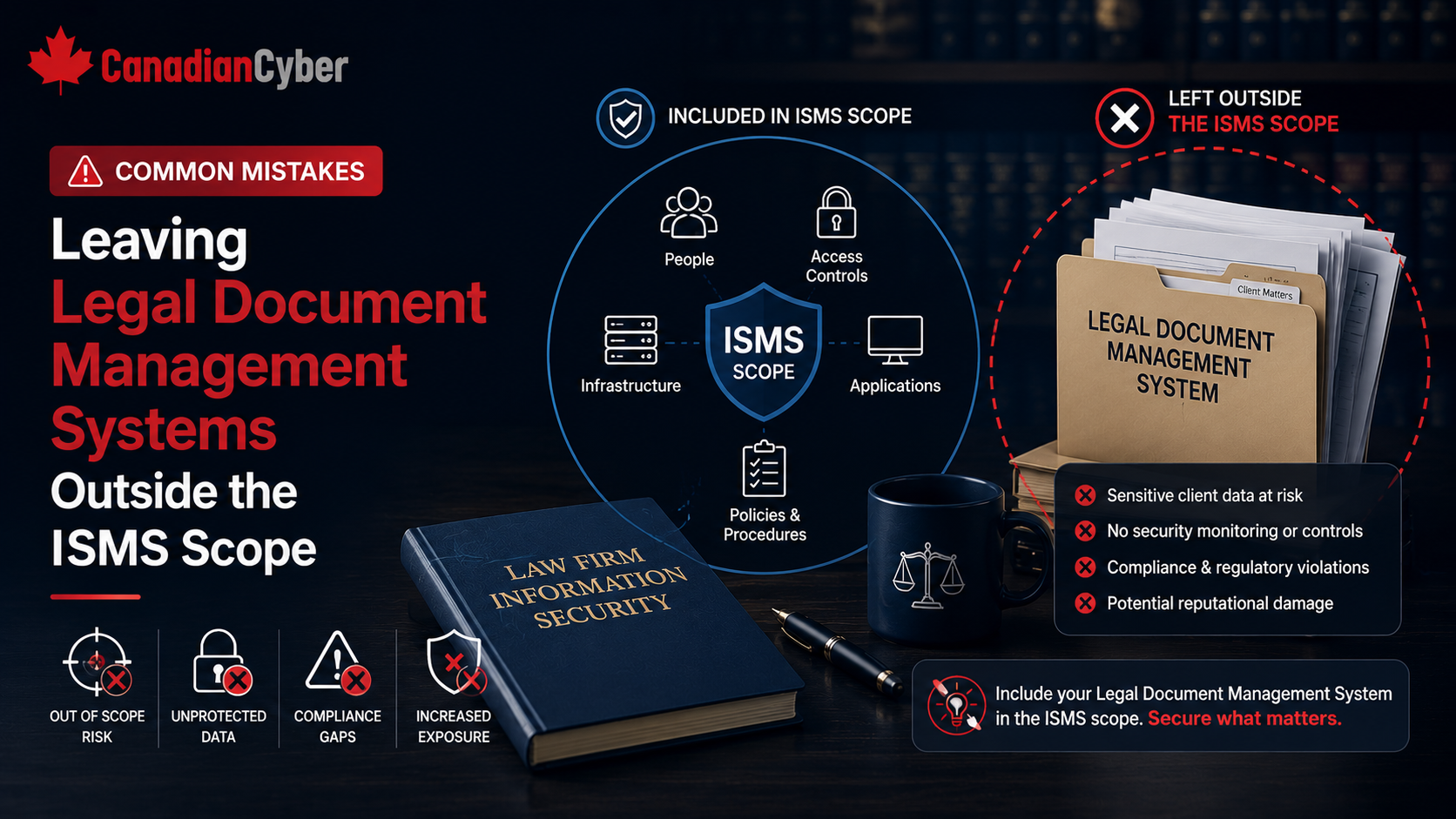
Common Mistakes: Leaving Legal Document Management Systems Outside the ISMS Scope
Legal document management systems hold the heart of a law firm’s client confidentiality obligations. Leaving the DMS outside the ISO 27001 ISMS scope can create audit gaps, confidentiality risks, and client trust concerns.
Canadian Cyber for Law Firm ISO 27001 Scope Readiness
Define ISO 27001 Scope Around Where Client Information Actually Lives
Canadian Cyber helps law firms define ISO 27001 scope, assess legal document management controls, review client matter access, test ethical walls, evaluate vendor assurance, organize audit evidence, and build SharePoint ISMS workspaces.
Quick Snapshot
| Risk Area | Why It Matters |
|---|---|
| Client Matter Confidentiality | Legal DMS platforms often store the firm’s most sensitive client information. |
| ISMS Scope Accuracy | ISO 27001 scope should reflect where critical information is stored, processed, shared, and protected. |
| Access Reviews | Matter-level and privileged access must be reviewed and evidenced. |
| Vendor Risk | DMS vendors, hosting providers, eDiscovery tools, integrations, and client portals may affect client data. |
| Audit Evidence | Auditors may ask how the firm protects matter documents, ethical walls, retention, sharing, and privileged access. |
| Business Outcome | Better ISO 27001 readiness, stronger client trust, and fewer audit surprises. |
Introduction
Law firms often begin ISO 27001 implementation by focusing on Microsoft 365, endpoints, firewalls, identity, email security, backups, and policies.
That is useful. But there is one mistake that can weaken the entire ISMS: leaving the legal document management system outside the scope.
For many law firms, the DMS is where the most sensitive information lives. It may contain:
Privileged communication
Litigation strategy
M&A documents
Employment records
Intellectual property files
Regulatory submissions
eDiscovery material
Court filings
Settlement documents
Confidential legal advice
If the DMS is excluded from the ISMS without a strong justification, the firm may struggle to prove that confidentiality controls are complete.
This blog explains the common mistakes law firms make when leaving legal document management systems outside the ISMS scope, why it matters for ISO 27001, and how to fix the issue before audit.
Need Help Defining ISO 27001 Scope for Your Law Firm?
Canadian Cyber helps law firms define ISO 27001 scope, assess document management controls, review client matter access, test confidentiality safeguards, organize audit evidence, and build SharePoint ISMS workspaces.
Why the Legal DMS Is Usually Critical to the ISMS
An ISMS exists to protect information. For law firms, the most valuable information is often client matter information, and that information is frequently stored in the legal document management system.
Common legal DMS platforms and repositories may include:
NetDocuments
SharePoint
OneDrive
Microsoft Teams
Legal case management platforms
eDiscovery platforms
Client portals
Virtual data rooms
Document automation platforms
Practical rule: If a system stores confidential client matter data, it should not be ignored during ISO 27001 scope definition.
Mistake 1: Treating the DMS as “Just a Business Tool”
Some firms treat the DMS as a legal operations tool, not an information security system. That is a mistake.
The DMS may control:
- who can access matter files
- how documents are shared
- whether ethical walls are enforced
- how versions are tracked
- how external users access files
- how client data is retained
- how documents are deleted
- how activity is logged
- how incidents are investigated
| DMS Function | Security Relevance |
|---|---|
| Matter permissions | Access control. |
| Ethical walls | Confidentiality and conflict protection. |
| Version history | Integrity and traceability. |
| External sharing | Data leakage prevention. |
| Retention rules | Information lifecycle control. |
| Audit logs | Investigation and monitoring. |
| Backup and recovery | Availability and resilience. |
Practical rule: A legal DMS is not only a document store. It is a core confidentiality control environment.
Mistake 2: Defining ISMS Scope Around IT Infrastructure Only
Some law firms define ISMS scope around technical infrastructure such as networks, firewalls, laptops, identity providers, email, endpoint protection, and backup tools. These are important, but ISO 27001 scope should reflect information risk.
| Better Scope Question | Why It Matters |
|---|---|
| Where is client matter information stored? | Identifies critical repositories. |
| Which systems process confidential legal documents? | Defines information flow. |
| Who can access matter records? | Defines access control scope. |
| Which systems enforce ethical walls? | Defines confidentiality controls. |
| Which vendors support document storage or hosting? | Defines supplier risk. |
| Which platforms support external client sharing? | Defines data leakage risk. |
Practical rule: Scope should follow the information, not only the infrastructure.
Review Your ISMS Scope Before the Auditor Does
Canadian Cyber helps law firms review ISO 27001 scope statements, asset inventories, data flows, DMS control coverage, supplier risk, and audit evidence before certification readiness pressure starts.
Mistake 3: Assuming Vendor-Hosted DMS Means “Out of Scope”
Many legal DMS platforms are cloud-hosted or vendor-managed. Some firms assume that because a vendor hosts the platform, it can be excluded from ISO 27001 scope. That is risky.
A vendor may operate the platform, but the firm still has responsibilities for:
- user access decisions
- matter workspace permissions
- ethical wall configuration
- external sharing decisions
- client confidentiality obligations
- vendor due diligence
- contract review
- incident escalation
- audit evidence collection
| Area to Review | Evidence |
|---|---|
| Vendor assurance | SOC 2, ISO 27001, or security questionnaire. |
| Contractual obligations | Confidentiality, data protection, and incident notice terms. |
| Access ownership | Who approves users and roles. |
| Logging | Available activity logs and retention. |
| Backup / recovery | Vendor recovery commitments and service levels. |
| Sub-processors | Third-party dependencies. |
Practical rule: Outsourcing the platform does not outsource accountability for client matter confidentiality.
Mistake 4: Not Mapping Matter Confidentiality Controls to the DMS
A law firm may have confidentiality policies, but auditors want to see how those policies are applied. The DMS is usually where many confidentiality controls become real.
| Confidentiality Control | DMS Evidence |
|---|---|
| Need-to-know access | Matter access lists. |
| Ethical walls | Restricted matter permissions. |
| Access approval | Matter access request records. |
| Access review | Periodic DMS permission reviews. |
| External sharing control | Sharing reports. |
| Document integrity | Version history. |
| Monitoring | Audit log samples. |
| Vendor risk | DMS vendor review. |
Mistake 5: No Matter-Level Access Review
General user access reviews are not enough for law firms. A lawyer may have normal system access but should not access every matter. Matter-level access matters.
| Matter Access Review Question | Yes / No |
|---|---|
| Is the matter owner identified? | |
| Is the matter team documented? | |
| Are access rights based on need-to-know? | |
| Are former team members removed? | |
| Are support staff access rights justified? | |
| Are restricted matters reviewed separately? | |
| Are external users reviewed? | |
| Is review evidence retained? |
Evidence to collect:
Matter team list
Matter owner sign-off
Removed user record
Exception approval
Restricted matter review
External user list
Access review tracker
Test Matter-Level Access Before ISO 27001 Audit
Canadian Cyber helps law firms test DMS permissions, matter access lists, ethical walls, external users, privileged administrators, and access review evidence before certification or surveillance audit.
Mistake 6: Ignoring Ethical Walls in ISMS Scope
Ethical walls are one of the clearest examples of confidentiality controls in law firms. If the DMS enforces ethical walls, it must be considered in the ISMS.
Ethical wall evidence should include:
Restricted matter list
Approval record
DMS permission evidence
Restricted group membership
Access test result
Exception approval
Staff awareness record
Mistake 7: Ignoring External Sharing and Client Portals
Legal documents are often shared externally through DMS sharing, SharePoint links, client portals, virtual data rooms, eDiscovery platforms, secure email, Teams guest access, and OneDrive links.
| External Sharing Audit Question | Yes / No |
|---|---|
| Are external sharing settings documented? | |
| Are external users approved? | |
| Are sharing links reviewed? | |
| Are expired links removed? | |
| Are client portals permissioned correctly? | |
| Are accidental sharing incidents tracked? |
Mistake 8: Forgetting DMS Admin and Privileged Access
DMS administrators may have powerful permissions. They may be able to create workspaces, change permissions, override access, view logs, configure sharing, or manage retention.
| Privileged Access Question | Yes / No |
|---|---|
| Who has DMS admin access? | |
| Is MFA required for DMS admins? | |
| Are admin accounts named individuals? | |
| Are shared admin accounts avoided? | |
| Is admin access reviewed periodically? | |
| Are admin actions logged? |
Mistake 9: Not Reviewing DMS Integrations
Legal document management systems rarely operate alone. They may connect to Microsoft 365, Outlook, Teams, eDiscovery platforms, document automation tools, signature platforms, client portals, data rooms, backup platforms, search tools, and AI document review tools.
| Integration Review Question | Why It Matters |
|---|---|
| Which systems integrate with the DMS? | Visibility. |
| What data flows through the integration? | Confidentiality. |
| Are permissions inherited or separate? | Access control. |
| Are vendors reviewed? | Supplier risk. |
| Are exports controlled? | Data leakage. |
| Are AI integrations approved? | AI governance risk. |
Mistake 10: No Backup, Recovery, or Continuity Evidence for the DMS
Law firms depend on access to client documents. If the DMS becomes unavailable, client service may be disrupted.
| Availability Question | Yes / No |
|---|---|
| Is the DMS included in business continuity planning? | |
| Are recovery expectations documented? | |
| Are vendor uptime commitments reviewed? | |
| Are backup responsibilities understood? | |
| Are DMS outages included in incident response planning? |
Mistake 11: No DMS Logging and Investigation Evidence
If a confidentiality concern arises, the firm may need to investigate. The DMS should support investigation where possible.
| Logging Question | Yes / No |
|---|---|
| Are document access logs available? | |
| Are admin actions logged? | |
| Are external sharing actions logged? | |
| Is log retention defined? | |
| Can logs support confidentiality investigations? |
Mistake 12: Not Documenting Why the DMS Is Included or Excluded
Sometimes a system can be excluded from the ISMS scope. But exclusion should be justified. If the DMS is excluded, the firm should clearly explain why it is excluded, what information it contains, what risk remains, which controls still apply, who accepted the decision, and how confidentiality obligations are still met.
Scope decision evidence should include:
Asset inventory
Data flow review
Risk assessment
System criticality rating
Supplier review
Management approval
Risk acceptance record
Statement of Applicability alignment
Practical rule: A scope exclusion should be defensible, documented, and risk-based.
Organize DMS Scope Evidence in SharePoint ISMS
Canadian Cyber helps law firms organize ISO 27001 scope decisions, asset inventories, DMS evidence, matter access reviews, ethical wall testing, vendor assurance, risk registers, audit requests, and corrective actions in a structured SharePoint ISMS workspace.
DMS Scope Readiness Checklist
Use this checklist before ISO 27001 audit.
Scope
| Question | Yes / No |
|---|---|
| Is the DMS listed in the asset inventory? | |
| Is client matter data stored in the DMS? | |
| Is the DMS included in the ISMS scope? | |
| If excluded, is the exclusion documented and justified? | |
| Is DMS risk included in the risk assessment? |
Access
| Question | Yes / No |
|---|---|
| Are matter permissions reviewed? | |
| Are DMS admins reviewed? | |
| Are former users removed? | |
| Are ethical walls tested? | |
| Are external users reviewed? |
Vendor and Continuity
| Question | Yes / No |
|---|---|
| Is the DMS vendor reviewed? | |
| Are vendor assurance reports collected? | |
| Are sub-processors reviewed where applicable? | |
| Is DMS availability considered in continuity planning? |
Evidence
| Question | Yes / No |
|---|---|
| Are DMS permission exports retained? | |
| Are external sharing reports available? | |
| Are access reviews signed off? | |
| Are audit logs available? | |
| Are corrective actions tracked? |
If several answers are “no,” the DMS may create ISO 27001 audit risk.
What Good Looks Like
A strong ISO 27001 approach for legal DMS scope can show:
- DMS included in asset inventory
- clear ISMS scope decision
- matter confidentiality risk assessment
- matter access reviews
- ethical wall testing
- DMS admin access review
- external sharing review
- vendor assurance evidence
- DMS integration review
- backup and recovery understanding
- logging and audit trail evidence
- retention and disposal controls
- corrective action tracker
- management review input
- SharePoint ISMS evidence workspace
This gives auditors and clients greater confidence.
Canadian Cyber’s Take
At Canadian Cyber, we often see law firms focus ISO 27001 scope on IT systems while underestimating the importance of legal document management platforms.
That creates a gap. For law firms, the DMS is often where client confidentiality becomes operational.
The better approach is to follow the information. If confidential client matter data lives in the DMS, the firm should assess the DMS, document the scope decision, test controls, and collect evidence.
Leaving the DMS outside the ISMS scope without a strong reason can weaken the entire ISO 27001 story. Including it properly helps law firms show that client confidentiality is protected where it matters most.
Takeaway
Legal document management systems should not be casually excluded from ISO 27001 ISMS scope.
Law firms should review:
- client matter data
- DMS permissions
- ethical walls
- external sharing
- admin access
- vendor assurance
- integrations
- backups and recovery
- logging
- retention
- scope justification
- audit evidence
The goal is simple: protect client confidentiality where the client information actually lives. For many law firms, that means the DMS must be part of the ISO 27001 conversation.
How Canadian Cyber Can Help
Canadian Cyber helps law firms define ISO 27001 scope and test controls around legal document management systems.
- ISO 27001 scope readiness reviews
- legal DMS control assessment
- client matter access reviews
- ethical wall testing
- DMS admin access reviews
- external sharing reviews
- vendor assurance reviews
- DMS integration risk assessment
- backup and recovery evidence reviews
- logging and audit trail review
- risk register updates
- Statement of Applicability support
- internal audit preparation
- SharePoint ISMS evidence workspace setup
- certification readiness support
Stay Connected With Canadian Cyber
Follow Canadian Cyber for practical guidance on ISO 27001, law firm cybersecurity, legal document management systems, ISMS scope, client confidentiality, internal audits, SharePoint ISMS, SOC 2, ISO 42001, and vCISO support.