Shadow AI
Internal Audit
ISO 42001 Readiness
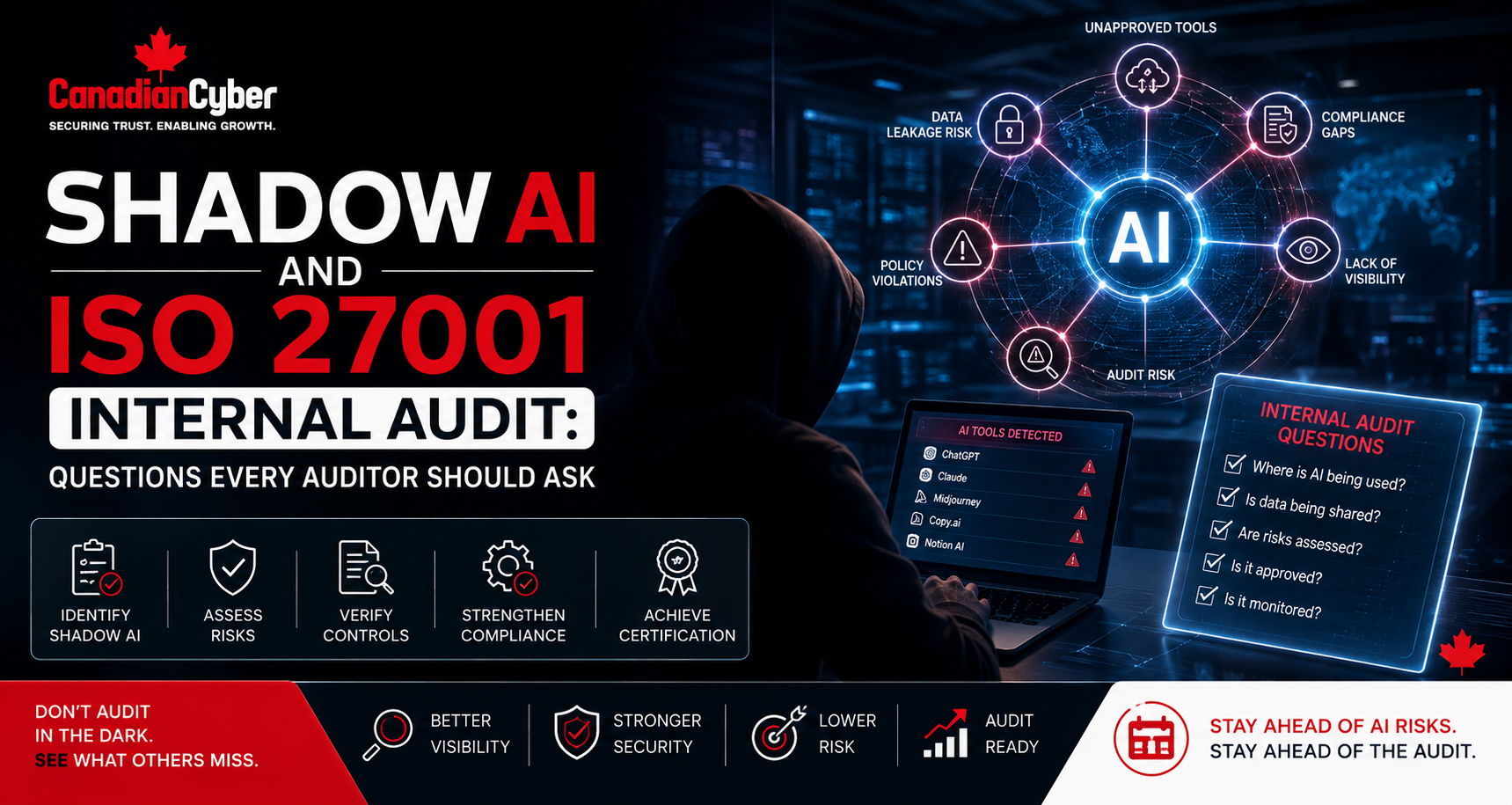
Shadow AI and ISO 27001 Internal Audit: Questions Every Auditor Should Ask
Employees are using AI to work faster. But when AI tools are not approved, reviewed, or monitored, they create a serious ISO 27001 audit blind spot.
Quick Answer
What should ISO 27001 auditors ask about Shadow AI?
Auditors should ask whether the organization knows which AI tools employees use.
They should also check AI risk, approved tools, sensitive data rules, vendor reviews, training, access control, AI incidents, and management review.
Bottom line: The goal is not to ban AI. The goal is to make AI use visible, safe, approved, monitored, and auditable.
Canadian Cyber Shadow AI Support
Bring Shadow AI Into Your ISO 27001 Audit Scope
Canadian Cyber helps organizations identify, assess, and govern Shadow AI before it becomes an audit finding.
We support ISO 27001 internal audits, Shadow AI risk assessments, AI acceptable use policies, AI vendor reviews, ISO 42001 readiness, and SharePoint AI governance workspaces.
Quick Snapshot
| Audit Area | Shadow AI Question |
|---|---|
| AI Inventory | Do we know which AI tools employees use? |
| Risk Assessment | Are AI risks included in the risk register? |
| Acceptable Use | Do employees know what AI use is allowed? |
| Data Protection | Are sensitive data types blocked from prompts? |
| Vendor Risk | Are AI vendors reviewed before use? |
| Incident Response | Can employees report AI-related incidents? |
Why Shadow AI Matters Right Now
AI adoption is moving faster than policy approval.
Employees use AI to write emails, summarize documents, analyze spreadsheets, generate code, prepare proposals, and answer customers.
Most employees are not trying to break rules.
They are trying to be productive. But unmanaged AI use can expose sensitive data.
If employees use AI for business work and the ISMS does not govern it, Shadow AI is already an audit topic.
What Is Shadow AI?
Shadow AI is the use of AI tools without formal approval, visibility, or governance.
It may include public chatbots, AI meeting bots, AI coding assistants, AI browser extensions, and AI features inside SaaS tools.
Shadow AI is not always malicious. But it can still create risk.
Common Shadow AI Examples
- A support agent pastes a customer ticket into a public AI tool.
- A developer uses AI to review proprietary source code.
- A meeting bot records a sensitive customer meeting.
- A sales team uses AI to answer a security questionnaire.
- An employee uploads a contract, invoice, or HR note for rewriting.
The Big Auditor Question
The best question is not only, “Do we use AI?”
A stronger question is:
Do we know where AI is used, what data it touches, who approved it, what risks it creates, and what controls exist?
Shadow AI Questions Every Auditor Should Ask
1. AI Inventory
Do we know which AI tools employees use?
Are AI features inside SaaS tools included?
Evidence: AI inventory, approved tool list, SaaS inventory, browser extension review, and employee survey results.
2. Risk Assessment
Is Shadow AI listed in the risk register?
Are data leakage and vendor risks assessed?
Evidence: Risk register, AI risk assessment, treatment plan, accepted risk records, and management review notes.
3. Acceptable Use
Do employees know which AI tools are allowed?
Do they know what data is prohibited?
Evidence: AI acceptable use policy, acknowledgments, training deck, email notices, and quick-reference guide.
4. Data Protection
Can employees paste customer data into AI tools?
Are prompts, uploads, screenshots, and logs covered?
Evidence: Data classification policy, prompt handling rules, DLP evidence, privacy review, and customer data rules.
5. AI Vendor Risk
Are AI vendors reviewed before approval?
Can vendors use company data for model training?
Evidence: AI vendor register, vendor review, DPA, subprocessor list, SOC 2 report, and training terms review.
6. Access Control
Who can access approved AI tools?
Are admin users and contractors reviewed?
Evidence: AI tool user list, admin review, SSO settings, MFA evidence, offboarding records, and access approvals.
7. AI Coding Assistants
Are AI coding tools approved?
Are AI-generated changes reviewed by humans?
Evidence: AI coding policy, developer training, pull request approvals, code review records, scans, and exception approvals.
8. Customer Support AI
Can support teams use AI to draft replies?
Are tickets, logs, and screenshots protected?
Evidence: Support AI procedure, redaction rules, customer data policy, training records, and quality reviews.
9. AI Meeting Tools
Are AI meeting bots approved?
Are sensitive meetings restricted?
Evidence: Meeting AI tool list, recording policy, retention settings, vendor review, privacy review, and meeting rules.
10. AI Incidents
Can employees report accidental AI data sharing?
Are AI incidents tracked and reviewed?
Evidence: AI incident procedure, incident register, severity matrix, lessons learned, and corrective action tracker.
11. AI Training
Are employees trained on safe AI use?
Do high-risk teams get role-specific examples?
Evidence: AI training records, role-based content, quiz results, acknowledgments, and overdue follow-up.
12. Management Review
Does leadership review Shadow AI risk?
Are actions and resources documented?
Evidence: Management review agenda, AI risk dashboard, incident summary, decision log, and action tracker.
Need to Review Shadow AI Before Your Internal Audit?
Canadian Cyber helps organizations assess Shadow AI exposure and build practical evidence before audit week.
How Shadow AI Maps to ISO 27001 Audit Areas
| ISO 27001 Area | Shadow AI Connection |
|---|---|
| Risk Assessment | Shadow AI creates data, privacy, vendor, and confidentiality risks. |
| Asset Management | AI tools and AI-enabled SaaS should be inventoried. |
| Acceptable Use | Employees need clear AI usage rules. |
| Information Classification | Sensitive data rules must apply to prompts and uploads. |
| Supplier Relationships | AI vendors need security and privacy review. |
| Incident Management | AI data leakage and harmful outputs need reporting. |
| Secure Development | AI coding assistants need governance. |
| Management Review | Leadership should review AI risks and actions. |
ISO 27001 Shadow AI Internal Audit Checklist
| Audit Question | Ready? |
|---|---|
| Do we have an approved AI tool inventory? | |
| Have we assessed Shadow AI risk? | |
| Is AI included in the risk register? | |
| Do we have an AI acceptable use policy? | |
| Are employees trained on safe AI use? | |
| Are sensitive data types blocked from prompts? | |
| Are AI vendors reviewed before approval? | |
| Are AI coding assistants governed? | |
| Are AI meeting tools controlled? | |
| Is support team AI use controlled? | |
| Are AI incidents reportable? | |
| Is Shadow AI discussed in management review? | |
| Is evidence stored in a central workspace? |
How to Fix Shadow AI Before It Becomes a Finding
- Discover AI use. Survey employees and review SaaS tools, browser extensions, and expenses.
- Create an approved AI tool list. Define approved, restricted, and prohibited tools.
- Update policies. Add AI rules to acceptable use, data handling, secure development, vendor management, and incident response.
- Review AI vendors. Check security, privacy, retention, training terms, and subprocessors.
- Train employees. Give practical examples by role.
- Add AI to the risk register. Document risks, owners, treatments, and review dates.
- Create AI incident reporting. Make accidental AI data sharing reportable.
- Track corrective actions. Close gaps with owners, deadlines, evidence, and verification.
The goal is not to eliminate AI use. The goal is to make AI use visible, approved, safe, and auditable.
Shadow AI Evidence Pack for ISO 27001 Internal Audit
Auditors should request a focused evidence pack.
This pack should prove visibility, rules, review, training, reporting, and improvement.
- AI tool inventory and approved AI tool list.
- AI acceptable use policy and employee acknowledgments.
- AI risk assessment and Shadow AI risk register entry.
- AI vendor register and AI vendor risk reviews.
- Prompt and data handling guidance.
- AI coding assistant policy and meeting tool policy.
- Support AI use procedure and training records.
- AI incident reporting procedure and incident register.
- AI corrective action tracker and management review summary.
How SharePoint Can Help Manage Shadow AI Evidence
A structured SharePoint ISMS can help manage Shadow AI evidence in one controlled workspace.
It can show AI tools, owners, risks, vendors, incidents, training, and actions.
Canadian Cyber’s ISMS SharePoint Solution can organize:
- AI tool inventory and approved AI tool list.
- AI vendor register and AI risk register.
- AI acceptable use policy and training evidence.
- AI incident register and corrective action tracker.
- AI meeting tool and coding assistant reviews.
- Support AI use evidence and data classification records.
- Management review dashboard, ISO 42001 readiness workspace, Teams notifications, and auditor-ready views.
How Canadian Cyber Helps
Canadian Cyber helps organizations bring Shadow AI into the ISO 27001 internal audit conversation.
We help identify Shadow AI exposure, assess risk, create evidence, and prepare for ISO 27001 and ISO 42001 readiness.
Canadian Cyber can support:
- ISO 27001 internal audits.
- Shadow AI risk assessments.
- AI governance readiness reviews.
- AI acceptable use policy development.
- AI tool inventory development.
- AI vendor risk reviews.
- AI coding assistant governance.
- AI incident response process design.
- ISO 42001 readiness assessments.
- SharePoint AI governance workspace setup, vCISO services, SOC 2 readiness, ISO 27017, and ISO 27018 support.
FAQ
What is Shadow AI?
Shadow AI is the use of AI tools at work without formal approval, visibility, or governance. It may include chatbots, AI meeting tools, AI coding assistants, browser extensions, and AI features inside SaaS tools.
Why should ISO 27001 auditors ask about Shadow AI?
They should ask because unapproved AI use can create data leakage, privacy, vendor, confidentiality, incident, and acceptable use risks inside the ISMS.
What evidence should auditors request?
Auditors should request AI inventories, approved tool lists, AI policies, risk assessments, vendor reviews, training records, incident procedures, incident registers, and management review records.
Is Shadow AI always a nonconformity?
Not always. It becomes an audit concern when AI use creates unmanaged risk, lacks approval, lacks vendor review, exposes sensitive data, or is not included in the ISMS risk process.
Does Shadow AI relate to ISO 42001?
Yes. Shadow AI governance supports ISO 42001 readiness because it helps identify AI systems, assess risks, define roles, review vendors, monitor use, and track AI incidents.
Takeaway
Shadow AI is already happening inside modern workplaces.
Employees use AI to write, summarize, code, analyze, and respond faster.
But without governance, AI can become an invisible data leakage channel.
The goal is not to block innovation. The goal is to make AI use visible, safe, approved, monitored, and auditable.
Ready to Review Shadow AI Before Your ISO 27001 Internal Audit?
Canadian Cyber can help you assess Shadow AI exposure and build practical AI governance evidence.
We provide ISO 27001 internal audits, Shadow AI risk assessments, AI acceptable use policies, AI vendor reviews, ISO 42001 readiness, SharePoint AI governance workspaces, vCISO services, cybersecurity assessments, SOC 2 readiness, ISO 27017, and ISO 27018 support.
Stay Connected With Canadian Cyber
Follow Canadian Cyber for practical guidance on Shadow AI, ISO 27001 internal audits, AI governance, ISO 42001, SOC 2, SharePoint ISMS, ISO 27017, ISO 27018, cybersecurity assessments, and vCISO support.