SOC 2 • Payments SaaS • Bank Partnership Review • Fintech Security • Processing Integrity
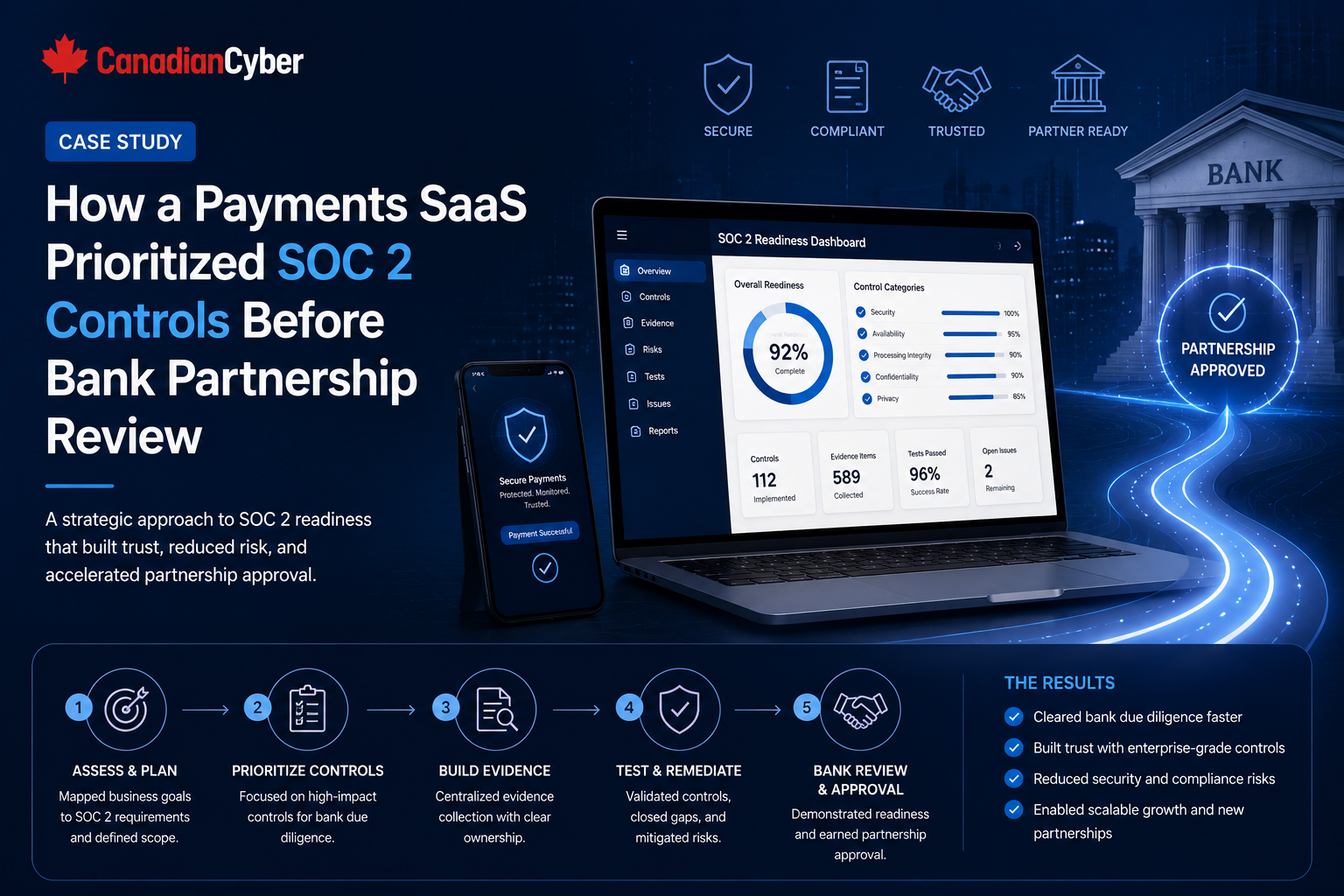
Case Study: How a Payments SaaS Prioritized SOC 2 Controls Before Bank Partnership Review
Bank partnership reviews are different from normal customer security questionnaires. A bank wants to understand how a payments SaaS protects data, secures APIs, controls access, monitors availability, validates transactions, manages vendors, and responds to incidents.
Quick Snapshot
| Case Study Area | What Improved |
|---|---|
| Business Context | Payments SaaS preparing for a bank partnership review. |
| Main Challenge | SOC 2 readiness was in progress, but the bank wanted evidence before the final report. |
| Biggest Risk | Scattered evidence, unclear control ownership, weak processing integrity proof, and slow questionnaire responses. |
| Priority Controls | Access control, API security, vendor risk, incident response, availability, change management, and processing integrity. |
| Outcome | Stronger bank-ready evidence, clearer SOC 2 roadmap, faster review responses, and better leadership confidence. |
Introduction
The payments SaaS had a major opportunity.
A bank was interested in a partnership. The product was strong. The API was already live. The team had real customers. The roadmap was moving quickly. The commercial value was clear.
Then the bank security review started.
The bank asked for:
Security policies
MFA evidence
Admin access reviews
API token controls
Rate limiting evidence
Vendor register
Incident response plan
Restore evidence
Transaction traceability
The payments SaaS was not careless. It had many controls in place. But the evidence was not ready for a bank-level review.
Some proof lived in GitHub. Some lived in cloud consoles. Some lived in Jira. Some lived in the API gateway. Some lived in spreadsheets. Some lived in vendor portals. Some lived in conversations with engineering.
The leadership team realized the issue was not only SOC 2. It was partnership readiness.
This fictional case study shows how a payments SaaS prioritized SOC 2 controls before a bank partnership review, built a bank-ready evidence pack, and turned security into a trust advantage.
Preparing for a Bank Partnership Review?
Canadian Cyber helps fintech and payments SaaS companies prepare for SOC 2, bank vendor reviews, API security evidence, processing integrity controls, vendor risk reviews, incident response, and SharePoint evidence workspaces.
Meet the Payments SaaS
Let’s call the company PayBridge Cloud.
PayBridge Cloud provided API-based payment workflow software for platforms and financial services teams.
Its platform supported:
Account onboarding
Transaction status tracking
Webhook notifications
Customer reporting
API integrations
Partner dashboards
Reconciliation exports
The company handled sensitive data, including:
- customer account information
- payment metadata
- transaction records
- business identifiers
- API credentials
- support records
- audit logs
- vendor integration data
The bank partnership could help PayBridge expand into larger financial services customers. But the review would be difficult.
The Starting Problem
PayBridge had started SOC 2 readiness. But the bank review arrived earlier than expected.
Problem 1: Evidence Was Scattered
The team had MFA, code review, cloud logging, backups, vendor reviews, and incident response materials, but no central evidence bank.
Problem 2: Priorities Were Too Broad
The team was trying to improve everything at once, which slowed progress before the bank review.
Problem 3: API and Transaction Risk Was Central
The bank focused heavily on API abuse, token revocation, transaction traceability, failed payments, recovery, and vendor dependencies.
Why Bank Partnership Reviews Are Harder Than Normal Security Reviews
A normal SaaS buyer may focus on general security. A bank focuses on trust, resilience, third-party risk, and operational impact.
| Bank Review Focus Area | What They Want to See |
|---|---|
| Security | Access control, MFA, encryption, API protection. |
| Availability | Monitoring, uptime, backups, incident response. |
| Processing Integrity | Accurate, complete, valid, authorized transaction processing. |
| Vendor Risk | Critical suppliers, sub-processors, assurance evidence. |
| Governance | Policies, risk register, owners, leadership review. |
| Change Management | Controlled releases and tested changes. |
| Evidence Quality | Proof that controls are operating. |
Practical rule: A bank does not only want to know what your product does. It wants to know how your company controls risk.
Step 1: Defining the SOC 2 Scope Around the Bank Partnership
The first step was scope. The team avoided a vague answer like, “We are preparing for SOC 2.” Instead, it defined what the SOC 2 readiness work covered.
| Scope Question | Why It Mattered |
|---|---|
| Which product is in scope? | Defines the payments SaaS platform. |
| Which APIs are in scope? | Defines integration and transaction risk. |
| Which data types are processed? | Defines sensitivity. |
| Which cloud systems support the platform? | Defines infrastructure scope. |
| Which vendors support payments and monitoring? | Defines dependency risk. |
| Which SOC 2 criteria matter most? | Defines audit and evidence focus. |
PayBridge focused its readiness on:
Customer dashboard
Admin console
Cloud infrastructure
Identity provider
CI/CD pipeline
Support tools
Vendor dependencies
Practical rule: SOC 2 scope should match the system the bank is relying on.
Step 2: Prioritizing the Most Important SOC 2 Control Areas
The team created a control prioritization matrix. This helped leadership decide what to fix first.
| Control Area | Bank Review Importance | Priority |
|---|---|---|
| MFA and privileged access | Very high | Immediate |
| API token lifecycle | Very high | Immediate |
| API rate limits and abuse alerts | Very high | Immediate |
| Processing integrity checks | Very high | Immediate |
| Vendor register and sub-processors | High | Immediate |
| Incident response plan | High | Immediate |
| Backup and restore evidence | High | Immediate |
| Change management evidence | High | Immediate |
| Policy library | Medium | Next |
| Long-term automation | Medium | Later |
Result: The company stopped treating every control as equally urgent and focused on what the bank would care about first.
Prioritize the Controls Banks Care About Most
Canadian Cyber helps payments SaaS teams prioritize SOC 2 controls for bank reviews, focusing on access, APIs, transaction integrity, vendors, availability, incident response, and evidence readiness.
Step 3: Fixing Access Control Evidence
Access control was the first evidence area. The bank wanted to know who had production access, whether MFA was enforced, how admin accounts were reviewed, how access was removed, and whether service accounts were controlled.
| Evidence Collected | Purpose |
|---|---|
| MFA report | Shows strong authentication. |
| Admin access review | Shows privileged access review. |
| Production access list | Shows who can access production. |
| Support access matrix | Shows customer data access rules. |
| Offboarding sample | Shows access removal. |
| Service account register | Shows non-human account ownership. |
| Access exception register | Shows approved exceptions. |
Gap found: Some service accounts had owners, but not all had review dates.
Action taken: The team created a service account register with:
- account name
- system
- purpose
- owner
- permissions
- created date
- last reviewed date
- rotation requirement
Result: The company could answer access questions with proof, not promises.
Step 4: Strengthening API Security Controls
The bank asked detailed API questions. PayBridge focused on API authentication, authorization, token lifecycle, rate limits, webhooks, and abuse monitoring.
| API Control | Evidence |
|---|---|
| API authentication | API authentication standard. |
| API authorization | Scope and permission matrix. |
| Token creation | Token issuance process. |
| Token revocation | Revocation procedure. |
| Token review | Active token review export. |
| Rate limiting | API gateway configuration. |
| Webhook signing | Webhook security standard. |
| Webhook retries | Retry and failure handling evidence. |
Common API gaps fixed:
- overly broad internal tokens
- missing token owner fields
- unclear revocation process
- rate limits not documented
- webhook signing not explained clearly
- API abuse response not linked to incident response
Strong bank response:
“Our API access model uses authenticated client tokens with defined scopes, rate limits, logging, and revocation procedures. API tokens are reviewed, and webhook events are signed and monitored for delivery failures.”
Step 5: Building Processing Integrity Evidence
Processing Integrity became one of the most important workstreams. The bank wanted to know whether payments-related workflows were complete, accurate, valid, timely, and authorized.
| Bank Question | Evidence Needed |
|---|---|
| How do you validate payment requests? | Input validation rules and test evidence. |
| How do you prevent duplicate processing? | Duplicate prevention logic. |
| How are failed transactions handled? | Failed job review records. |
| Can transactions be traced? | Transaction audit trail sample. |
| Are reconciliations performed? | Reconciliation report. |
| Are webhook failures monitored? | Webhook delivery logs. |
| Are processing errors reviewed? | Exception tracker. |
Evidence created:
Transaction trace sample
Reconciliation report
Failed job review
Webhook delivery review
Duplicate processing control summary
Processing exception tracker
Data mapping review record
A sample transaction trace showed:
- transaction ID
- client ID
- API request timestamp
- authorization decision
- processing status
- webhook delivery status
- reconciliation status
- final outcome
Result: The bank could see that PayBridge did not treat transaction processing as a black box.
Build Processing Integrity Evidence Before the Bank Asks
Canadian Cyber helps payments SaaS teams document transaction traceability, input validation, duplicate prevention, reconciliation, failed job reviews, webhook delivery evidence, and processing exception tracking.
Step 6: Reviewing Availability and Recovery
The bank needed confidence that the service could stay reliable. PayBridge gathered availability evidence and found an important gap.
| Availability Evidence | Purpose |
|---|---|
| Uptime report | Shows service reliability. |
| Monitoring configuration | Shows visibility. |
| Alert rules | Shows detection. |
| On-call schedule | Shows ownership. |
| Incident ticket samples | Shows response tracking. |
| Backup reports | Shows backup activity. |
| Restore test evidence | Shows recovery testing. |
| Dependency map | Shows vendor and system dependencies. |
Gap found: Backups were running, but restore testing evidence was incomplete.
Action taken: The team ran a restore test and documented:
- test date
- system tested
- data restored
- result
- issues found
- owner
- corrective actions
- next test date
Result: The bank received recovery evidence, not just backup screenshots.
Step 7: Organizing Vendor and Sub-Processor Evidence
Payments SaaS companies depend on vendors. PayBridge had to explain which vendors supported the platform.
Vendor types reviewed:
Payment processor
Identity provider
Monitoring provider
Support platform
Fraud screening tool
Source code platform
Backup provider
| Vendor Register Field | Purpose |
|---|---|
| Vendor Name | Supplier identification. |
| Service Provided | Business purpose. |
| Data Handled | Customer, payment, operational, support. |
| Criticality | High, medium, low. |
| Vendor Owner | Internal accountability. |
| Security Evidence | SOC 2, ISO 27001, questionnaire, contract. |
| Sub-Processor Status | Disclosure support. |
| Next Review Date | Ongoing monitoring. |
Step 8: Preparing Incident Response for Bank-Level Questions
The incident response plan existed, but it was too generic. The vCISO helped make it more fintech-specific.
Scenarios added:
Payment workflow failure
Bank integration outage
Vendor breach
Data exposure
Processing error
Webhook delivery failure
Cloud outage
| Incident Evidence | Why It Helped |
|---|---|
| Incident response plan | Shows response structure. |
| Severity matrix | Shows prioritization. |
| Role matrix | Shows ownership. |
| Bank/customer notification process | Shows communication readiness. |
| Tabletop exercise report | Shows the plan was tested. |
| Corrective action tracker | Shows follow-up. |
Result: The company could show that incident response was not just a policy. It had been tested.
Step 9: Mapping Change Management to API and Processing Risk
The bank wanted to know how production changes were controlled. PayBridge already used GitHub and Jira. The issue was evidence mapping.
| Change Evidence Pack | Purpose |
|---|---|
| Change management procedure | Defines rules. |
| Pull request approvals | Shows technical review. |
| Jira tickets | Shows business context. |
| Test results | Shows validation. |
| Deployment records | Shows traceability. |
| Emergency change record | Shows urgent changes are controlled. |
| Processing impact review | Shows financial workflow impact was considered. |
Gap found: The team reviewed code, but did not always document processing impact for changes affecting payment flows.
Action taken: A new field was added to change records: “Does this change affect payment processing, reconciliation, webhooks, transaction status, or customer reporting?”
Result: Change management evidence became stronger for SOC 2 and bank review.
Step 10: Building a Bank-Ready Evidence Pack in SharePoint
The company needed one place for evidence. PayBridge built a SharePoint SOC 2 evidence workspace.
| Evidence Workspace Section | Evidence |
|---|---|
| SOC 2 Roadmap | Scope, criteria, gap assessment, owner matrix. |
| Access Control | MFA, access reviews, offboarding, service accounts. |
| API Security | Tokens, scopes, rate limits, webhooks, abuse alerts. |
| Availability | Monitoring, uptime, backups, restore tests. |
| Processing Integrity | Validation, reconciliation, failed jobs, traceability. |
| Vendor Risk | Vendor register, assurance reviews, sub-processors. |
| Incident Response | Plan, tabletop, lessons learned. |
| Change Management | PRs, tickets, deployments, testing. |
| Governance | Risk register, management review, corrective actions. |
| Bank Trust Pack | Approved summaries and evidence index. |
Metadata used:
SOC 2 criteria
Evidence owner
Period covered
Review status
Source system
Sensitivity
Audit request ID
Explore the ISMS SharePoint Solution
Canadian Cyber’s ISMS SharePoint solution helps fintech and payments SaaS teams organize SOC 2 evidence, bank review materials, API controls, processing integrity evidence, risks, vendors, and audit requests in one Microsoft 365 workspace.
Results Before the Bank Review
PayBridge did not have a final SOC 2 report yet. But it had a credible readiness story.
| Before | After |
|---|---|
| Evidence scattered across tools. | Evidence centralized in SharePoint. |
| SOC 2 status was vague. | SOC 2 roadmap was clear. |
| API token controls existed but were not documented. | Token lifecycle evidence created. |
| Processing integrity proof was weak. | Reconciliation and traceability evidence built. |
| Backup reports existed. | Restore test evidence added. |
| Vendor list existed. | Vendor register and sub-processor evidence built. |
| Incident plan was generic. | Fintech scenarios and tabletop evidence added. |
| Bank questionnaire responses were slow. | Approved evidence pack improved response speed. |
Business impact:
- stronger bank review readiness
- stronger SOC 2 readiness
- better API security evidence
- stronger processing integrity confidence
- clearer availability evidence
- better vendor transparency
- improved leadership visibility
- faster questionnaire response speed
The bank review became easier because the company could show maturity before the final audit report.
Lessons for Payments SaaS Companies
1. Bank Reviews Arrive Before SOC 2 Is Finished
Build readiness evidence early so the review does not depend only on future audit plans.
2. API Security Must Be Evidence-Backed
Tokens, scopes, rate limits, webhooks, and abuse monitoring need clear proof.
3. Processing Integrity Matters
Payments SaaS companies must show how transactions are validated, traced, reconciled, and reviewed.
4. Backups Need Restore Evidence
Backup reports show activity. Restore tests show recovery confidence.
5. Vendor Risk Cannot Be Informal
Critical vendors and sub-processors need structured review and evidence.
6. SharePoint Can Reduce Evidence Chaos
A structured workspace helps organize SOC 2 and bank review evidence in one place.
Common Mistakes to Avoid
- Saying “SOC 2 is in progress” with no evidence. Banks need proof, not vague timelines.
- Treating API tokens like normal passwords. API tokens need ownership, scopes, review, rotation, and revocation.
- Ignoring processing integrity. Financial workflows need traceability and reconciliation evidence.
- Providing backup reports without restore tests. Backup success does not prove recovery.
- Forgetting vendor dependencies. Banks want to know who supports the service.
- Leaving evidence in engineering tools only. Evidence should be centralized and reviewer-ready.
- No approved bank trust pack. Do not rebuild answers from scratch during the review.
Payments SaaS Bank Review Checklist
Use this checklist before a bank partnership review.
SOC 2 Readiness
| Question | Yes / No |
|---|---|
| Is SOC 2 scope documented? | |
| Are Trust Services Criteria selected? | |
| Is a readiness roadmap available? | |
| Are control owners assigned? | |
| Is an evidence tracker active? |
API Security
| Question | Yes / No |
|---|---|
| Is API authentication documented? | |
| Are API scopes defined? | |
| Are tokens reviewed? | |
| Can tokens be revoked? | |
| Are rate limits documented? | |
| Are webhooks signed and monitored? |
Availability and Recovery
| Question | Yes / No |
|---|---|
| Is uptime monitored? | |
| Are alert rules documented? | |
| Is on-call ownership defined? | |
| Are backups monitored? | |
| Are restore tests documented? | |
| Are critical dependencies mapped? |
Processing Integrity
| Question | Yes / No |
|---|---|
| Are inputs validated? | |
| Are duplicate transactions prevented? | |
| Can transactions be traced? | |
| Are reconciliation checks documented? | |
| Are failed jobs reviewed? | |
| Are processing exceptions tracked? |
Vendor and Governance
| Question | Yes / No |
|---|---|
| Is the vendor register current? | |
| Is the sub-processor list available? | |
| Is incident response tested? | |
| Are policies approved? | |
| Is the risk register current? | |
| Is management review documented? |
What Good Looks Like
A strong payments SaaS preparing for a bank review can show:
- SOC 2 readiness roadmap
- scope statement
- control owner matrix
- MFA report
- admin access review
- service account register
- API token lifecycle
- API scope matrix
- rate limit evidence
- webhook security evidence
- uptime report
- restore test evidence
- vendor register
- sub-processor list
- incident response tabletop
- change management samples
- processing integrity controls
- transaction trace evidence
- reconciliation evidence
- risk register
- SharePoint evidence bank
- bank-ready trust pack
This gives banks confidence. It also prepares the company for SOC 2 audit work.
Canadian Cyber’s Take
At Canadian Cyber, we often see payments SaaS companies underestimate how detailed bank reviews can be.
A bank partnership review is not a normal sales checklist. The bank wants to know whether your platform can be trusted with sensitive workflows, APIs, transactions, vendors, and operational dependencies.
SOC 2 readiness helps, but only if evidence is organized. For payments SaaS companies, the most important areas are usually:
- access control
- API security
- availability
- vendor risk
- incident response
- change management
- processing integrity
- evidence management
The goal is to walk into the bank review with proof — not panic.
Takeaway
A payments SaaS can strengthen bank partnership readiness before the final SOC 2 report is complete.
Start by prioritizing the controls banks care about most:
- secure access
- review API tokens
- document rate limits
- monitor availability
- test recovery
- review vendors
- test incident response
- control changes
- prove processing integrity
- centralize evidence
That is how payments SaaS companies reduce bank review friction and build stronger trust.
How Canadian Cyber Can Help
Canadian Cyber helps fintech and payments SaaS companies prepare for SOC 2 and bank partnership reviews.
- SOC 2 readiness assessments
- payments SaaS SOC 2 implementation
- bank partnership evidence packs
- API security control reviews
- token lifecycle reviews
- availability evidence planning
- processing integrity control mapping
- vendor risk register setup
- sub-processor list preparation
- incident response planning
- tabletop exercises
- backup and restore evidence reviews
- change management evidence mapping
- SharePoint evidence workspace setup
- vCISO support for fintech governance
Stay Connected With Canadian Cyber
Follow Canadian Cyber for practical guidance on SOC 2, payments SaaS security, fintech API controls, bank partnership reviews, processing integrity, vendor risk, SharePoint ISMS, and vCISO support.